

- Open Access
Extrinsic Contribution to Bosonic Thermal Hall Transport
Phys. Rev. X 16, 011048 – Published 5 March, 2026
DOI: https://doi.org/10.1103/grzx-v6sj
Abstract
Bosonic excitations like phonons and magnons dominate the low-temperature transport of magnetic insulators. Similar to electronic Hall responses, the thermal Hall effect (THE) of charge-neutral bosons has been proposed as a powerful tool for probing topological properties of their wave functions. For example, the intrinsic contribution of the THE of a perfectly clean system is directly governed by the distribution of Berry curvature, and many experiments on topological magnon and phonon insulators have been interpreted in this way. However, disorder is inevitably present in any material, and its contribution to the THE has remained poorly understood. Here, we develop a rigorous kinetic theory of the extrinsic side-jump contribution to the THE of bosons. We show that the extrinsic THE is always relevant for bosonic systems and can be of the same order as the intrinsic one but sensitively depends on the type of local imperfection. We study different types of impurities and show that a THE can even arise as a pure impurity-induced effect in a system with a vanishing intrinsic contribution. As a side product, we also generalize existing results for the electronic anomalous Hall effect to general types of impurities beyond the standard assumption of local potential scattering. We discuss the importance of our results for the correct interpretation of THE measurements, for example, in the Kitaev magnet , and provide a ready-to-use formula for comparison to experimental data.
Physics Subject Headings (PhySH)
Popular Summary
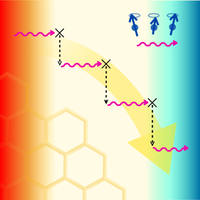
Understanding the origin of thermal Hall conductivity in insulating quantum materials remains a significant experimental and theoretical challenge, often complicated by the assumption that extrinsic effects from disorder can be neglected in favor of intrinsic quantum mechanisms. We counter this assumption by computing the disorder-induced side-jump effect in generality for heat carried by bosonic excitations like phonons and magnons. We rigorously derive the semiclassical kinetic equation and show that upon scattering, a particle does not only change velocity but also jumps to a new position, yielding a contribution to the thermal Hall effect comparable in amplitude to the intrinsic part. Our work provides a basic formula incorporating material-specific properties, and explicitly shows that extrinsic disorder effects are crucial for a full quantitative theory of thermal Hall transport.
Article Text
References (94)
- K v Klitzing, G. Dorda, and M. Pepper, New method for high-accuracy determination of the fine-structure constant based on quantized Hall resistance, Phys. Rev. Lett. 45, 494 (1980).
- D. J. Thouless, M. Kohmoto, M. P. Nightingale, and M. den Nijs, Quantized Hall conductance in a two-dimensional periodic potential, Phys. Rev. Lett. 49, 405 (1982).
- Naoto Nagaosa, Jairo Sinova, Shigeki Onoda, A. H. MacDonald, and N. P. Ong, Anomalous Hall effect, Rev. Mod. Phys. 82, 1539 (2010).
- J. M. Luttinger, Theory of thermal transport coefficients, Phys. Rev. 135, A1505 (1964).
- Alexei Kitaev, Anyons in an exactly solved model and beyond, Ann. Phys. (Amsterdam) 321, 2 (2006).
- C. L. Kane and Matthew P. A. Fisher, Quantized thermal transport in the fractional quantum Hall effect, Phys. Rev. B 55, 15832 (1997).
- Yuichi Kasahara, Tsuneya Ohnishi, Yuta Mizukami, Osamu Tanaka, Sixiao Ma, Kaori Sugii, Nobuyuki Kurita, Hidekazu Tanaka, Joji Nasu, Yukitoshi Motome et al., Majorana quantization and half-integer thermal quantum Hall effect in a Kitaev spin liquid, Nature (London) 559, 227 (2018).
- Arup Kumar Paul, Priya Tiwari, Ron Melcer, Vladimir Umansky, and Moty Heiblum, Topological thermal Hall conductance of even-denominator fractional states, Phys. Rev. Lett. 133, 076601 (2024).
- Y. Onose, T. Ideue, H. Katsura, Y. Shiomi, N. Nagaosa, and Y. Tokura, Observation of the magnon Hall effect, Science 329, 297 (2010).
- T. Ideue, Y. Onose, H. Katsura, Y. Shiomi, S. Ishiwata, N. Nagaosa, and Y. Tokura, Effect of lattice geometry on magnon Hall effect in ferromagnetic insulators, Phys. Rev. B 85, 134411 (2012).
- Max Hirschberger, Jason W. Krizan, R. J. Cava, and N. P. Ong, Large thermal Hall conductivity of neutral spin excitations in a frustrated quantum magnet, Science 348, 106 (2015).
- Max Hirschberger, Robin Chisnell, Young S. Lee, and Nai Phuan Ong, Thermal Hall effect of spin excitations in a kagome magnet, Phys. Rev. Lett. 115, 106603 (2015).
- Daiki Watanabe, Kaori Sugii, Masaaki Shimozawa, Yoshitaka Suzuki, Takeshi Yajima, Hajime Ishikawa, Zenji Hiroi, Takasada Shibauchi, Yuji Matsuda, and Minoru Yamashita, Emergence of nontrivial magnetic excitations in a spin-liquid state of kagomé volborthite, Proc. Natl. Acad. Sci. U.S.A. 113, 8653 (2016).
- Hayato Doki, Masatoshi Akazawa, Hyun-Yong Lee, Jung Hoon Han, Kaori Sugii, Masaaki Shimozawa, Naoki Kawashima, Migaku Oda, Hiroyuki Yoshida, and Minoru Yamashita, Spin thermal Hall conductivity of a kagome antiferromagnet, Phys. Rev. Lett. 121, 097203 (2018).
- Yuji Hirokane, Yoichi Nii, Yasuhide Tomioka, and Yoshinori Onose, Phononic thermal Hall effect in diluted terbium oxides, Phys. Rev. B 99, 134419 (2019).
- Masatoshi Akazawa, Masaaki Shimozawa, Shunichiro Kittaka, Toshiro Sakakibara, Ryutaro Okuma, Zenji Hiroi, Hyun-Yong Lee, Naoki Kawashima, Jung Hoon Han, and Minoru Yamashita, Thermal Hall effects of spins and phonons in kagome antiferromagnet cd-kapellasite, Phys. Rev. X 10, 041059 (2020).
- Heda Zhang, Chunqiang Xu, Caitlin Carnahan, Milos Sretenovic, Nishchay Suri, Di Xiao, and Xianglin Ke, Anomalous thermal Hall effect in an insulating van der Waals magnet, Phys. Rev. Lett. 127, 247202 (2021).
- Lu Chen, Marie-Eve Boulanger, Zhi-Cheng Wang, Fazel Tafti, and Louis Taillefer, Large phonon thermal Hall conductivity in the antiferromagnetic insulator , Proc. Natl. Acad. Sci. U.S.A. 119, e2208016119 (2022).
- É. Lefrançois, G. Grissonnanche, J. Baglo, P. Lampen-Kelley, J.-Q. Yan, C. Balz, D. Mandrus, S. E. Nagler, S. Kim, Y.-J. Kim, N. DoironLeyraud, and L. Taillefer, Evidence of a phonon Hall effect in the Kitaev spin liquid candidate , Phys. Rev. X 12, 021025 (2022).
- Richard Hentrich, Maria Roslova, Anna Isaeva, Thomas Doert, Wolfram Brenig, Bernd Büchner, and Christian Hess, Large thermal Hall effect in : Evidence for heat transport by Kitaev-Heisenberg paramagnons, Phys. Rev. B 99, 085136 (2019).
- M. Yamashita, J. Gouchi, Y. Uwatoko, N. Kurita, and H. Tanaka, Sample dependence of half-integer quantized thermal Hall effect in the Kitaev spin-liquid candidate , Phys. Rev. B 102, 220404(R) (2020).
- T. Yokoi, S. Ma, Y. Kasahara, S. Kasahara, T. Shibauchi, N. Kurita, H. Tanaka, J. Nasu, Y. Motome, C. Hickey, S. Trebst, and Y. Matsuda, Half-integer quantized anomalous thermal Hall effect in the Kitaev material candidate , Science 373, 568 (2021).
- J. A. N. Bruin, R. R. Claus, Y. Matsumoto, N. Kurita, H. Tanaka, and H. Takagi, Robustness of the thermal Hall effect close to half-quantization in , Nat. Phys. 18, 401 (2022).
- Y. Kasahara, S. Suetsugu, T. Asaba, S. Kasahara, T. Shibauchi, N. Kurita, H. Tanaka, and Y. Matsuda, Quantized and unquantized thermal Hall conductance of the Kitaev spin liquid candidate , Phys. Rev. B 106, L060410 (2022).
- Heda Zhang, Andrew F. May, Hu Miao, Brian C. Sales, David G. Mandrus, Stephen E. Nagler, Michael A. McGuire, and Jiaqiang Yan, Sample-dependent and sample-independent thermal transport properties of , Phys. Rev. Mater. 7, 114403 (2023).
- Heda Zhang, Michael A. McGuire, Andrew F. May, Hsin-Yun Chao, Qiang Zheng, Miaofang Chi, Brian C. Sales, David G. Mandrus, Stephen E. Nagler, Hu Miao, Feng Ye, and Jiaqiang Yan, Stacking disorder and thermal transport properties of , Phys. Rev. Mater. 8, 014402 (2024).
- Peter Czajka, Tong Gao, Max Hirschberger, Paula Lampen-Kelley, Arnab Banerjee, Nicholas Quirk, David G Mandrus, Stephen E Nagler, and N Phuan Ong, Planar thermal Hall effect of topological bosons in the Kitaev magnet , Nat. Mater. 22, 36 (2023).
- Xiao-Tian Zhang, Yong Hao Gao, and Gang Chen, Thermal Hall effects in quantum magnets, Phys. Rep. 1070, 1 (2024).
- Ryo Matsumoto and Shuichi Murakami, Rotational motion of magnons and the thermal Hall effect, Phys. Rev. B 84, 184406 (2011).
- Tao Qin, Qian Niu, and Junren Shi, Energy magnetization and the thermal Hall effect, Phys. Rev. Lett. 107, 236601 (2011).
- Tao Qin, Jianhui Zhou, and Junren Shi, Berry curvature and the phonon Hall effect, Phys. Rev. B 86, 104305 (2012).
- Ryo Matsumoto, Ryuichi Shindou, and Shuichi Murakami, Thermal Hall effect of magnons in magnets with dipolar interaction, Phys. Rev. B 89, 054420 (2014).
- Atsuo Shitade, Heat transport as torsional responses and Keldysh formalism in a curved spacetime, Prog. Theor. Exp. Phys. 2014, 123I01 (2014).
- Yinhan Zhang, Yang Gao, and Di Xiao, Thermodynamics of energy magnetization, Phys. Rev. B 102, 235161 (2020).
- Léo Mangeolle, Lucile Savary, and Leon Balents, Quantum kinetic equation and thermal conductivity tensor for bosons, Phys. Rev. B 109, 235137 (2024).
- Michiyasu Mori, Alexander Spencer-Smith, Oleg P. Sushkov, and Sadamichi Maekawa, Origin of the phonon Hall effect in rare-earth garnets, Phys. Rev. Lett. 113, 265901 (2014).
- B. Flebus and A. H. MacDonald, Charged defects and phonon Hall effects in ionic crystals, Phys. Rev. B 105, L220301 (2022).
- Xiao-Qi Sun, Jing-Yuan Chen, and Steven A. Kivelson, Large extrinsic phonon thermal Hall effect from resonant scattering, Phys. Rev. B 106, 144111 (2022).
- Léo Mangeolle, Leon Balents, and Lucile Savary, Phonon thermal Hall conductivity from scattering with collective fluctuations, Phys. Rev. X 12, 041031 (2022).
- Léo Mangeolle, Leon Balents, and Lucile Savary, Thermal conductivity and theory of inelastic scattering of phonons by collective fluctuations, Phys. Rev. B 106, 245139 (2022).
- Dimos Chatzichrysafis and Alexander Mook, Thermal Hall effect of magnons from many-body skew scattering, Phys. Rev. B 111, 134405 (2025).
See Ref. [3] and, especially, in Sec. I B 3: “A practical approach, which is followed at present for materials in which seems to be independent of , is to first calculate the intrinsic contribution to the AHE. If this explains the observation (and it appears that it usually does), then it is deemed that the intrinsic mechanism dominates. If not, we can take some comfort from understanding on the basis of simple model results that there can be other contributions to which are also independent of and can for the most part be identified with the side-jump mechanism.”
- Elihu Abrahams, P. W. Anderson, P. A. Lee, and T. V. Ramakrishnan, Quasiparticle lifetime in disordered two-dimensional metals, Phys. Rev. B 24, 6783 (1981).
- Elihu Abrahams, Philip W. Anderson, Donald C. Licciardello, and Tiruppattur V. Ramakrishnan, Scaling theory of localization: Absence of quantum diffusion in two dimensions, Phys. Rev. Lett. 42, 673 (1979).
- Richard E. Prange and Steven M. Girvin, The Quantum Hall Effect (Springer, New York, 1987).
In magnetic systems, long-range interactions also exist such as dipolar exchange, though instances where these dominate over other (local) magnetic interactions governing the physical properties are rare, especially for bulk 3D insulating magnets.
- Li Ern Chern, Emily Z. Zhang, and Yong Baek Kim, Sign structure of thermal Hall conductivity and topological magnons for in-plane field polarized Kitaev magnets, Phys. Rev. Lett. 126, 147201 (2021).
- Robert Karplus and J. M. Luttinger, Hall effect in ferromagnetics, Phys. Rev. 95, 1154 (1954).
- Ganesh Sundaram and Qian Niu, Wave-packet dynamics in slowly perturbed crystals: Gradient corrections and berry-phase effects, Phys. Rev. B 59, 14915 (1999).
- Christian Wickles and Wolfgang Belzig, Effective quantum theories for Bloch dynamics in inhomogeneous systems with nontrivial band structure, Phys. Rev. B 88, 045308 (2013).
- E. N. Adams and E. I. Blount, Energy bands in the presence of an external force field—II, J. Phys. Chem. Solids 10, 286 (1959).
- R. C. Fivaz, Transport theory for ferromagnets, Phys. Rev. 183, 586 (1969).
- P. Nozières and C. Lewiner, A simple theory of the anomalous Hall effect in semiconductors, J. Phys. (Les Ulis, Fr.) 34, 901 (1973).
- N. A. Sinitsyn, Q. Niu, J. Sinova, and K. Nomura, Disorder effects in the anomalous Hall effect induced by berry curvature, Phys. Rev. B 72, 045346 (2005).
- N. A. Sinitsyn, Q. Niu, and A. H. MacDonald, Coordinate shift in the semiclassical Boltzmann equation and the anomalous Hall effect, Phys. Rev. B 73, 075318 (2006).
- Elio J. König and Alex Levchenko, Quantum kinetics of anomalous and nonlinear Hall effects in topological semimetals, Ann. Phys. (Amsterdam) 435, 168492 (2021).
- N. A. Sinitsyn, A. H. MacDonald, T. Jungwirth, V. K. Dugaev, and J. Sinova, Anomalous Hall effect in a two-dimensional Dirac band: The link between the Kubo-Streda formula and the semiclassical Boltzmann equation approach, Phys. Rev. B 75, 045315 (2007).
- Haoyu Guo, Darshan G Joshi, and Subir Sachdev, Resonant thermal Hall effect of phonons coupled to dynamical defects, Proc. Natl. Acad. Sci. U.S.A. 119, e2215141119 (2022).
- Anton Kapustin and Lev Spodyneiko, Thermal Hall conductance and a relative topological invariant of gapped two-dimensional systems, Phys. Rev. B 101, 045137 (2020).
- Alex Kamenev, Field Theory of Non-Equilibrium Systems (Cambridge University Press, Cambridge, England, 2011).
In Ref. [56], an extra valley index is introduced, but the and indices remain decoupled, the spatial dependence is still of the type, and within one valley disorder is still .
- Dimitrie Culcer, Akihiko Sekine, and Allan H. MacDonald, Interband coherence response to electric fields in crystals: Berry-phase contributions and disorder effects, Phys. Rev. B 96, 035106 (2017).
- Jorgen Rammer, Quantum Transport Theory (Perseus Books, Reading, MA, 1998).
Throughout the paper, each time we use the word, “perturbative,” this refers specifically to an expansion in powers of the disorder strength.
- Martin C. Gutzwiller, Chaos in Classical and Quantum Mechanic (Springer-Verlag, Berlin, 1990).
- John M. Ziman, Electrons and Phonons: The Theory of Transport Phenomena in Solids (Oxford University Press, New York, 1960).
- P. B. Allen, New method for solving Boltzmann’s equation for electrons in metals, Phys. Rev. B 17, 3725 (1978).
Namely, one needs to fix whether the distribution function (against which the current operator is integrated) should be evaluated before or after the scattering event.
- N. R. Cooper, B. I. Halperin, and I. M. Ruzin, Thermoelectric response of an interacting two-dimensional electron gas in a quantizing magnetic field, Phys. Rev. B 55, 2344 (1997).
- Shinnosuke Koyama and Joji Nasu, Thermal Hall effect incorporating magnon damping in localized spin systems, Phys. Rev. B 109, 174442 (2024).
Note that here the theory is homogeneous (i.e., depends on only the relative coordinate ), but it can be made inhomogeneous a posteriori by allowing the coefficients to depend on and reintroducing the Moyal product.
- Assa Auerbach, Interacting Electrons and Quantum Magnetism (Springer-Verlag, Berlin, 1994).
The situation is less transparent for noncanonical bosons, for instance, the Holstein-Primakoff representation where TR acts as .
Because -type disorder does not satisfy the requirement stated below Eq. (33), it cannot be studied within our small-deviation expansion.
- Yuval Vinkler-Aviv and Achim Rosch, Approximately quantized thermal Hall effect of chiral liquids coupled to phonons, Phys. Rev. X 8, 031032 (2018).
- Mengxing Ye, Gábor B. Halász, Lucile Savary, and Leon Balents, Quantization of the thermal Hall conductivity at small Hall angles, Phys. Rev. Lett. 121, 147201 (2018).
- Heung-Sik Kim and Hae-Young Kee, Crystal structure and magnetism in : An ab initio study, Phys. Rev. B 93, 155143 (2016).
- Stephen M. Winter, Ying Li, Harald O. Jeschke, and Roser Valentí, Challenges in design of Kitaev materials: Magnetic interactions from competing energy scales, Phys. Rev. B 93, 214431 (2016).
- Wei Wang, Zhao-Yang Dong, Shun-Li Yu, and Jian-Xin Li, Theoretical investigation of magnetic dynamics in , Phys. Rev. B 96, 115103 (2017).
- Stephen M Winter, Kira Riedl, Pavel A Maksimov, Alexander L Chernyshev, Andreas Honecker, and Roser Valentí, Breakdown of magnons in a strongly spin-orbital coupled magnet, Nat. Commun. 8, 1152 (2017).
In the sense that they contain higher powers of spatial derivatives than another similar term already present in the Hamiltonian density.
- Lev D. Landau and Evgeny M. Lifshitz, Theory of Elasticity, 2nd ed. (Pergamon, New York, 1970).
- J. E. Avron, R. Seiler, and P. G. Zograf, Viscosity of quantum Hall fluids, Phys. Rev. Lett. 75, 697 (1995).
- Maissam Barkeshli, Suk Bum Chung, and Xiao-Liang Qi, Dissipationless phonon Hall viscosity, Phys. Rev. B 85, 245107 (2012).
- Takuma Saito, Kou Misaki, Hiroaki Ishizuka, and Naoto Nagaosa, Berry phase of phonons and thermal Hall effect in nonmagnetic insulators, Phys. Rev. Lett. 123, 255901 (2019).
- Mengxing Ye, Lucile Savary, and Leon Balents, Phonon Hall viscosity in magnetic insulators, arXiv:2103.04223.
- Paul A McClarty, Topological magnons: A review, Annu. Rev. Condens. Matter Phys. 13, 171 (2022).
- Alexander Mook et al., Topological magnon materials and transverse magnon transport, Ph.D. thesis, Universitäts-und Landesbibliothek Sachsen-Anhalt, 2017.
We note that the physics of thermal transport in fully nonmagnetic [90] appears to be quite different.
- Rohit Sharma, Martin Valldor, and Thomas Lorenz, Phonon thermal Hall effect in nonmagnetic , Phys. Rev. B 110, L100301 (2024).
- Kamran Behnia, Phonon thermal Hall as a lattice Aharonov-Bohm effect, SciPost Phys. Core 8, 061 (2025).
- Takamori Park, Xiaoyang Huang, Lucile Savary, and Leon Balents, Quantum geometry from the moyal product: Quantum kinetic equation and non-linear response, arXiv:2504.10447.
- Ramesh Dhakal, David AS Kaib, Kate Choi, Sananda Biswas, Roser Valenti, and Stephen M Winter, Theory of intrinsic phonon thermal Hall effect in , arXiv:2407.00660.
- G. D. Mahan, Many-Particle Physics, 3rd ed. (Kluwer Academic Plenum Publishers, New York, 2000).

