

- Open Access
Novel Mechanical Response of Parallelogram-Face Origami Governed by Topological Characteristics
Phys. Rev. X 15, 041034 – Published 20 November, 2025
DOI: https://doi.org/10.1103/gdb2-grvp
Abstract
Origami principles are used to create strong, lightweight structures with complex mechanical response. However, identifying the fundamental physical principles that determine a sheet’s behavior remains a challenge. We introduce a new analytic theory to account for the low-energy, spatially varying deformations of parallelogram-face origami, a broad class that includes widely studied sheets. We identify topological classes—previously predicted in quantum systems—with sharply distinct mechanical properties, offering a mechanism for control over origami’s effective stiffness and the smoothness of its mechanical response to external loads. The key control parameter is the Poisson’s ratio; when it is negative, as in the Miura ori, sheets have conventional, smooth mechanical response amenable to continuum-based approaches. In contrast, positive Poisson’s ratio, as in the eggbox ori, generates a topological transition to lines of doubly degenerate zero modes that lead to dramatically softer structures with uneven, complex patterns of spatial response. These patterns interact in complicated ways with origami boundary conditions and source terms, leading to rich physical phenomena in experimentally accessible systems. Indeed, these rich topological phenomena demonstrate that the complex response of some origami sheets is both intrinsic and topological in origin and cannot be captured via continuum-based approaches. Doubly degenerate modes, such as the topological ones identified here, are related to non-Abelian physics and coherent computing paradigms. By exploring such consequences and extending the theory to the broader class of origami with nonparallelogram faces, this work sheds light on intriguing new areas of physics.
Physics Subject Headings (PhySH)
Popular Summary
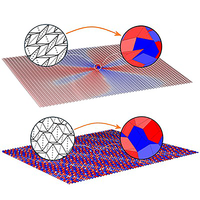
Thin sheets are usually easy to bend but hard to stretch, leading to complex and often unpredictable shapes when they are compressed. Origami, however, changes this behavior: Adding crease patterns to a sheet allows it to bend and counterbend in ways that mimic stretching. This principle appears in both nature, such as in leaves, and in engineering, where origami designs inspire deployable bridges and medical devices. The challenge is that when these flexible structures face strong or uneven forces, they can still deform unpredictably. In this study, we show that origami sheets can be sorted into two distinct classes that behave very differently under pressure.
To uncover this, we study how different crease patterns affect the way neighboring cells in the sheet deform. In one class of patterns, nearby cells deform in almost the same way, creating stiff sheets that resist jagged bending. In the other class, each cell can bend differently from its neighbors, and these irregular deformations add together to make the sheet softer and more compliant. The difference does not depend on material choice but instead comes directly from the crease geometry and the mathematical structure it imposes.
The most striking result is that this classification is topological, meaning it is robust in the same way as knots or certain quantum materials called topological insulators. This new framework gives us a powerful way to predict and design how origami structures will behave under real-world forces. Looking ahead, it may help in building soft robotic systems or adaptive materials.
Article Text
Supplemental Material
References (64)
- R. J. Lang, Origami Design Secrets: Mathematical Methods for an Ancient Art (CRC Press, Boca Raton, FL, 2012).
- Robert J. Lang, A computational algorithm for origami design, in Proceedings of the Twelfth Annual Symposium on Computational Geometry (ACM Press, New York, 1996), pp. 98–105.
- Erik D. Demaine and Joseph O’Rourke, Geometric Folding Algorithms: Linkages, Origami, Polyhedra (Cambridge University Press, Cambridge, England, 2007).
- James McInerney, Bryan Gin ge Chen, Louis Theran, Christian D. Santangelo, and D. Zeb Rocklin, Hidden symmetries generate rigid folding mechanisms in periodic origami, Proc. Natl. Acad. Sci. U.S.A. 117, 30252 (2020).
- James McInerney, Glaucio H. Paulino, and D. Zeb Rocklin, Discrete symmetries control geometric mechanics in parallelogram-based origami, Proc. Natl. Acad. Sci. U.S.A. 119, e2202777119 (2022).
- Anastasia Wickeler and Hani Naguib, Novel origami-inspired metamaterials: Design, mechanical testing and finite element modelling, Mater. Des. 186, 108242 (2019).
- Cheng Lv, Deepakshyam Krishnaraju, Goran Konjevod, Hongyu Yu, and Hanqing Jiang, Origami based mechanical metamaterials, Sci. Rep. 4, 5979 (2014).
- Mustafa Boyvat, Je-Sung Koh, and Robert J. Wood, Addressable wireless actuation for multijoint folding robots and devices, Sci. Rob. 2, eaan1544 (2017).
- Yuchen Jin, Jing Li, Shiyang Liu, Gongqi Cao, and Jianlin Liu, A worm-inspired robot based on origami structures driven by the magnetic field, Bioinspiration Biomimetics 18, 046008 (2023).
- Shengzhu Yi, Liu Wang, Zhipeng Chen, Jian Wang, Xingyi Song, Pengfei Liu, Yuanxi Zhang, Qingqing Luo, Lelun Peng, Zhigang Wu, Chuan Fei Guo, and Lelun Jiang, High-throughput fabrication of soft magneto-origami machines, Nat. Commun. 13, 4177 (2022).
- Diego Misseroni, Phanisri P. Pratapa, Ke Liu, and Glaucio H. Paulino, Experimental realization of tunable poisson’s ratio in deployable origami metamaterials, Extreme Mech. Lett. 53, 101685 (2022).
- Hairui Wang, Danyang Zhao, Yifei Jin, Minjie Wang, Tanmoy Mukhopadhyay, and Zhong You, Modulation of multi-directional auxeticity in hybrid origami metamaterials, Appl. Mater. Today 20, 100715 (2020).
- E. Hawkes, B. An, N. M. Benbernou, H. Tanaka, S. Kim, E. D. Demaine, D. Rus, and R. J. Wood, Programmable matter by folding, Proc. Natl. Acad. Sci. U.S.A. 107, 12441 (2010).
- Chunlong Wang, Hongwei Guo, Rongqiang Liu, and Zongquan Deng, A programmable origami-inspired space deployable structure with curved surfaces, Engineering structures 256, 113934 (2022).
- Christian D. Santangelo, Extreme mechanics: Self-folding origami, Annu. Rev. Condens. Matter Phys. 8, 165 (2017).
- K. v. Klitzing, G. Dorda, and M. Pepper, New method for high-accuracy determination of the fine-structure constant based on quantized Hall resistance, Phys. Rev. Lett. 45, 494 (1980).
- R. B. Laughlin, Quantized Hall conductivity in two dimensions, Phys. Rev. B 23, 5632 (1981).
- Martin R. Zirnbauer, Riemannian symmetric superspaces and their origin in random-matrix theory, J. Math. Phys. (N.Y.) 37, 4986 (1996).
- A. Altland and M. R. Zirnbauer, Nonstandard symmetry classes in mesoscopic normal-superconducting hybrid structures, Phys. Rev. B 55, 1142 (1997).
- Krishanu Roychowdhury and Michael J. Lawler, Classification of magnetic frustration and metamaterials from topology, Phys. Rev. B 98, 094432 (2018).
- Joel E. Moore, The birth of topological insulators, Nature (London) 464, 194 (2010).
- W-P_ Su, J. R. Schrieffer, and A. J. Heeger, Soliton excitations in polyacetylene, Phys. Rev. B 22, 2099 (1980).
- C. L. Kane and T. C. Lubensky, Topological boundary modes in isostatic lattices, Nat. Phys. 10, 39 (2014).
- Roman Süsstrunk and Sebastian D. Huber, Observation of phononic helical edge states in a mechanical topological insulator, Science 349, 47 (2015).
- Noah P. Mitchell, Lisa M. Nash, Daniel Hexner, Ari M. Turner, and William T. M. Irvine, Amorphous topological insulators constructed from random point sets, Nat. Phys. 14, 380 (2018).
- P. Wang, L. Lu, and K. Bertoldi, Topological phononic crystals with one-way elastic edge waves, Phys. Rev. Lett. 115, 104302 (2015).
- Bryan Gin-ge Chen, Bin Liu, Arthur A. Evans, Jayson Paulose, Itai Cohen, Vincenzo Vitelli, and C. D. Santangelo, Topological mechanics of origami and kirigami, Phys. Rev. Lett. 116, 135501 (2016).
- Yasuhiro Miyazawa, Chun-Wei Chen, Rajesh Chaunsali, Timothy S. Gormley, Ge Yin, Georgios Theocharis, and Jinkyu Yang, Topological state transfer in Kresling origami, Commun. Mater. 3, 62 (2022).
- S. Li, P. G. Kevrekidis, X. Mao, and J. Yang, Topological pumping in origami metamaterials, Phys. Rev. B 110, 075123 (2024).
- Phanisri P. Pratapa, Ke Liu, and Glaucio H. Paulino, Geometric mechanics of origami patterns exhibiting Poisson’s ratio switch by breaking mountain and valley assignment, Phys. Rev. Lett. 122, 155501 (2019).
- Arthur Cayley, The Collected Mathematical Papers (Cambridge University Press, Cambridge, England, 1894), Vol. 7.
- Charles L. Kane and Eugene J. Mele, Z 2 topological order and the quantum spin Hall effect, Phys. Rev. Lett. 95, 146802 (2005).
- Suraj Shankar, Petur Bryde, and L. Mahadevan, Geometric control of topological dynamics in a singing saw, Proc. Natl. Acad. Sci. U.S.A. 119, e2117241119 (2022).
- Koryo Miura and Robert J. Lang, The science of Miura-Ori: A review, Origami 4, 87 (2009).
- Mark Schenk and Simon D. Guest, Geometry of Miura-folded metamaterials, Proc. Natl. Acad. Sci. U.S.A. 110, 3276 (2013).
- Mark Schenk, Simon D. Guest et al., Origami folding: A structural engineering approach, Origami 5, 291 (2011).
- Hussein Nassar, Arthur Lebée, and Laurent Monasse, Curvature, metric and parametrization of origami tessellations: theory and application to the eggbox pattern, Proc. R. Soc. A 473, 20160705 (2017).
- Mark Schenk, Folded shell structures, Ph.D. thesis, University of Cambridge, 2012.
- Evgueni T. Filipov, Tomohiro Tachi, and Glaucio H. Paulino, Origami tubes assembled into stiff, yet reconfigurable structures and metamaterials, Proc. Natl. Acad. Sci. U.S.A. 112, 12321 (2015).
- Z. Y. Wei, Z. V. Guo, L. Dudte, H. Y. Liang, and L, Mahadevan, Geometric mechanics of periodic pleated origami, Phys. Rev. Lett. 110, 215501 (2013).
- Scott Waitukaitis, Rémi Menaut, Bryan Gin-ge Chen, and Martin Van Hecke, Origami multistability: From single vertices to metasheets, Phys. Rev. Lett. 114, 055503 (2015).
- See Supplemental Material at http://link.aps.org/supplemental/10.1103/gdb2-grvp for a detailed derivation of mathematical expressions such as the folding amplitude, the compatibility matrix, the scaling law, etc. It also contains the parameters we used in Mathematica and matlab simulations.
- James P. McInerney, Diego Misseroni, D. Zeb Rocklin, Glaucio H. Paulino, and Xiaoming Mao, Coarse-grained fundamental forms for characterizing isometries of trapezoid-based origami metamaterials, Nat. Commun. 16, 1823 (2025).
- D. Zeb Rocklin, Flexible Mechanical Structures and Their Topologically Protected Deformations (Springer, Berlin, Heidelberg, 2020), pp. 1–16.
- David J. Griffiths and Darrell F. Schroeter, Introduction to Quantum Mechanics (Cambridge University Press, Cambridge, England, 2018).
- Tomá š Bzdušek and Manfred Sigrist, Robust doubly charged nodal lines and nodal surfaces in centrosymmetric systems, Phys. Rev. B 96, 155105 (2017).
- Michael Peskin, An Introduction to Quantum Field Theory (CRC Press, Boca Raton, FL, 2018).
- Phanisri P. Pratapa, Phanish Suryanarayana, and Glaucio H. Paulino, Bloch wave framework for structures with nonlocal interactions: Application to the design of origami acoustic metamaterials, J. Mech. Phys. Solids 118, 115 (2018).
- J. Clerk Maxwell F. R. S., L. on the calculation of the equilibrium and stiffness of frames, London, Edinburgh, Dublin Philos. Mag. J. Sci. 27, 294 (1864).
- C. R. Calladine, Buckminster Fuller’s, “tensegrity” structures and Clerk Maxwell’s rules for the construction of stiff frames, Int. J. Solids Struct. 14, 161 (1978).
- E. T. Filipov, K. Liu, T. Tachi, M. Schenk, and G. H. Paulino, Bar and hinge models for scalable analysis of origami, Int. J. Solids Struct. 124, 26 (2017).
- A. A. Evans, J. L. Silverberg, and C. D. Santangelo, Lattice mechanics of origami tessellations, Phys. Rev. E 92, 013205 (2015).
- Gabriel Cramer, Introduction à l’analyse des lignes courbes (Cramer, Genève, 1750).
- Xiaoming Mao and T. C. Lubensky, Coherent potential approximation of random nearly isostatic kagome lattice, Phys. Rev. E 83, 011111 (2011).
- Chase P. Broedersz, Xiaoming Mao, Tom C. Lubensky, and Frederick C. MacKintosh, Criticality and isostaticity in fibre networks, Nat. Phys. 7, 983 (2011).
- K. Liu and G. H. Paulino, Highly efficient nonlinear structural analysis of origami assemblages using the merlin2 software, Origami 7, 1167 (2018).
- Gardoni Paolo Liu Ke, Novelino Larissa S., and Paulino Glaucio H, Big influence of small random imperfections in origami-based metamaterials, Proc. R. Soc. A 476, 20200236 (2020).
- M. Zahid Hasan and Charles L. Kane, Colloquium: Topological insulators, Rev. Mod. Phys. 82, 3045 (2010).
- Michael Czajkowski, James McInerney, Andrew M. Wu, and D. Zeb Rocklin, Orisometry formalism reveals duality and exotic nonuniform response in origami sheets, arXiv:2312.12432.
- Alon Sardas, Michael Moshe, and Cy Maor, A continuum geometric approach for inverse design of origami structures, J. Mech. Phys. Solids 196, 106003 (2025).
- Hu Xu, Ian Tobasco, and Paul Plucinsky, Derivation of an effective plate theory for parallelogram origami from bar and hinge elasticity, J. Mech. Phys. Solids 192, 105832 (2024).
- H Nassar, A. Lebée, and L. Monasse, Curvature, metric and parametrization of origami tessellations: Theory and application to the eggbox pattern, Proc. Math. Phys. Eng. Sci. 473, 20160705 (2017).
- Michel Fruchart, Yujie Zhou, and Vincenzo Vitelli, Dualities and non-Abelian mechanics, Nature (London) 577, 636 (2020).
- Krishanu Roychowdhury, D. Zeb Rocklin, and Michael J. Lawler, Topology and geometry of spin origami, Phys. Rev. Lett. 121, 177201 (2018).

