

- Open Access
Attosecond X-Ray Core-Level Chronoscopy of Aromatic Molecules
Phys. Rev. X 15, 041031 – Published 14 November, 2025
DOI: https://doi.org/10.1103/dp5w-qxqc
Abstract
Attosecond photoemission or photoionization delays are a unique probe of the structure and the electronic dynamics of matter. However, the spectral congestion of valence photoelectron spectra sets fundamental limits to the complexity of systems that can be studied, and the delocalization of valence electron wave functions blurs the spatial origin of the photoelectron wave packet. Using attosecond x-ray pulses from LCLS, we demonstrate the key advantages of measuring core-level delays: The photoelectron spectra remain atomlike, the measurements become element specific, and the observed scattering dynamics originate from a pointlike source when multicenter interference effects are negligible. We exploit these unique features to reveal the effects of changing functional groups (C-H vs N) and symmetry on attosecond scattering dynamics by measuring and calculating the photoionization delays between and core shells of a series of aromatic azabenzene molecules. Remarkably, the delays increase with the number of nitrogen atoms in the molecule and reveal multiple resonances. We identify two previously unknown mechanisms regulating the associated attosecond dynamics, namely the enhanced confinement of the trapped wave function with the replacement of C-H groups by N atoms and the decrease of the coupling strength among the photoemitted partial waves with increasing symmetry. This study demonstrates the unique opportunities opened by measurements of core-level photoionization delays for unraveling attosecond electron dynamics in complex matter.
Physics Subject Headings (PhySH)
Popular Summary
Electrons in matter move on attosecond timescales—billionths of a billionth of a second—making their motion extremely difficult to capture, especially in large molecules. Tracking this motion is vital for understanding how electrons drive chemical and physical processes. Earlier experiments have used ultraviolet attosecond pulses to eject outer, or valence, electrons and measure when they escape. But in complex molecules, these signals overlap and become ambiguous, making it unclear which atom an electron came from. In this study, we overcome these challenges by directly measuring element-specific electron dynamics in complex molecules using attosecond x-ray pulses.
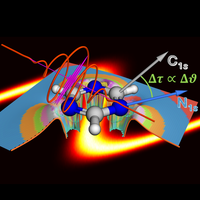
We achieve this by targeting core-level electrons—inner electrons bound tightly to specific atoms—that provide clean, element-specific signatures: Carbon and nitrogen atoms each produce distinct signals with no overlap. Using an “attosecond streaking” method that employs a circularly polarized infrared pulse as a stopwatch, we precisely measure the timing difference between electrons ejected from nitrogen and carbon atoms within the same molecule.
We find that electrons from nitrogen escape more slowly than those from carbon, and that this delay increases as nitrogen atoms replace carbon in a series of related molecules. The data also reveal signatures characteristic of transient trapping. Our analysis shows two main reasons for this slowdown: Nitrogen atoms deepen the potential well that holds the electrons, and symmetric arrangements of nitrogen restrict available escape paths.
Together, these results demonstrate the power of attosecond x-ray techniques for observing site-specific electron motion and open the door to studies of even more complex molecular systems.
Article Text
Supplemental Material
References (64)
- M. Schultze et al., Delay in photoemission, Science 328, 1658 (2010).
- K. Klünder, J. M. Dahlström, M. Gisselbrecht, T. Fordell, M. Swoboda, D. Guénot, P. Johnsson, J. Caillat, J. Mauritsson, A. Maquet, Taïeb, and A. L’Huillier, Probing single-photon ionization on the attosecond time scale, Phys. Rev. Lett. 106, 143002 (2011).
- R. Pazourek, S. Nagele, and J. Burgdörfer, Attosecond chronoscopy of photoemission, Rev. Mod. Phys. 87, 765 (2015).
- M. Huppert, I. Jordan, D. Baykusheva, A. von Conta, and H. J. Wörner, Attosecond delays in molecular photoionization, Phys. Rev. Lett. 117, 093001 (2016).
- J. Vos, L. Cattaneo, S. Patchkovskii, T. Zimmermann, C. Cirelli, M. Lucchini, A. Kheifets, A. S. Landsman, and U. Keller, Orientation-dependent stereo Wigner time delay and electron localization in a small molecule, Science 360, 1326 (2018).
- S. Biswas, B. Förg, J. Schötz, W. Schweinberger, L. Ortmann, T. Zimmermann, L.-W. Pi, D. Baykusheva, H. Masood, I. Liontos, K. A. M., K. N. G., A. F. Alharbi, M. Alharbi, A. M. Azzeer, G. Hartmann, H. J. Wörner, A. S. Landsman, and M. F. Kling, Probing molecular environment through photoemission delays, Nat. Phys. 16, 778 (2020).
- A. Kamalov, A. L. Wang, P. H. Bucksbaum, D. J. Haxton, and J. P. Cryan, Electron correlation effects in attosecond photoionization of , Phys. Rev. A 102, 023118 (2020).
- S. Nandi, E. Plésiat, S. Zhong, A. Palacios, D. Busto, M. Isinger, L. Neoričić, C. Arnold, R. Squibb, R. Feifel et al., Attosecond timing of electron emission from a molecular shape resonance, Sci. Adv. 6, eaba7762 (2020).
- S. Heck, D. Baykusheva, M. Han, J.-B. Ji, C. Perry, X. Gong, and H. J. Wörner, Attosecond interferometry of shape resonances in the recoil frame of , Sci. Adv. 7, eabj8121 (2021).
- X. Gong, S. Heck, D. Jelovina, C. Perry, K. Zinchenko, R. Lucchese, and H. J. Wörner, Attosecond spectroscopy of size-resolved water clusters, Nature (London) 609, 507 (2022).
- S. Heck, M. Han, D. Jelovina, J.-B. Ji, C. Perry, X. Gong, R. Lucchese, K. Ueda, and H. J. Wörner, Two-center interference in the photoionization delays of , Phys. Rev. Lett. 129, 133002 (2022).
- I. Jordan, M. Huppert, D. Rattenbacher, M. Peper, D. Jelovina, C. Perry, A. von Conta, A. Schild, and H. J. Wörner, Attosecond spectroscopy of liquid water, Science 369, 974 (2020).
- A. L. Cavalieri, N. Muller, T. Uphues, V. S. Yakovlev, A. Baltuska, B. Horvath, B. Schmidt, L. Blumel, R. Holzwarth, S. Hendel, M. Drescher, U. Kleineberg, P. M. Echenique, R. Kienberger, F. Krausz, and U. Heinzmann, Attosecond spectroscopy in condensed matter, Nature (London) 449, 1029 (2007).
- S. Neppl, R. Ernstorfer, A. L. Cavalieri, C. Lemell, G. Wachter, E. Magerl, E. M. Bothschafter, M. Jobst, M. Hofstetter, U. Kleineberg, J. V. Barth, D. Menzel, J. Burgdorfer, P. Feulner, F. Krausz, and R. Kienberger, Direct observation of electron propagation and dielectric screening on the atomic length scale, Nature (London) 517, 342 (2015).
- Z. Tao, C. Chen, T. Szilvási, M. Keller, M. Mavrikakis, H. Kapteyn, and M. Murnane, Direct time-domain observation of attosecond final-state lifetimes in photoemission from solids, Science 353, 62 (2016).
- F. Siek, S. Neb, P. Bartz, M. Hensen, C. Strüber, S. Fiechter, M. Torrent-Sucarrat, V. M. Silkin, E. E. Krasovskii, N. M. Kabachnik et al., Angular momentum–induced delays in solid-state photoemission enhanced by intra-atomic interactions, Science 357, 1274 (2017).
- J. Duris, S. Li, T. Driver, E. G. Champenois, J. P. MacArthur, A. A. Lutman, Z. Zhang, P. Rosenberger, J. W. Aldrich, R. Coffee et al., Tunable isolated attosecond x-ray pulses with gigawatt peak power from a free-electron laser, Nat. Photonics 14, 30 (2020).
- S. Li, Z. Guo, R. N. Coffee, K. Hegazy, Z. Huang, A. Natan, T. Osipov, D. Ray, A. Marinelli, and J. P. Cryan, Characterizing isolated attosecond pulses with angular streaking, Opt. Express 26, 4531 (2018).
- S. Li, T. Driver, P. Rosenberger, E. G. Champenois, J. Duris, A. Al-Haddad, V. Averbukh, J. C. Barnard, N. Berrah, C. Bostedt et al., Attosecond coherent electron motion in Auger-Meitner decay, Science 375, 285 (2022).
- T. Driver, M. Mountney, J. Wang, L. Ortmann, A. Al-Haddad, N. Berrah, C. Bostedt, E. G. Champenois, L. F. DiMauro, J. Duris et al., Attosecond delays in x-ray molecular ionization, Nature (London) 632, 762 (2024).
- Y. Ling, Z.-Y. Hao, D. Liang, C.-L. Zhang, Y.-F. Liu, and Y. Wang, The expanding role of pyridine and dihydropyridine scaffolds in drug design, Drug Des. Dev. Ther. 15, 4289 (2021).
- T. P. Selvam, C. R. James, P. V. Dniandev, and S. K. Valzita, A mini review of pyrimidine and fused pyrimidine marketed drugs, Res. Pharm. 2, 1 (2015).
- A. Sharma, R. Sheyi, B. G. de la Torre, A. El-Faham, and F. Albericio, s-triazine: A privileged structure for drug discovery and bioconjugation, Molecules 26, 864 (2021).
- A. Moliton, Optoelectronics of Molecules and Polymers (Springer, New York, 2010), Vol. 104.
- P. Walter et al., The time-resolved atomic, molecular and optical science instrument at the Linac Coherent Light Source, J. Synchrotron Radiat. 29, 957 (2022).
- Z. Zhao, Z. Chang, X. Tong, and C. Lin, Circularly-polarized laser-assisted photoionization spectra of argon for attosecond pulse measurements, Opt. Express 13, 1966 (2005).
- P. Eckle, M. Smolarski, P. Schlup, J. Biegert, A. Staudte, M. Schöffler, H. G. Muller, R. Dörner, and U. Keller, Attosecond angular streaking, Nat. Phys. 4, 565 (2008).
- A. K. Kazansky, A. V. Bozhevolnov, I. P. Sazhina, and N. M. Kabachnik, Interference effects in angular streaking with a rotating terahertz field, Phys. Rev. A 93, 013407 (2016).
- A. Kazansky, I. Sazhina, and N. Kabachnik, Fast retrieval of temporal characteristics of FEL pulses using streaking by THz field, Opt. Express 27, 12939 (2019).
- N. Hartmann, G. Hartmann, R. Heider, M. Wagner, M. Ilchen, J. Buck, A. Lindahl, C. Benko, J. Grünert, J. Krzywinski et al., Attosecond time–energy structure of x-ray free-electron laser pulses, Nat. Photonics 12, 215 (2018).
- A. S. Kheifets, R. Wielian, V. V. Serov, I. A. Ivanov, A. L. Wang, A. Marinelli, and J. P. Cryan, Ionization phase retrieval by angular streaking from random shots of XUV radiation, Phys. Rev. A 106, 033106 (2022).
- V. V. Serov and A. S. Kheifets, XUV ionization of the molecule studied with attosecond angular streaking, J. Phys. B 56, 025601 (2023).
- J. M. Glownia, J. Cryan, J. Andreasson, A. Belkacem, N. Berrah, C. Blaga, C. Bostedt, J. Bozek, L. DiMauro, L. Fang et al., Time-resolved pump-probe experiments at the LCLS, Opt. Express 18, 17620 (2010).
- See Supplemental Material at http://link.aps.org/supplemental/10.1103/dp5w-qxqc, which includes Refs. [35–45], for details about the experimental methodology, data analysis, determination of photoelectron asymmetry parameters, theoretical methodology and additional comparisons between experiment and theory.
- S. Li, E. G. Champenois, R. Coffee, Z. Guo, K. Hegazy, A. Kamalov, A. Natan, J. O’Neal, T. Osipov, M. Owens, D. Ray, D. Rich, P. Walter, A. Marinelli, and J. P. Cryan, A co-axial velocity map imaging spectrometer for electrons, AIP Adv. 8, 115308 (2018).
- Z. Guo et al., Experimental demonstration of attosecond pump–probe spectroscopy with an x-ray free-electron laser, Nat. Photonics 18, 691 (2024).
- M. Hoshino, H. Kato, N. Kuze, H. Tanaka, H. Fukuzawa, K. Ueda, and R. R. Lucchese, Changes in site-specific shape resonances in nitrogen K-shell photoionization of induced by vibrational excitation, J. Phys. B 51, 065402 (2018).
- R. R. Lucchese and F. A. Gianturco, One-electron resonances in electron scattering from polyatomic molecules, Int. Rev. Phys. Chem. 15, 429 (1996).
- A. M. Lane and D. Robson, Comprehensive formalism for nuclear reaction problems. I. Derivation of existing reaction theories, Phys. Rev. 151, 774 (1966).
- H. D. Meyer and O. Walter, On the calculation of S-matrix poles using the Siegert method, J. Phys. B 15, 3647 (1982).
- V. I. Kukulin, V. M. Krasnopol’sky, and J. Horáček, Theory of Resonances: Principles and Applications (Springer Netherlands, Dordrecht, 1989).
- J. M. Dahlström, D. Guénot, K. Klünder, M. Gisselbrecht, J. Mauritsson, A. L’Huillier, A. Maquet, and R. Taïeb, Theory of attosecond delays in laser-assisted photoionization, Chem. Phys. 414, 53 (2013).
- V. V. Serov, V. L. Derbov, and T. A. Sergeeva, Interpretation of the time delay in the ionization of Coulomb systems by attosecond laser pulses, in Advanced Lasers: Laser Physics and Technology for Applied and Fundamental Science, Springer Series in Optical Sciences, edited by O. Shulika and I. Sukhoivanov (Springer Netherlands, Dordrecht, 2015), pp. 213–230.
- C. Nicolas and C. Miron, Lifetime broadening of core-excited and -ionized states, J. Electron Spectrosc. Relat. Phenom. 185, 267 (2012).
- A. Russek and W. Mehlhorn, Post-collision interaction and the Auger lineshape, J. Phys. B 19, 911 (1986).
- J. Wang, Z. Guo, E. Isele, P. H. Bucksbaum, A. Marinelli, J. P. Cryan, and T. Driver, Covariance analysis of impulsive streaking, arXiv:2411.01729.
- G. Vall-Ilosera, B. Gao, A. Kivimaki, M. Coreno, J. A. Ruiz, M. de Simone, H. Ågren, and E. Rachlew, The C 1s and N 1s near edge x-ray absorption fine structure spectra of five azabenzenes in the gas phase, J. Chem. Phys. 128 (2008).
- M. Piancastelli, The neverending story of shape resonances, J. Electron Spectrosc. Relat. Phenom. 100, 167 (1999).
- J. M. Dahlström, A. L’Huillier, and A. Maquet, Introduction to attosecond delays in photoionization, J. Phys. B 45, 183001 (2012).
- J.-B. Ji, K. Ueda, M. Han, and H. J. Wörner, Analytical expression for continuum-continuum transition amplitude of hydrogen-like atoms with angular-momentum dependence, J. Phys. B 57, 235601 (2024).
- E. Karule, Integrals of two confluent hypergeometric functions, J. Phys. A 23, 1969 (1990).
- Z. Zhang, J. Duris, J. P. MacArthur, A. Zholents, Z. Huang, and A. Marinelli, Experimental demonstration of enhanced self-amplified spontaneous emission by photocathode temporal shaping and self-compression in a magnetic wiggler, New J. Phys. 22, 083030 (2020).
- M. Seaberg et al., The x-ray focusing system at the time-resolved AMO instrument, Synchrotron Radiat. News 35, 20 (2022).
- R. Obaid, C. Buth, G. L. Dakovski, R. Beerwerth, M. Holmes, J. Aldrich, M.-F. Lin, M. Minitti, T. Osipov, W. Schlotter et al., LCLS in–photon out: Fluorescence measurement of neon using soft x-rays, J. Phys. B 51, 034003 (2018).
- M. C. Hettrick, J. H. Underwood, P. J. Batson, and M. J. Eckart, Resolving power of 35,000 (5 mA) in the extreme ultraviolet employing a grazing incidence spectrometer, Appl. Opt. 27, 200 (1988).
- A. E. Orel, T. N. Rescigno, and B. H. Lengsfield III, Theoretical study of electron-impact excitation of , Phys. Rev. A 42, 5292 (1990).
- F. A. Gianturco, R. R. Lucchese, and N. Sanna, Calculation of low-energy elastic cross sections for electron- scattering, J. Chem. Phys. 100, 6464 (1994).
- A. P. P. Natalense and R. R. Lucchese, Cross section and asymmetry parameter calculation for sulfur 1s photoionization of , J. Chem. Phys. 111, 5344 (1999).
- J. Dunning and H. Thom, Gaussian basis sets for use in correlated molecular calculations. I. The atoms boron through neon and hydrogen, J. Chem. Phys. 90, 1007 (1989).
- J. P. Perdew and A. Zunger, Self-interaction correction to density-functional approximations for many-electron systems, Phys. Rev. B 23, 5048 (1981).
- C. A. Marante, L. Greenman, C. S. Trevisan, T. N. Rescigno, C. W. McCurdy, and R. R. Lucchese, Validity of the static-exchange approximation for inner-shell photoionization of polyatomic molecules, Phys. Rev. A 102, 012815 (2020).
- J. C. Baggesen and L. B. Madsen, Polarization effects in attosecond photoelectron spectroscopy, Phys. Rev. Lett. 104, 043602 (2010).
- J. Benda and Z. Mašín, Dipole-laser coupling delay in two-color RABBITT photoionization of polar molecules, Phys. Rev. A 109, 013106 (2024).
- J.-B. Ji et al., Dataset for “Attosecond x-ray core-level chronoscopy of aromatic molecules”, ETH Zürich Research Collection, 10.3929/ethz-c-000785516 (2025).

