

- Open Access
Quantum Thermal State Preparation for Near-Term Quantum Processors
Phys. Rev. X 16, 031053 – Published 28 August, 2026
DOI: https://doi.org/10.1103/cbrd-ssnm
Abstract
Preparation of quantum thermal states of many-body systems is a key computational challenge for quantum processors, with applications in physics, chemistry, and classical optimization. We provide a simple and efficient algorithm for thermal state preparation, combining engineered bath resetting and modulated system-bath coupling to derive a quantum channel approximately satisfying quantum detailed balance relations. We show that the fixed point of the channel approximates the Gibbs state as , where is the system-bath coupling and . We provide extensive numerics, for the example of the 2D quantum Ising model, confirming that the protocol successfully prepares the thermal state throughout the finite-temperature phase diagram, including near the quantum phase transition. Simulations for free-fermion systems provide further evidence for the accuracy of the protocol for large system sizes in the weak-coupling limit. Our algorithm provides a path to efficient quantum simulation of quantum-correlated states at finite temperature with current and near-term quantum processors.
Physics Subject Headings (PhySH)
Popular Summary
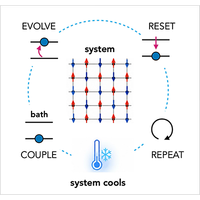
Preparing quantum thermal states of many-body systems, especially at low temperatures where quantum effects are most significant, is a central challenge of quantum simulation. We address this difficulty by designing an efficient algorithm which combines engineered bath resetting with time-dependent system-bath coupling. The time-dependent coupling provides a simple way to approximately enforce detailed balance relations, and is particularly suited for near-term quantum processors. We demonstrate the accuracy of our protocol with numerical simulations of two-dimensional quantum magnetic systems and large-scale free-fermion chains, finding close agreement for key thermodynamic observables, including near quantum phase transitions. In the long term, our method provides a practical path toward simulating strongly correlated quantum matter at finite temperatures on near-term digital and analog quantum hardware.
Article Text
References (77)
- A. M. Dalzell, S. McArdle, M. Berta, P. Bienias, C.-F. Chen, A. Gilyén, C. T. Hann, M. J. Kastoryano, E. T. Khabiboulline, A. Kubica et al., Quantum Algorithms: A Survey of Applications and End-to-End Complexities (Cambridge University Press, Cambridge, England, 2025).
- T. Bergamaschi, C.-F. Chen, and Y. Liu, Quantum computational advantage with constant-temperature Gibbs sampling, in Proceedings of the 2024 IEEE 65th Annual Symposium on Foundations of Computer Science (FOCS) (IEEE, Piscataway, NJ, USA, 2024), pp. 1063–1085.
- J. Rajakumar and J. D. Watson, Gibbs sampling gives quantum advantage at constant temperatures with O(1)-local Hamiltonians, Quantum 10, 1981 (2026).
- J. Lemieux, G. Duclos-Cianci, D. Sénéchal, and D. Poulin, Resource estimate for quantum many-body ground-state preparation on a quantum computer, Phys. Rev. A 103, 052408 (2021).
- Y. Cao, J. Romero, J. P. Olson, M. Degroote, P. D. Johnson, M. Kieferová, I. D. Kivlichan, T. Menke, B. Peropadre, N. P. Sawaya et al., Quantum chemistry in the age of quantum computing, Chem. Rev. 119, 10856 (2019).
- F. G. Brandao and K. Svore, Quantum speed-ups for semidefinite programming, arXiv:1609.05537.
- C. Cohen-Tannoudji, J. Dupont-Roc, and G. Grynberg, Photons and Atoms: Introduction to Quantum Electrodynamics (John Wiley & Sons, New York, 2024).
- H.-P. Breuer and F. Petruccione, The Theory of Open Quantum Systems (Oxford University Press, Oxford, 2002).
- A. Y. Kitaev, Quantum measurements and the Abelian stabilizer problem, arXiv:quant-ph/9511026.
- K. Temme, T. J. Osborne, K. G. Vollbrecht, D. Poulin, and F. Verstraete, Quantum Metropolis sampling, Nature (London) 471, 87 (2011).
- Talia L. Lezama, E. J. Torres-Herrera, F. Pérez-Bernal, Y. Bar Lev, and L. F. Santos, Equilibration time in many-body quantum systems, Phys. Rev. B 104, 085117 (2021).
- X. Mi, A. Michailidis, S. Shabani, K. Miao, P. Klimov, J. Lloyd, E. Rosenberg, R. Acharya, I. Aleiner, T. Andersen et al., Stable quantum-correlated many-body states through engineered dissipation, Science 383, 1332 (2024).
- C.-F. Chen, M. J. Kastoryano, and A. Gilyén, An efficient and exact noncommutative quantum Gibbs sampler, arXiv:2311.09207.
- C.-F. Chen, M. Kastoryano, F. G. Brandão, and A. Gilyén, Efficient quantum thermal simulation, Nature (London) 646, 561 (2025).
- C.-F. Chen, M. J. Kastoryano, F. G. Brandão, and A. Gilyén, Quantum thermal state preparation, arXiv:2303.18224.
- C.-F. Chen and F. G. Brandão, Fast thermalization from the eigenstate thermalization hypothesis, arXiv:2112.07646.
- O. Shtanko and R. Movassagh, Preparing thermal states on noiseless and noisy programmable quantum processors, arXiv:2112.14688.
- A. Gilyén, C.-F. Chen, J. F. Doriguello, and M. J. Kastoryano, Quantum generalizations of Glauber and Metropolis dynamics, arXiv:2405.20322.
- Z. Ding, B. Li, and L. Lin, Efficient quantum Gibbs samplers with Kubo–Martin–Schwinger detailed balance condition, Commun. Math. Phys. 406, 67 (2025).
- J. Guo, O. Hart, C.-F. Chen, A. J. Friedman, and A. Lucas, Designing open quantum systems with known steady states: Davies generators and beyond, Quantum 9, 1612 (2025).
- D. Hahn, S. Parameswaran, and B. Placke, Towards efficient quantum thermal state preparation via local driving: Lindbladian simulation with provable guarantees, arXiv:2505.22816.
- Z. Ding, Y. Zhan, J. Preskill, and L. Lin, End-to-end efficient quantum thermal and ground state preparation made simple, arXiv:2508.05703.
- L. Lin, Dissipative preparation of many-body quantum states: Towards practical quantum advantage, APL Comput. Phys. 1, 010901 (2025), https://pubs.aip.org/aip/aco/article/1/1/010901/3362109/Dissipative-preparation-of-many-body-quantum.
- D. Hahn, R. Sweke, A. Deshpande, and O. Shtanko, Efficient quantum Gibbs sampling with local circuits, PRX Quantum 7, 020314 (2026).
- D. A. Levin and Y. Peres, Markov Chains and Mixing Times (American Mathematical Society, Providence, 2017), Vol. 107.
- I. Bardet, Á. Capel, L. Gao, A. Lucia, D. Pérez-García, and C. Rouzé, Rapid thermalization of spin chain commuting Hamiltonians, Phys. Rev. Lett. 130, 060401 (2023).
- C. Rouzé, D. S. França, and Á. M. Alhambra, Efficient thermalization and universal quantum computing with quantum Gibbs samplers, Nat. Phys. 22, 1123 (2026).
- C. Rouzé, D. S. França, and Á. M. Alhambra, Optimal quantum algorithm for Gibbs state preparation, Phys. Rev. Lett. 136, 060601 (2026).
- A. Bakshi, A. Liu, A. Moitra, and E. Tang, High-temperature Gibbs states are unentangled and efficiently preparable, in Proceedings of the 2024 IEEE 65th Annual Symposium on Foundations of Computer Science (FOCS) (IEEE, Piscataway, NJ, USA, 2024), pp. 1027–1036.
- Y. Tong and Y. Zhan, Fast mixing of weakly interacting fermionic systems at any temperature, arXiv:2501.00443.
- Š. Šmíd, R. Meister, M. Berta, and R. Bondesan, Polynomial time quantum Gibbs sampling for Fermi-Hubbard model at any temperature, Nat. Commun. 16, 10736 (2025).
- J. Lloyd, A. A. Michailidis, X. Mi, V. Smelyanskiy, and D. A. Abanin, Quasiparticle cooling algorithms for quantum many-body state preparation, PRX Quantum 6, 010361 (2025).
- B. Kraus, H. P. Büchler, S. Diehl, A. Kantian, A. Micheli, and P. Zoller, Preparation of entangled states by quantum Markov processes, Phys. Rev. A 78, 042307 (2008).
- F. Verstraete, M. M. Wolf, and J. Ignacio Cirac, Quantum computation and quantum-state engineering driven by dissipation, Nat. Phys. 5, 633 (2009).
- S. Roy, J. T. Chalker, I. V. Gornyi, and Y. Gefen, Measurement-induced steering of quantum systems, Phys. Rev. Res. 2, 033347 (2020).
- M. Metcalf, J. E. Moussa, W. A. de Jong, and M. Sarovar, Engineered thermalization and cooling of quantum many-body systems, Phys. Rev. Res. 2, 023214 (2020).
- M. Raghunandan, F. Wolf, C. Ospelkaus, P. O. Schmidt, and H. Weimer, Initialization of quantum simulators by sympathetic cooling, Sci. Adv. 6, eaaw9268 (2020).
- A. Matthies, M. Rudner, A. Rosch, and E. Berg, Programmable adiabatic demagnetization for systems with trivial and topological excitations, Quantum 8, 1505 (2024).
- G. Kishony, M. S. Rudner, A. Rosch, and E. Berg, Gauged cooling of topological excitations and emergent fermions on quantum simulators, Phys. Rev. Lett. 134, 086503 (2025).
- Z. Ding, C.-F. Chen, and L. Lin, Single-ancilla ground state preparation via Lindbladians, Phys. Rev. Res. 6, 033147 (2024).
- Y. Zhan, Z. Ding, J. Huhn, J. Gray, J. Preskill, G. K. Chan, and L. Lin, Rapid quantum ground state preparation via dissipative dynamics, Phys. Rev. X 16, 011004 (2026).
- D. Molpeceres, S. Lu, J. I. Cirac, and B. Kraus, Quantum algorithms for cooling: A simple case study, Phys. Rev. Res. 7, 033162 (2025).
- P. Stadler, M. Lodi, A. Khedri, R. Reiner, K. Bark, N. Vogt, M. Marthaler, and J. Leppäkangas, Demonstration of system-bath physics on a gate-based quantum computer, Phys. Rev. A 111, 022614 (2025).
- B. M. Terhal and D. P. DiVincenzo, Problem of equilibration and the computation of correlation functions on a quantum computer, Phys. Rev. A 61, 022301 (2000).
- C. Yin and A. Lucas, Prethermalization and the local robustness of gapped systems, Phys. Rev. Lett. 131, 050402 (2023).
- D. A. Abanin, W. De Roeck, W. W. Ho, and F. Huveneers, Effective Hamiltonians, prethermalization, and slow energy absorption in periodically driven many-body systems, Phys. Rev. B 95, 014112 (2017).
- A. M. Childs, Y. Su, M. C. Tran, N. Wiebe, and S. Zhu, Theory of trotter error with commutator scaling, Phys. Rev. X 11, 011020 (2021).
- T. I. Andersen, N. Astrakhantsev, A. H. Karamlou, J. Berndtsson, J. Motruk, A. Szasz, J. A. Gross, A. Schuckert, T. Westerhout, Y. Zhang et al., Thermalization and criticality on an analogue–digital quantum simulator, Nature (London) 638, 79 (2025).
- J. T. Barreiro, M. Müller, P. Schindler, D. Nigg, T. Monz, M. Chwalla, M. Hennrich, C. F. Roos, P. Zoller, and R. Blatt, An open-system quantum simulator with trapped ions, Nature (London) 470, 486 (2011).
- M. McEwen, D. Kafri, Z. Chen, J. Atalaya, K. Satzinger, C. Quintana, P. V. Klimov, D. Sank, C. Gidney, A. Fowler et al., Removing leakage-induced correlated errors in superconducting quantum error correction, Nat. Commun. 12, 1761 (2021).
- K. C. Miao, M. McEwen, J. Atalaya, D. Kafri, L. P. Pryadko, A. Bengtsson, A. Opremcak, K. J. Satzinger, Z. Chen, P. V. Klimov et al., Overcoming leakage in scalable quantum error correction, Nat. Phys. 19, 1780 (2023).
A rigorous bound on the commutator norm can be obtained using similar methods to Ref. [21].
In a previous version of the paper, we derived the errors via a direct perturbation theory, but this did not allow us to estimate the populations.
- Š. Šmíd, R. Meister, M. Berta, and R. Bondesan, Rapid mixing of quantum Gibbs samplers for weakly-interacting quantum systems, arXiv:2510.04954.
- J. S. Lee and J. Yeo, Perturbative steady states of completely positive quantum master equations, Phys. Rev. E 106, 054145 (2022).
- G. M. Timofeev and A. Trushechkin, Hamiltonian of mean force in the weak-coupling and high-temperature approximations and refined quantum master equations, Int. J. Mod. Phys. A 37, 2243021 (2022).
- S. Hesselmann and S. Wessel, Thermal Ising transitions in the vicinity of two-dimensional quantum critical points, Phys. Rev. B 93, 155157 (2016).
- S. V. Isakov, D. Kafri, O. Martin, C. V. Heidweiller, W. Mruczkiewicz, M. P. Harrigan, N. C. Rubin, R. Thomson, M. Broughton, K. Kissell et al., Simulations of quantum circuits with approximate noise using qsim and Cirq, arXiv:2111.02396.
- A. J. Bray, Theory of phase-ordering kinetics, Adv. Phys. 43, 357 (1994).
This scaling choice is motivated by taking the limit of in the formula for the coherences corrections Eq. (43).
- M. M. Wolf, F. Verstraete, M. B. Hastings, and J. I. Cirac, Area laws in quantum systems: Mutual information and correlations, Phys. Rev. Lett. 100, 070502 (2008).
- L. Henriet, L. Beguin, A. Signoles, T. Lahaye, A. Browaeys, G.-O. Reymond, and C. Jurczak, Quantum computing with neutral atoms, Quantum 4, 327 (2020).
- D. Bluvstein, S. J. Evered, A. A. Geim, S. H. Li, H. Zhou, T. Manovitz, S. Ebadi, M. Cain, M. Kalinowski, D. Hangleiter et al., Logical quantum processor based on reconfigurable atom arrays, Nature (London) 626, 58 (2024).
- C. Monroe, W. C. Campbell, L.-M. Duan, Z.-X. Gong, A. V. Gorshkov, P. W. Hess, R. Islam, K. Kim, N. M. Linke, G. Pagano et al., Programmable quantum simulations of spin systems with trapped ions, Rev. Mod. Phys. 93, 025001 (2021).
- M. Foss-Feig, G. Pagano, A. C. Potter, and N. Y. Yao, Progress in trapped-ion quantum simulation, Annu. Rev. Condens. Matter Phys. 16 (2024).
- S. Diehl, A. Micheli, A. Kantian, B. Kraus, H. Büchler, and P. Zoller, Quantum states and phases in driven open quantum systems with cold atoms, Nat. Phys. 4, 878 (2008).
- H. Chen, Z. Ding, and R. Zhang, Overcoming the Lamb shift in system-bath models via KMS detailed balance: High-accuracy thermalization with time-bounded interactions, arXiv:2604.15616.
- C. Ong, S. Parameswaran, B. Placke, and D. Hahn, Rigorous error bounds for dissipative thermal state preparation from weak system-bath coupling, arXiv:2605.03011.
- J. Lloyd and D. Abanin, Dataset for “Quantum thermal state preparation for near-term quantum processors”, dataset, 10.5281/zenodo.21343211 (2026).
- E. Lieb, T. Schultz, and D. Mattis, Two soluble models of an antiferromagnetic chain, Ann. Phys. (N.Y.) 16, 407 (1961).
- T. Barthel and Y. Zhang, Solving quasi-free and quadratic Lindblad master equations for open fermionic and bosonic systems, J. Stat. Mech. (2022) 113101.
- J. Surace and L. Tagliacozzo, Fermionic Gaussian states: An introduction to numerical approaches, SciPost Phys. Lecture Notes 054 (2022).
- M. J. Donald, Free energy and the relative entropy, J. Stat. Phys. 49, 81 (1987).
- D. A. Lidar, Lecture notes on the theory of open quantum systems, arXiv:1902.00967.
- F. Nathan and M. S. Rudner, Universal Lindblad equation for open quantum systems, Phys. Rev. B 102, 115109 (2020).
- A. S. Trushechkin, M. Merkli, J. D. Cresser, and J. Anders, Open quantum system dynamics and the mean force Gibbs state, AVS Quantum Sci. 4 (2022).
- L. A. Correa and J. Glatthard, Potential renormalisation, Lamb shift and mean-force Gibbs state—To shift or not to shift?, Quantum 9, 1868 (2025).

