

- Open Access
Fractional Quantum Hall States under Density Decoherence
Phys. Rev. X 16, 031074 – Published 21 September, 2026
DOI: https://doi.org/10.1103/bw7c-y5dc
Abstract
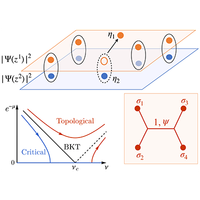
Fractional quantum Hall states are promising platforms for topological quantum computation due to their capacity to encode quantum information in topologically degenerate ground states and in the fusion space of non-Abelian anyons. We investigate how the information encoded in two paradigmatic states, the Laughlin and Moore-Read states, is affected by density decoherence—coupling of local charge density to nonthermal noise. We identify a critical filling factor , above which the quantum information remains fully recoverable for arbitrarily strong decoherence. The Laughlin state and Moore-Read state both lie within this range. Below both classes of states undergo a decoherence-induced Berezinskii-Kosterlitz-Thouless (BKT) transition into a critical decohered phase. For Laughlin states, information encoded in the topological ground state manifold degrades continuously with decoherence strength inside this critical phase, vanishing only in the limit of infinite decoherence strength. On the other hand, quantum information encoded in the fusion space of non-Abelian anyons of the Moore-Read states remains fully recoverable under arbitrarily strong decoherence even beyond the BKT transition. These results lend further support to the promise of non-Abelian FQH states as platforms for topological quantum computation. They reveal how the interplay between chiral topological order and global symmetry can give rise to novel mixed-state phases under decoherence, distinguished by their capacity for storing quantum information.
Physics Subject Headings (PhySH)
Popular Summary
How does quantum information stored in fractional quantum Hall states evolve under noise? Thermal noise is effectively suppressed by cooling below the energy gap, but decoherence from external nonequilibrium sources can still affect the sample at low temperatures. We study the effect of such decoherence, coupled to the local charge density using mappings to statistical mechanics models. In Laughlin states, we find a critical filling factor above which the quantum information stored in the topological ground state degeneracy remains stable to arbitrary strong charge decoherence. For smaller filling factors, we identify a threshold at a finite decoherence strength, above which the encoded information gradually degrades. Moore-Read states, on the other hand, can store quantum information in exotic (non-Abelian) excitations and we find that this information is resilient to arbitrary strength of charge noise regardless of filling factor. These results lay the groundwork for future error correction in quantum Hall devices.
Article Text
References (81)
- A. Kitaev, Unpaired Majorana fermions in quantum wires, Phys. Usp. 44, 131 (2001).
- A. Kitaev, Anyons in an exactly solved model and beyond, Ann. Phys. (Amsterdam) 321, 2 (2006).
- C. Nayak, S. H. Simon, A. Stern, M. Freedman, and S. Das Sarma, Non-Abelian anyons and topological quantum computation, Rev. Mod. Phys. 80, 1083 (2008).
- J. Alicea, New directions in the pursuit of Majorana fermions in solid state systems, Rep. Prog. Phys. 75, 076501 (2012).
- T. Karzig et al., Scalable designs for quasiparticle-poisoning-protected topological quantum computation with Majorana zero modes, Phys. Rev. B 95, 235305 (2017).
- K. Klocke, Y. Liu, G. B. Halász, and J. Alicea, Spin-liquid-based topological qubits, arXiv:2411.08093.
- R. E. Prange, S. M. Girvin et al., The Quantum Hall Effect (Springer US, New York, 1989).
- B. I. Halperin and J. K. Jain, Fractional Quantum Hall Effects: New Developments (World Scientific, Singapore, 2020).
- S. Das Sarma, M. Freedman, and C. Nayak, Topologically protected qubits from a possible Non-Abelian fractional quantum Hall state, Phys. Rev. Lett. 94, 166802 (2005).
- M. Freedman, C. Nayak, and K. Walker, Towards universal topological quantum computation in the fractional quantum Hall state, Phys. Rev. B 73, 245307 (2006).
- S. Bravyi, Universal quantum computation with the fractional quantum Hall state, Phys. Rev. A 73, 042313 (2006).
- A. Assouline, T. Wang, H. Zhou, L. A. Cohen, F. Yang, R. Zhang, T. Taniguchi, K. Watanabe, Roger S. K. Mong, M. P. Zaletel, and A. F. Young, Energy gap of the Even-Denominator fractional quantum Hall state in bilayer graphene, Phys. Rev. Lett. 132, 046603 (2024).
- Y. Hu, Y.-C. Tsui, M. He, U. Kamber, T. Wang, A. S. Mohammadi, K. Watanabe, T. Taniguchi, Z. Papic, M. P. Zaletel, and A. Yazdani, High-Resolution tunneling spectroscopy of fractional quantum Hall states, Nat. Phys. 21, 716 (2025).
- N. H. Lindner, E. Berg, G. Refael, and A. Stern, Fractionalizing Majorana fermions: Non-Abelian statistics on the edges of Abelian quantum Hall states, Phys. Rev. X 2, 041002 (2012).
- M. Barkeshli, Charge superconductivity and topological degeneracies without localized zero modes in bilayer fractional quantum Hall states, Phys. Rev. Lett. 117, 096803 (2016).
- R. Wen and A. C. Potter, Cheshire qudits from fractional quantum spin Hall states in twisted , arXiv preprint arXiv:2407.03401 (2024).
- R. Fan, Y. Bao, E. Altman, and A. Vishwanath, Diagnostics of mixed-state topological order and breakdown of quantum memory, PRX Quantum 5, 020343 (2024).
- Y. Bao, R. Fan, A. Vishwanath, and E. Altman, Mixed-state topological order and the errorfield double formulation of decoherence-induced transitions, Phys. Rev. Lett. 136, 220402 (2026).
- J. Y. Lee, C.-M. Jian, and C. Xu, Quantum criticality under decoherence or weak measurement, PRX Quantum 4, 030317 (2023).
- Z. Wang, Z. Wu, and Z. Wang, Intrinsic mixed-state topological order, PRX Quantum 6, 010314 (2025).
- R. Sohal and A. Prem, Noisy approach to intrinsically mixed-state topological order, PRX Quantum 6, 010313 (2025).
- T. D. Ellison and M. Cheng, Toward a classification of mixed-state topological orders in two dimensions, PRX Quantum 6, 010315 (2025).
- S. Sang, Y. Zou, and T. H. Hsieh, Mixed-state quantum phases: Renormalization and quantum error correction, Phys. Rev. X 14, 031044 (2024).
- S. Sang and T. H. Hsieh, Stability of mixed-state quantum phases via finite Markov length, Phys. Rev. Lett. 134, 070403 (2025).
- S. Sang, L. A. Lessa, R. S. Mong, T. Grover, C. Wang, and T. H. Hsieh, Mixed-state phases from local reversibility, arXiv:2507.02292 [Phys. Rev. X (to be published)].
- T.-H. Yang, B. Shi, and J. Y. Lee, Topological mixed states: Axiomatic approaches and phases of matter, arXiv:2506.04221 [Phys. Rev. X (to be published)].
- C. Zhang, Y. Xu, J.-H. Zhang, C. Xu, Z. Bi, and Z.-X. Luo, Strong-to-weak spontaneous breaking of 1-form symmetry and intrinsically mixed topological order, Phys. Rev. B 111, 115137 (2025).
- L. A. Lessa, S. Sang, T.-C. Lu, T. H. Hsieh, and C. Wang, Higher-form anomaly and long-range entanglement of mixed states, arXiv:2503.12792.
- Y.-H. Chen and T. Grover, Unconventional topological mixed-state transition and critical phase induced by self-dual coherent errors, arXiv:2403.06553.
- P. Sala, J. Alicea, and R. Verresen, Decoherence and wave-function deformation of non-Abelian topological order, Phys. Rev. X 15, 031002 (2025).
- P. Sala and R. Verresen, Stability and loop models from decohering non-Abelian topological order, Phys. Rev. Lett. 134, 250403 (2025).
- T. Yoshida, K. Kudo, H. Katsura, and Y. Hatsugai, Fate of fractional quantum Hall states in open quantum systems: Characterization of correlated topological states for the full Liouvillian, Phys. Rev. Res. 2, 033428 (2020).
- Z. Li, D. Lee, and B. Yoshida, How much entanglement is needed for topological codes and mixed states with anomalous symmetry?, Phys. Rev. X 15, 021090 (2025).
- Y. Tang and Y. Bao, Phases of Floquet code under local decoherence, Phys. Rev. A 112, 062437 (2025).
- E. Dennis, A. Kitaev, A. Landahl, and J. Preskill, Topological quantum memory, J. Math. Phys. (N.Y.) 43, 4452 (2002).
- D. Gottesman, An introduction to quantum error correction and fault-tolerant quantum computation, Proc. Symp. Appl. Math. 68, 13 (2010).
- B. M. Terhal, Quantum error correction for quantum memories, Rev. Mod. Phys. 87, 307 (2015).
- K. Fujii, Quantum computation with topological codes: From qubit to topological fault-tolerance, arXiv:1504.01444.
- B. Schumacher and M. A. Nielsen, Quantum data processing and error correction, Phys. Rev. A 54, 2629 (1996).
- B. Schumacher and M. D. Westmoreland, Approximate quantum error correction, Quantum Inf. Process. 1, 5 (2002).
It is natural to expect that the universal physics is insensitive to the precise form of the regularization. One specific and possibly physical choice is to use the lowest-Landau-Level projected density operator in Eq. (1) and the short-distance length scale is the magnetic length. We will comment on its effect at the end of the manuscript.
- R. B. Laughlin, Anomalous quantum Hall effect: An incompressible quantum fluid with fractionally charged excitations, Phys. Rev. Lett. 50, 1395 (1983).
- G. Moore and N. Read, Nonabelions in the fractional quantum Hall effect, Nucl. Phys. B360, 362 (1991).
- N. Read, Non-Abelian adiabatic statistics and hall viscosity in quantum Hall states and paired superfluids, Phys. Rev. B 79, 045308 (2009).
- P. Bonderson, V. Gurarie, and C. Nayak, Plasma analogy and non-Abelian statistics for Ising-type quantum Hall states, Phys. Rev. B 83, 075303 (2011).
- V. Berezinskii, Destruction of long-range order in one-dimensional and two-dimensional systems possessing a continuous symmetry group. II. Quantum systems, Sov. Phys. JETP 34, 610 (1972).
- J. M. Kosterlitz and D. J. Thouless, Ordering, metastability and phase transitions in two-dimensional systems, J. Phys. C 6, 1181 (1973).
- J. M. Kosterlitz, The critical properties of the two-dimensional xy model, J. Phys. C 7, 1046 (1974).
- J. V. José, L. P. Kadanoff, S. Kirkpatrick, and D. R. Nelson, Renormalization, vortices, and symmetry-breaking perturbations in the two-dimensional planar model, Phys. Rev. B 16, 1217 (1977).
- J. M. Caillol, D. Levesque, J. J. Weis, and J. P. Hansen, A Monte Carlo study of the classical two-dimensional one-component plasma, J. Stat. Phys. 28, 325 (1982).
Equation (14) implicitly depends on the short-distance cutoff . First, it holds only when the distances between these pairs are larger than . Second, we omit a prefactor that accounts for the residual relative motion of each pair. Namely, the two particles in each pair can still move relative to each other within a disk of radius . And is a nonuniversal geometric factor.
The fugacity comes from the unbinding energy as well as the entropic effect analyzed above, i.e., . We also omitted an prefactor that depends on the details of the screening due to the charge- plasma and the short-distance cutoff.
- R. Ma, J.-H. Zhang, Z. Bi, M. Cheng, and C. Wang, Topological phases with average symmetries: The decohered, the disordered, and the intrinsic, Phys. Rev. X 15, 021062 (2025).
- L. A. Lessa, R. Ma, J.-H. Zhang, Z. Bi, M. Cheng, and C. Wang, Strong-to-weak spontaneous symmetry breaking in mixed quantum states, PRX Quantum 6, 010344 (2025).
- P. Sala, S. Gopalakrishnan, M. Oshikawa, and Y. You, Spontaneous strong symmetry breaking in open systems: Purification perspective, Phys. Rev. B 110, 155150 (2024).
- A. Sarma, Y. Bao, N. Myerson-Jain, T. Kiely, and C. Xu, Effective conformal field theory generated from pure and dephased Chern insulator, Phys. Rev. B 112, 085130 (2025).
- S. M. Girvin and A. H. MacDonald, Off-diagonal long-range order, oblique confinement, and the fractional quantum Hall effect, Phys. Rev. Lett. 58, 1252 (1987).
- S. C. Zhang, T. H. Hansson, and S. Kivelson, Effective-Field-theory model for the fractional quantum Hall effect, Phys. Rev. Lett. 62, 82 (1989).
- T.-C. Lu, Z. Zhang, S. Vijay, and T. H. Hsieh, Mixed-state long-range order and criticality from measurement and feedback, PRX Quantum 4, 030318 (2023).
- Z. Liu, L. Chen, Y. Zhang, S. Zhou, and P. Zhang, Diagnosing strong-to-weak symmetry breaking via wightman correlators, arXiv:2410.09327.
- Z. Weinstein, Efficient detection of strong-to-weak spontaneous symmetry breaking via the Rényi-1 correlator, Phys. Rev. Lett. 134, 150405 (2025).
Coarse grained because the noise inevitably has a short-range cutoff .
To understand this equality, we first note . We then compute by counting electron configurations that differ from a given configuration by exactly one electron position. There are choices for which electron is moved, and the allowed area available to that electron is with a nonuniversal factor .
Any separable state across and can be written as a convex sum , where and are sets of generically nonorthogonal but normalized pure states on and . It is then easy to see that and cannot be positive.
- F. D. M. Haldane, Many-particle translational symmetries of two-dimensional electrons at rational landau-level filling, Phys. Rev. Lett. 55, 2095 (1985).
- A. Belavin, A. Polyakov, and A. Zamolodchikov, Infinite conformal symmetry in two-dimensional quantum field theory, Nucl. Phys. B241, 333 (1984).
- D. Gaiotto, A. Kapustin, N. Seiberg, and B. Willett, Generalized global symmetries, J. High Energy Phys. 02 (2015) 172.
- C.-M. Chang, Y.-H. Lin, S.-H. Shao, Y. Wang, and X. Yin, Topological defect lines and renormalization group flows in two dimensions, J. High Energy Phys. 01 (2019) 026.
Specifically, the symmetry is generated by the following line operators (78)where is a loop and is the vector potential for the background magnetic field. They are related to the worldline of charge- Laughlin quasiholes. The partition function with inserted is invariant under continuous deformation of , i.e., the line operators (78) are topological, ensuring the symmetry.
- P. H. Ginsparg, Applied conformal field theory, in Les Houches Summer School in Theoretical Physics: Fields, Strings, Critical Phenomena (1988), arXiv:hep-th/9108028.
The and symmetries have a mixed anomaly. Therefore, the coexistence of and condensates is also a coexistence of the ordered and disordered phase for each of the U(1) symmetries, which typically happen at first order transitions. The current situation is even more special as the Mermin-Wagner theorem forbids continuous symmetry breaking in usual 2D theories. Our theory, not described by a local Lagrangian, can evade this no-go constraint.
- N. Read and D. Green, Paired states of fermions in two dimensions with breaking of parity and time-reversal symmetries and the fractional quantum Hall effect, Phys. Rev. B 61, 10267 (2000).
- S. B. Chung and M. Stone, Explicit monodromy of Moore–Read wavefunctions on a torus, J. Phys. A 40, 4923 (2007).
- K. Su, Z. Yang, and C.-M. Jian, Tapestry of dualities in decohered quantum error correction codes, Phys. Rev. B 110, 085158 (2024).
- V. Temkin, Z. Weinstein, R. Fan, D. Podolsky, and E. Altman, Charge-informed quantum error correction, arXiv:2512.22119.
- P. Francesco, P. Mathieu, and D. Sénéchal, Conformal Field Theory (Springer Science & Business Media, New York, 2012).
- S. D. Mathur, Quantum Kac-Moody symmetry in integrable field theories, Nucl. Phys. B369, 433 (1992).
- R. A. Horn and C. R. Johnson, Topics in Matrix Analysis (Cambridge University Press, Cambridge, England, 1994).
- J.-R. Lee and S. Teitel, Phase transitions in classical two-dimensional lattice Coulomb gases, Phys. Rev. B 46, 3247 (1992).
- R. Tao and D. J. Thouless, Fractional quantization of Hall conductance, Phys. Rev. B 28, 1142(R) (1983).
- E. J. Bergholtz and A. Karlhede, Quantum Hall system in Tao-Thouless limit, Phys. Rev. B 77, 155308 (2008).

