

- Open Access
Theory of Out-of-Time-Ordered Transport
Phys. Rev. X 16, 041010 – Published 8 October, 2026
DOI: https://doi.org/10.1103/b5vq-s853
Abstract
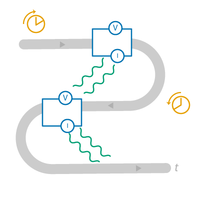
We construct an effective field theory (EFT) that captures the universal behavior of out-of-time-order correlators (OTOCs) at late times in generic quantum many-body systems with conservation laws. The EFT hinges on a generalization of the strong-to-weak spontaneous symmetry-breaking pattern adapted to out-of-time-order observables and reduces to conventional fluctuating hydrodynamics when time-ordered observables are probed. We use the EFT to explain different power-law behavior observed in OTOCs at late times and show that many OTOCs are entirely fixed by conventional transport data at leading order. Nevertheless, we show that a specific combination of OTOCs is sensitive to novel transport parameters not visible in regular time-ordered correlators. We test our predictions in Hamiltonian and Floquet spin chains in one spatial dimension.
Physics Subject Headings (PhySH)
Popular Summary
Strongly interacting quantum systems often display simple universal behavior at late times: they equilibrate, much like everyday gases or fluids. In this late-time hydrodynamic regime, the underlying quantumness gets hidden, and the system’s behavior can be described by simple equations similar to those of classical fluids.
In this work, this hidden quantumness is revealed by studying a special class of quantum observables called out-of-time-ordered correlators (OTOCs). OTOCs are widely used as probes of quantum chaos and information scrambling. We develop a theoretical framework that makes the first universal predictions for how OTOCs behave in a hydrodynamic regime. Remarkably, we find that these intrinsically quantum observables are often uniquely determined by familiar transport parameters such as the conductivity. However, one specific OTOC reveals new transport parameters that have no classical counterparts. These parameters represent a fundamental generalization of transport theory—we measure them and confirm our predictions numerically in quantum spin chains.
Article Text
References (94)
- J. M. Deutsch, Quantum statistical mechanics in a closed system, Phys. Rev. A 43, 2046 (1991).
- Mark Srednicki, Chaos and quantum thermalization, Phys. Rev. E 50, 888 (1994).
- Marcos Rigol, Vanja Dunjko, and Maxim Olshanii, Thermalization and its mechanism for generic isolated quantum systems, Nature (London) 452, 854 (2008).
- Luca D’Alessio, Yariv Kafri, Anatoli Polkovnikov, and Marcos Rigol, From quantum chaos and eigenstate thermalization to statistical mechanics and thermodynamics, Adv. Phys. 65, 239 (2016).
- Aaron J. Friedman, Amos Chan, Andrea De Luca, and J. T. Chalker, Spectral statistics and many-body quantum chaos with conserved charge, Phys. Rev. Lett. 123, 210603 (2019).
- Michael Winer and Brian Swingle, Hydrodynamic theory of the connected spectral form factor, Phys. Rev. X 12, 021009 (2022).
- Tibor Rakovszky, Frank Pollmann, and C. W. von Keyserlingk, Sub-ballistic growth of Rényi entropies due to diffusion, Phys. Rev. Lett. 122, 250602 (2019).
- Yichen Huang, Dynamics of Rényi entanglement entropy in diffusive qudit systems, IOP SciNotes 1, 035205 (2020).
- Tibor Rakovszky, Frank Pollmann, and C. W. von Keyserlingk, Diffusive hydrodynamics of out-of-time-ordered correlators with charge conservation, Phys. Rev. X 8, 031058 (2018).
- Vedika Khemani, Ashvin Vishwanath, and D. A. Huse, Operator spreading and the emergence of dissipation in unitary dynamics with conservation laws, Phys. Rev. X 8, 031057 (2018).
- P. C. Martin, E. D. Siggia, and H. A. Rose, Statistical dynamics of classical systems, Phys. Rev. A 8, 423 (1973).
- C de Dominicis, Techniques de renormalisation de la théorie des champs et dynamique des phénomenes critiques, J. Phys. (Paris), Colloq. 37, 247 (1976).
- Hans-Karl Janssen, On a lagrangean for classical field dynamics and renormalization group calculations of dynamical critical properties, Z. Phys. B 23, 377 (1976).
- Dieter Forster, David R. Nelson, and Michael J. Stephen, Large-distance and long-time properties of a randomly stirred fluid, Phys. Rev. A 16, 732 (1977).
- Sašo Grozdanov and Janos Polonyi, Viscosity and dissipative hydrodynamics from effective field theory, Phys. Rev. D 91, 105031 (2015).
- Michael Crossley, Paolo Glorioso, and Hong Liu, Effective field theory of dissipative fluids, J. High Energy Phys. 09 (2017) 095.
- Felix M. Haehl, R. Loganayagam, and Mukund Rangamani, The fluid manifesto: Emergent symmetries, hydrodynamics, and black holes, J. High Energy Phys. 01 (2016) 184.
- Kristan Jensen, Raja Marjieh, Natalia Pinzani-Fokeeva, and Amos Yarom, A panoply of Schwinger-Keldysh transport, SciPost Phys. 5, 053 (2018).
- Hong Liu and Paolo Glorioso, Lectures on non-equilibrium effective field theories and fluctuating hydrodynamics, Proc. Sci., TASI2017 (2018) 008 [arXiv:1805.09331].
- Anatoly I Larkin and Yu N Ovchinnikov, Quasiclassical method in the theory of superconductivity, Sov Phys JETP 28, 1200 (1969).
- Stephen H. Shenker and Douglas Stanford, Black holes and the butterfly effect, J. High Energy Phys. 03 (2014) 067.
- Juan Maldacena, Stephen H. Shenker, and Douglas Stanford, A bound on chaos, J. High Energy Phys. 08 (2016) 106.
- Igor L. Aleiner, Lara Faoro, and Lev B. Ioffe, Microscopic model of quantum butterfly effect: out-of-time-order correlators and traveling combustion waves, Ann. Phys. (Amsterdam) 375, 378 (2016).
- Mike Blake, Hyunseok Lee, and Hong Liu, A quantum hydrodynamical description for scrambling and many-body chaos, J. High Energy Phys. 10 (2018) 127.
- Sašo Grozdanov, Koenraad Schalm, and Vincenzo Scopelliti, Kinetic theory for classical and quantum many-body chaos, Phys. Rev. E 99, 012206 (2019).
- Mike Blake, Richard A. Davison, Sašo Grozdanov, and Hong Liu, Many-body chaos and energy dynamics in holography, J. High Energy Phys. 10 (2018) 035.
- Anna Keselman, Laimei Nie, and Erez Berg, Scrambling and Lyapunov exponent in spatially extended systems, Phys. Rev. B 103, L121111 (2021).
- Alessio Lerose and Silvia Pappalardi, Bridging entanglement dynamics and chaos in semiclassical systems, Phys. Rev. A 102, 032404 (2020).
- Changha Choi, Felix M. Haehl, Márk Mezei, and Gábor Sárosi, Effective description of sub-maximal chaos: stringy effects for SYK scrambling, J. High Energy Phys. 03 (2023) 142.
- Ping Gao and Hong Liu, An effective field theory for non-maximal quantum chaos, J. High Energy Phys. 11 (2023) 076.
- Ignacio García-Mata, Rodolfo A. Jalabert, and Diego A. Wisniacki, Out-of-time-order correlators and quantum chaos, Scholarpedia 18, 55237 (2023).
- Camille Aron, Éric Brunet, and Aditi Mitra, Kinetics of information scrambling in correlated metals: Disorder-driven transition from shock wave to fisher or kolmogorov-petrovsky-piskunov dynamics, Phys. Rev. B 108, L241106 (2023).
- Ivan Kukuljan, Sašo Grozdanov, and Tomaž Prosen, Weak quantum chaos, Phys. Rev. B 96, 060301 (2017).
- Curt von Keyserlingk, Tibor Rakovszky, Frank Pollmann, and Shivaji Sondhi, Operator hydrodynamics, OTOCs, and entanglement growth in systems without conservation laws, Phys. Rev. X 8, 021013 (2018).
- Adam Nahum, Sagar Vijay, and Jeongwan Haah, Operator spreading in random unitary circuits, Phys. Rev. X 8, 021014 (2018).
- Shenglong Xu and Brian Swingle, Scrambling dynamics and Out-of-Time-Ordered correlators in quantum many-body systems, PRX Quantum 5, 010201 (2024).
- Luca V. Delacretaz and Ruchira Mishra, Nonlinear response in diffusive systems, SciPost Phys. 16, 047 (2024).
- Paolo Glorioso, Luca V. Delacrétaz, Xiao Chen, Rahul M. Nandkishore, and Andrew Lucas, Hydrodynamics in lattice models with continuous non-Abelian symmetries, SciPost Phys. 10, 015 (2021).
- Anne Matthies, Nicolas Dannenfeld, Silvia Pappalardi, and Achim Rosch, Thermalization and hydrodynamic long-time tails in a floquet system, arXiv:2410.16182.
- Luca V. Delacretaz, A bound on thermalization from diffusive fluctuations, Nat. Phys. 21, 669 (2025).
Note that when the microscopic description is a field theory, we do not expect its OPE to apply to the OTOC (see, e.g., Ref. [42]). However, because the OTOC is a regular correlator of our Schwinger-Keldysh EFT (Sec. 3), the OPE of the EFT applies.
- Simon Caron-Huot, Holographic cameras: An eye for the bulk, J. High Energy Phys. 03 (2023) 047.
- Enke Wang and Ulrich W. Heinz, A generalized fluctuation dissipation theorem for nonlinear response functions, Phys. Rev. D 66, 025008 (2002).
- L. M. Sieberer, A. Chiocchetta, A. Gambassi, U. C. Täuber, and S. Diehl, Thermodynamic equilibrium as a symmetry of the Schwinger-Keldysh action, Phys. Rev. B 92, 134307 (2015).
- Felix M. Haehl, R. Loganayagam, Prithvi Narayan, Amin A. Nizami, and Mukund Rangamani, Thermal out-of-time-order correlators, KMS relations, and spectral functions, J. High Energy Phys. 12 (2017) 154.
- Berislav Buca and Tomaz Prosen, A note on symmetry reductions of the lindblad equation: Transport in constrained open spin chains, New J. Phys. 14, 073007 (2012).
- Olumakinde Ogunnaike, Johannes Feldmeier, and Jong Yeon Lee, Unifying emergent hydrodynamics and Lindbladian low-energy spectra across symmetries, constraints, and Long-Range interactions, Phys. Rev. Lett. 131, 220403 (2023).
- Can Onur Akyuz, Garrett Goon, and Riccardo Penco, The Schwinger-Keldysh coset construction, J. High Energy Phys. 06 (2024) 004.
- Sanjay Moudgalya and Olexei I. Motrunich, Symmetries as ground states of local superoperators: Hydrodynamic implications, PRX Quantum 5, 040330 (2024).
- Ding Gu, Zijian Wang, and Zhong Wang, Spontaneous symmetry breaking in open quantum systems: strong, weak, and strong-to-weak, Phys. Rev. B 112, 245123 (2025).
- Xiaoyang Huang, Marvin Qi, Jian-Hao Zhang, and Andrew Lucas, Hydrodynamics as the effective field theory of strong-to-weak spontaneous symmetry breaking, Phys. Rev. B 111, 125147 (2025).
- Eren Firat, Andrew Gomes, Filippo Nardi, Riccardo Penco, and Riccardo Rattazzi, Schwinger-Keldysh effective theory of charge transport: redundancies and systematic expansion, J. High Energy Phys. 05 (2026) 079.
- Leonardo A. Lessa, Ruochen Ma, Jian-Hao Zhang, Zhen Bi, Meng Cheng, and Chong Wang, Strong-to-weak spontaneous symmetry breaking in mixed quantum states, PRX Quantum 6, 010344 (2025).
- Carolyn Zhang, Yichen Xu, Jian-Hao Zhang, Cenke Xu, Zhen Bi, and Zhu-Xi Luo, Strong-to-weak spontaneous breaking of 1-form symmetry and intrinsically mixed topological order, Phys. Rev. B 111, 115137 (2025).
- Shu-Tong Zhou, Meng Cheng, Tibor Rakovszky, Curt von Keyserlingk, and Tyler D. Ellison, Finite-temperature quantum topological order in three dimensions, Phys. Rev. Lett. 135, 040402 (2025).
- Soumyadeep Chaudhuri and R. Loganayagam, Probing out-of-time-order correlators, J. High Energy Phys. 07 (2019) 006.
- Paolo Glorioso and Hong Liu, The second law of thermodynamics from symmetry and unitarity, arXiv:1612.07705.
- Simon Caron-Huot and Guy D. Moore, Heavy quark diffusion in QCD and SYM at next-to-leading order, J. High Energy Phys. 02 (2008) 081.
- Ping Gao, Paolo Glorioso, and Hong Liu, Ghostbusters: Unitarity and causality of Non-equilibrium effective field theories, J. High Energy Phys. 03 (2020) 040.
- Alexios A. Michailidis, Dmitry A. Abanin, and Luca V. Delacrétaz, Corrections to diffusion in interacting quantum systems, Phys. Rev. X 14, 031020 (2024).
- Anne Matthies, Nicolas Dannenfeld, Silvia Pappalardi, and Achim Rosch, Thermalization and hydrodynamic long-time tails in a floquet system, Phys. Rev. B 113, 024305 (2026).
- Christian Bartsch and Jochen Gemmer, Dynamical typicality of quantum expectation values, Phys. Rev. Lett. 102, 110403 (2009).
- Tjark Heitmann, Jonas Richter, Dennis Schubert, and Robin Steinigeweg, Selected applications of typicality to real-time dynamics of quantum many-body systems, Z. Naturforsch. A 75, 421 (2020).
- Robin Steinigeweg, Jochen Gemmer, and Wolfram Brenig, Spin-current autocorrelations from single pure-state propagation, Phys. Rev. Lett. 112, 120601 (2014).
- R. Steinigeweg, F. Jin, D. Schmidtke, H. De Raedt, K. Michielsen, and J. Gemmer, Real-time broadening of nonequilibrium density profiles and the role of the specific initial-state realization, Phys. Rev. B 95, 035155 (2017).
- Tjark Heitmann, Jonas Richter, Jacek Herbrych, Jochen Gemmer, and Robin Steinigeweg, Real-time broadening of bath-induced density profiles from closed-system correlation functions, Phys. Rev. E 108, 024102 (2023).
- Robin Steinigeweg, Jochen Gemmer, and Wolfram Brenig, Spin and energy currents in integrable and nonintegrable spin- chains: A typicality approach to real-time autocorrelations, Phys. Rev. B 91, 104404 (2015).
- R. Steinigeweg, F. Jin, D. Schmidtke, H. De Raedt, K. Michielsen, and J. Gemmer, Real-time broadening of nonequilibrium density profiles and the role of the specific initial-state realization, Phys. Rev. B 95, 035155 (2017).
- Luis Colmenarez and David J. Luitz, Lieb-robinson bounds and out-of-time order correlators in a long-range spin chain, Phys. Rev. Res. 2, 043047 (2020).
- David J. Luitz and Yevgeny Bar Lev, Information propagation in isolated quantum systems, Phys. Rev. B 96, 020406 (2017).
- Martin Gärttner, Justin G. Bohnet, Arghavan Safavi-Naini, Michael L. Wall, John J. Bollinger, and Ana Maria Rey, Measuring out-of-time-order correlations and multiple quantum spectra in a trapped ion quantum magnet, Nat. Phys. 13, 781 (2017).
- Kevin A. Landsman, Caroline Figgatt, Thomas Schuster, Norbert M. Linke, Beni Yoshida, Norman Y. Yao, and Christopher Monroe, Verified quantum information scrambling, Nature (London) 567, 61 (2019).
- Manoj K. Joshi, Andreas Elben, Benô𝚤t Vermersch, Tiff Brydges, Christine Maier, Peter Zoller, Rainer Blatt, and Christian F. Roos, Quantum information scrambling in a trapped-ion quantum simulator with tunable range interactions, Phys. Rev. Lett. 124, 240505 (2020).
- Jun Li, Ruihua Fan, Hengyan Wang, Bingtian Ye, Bei Zeng, Hui Zhai, Xinhua Peng, and Jiangfeng Du, Measuring out-of-time-order correlators on a nuclear magnetic resonance quantum simulator, Phys. Rev. X 7, 031011 (2017).
- C. Zhang et al., Quantum computation of molecular geometry via many-body nuclear spin echoes (2025).
- Jochen Braumüller et al., Probing quantum information propagation with out-of-time-ordered correlators, Nat. Phys. 18, 172 (2022).
- Dmitry A. Abanin et al., Observation of constructive interference at the edge of quantum ergodicity, Nature (London) 646, 825 (2025).
- Lakshya Agarwal, Subhayan Sahu, and Shenglong Xu, Charge transport, information scrambling and quantum operator-coherence in a many-body system with U(1) symmetry, J. High Energy Phys. 05 (2023) 037.
- J. Alexander Jacoby, David A. Huse, and Sarang Gopalakrishnan, Spectral gaps of local quantum channels in the weak-dissipation limit, Phys. Rev. B 111, 104303 (2025).
- Sašo Grozdanov, Koenraad Schalm, and Vincenzo Scopelliti, Black hole scrambling from hydrodynamics, Phys. Rev. Lett. 120, 231601 (2018).
- Changha Choi, Márk Mezei, and Gábor Sárosi, Pole skipping away from maximal chaos, J. High Energy Phys. 02 (2021) 207.
- Curtis T. Asplund, Sebastian Fischetti, Alexandra Miller, and David M. Ramirez, Quantum chaos and pole skipping in two-dimensional conformal perturbation theory, arXiv:2509.18540.
- Avijit Das, Saurish Chakrabarty, Abhishek Dhar, Anupam Kundu, David A. Huse, Roderich Moessner, Samriddhi Sankar Ray, and Subhro Bhattacharjee, Light-cone spreading of perturbations and the butterfly effect in a classical spin chain, Phys. Rev. Lett. 121, 024101 (2018).
- Thomas Bilitewski, Subhro Bhattacharjee, and Roderich Moessner, Classical many-body chaos with and without quasiparticles, Phys. Rev. B 103, 174302 (2021).
- Manoj Kumar, Anupam Kundu, Manas Kulkarni, David A. Huse, and Abhishek Dhar, Transport, correlations, and chaos in a classical disordered anharmonic chain, Phys. Rev. E 102, 022130 (2020).
- Sarang Gopalakrishnan and Bahti Zakirov, Facilitated quantum cellular automata as simple models with non-thermal eigenstates and dynamics, Quantum Sci. Technol. 3, 044004 (2018).
- Philippe Suchsland, Benoît Douçot, Vedika Khemani, and Roderich Moessner, Dynamical correlations and domain wall relocalization in transverse field Ising chains, Phys. Rev. B 112, 014311 (2025).
- Sarang Gopalakrishnan, Ewan McCulloch, and Romain Vasseur, Monitored fluctuating hydrodynamics, Phys. Rev. X 16, 011024 (2026).
- Ruchira Mishra, Jiaozi Wang, Silvia Pappalardi, and Luca Delacretaz, Dataset for Theory of Out-of-Time-Ordered Transport (2026).
- B. J. Alder and T. E. Wainwright, Decay of the velocity autocorrelation function, Phys. Rev. A 1, 18 (1970).
- M. H. Ernst, E. H. Hauge, and J. M. J. van Leeuwen, Asymptotic time behavior of correlation functions, Phys. Rev. Lett. 25, 1254 (1970).
One exception is in “super-Planckian” theories of hydrodynamics, where the EFT cutoff is parametrically larger than the temperature . In this situation, the modern approach allows us to impose KMS exactly with specific nonlocal terms in the action. However, generic quantum many-body systems are expected to satisfy [40].
- Xinyi Chen-Lin, Luca V. Delacrétaz, and Sean A. Hartnoll, Theory of diffusive fluctuations, Phys. Rev. Lett. 122, 091602 (2019).
- Akash Jain and Pavel Kovtun, Late time correlations in hydrodynamics: Beyond constitutive relations, Phys. Rev. Lett. 128, 071601 (2022).

