

- Open Access
Observation of Unprecedented Fractional Magnetization Plateaus in a New Shastry-Sutherland Ising Compound
Phys. Rev. X 15, 041045 – Published 8 December, 2025
DOI: https://doi.org/10.1103/9ynf-xx1t
Abstract
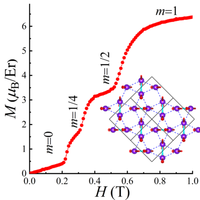
Geometrically frustrated magnetic systems, such as those based on the Shastry-Sutherland lattice (SSL), offer a rich playground for exploring unconventional magnetic states. The delicate balance between competing interactions in these systems leads to the emergence of novel phases. We present the characterization of , an SSL compound with ions forming orthogonal dimers separated by nonmagnetic layers whose structure is invariant under the space group. Neutron scattering reveals an antiferromagnetic dimer structure at zero field, typical of Ising spins on that lattice and consistent with the anisotropic magnetization observed. However, magnetization measurements exhibit fractional plateaus at and of saturation, in contrast to the expected plateau of the SSL Ising model. By comparing the energy of candidate states with ground-state lower bounds we show that this behavior requires spatially anisotropic interactions, leading to an anisotropic Shastry-Sutherland Ising model symmetric under the space group. This anisotropy is consistent with the small orthorhombic distortion observed with single-crystal neutron diffraction. The other properties, including thermodynamics, which have been investigated theoretically using tensor networks, point to small residual interactions, potentially due to further couplings and quantum fluctuations. This study highlights as a promising platform for investigating exotic magnetic phenomena.
Physics Subject Headings (PhySH)
Popular Summary
In geometrically frustrated magnets, competing interactions among atomic spins prevent all spins from aligning, often producing exotic patterns of order. One well-known model system, the Shastry-Sutherland lattice, has long been predicted to show a fractional magnetization plateau at one-third of the saturation magnetization—where magnetization rises in a discrete jump instead of smoothly as the magnetic field increases. The compound closely matches the ideal Ising version of this system, a version where spins can point only up or down. In this study, we discover that this compound displays not one but two distinct plateaus at one-quarter and one-half of the saturation magnetization, contradicting long-standing theoretical expectations.
To understand this surprising behavior, we grow and measure single crystals of . Magnetization measurements show that the spins prefer to align along a single crystallographic axis, confirming its Ising-like character. When we apply a magnetic field along that axis at low temperatures, the magnetization increases in two sharp steps corresponding to the one-quarter and one-half plateaus. Using neutron scattering and structural studies, we detect a subtle lattice distortion that alters the relative strengths of certain atomic bonds, introducing anisotropy into the Shastry-Sutherland lattice. By incorporating this anisotropy into theoretical models, we reproduce both plateaus and explain the absence of the predicted one-third plateau.
Our results demonstrate that even small structural distortions can dramatically reshape the magnetic behavior of frustrated systems. The clean emergence of two ordered plateau states without residual disorder points to additional stabilizing influences, such as longer-range interactions or quantum effects. therefore provides a valuable platform for exploring how small changes in geometry control the collective behavior of frustrated magnets.
Article Text
References (46)
- L. Balents, Spin liquids in frustrated magnets, Nature (London) 464, 199 (2010).
- J. Knolle and R. Moessner, A field guide to spin liquids, Annu. Rev. Condens. Matter Phys. 10, 451 (2019).
- M. Takigawa and F. Mila, Magnetization plateaus, in Introduction to Frustrated Magnetism: Materials, Experiments, Theory, edited by C. Lacroix, P. Mendels, and F. Mila (Springer, Berlin, Heidelberg, 2011), p. 241.
- H. Kageyama, K. Onizuka, T. Yamauchi, Y. Ueda, S. Hane, H. Mitamura, T. Goto, K. Yoshimura, and K. Kosuge, Anomalous magnetizations in single crystalline , J. Phys. Soc. Jpn. 68, 1821 (1999).
- K. Onizuka, H. Kageyama, Y. Narumi, K. Kindo, Y. Ueda, and T. Goto, magnetization plateau in —stripe order of excited triplets, J. Phys. Soc. Jpn. 69, 1016 (2000).
- K. Kodama, M. Takigawa, M. Horvatić, C. Berthier, H. Kageyama, Y. Ueda, S. Miyahara, F. Becca, and F. Mila, Magnetic superstructure in the two-dimensional quantum antiferromagnet , Science 298, 395 (2002).
- M. Jaime, R. Daou, S. A. Crooker, F. Weickert, A. Uchida, A. E. Feiguin, C. D. Batista, H. A. Dabkowska, and B. D. Gaulin, Magnetostriction and magnetic texture to 100.75 tesla in frustrated , Proc. Natl. Acad. Sci. U.S.A. 109, 12404 (2012).
- M. Takigawa, M. Horvatić, T. Waki, S. Krämer, C. Berthier, F. Lévy-Bertrand, I. Sheikin, H. Kageyama, Y. Ueda, and F. Mila, Incomplete devil’s staircase in the magnetization curve of , Phys. Rev. Lett. 110, 067210 (2013).
- Y. H. Matsuda, N. Abe, S. Takeyama, H. Kageyama, P. Corboz, A. Honecker, S. R. Manmana, G. R. Foltin, K. P. Schmidt, and F. Mila, Magnetization of in ultrahigh magnetic fields up to 118 T, Phys. Rev. Lett. 111, 137204 (2013).
- P. Corboz and F. Mila, Crystals of bound states in the magnetization plateaus of the Shastry-Sutherland model, Phys. Rev. Lett. 112, 147203 (2014).
- B. Sriram Shastry and B. Sutherland, Exact ground state of a quantum mechanical antiferromagnet, Physica (Amsterdam) 108B+C, 1069 (1981).
- Z. Y. Meng and S. Wessel, Phases and magnetization process of an anisotropic Shastry-Sutherland model, Phys. Rev. B 78, 224416 (2008).
- Yu. I. Dublenych, Ground states of the Ising model on the Shastry-Sutherland lattice and the origin of the fractional magnetization plateaus in rare-earth-metal tetraborides, Phys. Rev. Lett. 109, 167202 (2012).
- D. Brunt, G. Balakrishnan, D. A. Mayoh, M. R. Lees, D. Gorbunov, N. Qureshi, and O. A. Petrenko, Magnetisation process in the rare earth tetraborides, and , Sci. Rep. 8, 232 (2018).
- T. Suzuki, Y. Tomita, N. Kawashima, and P. Sengupta, Finite-temperature phase transition to the /2 plateau phase in the spin-1/2 XXZ model on the Shastry-Sutherland lattices, Phys. Rev. B 82, 214404 (2010).
- M. Orendáč, S. Gabáni, P. Farkašovský, E. Gažo, J. Kačmarčík, M. Marcin, G. Pristáš, K. Siemensmeyer, N. Shitsevalova, and K. Flachbart, Ground state and stability of the fractional plateau phase in metallic Shastry–Sutherland system , Sci. Rep. 11, 6835 (2021).
- Y. Ishii, G. Sala, M. B. Stone, V. O. Garlea, S. Calder, J. Chen, H. K. Yoshida, S. Fukuoka, J. Yan, C. Dela Cruz, M. H. Du, D. S. Parker, H. Zhang, C. D. Batista, K. Yamaura, and A. D. Christianson, Magnetic properties of the Shastry-Sutherland lattice material , Phys. Rev. Mater. 5, 064418 (2021).
- M. Marshall, B. R. Billingsley, X. Bai, Q. Ma, T. Kong, and H. Cao, Field-induced partial disorder in a Shastry-Sutherland lattice, Nat. Commun. 14, 1 (2023).
- M. Ashtar, Y. Bai, L. Xu, Z. Wan, Z. Wei, Y. Liu, M. A. Marwat, and Z. Tian, Structure and magnetic properties of melilite- type compounds (, Nd, Gd-Yb) with rare-earth ions on Shastry–Sutherland lattice, Inorg. Chem. 60, 3626 (2021).
- A. Liu, F. Song, Y. Cao, H. Ge, H. Bu, J. Zhou, Y. Qin, Q. Zeng, J. Li, L. Ling, W. Tong, J. Sheng, M. Yang, L. Wu, H. Guo, and Z. Tian, Distinct magnetic ground states in Shastry-Sutherland lattice materials: versus , Phys. Rev. B 109, 184413 (2024).
- M. Pula, S. Sharma, J. Gautreau, S. K. P., A. Kanigel, M. D. Frontzek, T. N. Dolling, L. Clark, S. Dunsiger, A. Ghara, and G. M. Luke, Candidate for a quantum spin liquid ground state in the Shastry-Sutherland lattice material , Phys. Rev. B 110, 014412 (2024).
- J. Perez-Mato, S. Gallego, E. Tasci, L. Elcoro, G. de la Flor, and M. Aroyo, Symmetry-based computational tools for magnetic crystallography, Annu. Rev. Mater. Res. 45, 217 (2015).
- C. Liu, G. Duan, and R. Yu, Theory of rare-earth Kramers magnets on a Shastry-Sutherland lattice: Dimer phases in presence of strong spin-orbit coupling, arXiv:2412.00757.
- A. M. Mulders, A. Yaouanc, P. Dalmas de Réotier, P. C. M. Gubbens, A. A. Moolenaar, B. Fåk, E. Ressouche, K. Prokeš, A. A. Menovsky, and K. H. J. Buschow, : A giant anisotropic induced magnet with a singlet crystal-field ground state, Phys. Rev. B 56, 8752 (1997).
- I. A. Zaliznyak, A. T. Savici, V. Ovidiu Garlea, B. Winn, U. Filges, J. Schneeloch, J. M. Tranquada, G. Gu, A. Wang, and C. Petrovic, Polarized neutron scattering on HYSPEC: The hybrid spectrometer at SNS, J. Phys. Conf. Ser. 862, 012030 (2017).
- J. A. Koziol, A. Duft, G. Morigi, and K. P. Schmidt, Systematic analysis of crystalline phases in bosonic lattice models with algebraically decaying density-density interactions, SciPost Phys. 14, 136 (2023).
- J. A. Koziol, G. Morigi, and K. P. Schmidt, Quantum phases of hardcore bosons with repulsive dipolar density-density interactions on two-dimensional lattices, SciPost Phys. 17, 111 (2024).
- T. Graim and D. P. Landau, Monte Carlo study of three-dimensional—to—one-dimensional crossover in the Ising model, Phys. Rev. B 24, 5156 (1981).
- J. L. Jiménez, S. P. G. Crone, E. Fogh, M. E. Zayed, R. Lortz, E. Pomjakushina, K. Conder, A. M. Läuchli, L. Weber, S. Wessel, A. Honecker, B. Normand, C. R. P. Corboz, H. M. Rønnow, and F. Mila, A quantum magnetic analogue to the critical point of water, Nature (London) 592, 370 (2021).
- V. O. Garlea, B. C. Chakoumakos, S. A. Moore, G. B. Taylor, T. Chae, R. G. Maples, R. A. Riedel, G. W. Lynn, and D. L. Selby, The high-resolution powder diffractometer at the high flux isotope reactor, Appl. Phys. A 99, 531 (2010).
- I. A. Zaliznyak, A. T. Savici, V. O. Garlea, B. Winn, U. Filges, J. Schneeloch, J. M. Tranquada, G. Gu, A. Wang, and C. Petrovic, Polarized neutron scattering on HYSPEC: The HYbrid SPECtrometer at SNS, J. Phys. Conf. Ser. 862, 012030 (2017).
- G. E. Granroth, A. I. Kolesnikov, T. E. Sherline, J. P. Clancy, K. A. Ross, J. P. C. Ruff, B. D. Gaulin, and S. E. Nagler, SEQUOIA: A newly operating chopper spectrometer at the SNS, J. Phys. Conf. Ser. 251, 012058 (2010).
- R. T. Azuah, L. R. Kneller, Y. Qiu, P. L. Tregenna-Piggott, C. M. Brown, J. R. Copley, and R. M. Dimeo, DAVE: A comprehensive software suite for the reduction, visualization, and analysis of low energy neutron spectroscopic data, J. Res. Natl. Inst. Stand. Technol. 114, 341 (2009).
- A. Scheie, pycrystalfield: Software for calculation, analysis and fitting of crystal electric field Hamiltonians, J. Appl. Crystallogr. 54, 356 (2021).
- M. T. Hutchings, Point-charge calculations of energy levels of magnetic ions in crystalline electric fields, Solid State Phys. 16, 227 (1964).
- K. W. H. Stevens, Matrix elements and operator equivalents connected with the magnetic properties of rare earth ions, Proc. Phys. Soc. London Sect. A 65, 209 (1952).
- J. G. Rau and M. J. P. Gingras, Frustrated quantum rare-earth pyrochlores, Annu. Rev. Condens. Matter Phys. 10, 357 (2019).
- J. G. Rau and M. J. P. Gingras, Magnitude of quantum effects in classical spin ices, Phys. Rev. B 92, 144417 (2015).
- A. Messiah, Representation of irreducible tensor operators: Wigner-Eckart theorem, in Quantum Mechanics (Elsevier, New York, 1961), pp. 573–575.
- S. Rosenkranz, A. P. Ramirez, A. Hayashi, R. J. Cava, R. Siddharthan, and B. S. Shastry, Crystal-field interaction in the pyrochlore magnet , J. Appl. Phys. 87, 5914 (2000).
- B. Vanhecke, J. Colbois, L. Vanderstraeten, F. Verstraete, and F. Mila, Solving frustrated Ising models using tensor networks, Phys. Rev. Res. 3, 013041 (2021).
- W. Huang, D. A. Kitchaev, S. T. Dacek, Z. Rong, A. Urban, S. Cao, C. Luo, and G. Ceder, Finding and proving the exact ground state of a generalized ising model by convex optimization and MAX-SAT, Phys. Rev. B 94, 134424 (2016).
- J. Dorier, K. P. Schmidt, and F. Mila, Theory of magnetization plateaux in the Shastry-Sutherland model, Phys. Rev. Lett. 101, 250402 (2008).
- A. A. Buchheit, J. Busse, and R. Gutendorf, Computation and properties of the Epstein zeta function with high-performance implementation in EpsteinLib, arXiv:2412.16317.
- T. Nishino and K. Okunishi, Corner transfer matrix renormalization group method, J. Phys. Soc. Jpn. 65, 891 (1996).
- R. Orús and G. Vidal, Simulation of two-dimensional quantum systems on an infinite lattice revisited: Corner transfer matrix for tensor contraction, Phys. Rev. B 80, 094403 (2009).

