

- Open Access
Nanoscale Defects as Probes of Time-Reversal Symmetry Breaking
Phys. Rev. X 16, 011001 – Published 2 January, 2026
DOI: https://doi.org/10.1103/9h4l-21mt
Abstract
Nanoscale defects such as nitrogen-vacancy (NV) centers can serve as sensitive and noninvasive probes of electromagnetic fields and fluctuations from materials, which in turn can be used to characterize these systems. Here we specifically discuss how NV centers can probe time-reversal symmetry breaking (TRSB) phenomena in low-dimensional electronic systems. We argue that the difference in relaxation rates of NV centers starting from spin states to the ground state with directly probes TRSB. The effect arises from the difference in the fluctuation spectrum of left- and right-polarized electromagnetic fields emanating from such materials. In the quantum Hall setting, the NV center experiences (nearly zero) large additional contribution to its relaxation due to the presence of the material when its magnetic dipole (anti)aligns with the external field. More generally, the difference in the relaxation rates is sensitive to the imaginary part of the wave-vector-dependent Hall conductivity. We argue that this can be used to determine the Hall viscosity, which can potentially distinguish candidate fractional quantum Hall states and be used to infer the pairing angular momentum in TRSB superconductors. We compute the average relaxation rate near thin film superconductors and find that it exhibits a Hebel-Slichter-like enhancement below . The difference also inherits this peak but is only nonzero for and only if the superconductivity is chiral. We provide concrete estimates for observing this effect in stacked twisted bismuth strontium calcium copper oxide flakes.
Physics Subject Headings (PhySH)
Popular Summary
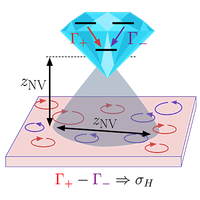
Determining when a material breaks time-reversal symmetry—a property that distinguishes between the forward and backward flow of time—is especially challenging in low-dimensional systems. Conventional experimental methods often disturb the material or fail to detect such effects on very small scales. We introduce a noninvasive way to probe time-reversal symmetry breaking using nanoscale defects called nitrogen-vacancy (NV) centers in diamond. When placed near a material that breaks time-reversal symmetry, these atomic-scale sensors respond differently to left- and right-circularly polarized magnetic fields, allowing us to detect this subtle property through precise spin-relaxation measurements.
To establish this approach, we calculate how the spin-relaxation rate of an NV center depends on magnetic field fluctuations above a material’s surface. When the NV center’s magnetic dipole is oriented perpendicular to the surface, the relaxation rates for its two spin states differ only if the material itself breaks time-reversal symmetry. Subtracting these rates isolates a signal that directly reflects the asymmetric electromagnetic behavior of the material. In particular, this differential signal reveals information about a key property known as the Hall conductivity, which characterizes how electric currents deflect sideways under a magnetic field.
This method provides a window into the local electromagnetic behavior of 2D materials that break time-reversal symmetry. It offers a route to measure elusive quantities such as the Hall viscosity—a special, nondissipative type of viscosity that arises in quantum Hall fluids and chiral superconductors. With further development, this NV-based technique could distinguish between competing fractional quantum Hall states and reveal the internal angular momentum of exotic superconducting phases.
Article Text
References (70)
- J. R. Maze, P. L. Stanwix, J. S. Hodges, S. Hong, J. M. Taylor, P. Cappellaro, L. Jiang, M. G. Dutt, E. Togan, A. Zibrov et al., Nanoscale magnetic sensing with an individual electronic spin in diamond, Nature (London) 455, 644 (2008).
- J. Rovny, S. Gopalakrishnan, A. C. B. Jayich, P. Maletinsky, E. Demler, and N. P. de Leon, New opportunities in condensed matter physics for nanoscale quantum sensors, arXiv:2403.13710.
- E. Marchiori, L. Ceccarelli, N. Rossi, L. Lorenzelli, C. L. Degen, and M. Poggio, Nanoscale magnetic field imaging for 2D materials, Nat. Rev. Phys. 4, 49 (2022).
- M. Abobeih, J. Randall, C. Bradley, H. Bartling, M. Bakker, M. Degen, M. Markham, D. Twitchen, and T. Taminiau, Atomic-scale imaging of a 27-nuclear-spin cluster using a quantum sensor, Nature (London) 576, 411 (2019).
- R. Hanson, O. Gywat, and D. D. Awschalom, Room-temperature manipulation and decoherence of a single spin in diamond, Phys. Rev. B 74, 161203(R) (2006).
- S. Kolkowitz, A. Safira, A. High, R. Devlin, S. Choi, Q. Unterreithmeier, D. Patterson, A. Zibrov, V. Manucharyan, H. Park et al., Probing Johnson noise and ballistic transport in normal metals with a single-spin qubit, Science 347, 1129 (2015).
- K. Agarwal, R. Schmidt, B. Halperin, V. Oganesyan, G. Zaránd, M. D. Lukin, and E. Demler, Magnetic noise spectroscopy as a probe of local electronic correlations in two-dimensional systems, Phys. Rev. B 95, 155107 (2017).
- A. Ariyaratne, D. Bluvstein, B. A. Myers, and A. C. B. Jayich, Nanoscale electrical conductivity imaging using a nitrogen-vacancy center in diamond, Nat. Commun. 9, 2406 (2018).
- C. P. Slichter, Principles of Magnetic Resonance (Springer Science & Business Media, New York, 2013), Vol. 1.
- P. Appel, B. J. Shields, T. Kosub, N. Hedrich, R. Hübner, J. Faßbender, D. Makarov, and P. Maletinsky, Nanomagnetism of magnetoelectric granular thin-film antiferromagnets, Nano Lett. 19, 1682 (2019).
- A. Finco, A. Haykal, R. Tanos, F. Fabre, S. Chouaieb, W. Akhtar, I. Robert-Philip, W. Legrand, F. Ajejas, K. Bouzehouane et al., Imaging non-collinear antiferromagnetic textures via single spin relaxometry, Nat. Commun. 12, 767 (2021).
- A. Haykal, J. Fischer, W. Akhtar, J.-Y. Chauleau, D. Sando, A. Finco, F. Godel, Y. Birkhölzer, C. Carrétéro, N. Jaouen et al., Antiferromagnetic textures in controlled by strain and electric field, Nat. Commun. 11, 1704 (2020).
- E. Lee-Wong, R. Xue, F. Ye, A. Kreisel, T. van Der Sar, A. Yacoby, and C. R. Du, Nanoscale detection of magnon excitations with variable wavevectors through a quantum spin sensor, Nano Lett. 20, 3284 (2020).
- B. G. Simon, S. Kurdi, J. J. Carmiggelt, M. Borst, A. J. Katan, and T. Van Der Sar, Filtering and imaging of frequency-degenerate spin waves using nanopositioning of a single-spin sensor, Nano Lett. 22, 9198 (2022).
- U. Vool, A. Hamo, G. Varnavides, Y. Wang, T. X. Zhou, N. Kumar, Y. Dovzhenko, Z. Qiu, C. A. Garcia, A. T. Pierce et al., Imaging phonon-mediated hydrodynamic flow in , Nat. Phys. 17, 1216 (2021).
- A. Jenkins, S. Baumann, H. Zhou, S. A. Meynell, Y. Daipeng, K. Watanabe, T. Taniguchi, A. Lucas, A. F. Young, and A. C. Bleszynski Jayich, Imaging the breakdown of Ohmic transport in graphene, Phys. Rev. Lett. 129, 087701 (2022).
- R. Monge, T. Delord, N. V. Proscia, Z. Shotan, H. Jayakumar, J. Henshaw, P. R. Zangara, A. Lozovoi, D. Pagliero, P. D. Esquinazi et al., Spin dynamics of a solid-state qubit in proximity to a superconductor, Nano Lett. 23, 422 (2023).
- L. Thiel, D. Rohner, M. Ganzhorn, P. Appel, E. Neu, B. Müller, R. Kleiner, D. Koelle, and P. Maletinsky, Quantitative nanoscale vortex imaging using a cryogenic quantum magnetometer, Nat. Nanotechnol. 11, 677 (2016).
- Y. Schlussel, T. Lenz, D. Rohner, Y. Bar-Haim, L. Bougas, D. Groswasser, M. Kieschnick, E. Rozenberg, L. Thiel, A. Waxman et al., Wide-field imaging of superconductor vortices with electron spins in diamond, Phys. Rev. Appl. 10, 034032 (2018).
- M. Pelliccione, A. Jenkins, P. Ovartchaiyapong, C. Reetz, E. Emmanouilidou, N. Ni, and A. C. Bleszynski Jayich, Scanned probe imaging of nanoscale magnetism at cryogenic temperatures with a single-spin quantum sensor, Nat. Nanotechnol. 11, 700 (2016).
- T. I. Andersen, B. L. Dwyer, J. D. Sanchez-Yamagishi, J. F. Rodriguez-Nieva, K. Agarwal, K. Watanabe, T. Taniguchi, E. A. Demler, P. Kim, H. Park et al., Electron-phonon instability in graphene revealed by global and local noise probes, Science 364, 154 (2019).
- G. Balasubramanian, P. Neumann, D. Twitchen, M. Markham, R. Kolesov, N. Mizuochi, J. Isoya, J. Achard, J. Beck, J. Tissler et al., Ultralong spin coherence time in isotopically engineered diamond, Nat. Mater. 8, 383 (2009).
- M. H. Abobeih, J. Cramer, M. A. Bakker, N. Kalb, M. Markham, D. J. Twitchen, and T. H. Taminiau, One-second coherence for a single electron spin coupled to a multi-qubit nuclear-spin environment, Nat. Commun. 9, 2552 (2018).
- N. H. Wan, B. J. Shields, D. Kim, S. Mouradian, B. Lienhard, M. Walsh, H. Bakhru, T. Schröder, and D. Englund, Efficient extraction of light from a nitrogen-vacancy center in a diamond parabolic reflector, Nano Lett. 18, 2787 (2018).
- N. Hedrich, D. Rohner, M. Batzer, P. Maletinsky, and B. J. Shields, Parabolic diamond scanning probes for single-spin magnetic field imaging, Phys. Rev. Appl. 14, 064007 (2020).
- I. Aharonovich, J. C. Lee, A. Magyar, B. B. Buckley, C. G. Yale, D. D. Awschalom, and E. Hu, Homoepitaxial growth of single crystal diamond membranes for quantum information processing, Adv. Mater. 24, OP54 (2012).
- X. Guo, N. Delegan, J. C. Karsch, Z. Li, T. Liu, R. Shreiner, A. Butcher, D. D. Awschalom, F. J. Heremans, and A. A. High, Tunable and transferable diamond membranes for integrated quantum technologies, Nano Lett. 21, 10392 (2021).
- B. Khanaliloo, M. Mitchell, A. C. Hryciw, and P. E. Barclay, High-Q/V monolithic diamond microdisks fabricated with quasi-isotropic etching, Nano Lett. 15, 5131 (2015).
- M. Challier, S. Sonusen, A. Barfuss, D. Rohner, D. Riedel, J. Koelbl, M. Ganzhorn, P. Appel, P. Maletinsky, and E. Neu, Advanced fabrication of single-crystal diamond membranes for quantum technologies, Micromachines 9, 148 (2018).
- J. A. Zuber, M. Li, M. l. Grimau Puigibert, J. Happacher, P. Reiser, B. J. Shields, and P. Maletinsky, Shallow silicon vacancy centers with lifetime-limited optical linewidths in diamond nanostructures, Nano Lett. 23, 10901 (2023).
- P. Stevenson, C. M. Phenicie, I. Gray, S. P. Horvath, S. Welinski, A. M. Ferrenti, A. Ferrier, P. Goldner, S. Das, R. Ramesh, R. J. Cava, N. P. de Leon, and J. D. Thompson, Erbium-implanted materials for quantum communication applications, Phys. Rev. B 105, 224106 (2022).
- G. Wolfowicz, F. J. Heremans, C. P. Anderson, S. Kanai, H. Seo, A. Gali, G. Galli, and D. D. Awschalom, Quantum guidelines for solid-state spin defects, Nat. Rev. Mater. 6, 906 (2021).
- P. E. Dolgirev, I. Esterlis, A. A. Zibrov, M. D. Lukin, T. Giamarchi, and E. Demler, Local noise spectroscopy of Wigner crystals in two-dimensional materials, Phys. Rev. Lett. 132, 246504 (2023).
- P. A. Lee and S. Morampudi, Proposal to detect emergent gauge field and its Meissner effect in spin liquids using NV centers, Phys. Rev. B 107, 195102 (2023).
- J. F. Rodriguez-Nieva, K. Agarwal, T. Giamarchi, B. I. Halperin, M. D. Lukin, and E. Demler, Probing one-dimensional systems via noise magnetometry with single spin qubits, Phys. Rev. B 98, 195433 (2018).
- S. Chatterjee, P. E. Dolgirev, I. Esterlis, A. A. Zibrov, M. D. Lukin, N. Y. Yao, and E. Demler, Single-spin qubit magnetic spectroscopy of two-dimensional superconductivity, Phys. Rev. Res. 4, L012001 (2022).
- D. Tong, Lectures on the quantum Hall effect, arXiv:1606.06687.
- M. Born and E. Wolf, Principles of Optics: Electromagnetic Theory of Propagation, Interference and Diffraction of Light (Elsevier, New York, 2013).
- J. E. Avron, R. Seiler, and P. G. Zograf, Viscosity of quantum Hall fluids, Phys. Rev. Lett. 75, 697 (1995).
- N. Read, Non-Abelian adiabatic statistics and Hall viscosity in quantum Hall states and paired superfluids, Phys. Rev. B 79, 045308 (2009).
- B. Bradlyn, M. Goldstein, and N. Read, Kubo formulas for viscosity: Hall viscosity, Ward identities, and the relation with conductivity, Phys. Rev. B 86, 245309 (2012).
- N. Read and E. H. Rezayi, Hall viscosity, orbital spin, and geometry: Paired superfluids and quantum Hall systems, Phys. Rev. B 84, 085316 (2011).
- X. G. Wen and A. Zee, Shift and spin vector: New topological quantum numbers for the Hall fluids, Phys. Rev. Lett. 69, 953 (1992).
- C. Hoyos and D. T. Son, Hall viscosity and electromagnetic response, Phys. Rev. Lett. 108, 066805 (2012).
- R. M. Lutchyn, P. Nagornykh, and V. M. Yakovenko, Gauge-invariant electromagnetic response of a chiral superconductor, Phys. Rev. B 77, 144516 (2008).
- A. Kapitulnik, J. Xia, E. Schemm, and A. Palevski, Polar Kerr effect as probe for time-reversal symmetry breaking in unconventional superconductors, New J. Phys. 11, 055060 (2009).
- K. Shinagawa, Faraday and Kerr effects in ferromagnets, Magneto-Optics (Springer, New York, 2000), pp. 137–177.
- J. J. Sakurai, Advanced Quantum Mechanics (Addison-Wesley Publishing Co., Reading, MA, 1967).
- L. Pitaevskii and S. Stringari, Bose-Einstein Condensation and Superfluidity (Oxford University Press, New York, 2016), Vol. 164.
- T. Arakawa, T. Oka, S. Kon, and Y. Niimi, Microwave dynamical conductivity in the quantum Hall regime, Phys. Rev. Lett. 129, 046801 (2022).
- X. G. Wen and A. Zee, Shift and spin vector: New topological quantum numbers for the Hall fluids, Phys. Rev. Lett. 69, 953 (1992).
- M. Sherafati, A. Principi, and G. Vignale, Hall viscosity and electromagnetic response of electrons in graphene, Phys. Rev. B 94, 125427 (2016).
- D. A. Ivanov, Non-Abelian statistics of half-quantum vortices in p-wave superconductors, Phys. Rev. Lett. 86, 268 (2001).
- N. Read and E. Rezayi, Quasiholes and fermionic zero modes of paired fractional quantum Hall states: The mechanism for non-Abelian statistics, Phys. Rev. B 54, 16864 (1996).
- J. Xia, Y. Maeno, P. T. Beyersdorf, M. M. Fejer, and A. Kapitulnik, High resolution polar Kerr effect measurements of : Evidence for broken time-reversal symmetry in the superconducting state, Phys. Rev. Lett. 97, 167002 (2006).
- E. Schemm, W. Gannon, C. Wishne, W. Halperin, and A. Kapitulnik, Observation of broken time-reversal symmetry in the heavy-fermion superconductor , Science 345, 190 (2014).
- E. R. Schemm, R. E. Baumbach, P. H. Tobash, F. Ronning, E. D. Bauer, and A. Kapitulnik, Evidence for broken time-reversal symmetry in the superconducting phase of , Phys. Rev. B 91, 140506(R) (2015).
- G. M. Luke, Y. Fudamoto, K. Kojima, M. Larkin, J. Merrin, B. Nachumi, Y. Uemura, Y. Maeno, Z. Mao, Y. Mori et al., Time-reversal symmetry-breaking superconductivity in , Nature (London) 394, 558 (1998).
- F. Jerzembeck, Y.-S. Li, G. Palle, Z. Hu, M. Biderang, N. Kikugawa, D. A. Sokolov, S. Ghosh, B. J. Ramshaw, T. Scaffidi, M. Nicklas, J. Schmalian, A. P. Mackenzie, and C. W. Hicks, and the elastocaloric effect of under uniaxial stress: No indications of transition splitting, Phys. Rev. B 110, 064514 (2024).
- C. W. Hicks, D. O. Brodsky, E. A. Yelland, A. S. Gibbs, J. A. Bruin, M. E. Barber, S. D. Edkins, K. Nishimura, S. Yonezawa, Y. Maeno et al., Strong increase of T(c) of under both tensile and compressive strain, Science 344, 283 (2014).
- H. Taniguchi, K. Nishimura, S. K. Goh, S. Yonezawa, and Y. Maeno, Higher- superconducting phase in induced by in-plane uniaxial pressure, J. Phys. Soc. Jpn. 84, 014707 (2015).
- A. P. Mackenzie, T. Scaffidi, C. W. Hicks, and Y. Maeno, Even odder after twenty-three years: The superconducting order parameter puzzle of , npj Quantum Mater. 2, 40 (2017).
- O. Can, T. Tummuru, R. P. Day, I. Elfimov, A. Damascelli, and M. Franz, High-temperature topological superconductivity in twisted double-layer copper oxides, Nat. Phys. 17, 519 (2021).
- R. Haenel, T. Tummuru, and M. Franz, Incoherent tunneling and topological superconductivity in twisted cuprate bilayers, Phys. Rev. B 106, 104505 (2022).
- S. F. Zhao, X. Cui, P. A. Volkov, H. Yoo, S. Lee, J. A. Gardener, A. J. Akey, R. Engelke, Y. Ronen, R. Zhong et al., Time-reversal symmetry breaking superconductivity between twisted cuprate superconductors, Science 382, 1422 (2023).
- Y. Dai, A. Kreisel, and B. M. Andersen, Existence of Hebel-Slichter peak in unconventional kagome superconductors, Phys. Rev. B 110, 144516 (2024).
- P. I. Arseev, S. O. Loiko, and N. K. Fedorov, Theory of gauge-invariant response of superconductors to an external electromagnetic field, Phys. Usp. 49, 1 (2006).
- Z. Liu, R. Gong, J. Kim, O. K. Diessel, Q. Xu, Z. Rehfuss, X. Du, G. He, A. Singh, Y. S. Eo et al., Quantum noise spectroscopy of superconducting critical dynamics and vortex fluctuations in a high-temperature cuprate, arXiv:2502.04439.
- Y. Xu, W. Zhang, and C. Tian, Recent advances on applications of NV-magnetometry in condensed matter physics, Photonics Res. 11, 393 (2023).
- P. Dolgirev et al. (private communication).

