

- Open Access
Unveiling the Amorphous Ice Layer during Premelting Using AFM Integrating Machine Learning
Phys. Rev. X 15, 041048 – Published 11 December, 2025
DOI: https://doi.org/10.1103/9fzf-y9n9
Abstract
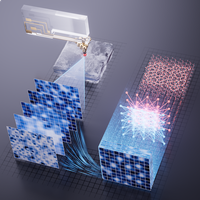
Premelting plays a key role across physics, chemistry, materials, and biology sciences but remains poorly understood at the atomic level due to surface characterization limitations. We report the discovery of an amorphous ice layer (AIL) preceding the quasiliquid layer during ice premelting, enabled by a machine learning framework integrating atomic force microscopy (AFM) with molecular dynamics simulations. This approach overcomes AFM’s depth and signal limitations, allowing for three-dimensional surface structure reconstruction from AFM images. It further enables structural exploration of premelting interfaces across a wide temperature range that are experimentally inaccessible. We identify the AIL present between 121 and 180 K displaying a disordered two-dimensional hydrogen-bond network with solidlike dynamics. Our findings refine the ice premelting phase diagram and offer new insights into the surface growth dynamic, dissolution, and interfacial chemical reactivity. Methodologically, this work establishes a novel framework for AFM-based 3D structural discovery, marking a significant leap in our ability to probe complex disordered interfaces with unprecedented precision and paving the way for future disciplinary research, including surface reconstruction, crystallization, ion solvation, and biomolecular recognition.
Physics Subject Headings (PhySH)
Popular Summary
Ice begins to change well before it melts. Even far below freezing, its surface forms a thin, liquidlike layer through premelting—a process relevant in cloud formation, cryopreservation, and planetary science. We provide a machine learning framework that combines high-resolution atomic force microscopy and computer simulations to map the ice surface at the atomic level, identifying an amorphous ice layer. This layer is a disordered, solidlike state that appears between 121 and 180 K prior to the liquidlike layer. Recognizing this previously overlooked phase informs our understanding of ice melting and growth. Our AI-assisted framework offers a promising approach to exploring other problems in materials and surface science, including complex, disordered surfaces, catalysts, functional materials, and biomolecules.
Article Text
Supplemental Material
References (81)
- B. Slater and A. Michaelides, Surface premelting of water ice, Nat. Rev. Chem. 3, 172 (2019).
- Y. Qiu and V. Molinero, Why is it so difficult to identify the onset of ice premelting?, J. Phys. Chem. Lett. 9, 5179 (2018).
- Z. Jia, C. I. DeLuca, H. Chao, and P. L. Davies, Structural basis for the binding of a globular antifreeze protein to ice, Nature (London) 384, 285 (1996).
- L. Canale, J. Comtet, A. Niguès, C. Cohen, C. Clanet, A. Siria, and L. Bocquet, Nanorheology of interfacial water during ice gliding, Phys. Rev. X 9, 041025 (2019).
- J. Devlin, N. Uras, J. Sadlej, and V. Buch, Discrete stages in the solvation and ionization of hydrogen chloride adsorbed on ice particles, Nature (London) 417, 269 (2002).
- T. Huthwelker, M. Ammann, and T. Peter, The uptake of acidic gases on ice, Chem. Rev. 106, 1375 (2006).
- M. J. Molina, T.-L. Tso, L. T. Molina, and F. C.-Y. Wang, Antarctic stratospheric chemistry of chlorine nitrate, hydrogen chloride, and ice: Release of active chlorine, Science 238, 1253 (1987).
- T. Hama and N. Watanabe, Surface processes on interstellar amorphous solid water: Adsorption, diffusion, tunneling reactions, and nuclear-spin conversion, Chem. Rev. 113, 8783 (2013).
- J. Braun, A. Glebov, A. P. Graham, A. Menzel, and J. P. Toennies, Structure and phonons of the ice surface, Phys. Rev. Lett. 80, 2638 (1998).
- X. Wei and P. B. Miranda, and Y. R. Shen, Surface vibrational spectroscopic study of surface melting of ice, Phys. Rev. Lett. 86, 1554 (2001).
- M. Mehlhorn and K. Morgenstern, Faceting during the transformation of amorphous to crystalline ice, Phys. Rev. Lett. 99, 246101 (2007).
- V. Buch, H. Groenzin, I. Li, M. J. Shultz, and E. Tosatti, Proton order in the ice crystal surface, Proc. Natl. Acad. Sci. U.S.A. 105, 5969 (2008).
- N. Kawakami, K. Iwata, A. Shiotari, and Y. Sugimoto, Intrinsic reconstruction of ice-I surfaces, Sci. Adv. 6, eabb7986 (2020).
- X. Huang et al., Tracking cubic ice at molecular resolution, Nature (London) 617, 86 (2023).
- A. Rosu-Finsen, M. B. Davies, A. Amon, H. Wu, A. Sella, A. Michaelides, and C. G. Salzmann, Medium-density amorphous ice, Science 379, 474 (2023).
- N. Materer, U. Starke, A. Barbieri, M. Van Hove, G. Somorjai, G. J. Kroes, and C. Minot, Molecular surface structure of a low-temperature ice Ih (0001) crystal, J. Phys. Chem. 99, 6267 (1995).
- D. Nordlund, H. Ogasawara, P. Wernet, M. Nyberg, M. Odelius, L. Pettersson, and A. Nilsson, Surface structure of thin ice films, Chem. Phys. Lett. 395, 161 (2004).
- M. A. Sánchez et al., Experimental and theoretical evidence for bilayer-by-bilayer surface melting of crystalline ice, Proc. Natl. Acad. Sci. U.S.A. 114, 227 (2017).
- T. Sugimoto, Y. Otsuki, T. Ishiyama, A. Morita, K. Watanabe, and Y. Matsumoto, Topologically disordered mesophase at the topmost surface layer of crystalline ice between 120 and 200 K, Phys. Rev. B 99, 121402(R) (2019).
- Y. Nojima, Y. Suzuki, M. Takahashi, and S. Yamaguchi, Proton order toward the surface of ice Ih revealed by heterodyne-detected sum frequency generation spectroscopy, J. Phys. Chem. Lett. 8, 5031 (2017).
- W. J. Smit, F. Tang, M. A. Sánchez, E. H. G. Backus, L. Xu, T. Hasegawa, M. Bonn, H. J. Bakker, and Y. Nagata, Excess hydrogen bond at the ice-vapor interface around 200 K, Phys. Rev. Lett. 119, 133003 (2017).
- L. Bartels, G. Meyer, and K. H. Rieder, Controlled vertical manipulation of single molecules with the scanning tunneling microscope: A route to chemical contrast, Appl. Phys. Lett. 71, 213 (1997).
- J. B. Peng et al., The effect of hydration number on the interfacial transport of sodium ions, Nature (London) 557, 701 (2018).
- J. B. Peng et al., Weakly perturbative imaging of interfacial water with submolecular resolution by atomic force microscopy, Nat. Commun. 9, 1 (2018).
- F. J. Giessibl, The qPlus sensor, a powerful core for the atomic force microscope, Rev. Sci. Instrum. 90, 011101 (2019).
- L. Gross, F. Mohn, N. Moll, P. Liljeroth, and G. Meyer, The chemical structure of a molecule resolved by atomic force microscopy, Science 325, 1110 (2009).
- N. Pavliček and L. Gross, Generation, manipulation and characterization of molecules by atomic force microscopy, Nat. Rev. Chem. 1, 1 (2017).
- P. Hapala, R. Temirov, F. S. Tautz, and P. Jelinek, Origin of high-resolution IETS-STM images of organic molecules with functionalized tips, Phys. Rev. Lett. 113, 226101 (2014).
- P. Hapala, G. Kichin, C. Wagner, F. S. Tautz, R. Temirov, and P. Jelinek, Mechanism of high-resolution STM/AFM imaging with functionalized tips, Phys. Rev. B 90, 085421 (2014).
- A. Shiotari and Y. Sugimoto, Ultrahigh-resolution imaging of water networks by atomic force microscopy, Nat. Commun. 8, 14313 (2017).
- P. Chen et al., Identification of a common ice nucleus on hydrophilic and hydrophobic close-packed metal surfaces, Nat. Commun. 14, 5813 (2023).
- P. Yang, C. Zhang, W. Sun, J. Dong, D. Cao, J. Guo, and Y. Jiang, Robustness of bilayer hexagonal ice against surface symmetry and corrugation, Phys. Rev. Lett. 129, 046001 (2022).
- Y. Tian et al., Visualizing Eigen/Zundel cations and their interconversion in monolayer water on metal surfaces, Science 377, 315 (2022).
- K. Bian, C. Gerber, A. J. Heinrich, D. J. Müller, S. Scheuring, and Y. Jiang, Scanning probe microscopy, Nat. Rev. Methods Primers 1, 36 (2021).
- F. J. Giessibl, The qPlus sensor, a powerful core for the atomic force microscope, Rev. Sci. Instrum. 90, 011101 (2019).
- F. Priante, N. Oinonen, Y. Tian, D. Guan, C. Xu, S. Cai, P. Liljeroth, Y. Jiang, and A. S. Foster, Structure discovery in atomic force microscopy imaging of ice, ACS Nano 18, 5546 (2024).
- N. Oinonen, L. Kurki, A. Ilin, and A. S. Foster, Molecule graph reconstruction from atomic force microscope images with machine learning, MRS Bull. 47, 895 (2022).
- B. Tang, Y. Song, M. Qin, Y. Tian, Z. W. Wu, Y. Jiang, D. Cao, and L. Xu, Machine learning-aided atomic structure identification of interfacial ionic hydrates from AFM images, Natl. Sci. Rev. 10, nwac282 (2023).
- J. Carracedo-Cosme, C. Romero-Muñiz, and R. Pérez, A deep learning approach for molecular classification based on AFM images, Nanomaterials 11, 1658 (2021).
- J. Carracedo-Cosme, C. Romero-Muñiz, P. Pou, and R. Pérez, Molecular identification from afm images using the iupac nomenclature and attribute multimodal recurrent neural networks, ACS Appl. Mater. Interfaces 15, 22692 (2023).
- J. Carracedo-Cosme and R. Pérez, Molecular identification with atomic force microscopy and conditional generative adversarial networks, npj Comput. Mater. 10, 19 (2024).
- N. Oinonen et al., Electrostatic discovery atomic force microscopy, ACS Nano 16, 89 (2021).
- J. Jumper et al., Highly accurate protein structure prediction with alphafold, Nature (London) 596, 583 (2021).
- M. Xu, L. Yu, Y. Song, C. Shi, S. Ermon, and J. Tang, Geodiff: A geometric diffusion model for molecular conformation generation, arXiv:2203.02923.
- Y. Zhao, E. M. D. Siriwardane, Z. Wu, N. Fu, M. Al-Fahdi, M. Hu, and J. Hu, Physics guided deep learning for generative design of crystal materials with symmetry constraints, npj Comput. Mater. 9, 38 (2023).
- J. Hoffmann, L. Maestrati, Y. Sawada, J. Tang, J. M. Sellier, and Y. Bengio, Data-driven approach to encoding and decoding 3-d crystal structures, arXiv:1909.00949.
- N. Rønne, A. Aspuru-Guzik, and B. Hammer, Generative diffusion model for surface structure discovery, Phys. Rev. B 110, 235427 (2024).
- Ö. Çiçek, A. Abdulkadir, S. S. Lienkamp, T. Brox, and O. Ronneberger, in Medical Image Computing and Computer-Assisted Intervention–MICCAI 2016: 19th International Conference, Athens, Greece, 2016, Proceedings, Part II 19 (Springer, New York, 2016), p. 424.
- See Supplemental Material at http://link.aps.org/supplemental/10.1103/9fzf-y9n9 for detailed information on the neural-network architectures, network training procedures, molecular structure analysis methods and results, and the assessment of the network performance, which include Refs. [19,50–54].
- S. Marcel and Y. Rodriguez, Torchvision the machine-vision package of torch, in Proceedings of the 18th ACM International Conference on Multimedia (Association for Computing Machinery, New York, NY, 2010), pp. 1485–1488.
- I. Loshchilov and F. Hutter, Decoupled weight decay regularization, arXiv:1711.05101.
- D. P. Kingma, Adam: A method for stochastic optimization, arXiv:1412.6980.
- J. R. Errington and P. G. Debenedetti, Relationship between structural order and the anomalies of liquid water, Nature (London) 409, 318 (2001).
- P. B. Louden and J. D. Gezelter, Friction at ice-ih/water interfaces is governed by solid/liquid hydrogen-bonding, J. Phys. Chem. C 121, 26764 (2017).
- T. Kling, F. Kling, and D. Donadio, Structure and dynamics of the quasi-liquid layer at the surface of ice from molecular simulations, J. Phys. Chem. C 122, 24780 (2018).
- J. Abascal, E. Sanz, R. García Fernández, and C. Vega, A potential model for the study of ices and amorphous water: TIP4P/Ice, J. Chem. Phys. 122, 234511 (2005).
- M. Heusel, H. Ramsauer, T. Unterthiner, B. Nessler, and S. Hochreiter, Gans trained by a two time-scale update rule converge to a local nash equilibrium, Adv. Neural Inf. Process. Syst. 30, 6629 (2017).
- J. Hong et al., Imaging surface structure and premelting of ice Ih with atomic resolution, Nature (London) 630, 375 (2024).
- A. Pedersen, K. T. Wikfeldt, L. Karssemeijer, H. Cuppen, and H. Jónsson, Molecular reordering processes on ice (0001) surfaces from long timescale simulations, J. Chem. Phys. 141, 234706 (2014).
- M. Watkins, D. Pan, E. G. Wang, A. Michaelides, J. VandeVondele, and B. Slater, Large variation of vacancy formation energies in the surface of crystalline ice, Nat. Mater. 10, 794 (2011).
- K. Koga, H. Tanaka, and X. Zeng, First-order transition in confined water between high-density liquid and low-density amorphous phases, Nature (London) 408, 564 (2000).
- H. Pathak, A. Späh, K. H. Kim, I. Tsironi, D. Mariedahl, M. Blanco, S. Huotari, V. Honkimäki, and A. Nilsson, Intermediate range O–O correlations in supercooled water down to 235 K, J. Chem. Phys. 150, 224506 (2019).
- N. Giovambattista, H. Eugene Stanley, and F. Sciortino, Phase diagram of amorphous solid water: Low-density, high-density, and very-high-density amorphous ices, Phys. Rev. E 72, 031510 (2005).
- M. B. Davies, A. Rosu-Finsen, C. G. Salzmann, and A. Michaelides, Low-density amorphous ice contains crystalline ice grains, Phys. Rev. B 112, 024203 (2025).
- J. Dash, A. Rempel, and J. Wettlaufer, The physics of premelted ice and its geophysical consequences, Rev. Mod. Phys. 78, 695 (2006).
- J. Liu, C. Zhu, K. Liu, Y. Jiang, Y. Song, J. S. Francisco, X. C. Zeng, and J. Wang, Distinct ice patterns on solid surfaces with various wettabilities, Proc. Natl. Acad. Sci. U.S.A. 114, 11285 (2017).
- C. J. Stubenrauch et al., Assessment of global cloud datasets from satellites: Project and database initiated by the GEWEX radiation panel, Bull. Am. Meteorol. Soc. 94, 1031 (2013).
- H. Kang, Chemistry of ice surfaces. Elementary reaction steps on ice studied by reactive ion scattering, Acc. Chem. Res. 38, 893 (2005).
- B. Ervens, Modeling the processing of aerosol and trace gases in clouds and fogs, Chem. Rev. 115, 4157 (2015).
- M. Clegg and D. Abbatt, Uptake of gas-phase and by ice surfaces: Dependence on partial pressure, temperature, and surface acidity, J. Phys. Chem. A 105, 6630 (2001).
- B. Tang, Experimental data, source code, and training dataset for the machine learning framework, and simulated structure of the amorphous ice layer, 10.5281/zenodo.17471822.
- M. Matsumoto, T. Yagasaki, and H. Tanaka, GenIce: Hydrogen-disordered ice generator, J. Comput. Chem. 39, 61 (2017).
- V. Fidalgo Cândido, R. Gomes de Aguiar Veiga, and M. de Koning, Generating proton-disordered ice configurations using orientational simulated annealing, J. Chem. Phys. 161, 066101 (2024).
- S. Plimpton, Fast parallel algorithms for short-range molecular dynamics, J. Comput. Phys. 117, 1 (1995).
- P. Jiang, D. Ergu, F. Liu, Y. Cai, and B. Ma, A review of Yolo algorithm developments, Proc. Comput. Sci. 199, 1066 (2022).
- J. Ho, A. Jain, and P. Abbeel, Denoising diffusion probabilistic models, Adv. Neural Inf. Process. Syst. 33, 6840 (2020).
- J.-Y. Zhu, T. Park, P. Isola, and A. A. Efros, Unpaired image-to-image translation using cycle-consistent adversarial networks, in Proceedings of the IEEE International Conference on Computer Vision (IEEE, Venice, Italy, 2017), pp. 2223–2232.
- C. Szegedy, V. Vanhoucke, S. Ioffe, J. Shlens, and Z. Wojna, Rethinking the inception architecture for computer vision, in Proceedings of the IEEE Conference on Computer Vision and Pattern Recognition (IEEE, Las Vegas, NV, 2016), pp. 2818–2826.
- K. Sohn, H. Lee, and X. Yan, Learning structured output representation using deep conditional generative models, Adv. Neural Inf. Process. Syst. 28, 3483 (2015).
- I. Higgins, L. Matthey, A. Pal, C. P. Burgess, X. Glorot, M. M. Botvinick, S. Mohamed, and A. Lerchner, beta-vae: Learning basic visual concepts with a constrained variational framework, ICLR (Poster), Toulon, France (International Conference on Learning Representations (ICLR), 2017).
- J. D. Bernal and R. H. Fowler, A theory of water and ionic solution, with particular reference to hydrogen and hydroxyl ions, J. Chem. Phys. 1, 515 (1933).

