

- Open Access
Learning Geometric Models for Developmental Dynamics
Phys. Rev. X 15, 031070 – Published 15 September, 2025
DOI: https://doi.org/10.1103/8vpj-bj7d
Abstract
Successful development from a single cell to a complex, multicellular organism requires that cells differentiate in a coordinated and organized manner in response to a variety of signaling modalities. While the molecular underpinnings may be complex, the resulting phenomenon, in which a cell decides between one fate or another, is relatively simple. A body of work—rooted in dynamical systems theory—has formalized this notion of cellular decision making as flow in a Waddington-like landscape, in which cells evolve according to gradientlike dynamics within a potential that changes shape in response to a number of signals. We present a framework leveraging neural networks as universal function approximators to infer such a parametrized landscape from gene expression data. Inspired by the success of physics-informed machine learning in data-limited contexts, we enforce principled constraints motivated not by physical laws but by this phenomenological understanding of differentiation. Our data-driven approach infers a governing landscape atop a manifold situated within expression space, thereby describing the dynamics of interest in a biologically meaningful context. The resulting system provides an intuitive, visualizable, and interpretable model of cellular differentiation dynamics.
Physics Subject Headings (PhySH)
Popular Summary
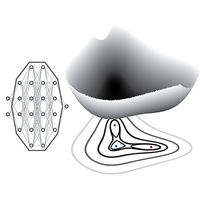
A central mystery in biology is how a single cell develops into a complex organism through a series of robust and reliable transitions between different cell states. Even though the molecular details inside cells are extremely complex, the outcome often looks surprisingly simple: Cells tend to move between only a few distinct states in a highly predictable way. This reliability motivates what is known as the Waddington perspective: Development may follow a kind of landscape where cells move along paths shaped by genetic and signaling constraints. To address this, we design a neural network model that learns the shape of a developmental landscape in a low-dimensional space linked to the underlying genes.
In our framework, the neural network captures the gradientlike dynamics of how cells move across the landscape. In this space, external chemical signals act like forces that push the cells in particular directions. The result is a stochastic differential equation that provides both predictive power and intuitive interpretation. We apply this model to an experimental system where cells make a simple binary decision, allowing us to test the framework in a controlled setting.
Our findings show that neural networks can be used to model the rules of development, an approach that opens the door to mapping more complex landscapes underlying tissue formation and differentiation.
Article Text
Supplemental Material
References (67)
- N. Saiz and A.-K. Hadjantonakis, Coordination between patterning and morphogenesis ensures robustness during mouse development, Phil. Trans. R. Soc. B 375, 20190562 (2020).
- F. Tang, C. Barbacioru, Y. Wang, E. Nordman, C. Lee, N. Xu, X. Wang, J. Bodeau, B. B. Tuch, A. Siddiqui, K. Lao, and M. A. Surani, mRNA-Seq whole-transcriptome analysis of a single cell, Nat. Methods 6, 377 (2009).
- J. W. Tung, D. R. Parks, W. A. Moore, L. A. Herzenberg, and L. A. Herzenberg, New approaches to fluorescence compensation and visualization of FACS data, Clin. Immunol. 110, 277 (2004).
- L. A. Herzenberg, J. Tung, W. A. Moore, L. A. Herzenberg, and D. R. Parks, Interpreting flow cytometry data: A guide for the perplexed, Nat. Rev. Immunol. 7, 681 (2006).
- L. Heumos, A. C. Schaar, C. Lance, A. Litinetskaya, F. Drost, L. Zappia, M. D. Lücken, D. C. Strobl, J. Henao, F. Curion, H. B. Schiller, and F. J. Theis, Best practices for single-cell analysis across modalities, Nat. Rev. Genet. 24, 550 (2023).
- A. M. Klein, L. Mazutis, I. Akartuna, N. Tallapragada, A. Veres, V. Li, L. Peshkin, D. A. Weitz, and M. W. Kirschner, Droplet barcoding for single-cell transcriptomics applied to embryonic stem cells, Cell 161, 1187 (2015).
- A. Zeisel, A. B. Muñoz-Manchado, S. Codeluppi, P. Lönnerberg, G. La Manno, A. Juréus, S. Marques, H. Munguba, L. He, C. Betsholtz, C. Rolny, G. Castelo-Branco, J. Hjerling-Leffler, and S. Linnarsson, Cell types in the mouse cortex and hippocampus revealed by single-cell RNA-seq, Science 347, 1138 (2015).
- E. Z. Macosko, A. Basu, R. Satija, J. Nemesh, K. Shekhar, M. Goldman, I. Tirosh, A. R. Bialas, N. Kamitaki, E. M. Martersteck, J. J. Trombetta, D. A. Weitz, J. R. Sanes, A. K. Shalek, A. Regev, and S. A. McCarroll, Highly Parallel genome-wide expression profiling of individual cells using nanoliter droplets, Cell 161, 1202 (2015).
- B. Tasic et al., Adult mouse cortical cell taxonomy revealed by single cell transcriptomics, Nat. Neurosci. 19, 335 (2016).
- A. M. Turing, The chemical basis of morphogenesis, Phil. Trans. R. Soc. B 237, 37 (1997).
- E. Camacho-Aguilar, S. T. Yoon, M. A. Ortiz-Salazar, S. Du, M. C. Guerra, and A. Warmflash, Combinatorial interpretation of BMP and WNT controls the decision between primitive streak and extraembryonic fates, Cell Syst. 15, 445 (2024).
- F. Corson, L. Couturier, H. Rouault, K. Mazouni, and F. Schweisguth, Self-organized Notch dynamics generate stereotyped sensory organ patterns in Drosophila, Science 356, eaai7407 (2017).
- S. Huang and D. E. Ingber, Shape-dependent control of cell growth, differentiation, and apoptosis: Switching between attractors in cell regulatory networks, Exp. Cell Res. 261, 91 (2000).
- H. Kitano, Computational systems biology, Nature (London) 420, 206 (2002).
- A. Hartmann, S. Ravichandran, and A. del Sol, Modeling cellular differentiation and reprogramming with gene regulatory networks, in Computational Stem Cell Biology: Methods and Protocols, edited by P. Cahan (Springer, New York, 2019), pp. 37–51.
- R. N. Gutenkunst, J. J. Waterfall, F. P. Casey, K. S. Brown, C. R. Myers, and J. P. Sethna, Universally sloppy parameter sensitivities in systems biology models, PLoS Comput. Biol. 3, e189 (2007).
- P. J. Ingram, M. P. Stumpf, and J. Stark, Network motifs: Structure does not determine function, BMC Genomics 7, 108 (2006).
- L. Deconinck, R. Cannoodt, W. Saelens, B. Deplancke, and Y. Saeys, Recent advances in trajectory inference from single-cell omics data, Current Opin. Syst. Biol. 27, 100344 (2021).
- W. Saelens, R. Cannoodt, H. Todorov, and Y. Saeys, A comparison of single-cell trajectory inference methods, Nat. Biotechnol. 37, 547 (2019).
- J. Ding, N. Sharon, and Z. Bar-Joseph, Temporal modelling using single-cell transcriptomics, Nat. Rev. Genet. 23, 355 (2022).
- G. La Manno et al., RNA velocity of single cells, Nature (London) 560, 494 (2018).
- V. Bergen, M. Lange, S. Peidli, F. A. Wolf, and F. J. Theis, Generalizing RNA velocity to transient cell states through dynamical modeling, Nat. Biotechnol. 38, 1408 (2020).
- S. Farrell, M. Mani, and S. Goyal, Inferring single-cell transcriptomic dynamics with structured latent gene expression dynamics, Cell Rep. Methods 3, 100581 (2023).
- C. Qiao and Y. Huang, Representation learning of RNA velocity reveals robust cell transitions, Proc. Natl. Acad. Sci. U.S.A. 118, e2105859118 (2021).
- X. Qiu et al., Mapping transcriptomic vector fields of single cells, Cell 185, 690 (2022).
- Z. Zhang and X. Zhang, Inference of high-resolution trajectories in single-cell RNA-seq data by using RNA velocity, Cell Rep. Methods 1, 100095 (2021).
- R. Liu, A. O. Pisco, E. Braun, S. Linnarsson, and J. Zou, Dynamical systems model of RNA velocity improves inference of single-cell trajectory, pseudo-time and gene regulation, J. Mol. Biol. 434, 167606 (2022).
- A. Raju and E. D. Siggia, A geometrical perspective on development, Dev. Growth Differ. 65, 245 (2023).
- C. H. Waddington, The Strategy of the Genes (Routledge, London, 1957).
- S. Gilbert, Developmental Biology (Sinauer Associates, Incorporated Publishers, Sunderland, MA, 2014), Vol. 3.
- R. Thom, Topological models in biology, Topology 8, 313 (1969).
- J. M. W. Slack, From Egg to Embryo: Regional Specification in Early Development, 2nd ed., Developmental and Cell Biology Series (Cambridge University Press, Cambridge, England, 1991).
- S. Huang, Cell fates as high-dimensional attractor states of a complex gene regulatory network, Phys. Rev. Lett. 94, 128701 (2005).
- S. Huang, Y.-P. Guo, G. May, and T. Enver, Bifurcation dynamics in lineage-commitment in bipotent progenitor cells, Dev. Biol. 305, 695 (2007).
- S. Huang, The molecular and mathematical basis of Waddington’s epigenetic landscape: A framework for post-Darwinian biology?, BioEssays 34, 149 (2012).
- E. Marco, R. L. Karp, G. Guo, P. Robson, A. H. Hart, L. Trippa, and G.-C. Yuan, Bifurcation analysis of single-cell gene expression data reveals epigenetic landscape, Proc. Natl. Acad. Sci. U.S.A. 111, E5643 (2014).
- S. L. Freedman, B. Xu, S. Goyal, and M. Mani, A dynamical systems treatment of transcriptomic trajectories in hematopoiesis, Development 150, dev201280 (2023).
- F. Corson and E. D. Siggia, Geometry, epistasis, and developmental patterning, Proc. Natl. Acad. Sci. U.S.A. 109, 5568 (2012).
- M. Mojtahedi, A. Skupin, J. Zhou, I. G. Castaño, R. Y. Y. Leong-Quong, H. Chang, K. Trachana, A. Giuliani, and S. Huang, Cell fate decision as high-dimensional critical state transition, PLOS Biol. 14, e2000640 (2016).
- F. Corson and E. D. Siggia, Gene-free methodology for cell fate dynamics during development, eLife 6, e30743 (2017).
- E. Camacho-Aguilar, A. Warmflash, and D. A. Rand, Quantifying cell transitions in C. elegans with data-fitted landscape models, PLoS Comput. Biol. 17, e1009034 (2021).
- D. A. Rand, A. Raju, M. Sáez, F. Corson, and E. D. Siggia, Geometry of gene regulatory dynamics, Proc. Natl. Acad. Sci. U.S.A. 118, e2109729118 (2021).
- M. Sáez, R. Blassberg, E. Camacho-Aguilar, E. D. Siggia, D. A. Rand, and J. Briscoe, Statistically derived geometrical landscapes capture principles of decision-making dynamics during cell fate transitions, Cell Syst. 13, 12 (2022).
- M. Maurizi, C. Gao, and F. Berto, Predicting stress, strain and deformation fields in materials and structures with graph neural networks, Sci. Rep. 12, 21834 (2022).
- D. Kochkov, J. A. Smith, A. Alieva, Q. Wang, M. P. Brenner, and S. Hoyer, Machine learning–accelerated computational fluid dynamics, Proc. Natl. Acad. Sci. U.S.A. 118, e2101784118 (2021).
- See Supplemental Material at http://link.aps.org/supplemental/10.1103/8vpj-bj7d for additional details regarding the mathematical theory of parametrized landscapes, model architectures and numerical procedures, and the application of the modeling framework to in vitro data.
- C. W. Gardiner, Handbook of Stochastic Methods: For Physics, Chemistry and the Natural Sciences; With 29 Figures, Springer Series in Synergetics Vol. 13 (Springer, Berlin, Heidelberg, 1983).
- A. Gretton, K. Borgwardt, M. J. Rasch, B. Scholkopf, and A. J. Smola, A kernel method two-sample test, J. Mach. Learn. Res. 13, 723 (2012), https://www.jmlr.org/papers/volume13/gretton12a/gretton12a.pdf.
- A. Jepson and A. Spence, Folds in solutions of two parameter systems and their calculation. Part I, SIAM J. Num. Anal. 22, 347 (1985).
- W. J. F. Govaerts, Numerical Methods for Bifurcations of Dynamical Equilibria (Society for Industrial and Applied Mathematics, Philadelphia, 2000).
- S. Smale, On gradient dynamical systems, Ann. Math. 74, 199 (1961).
- J. Ma, J. Zhao, J. Tian, X. Bai, and Z. Tu, Regularized vector field learning with sparse approximation for mismatch removal, Pattern Recogn. 46, 3519 (2013).
- S. Chhabra, L. Liu, R. Goh, X. Kong, and A. Warmflash, Dissecting the dynamics of signaling events in the BMP, WNT, and NODAL cascade during self-organized fate patterning in human gastruloids, PLoS Biol. 17, e3000498 (2019).
- P. Caldarelli, A. Chamolly, A. Villedieu, O. Alegria-Prévot, C. Phan, J. Gros, and F. Corson, Self-organized tissue mechanics underlie embryonic regulation, Nature (London) 633, 887 (2024).
- X. Glorot and Y. Bengio, Understanding the difficulty of training deep feedforward neural networks, in Proceedings of the Thirteenth International Conference on Artificial Intelligence and Statistics, Chia Laguna Resort, Sardinia, Italy, edited by Y. W. Teh and M. Titterington (PMLR, 2010), Vol. 9, pp. 249–256.
- R. Frostig, M. J. Johnson, and C. Leary, Compiling machine learning programs via high-level tracing, in Proceedings of the First Machine Learning and Systems Conference (MLsys) (2019).
- P. Kidger, On neural differential equations, arXiv:2202.02435.
- E. Hairer, S. Nørsett, and G. Wanner, Solving Ordinary Differential Equations I Nonstiff Problems, second revised edition (Springer, Berlin, 2008).
- I. Babuschkin et al. (DeepMind Collaboration), The DeepMind JAX Ecosystem (2020), http://github.com/google-deepmind.
- T. Tieleman and G. Hinton, Lecture 6.5-rmsprop: Divide the gradient by a running average of its recent magnitude, COURSERA 4, 26 (2012), https://cir.nii.ac.jp/crid/1370017282431050757.
- F. Perez-Cruz, Kullback-Leibler divergence estimation of continuous distributions, in 2008 IEEE International Symposium on Information Theory (IEEE, Toronto, ON, Canada, 2008), pp. 1666–1670.
- G. K. Dziugaite, D. M. Roy, and Z. Ghahramani, Training generative neural networks via maximum mean discrepancy optimization, arXiv:1505.03906.
- K. Fukumizu, A. Gretton, X. Sun, and B. Schölkopf, Kernel measures of conditional dependence, in Advances in Neural Information Processing Systems (Curran Associates, Inc., Red Hook, NY, 2007), Vol. 20.
- D. Garreau, W. Jitkrittum, and M. Kanagawa, Large sample analysis of the median heuristic, arXiv:1707.07269.
- A. Howe, plnn: v0.1.2-alpha, Zenodo, implementation of the parameterized landscape architecture and training process (2025), 10.5281/zenodo.16895870 (Version 0.1.2-alpha).
- A. Howe, dynamical-landscape-inference: v0.1.1-alpha, Zenodo, applications of the PLNN architecture to data and figure generation (2025), 10.5281/zenodo.16895934 (Version 0.1.1-alpha).
- A. Howe, mescs-invitro-facs: v0.1.1-alpha, Zenodo, cell type labeling recapitulating Sáez et al. (2025), 10.5281/zenodo.16895951 (Version 0.1.1-alpha).

