

- Open Access
Non-Abelian Quantum Signal Processing: A Composite Pulse for Fast Analytic Control of Hybrid Oscillator-Qubit Processors
Phys. Rev. X 16, 041018 – Published 15 October, 2026
DOI: https://doi.org/10.1103/7jwl-k8xg
Abstract
Quantum signal processing (QSP) transforms a unitary parametrized by a classical variable into one governed by a polynomial function . Though quantum mechanics is linear, such highly nonlinear transformations arise naturally from the curvature of the qubit Bloch sphere. This capability underpins many quantum algorithms and enables robust control by decreasing sensitivity to errors in a control parameter, or quantum sensing by increasing sensitivity to variations one seeks to measure. Here, we extend QSP from classical, commuting control parameters to noncommuting quantum operators. We call this new multivariate class non-Abelian QSP. Rather than treating the noncommutativity of quantum control variables as a complication, non-Abelian QSP exploits their richer commutator algebra as a resource for efficient control. A natural setting is hybrid oscillator-qubit systems realized in superconducting and trapped-ion processors, where the control variables can be the noncommuting position and momentum of a quantum harmonic oscillator. We introduce the Gaussian-controlled rotation (GCR), a canonical instance of non-Abelian QSP that cancels the Gaussian quantum-fluctuation error of an oscillator-controlled qubit rotation, matching the robustness of classical composite pulses with a much shorter circuit and an order-of-magnitude lower error. GCR enables fully analytical circuits for preparing squeezed, cat, GKP, and Fock states with performance comparable to state-of-the-art numerically optimized protocols. Building on this primitive, we develop an analytical framework for universal control of GKP bosonic codes, in which logical readout doubles as piecewise gate teleportation, yielding the first high-fidelity, error-mitigated single- and two-qubit logical gates for finite-energy GKP that surpass prior schemes even in the noiseless regime. The same framework supplies midcircuit error detection and extends in closed form to arbitrary lattices, qudits, and multimode codes relevant to the superconducting-circuit experiments now demonstrating beyond-break-even GKP memory. We further apply these ideas to close a key gap in oscillator-assisted quantum phase estimation. Together, these results show that the non-Abelian structure of quantum control operators can provide a practical resource for robust and efficient quantum control, establishing non-Abelian QSP as both a new theoretical framework and an experimentally accessible control paradigm.
Physics Subject Headings (PhySH)
Popular Summary
Quantum computers that pair a qubit with an oscillator—a vibrating ion or microwave resonator—can use the qubit to control and read it out precisely. But the uncertainty principle forbids pinning down an oscillator’s exact position and momentum: Its state can only have a mean value of each, surrounded by an irreducible spread in phase space. However, the cause of the problem can also be its cure. Our composite pulse, the Gaussian-controlled rotation, uses a momentum-based correction to cancel the error a position-based step leaves behind, giving one qubit measurement single-shot access to that mean. This is an instance of a class of quantum signal processing whose control variables do not commute, needing fewer operations than before. It yields recipes for preparing states and manipulating error-corrected information, matching numerical optimization, and realizes a phase-estimation scheme a prior proposal needed but could not build—all compatible with superconducting-circuit and trapped-ion hardware.
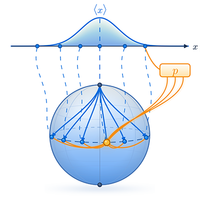
Article Text
References (74)
- G. H. Low and I. L. Chuang, Optimal Hamiltonian simulation by quantum signal processing, Phys. Rev. Lett. 118, 010501 (2017).
- D. Motlagh and N. Wiebe, Generalized quantum signal processing, PRX Quantum 5, 020368 (2024).
- J. M. Martyn, Z. M. Rossi, A. K. Tan, and I. L. Chuang, Grand unification of quantum algorithms, PRX Quantum 2, 040203 (2021).
- L. Brenner, L. Caha, X. Coiteux-Roy, and R. Koenig, Factoring an integer with three oscillators and a qubit, Nat. Commun. 17, 227 (2026).
- Y. Liu, S. Singh, K. C. Smith, E. Crane, J. M. Martyn, A. Eickbusch, A. Schuckert, R. D. Li, J. Sinanan-Singh, M. B. Soley, T. Tsunoda, I. L. Chuang, N. Wiebe, and S. M. Girvin, Hybrid oscillator-qubit quantum processors: Instruction set architectures, abstract machine models, and applications, PRX Quantum 7, 010201 (2026).
- S. L. Braunstein and P. van Loock, Quantum information with continuous variables, Rev. Mod. Phys. 77, 513 (2005).
- A. Eickbusch, V. Sivak, A. Z. Ding, S. S. Elder, S. R. Jha, J. Venkatraman, B. Royer, S. M. Girvin, R. J. Schoelkopf, and M. H. Devoret, Fast universal control of an oscillator with weak dispersive coupling to a qubit, Nat. Phys. 18, 1464 (2022).
- S. Haroche, Nobel Lecture: Controlling photons in a box and exploring the quantum to classical boundary, Rev. Mod. Phys. 85, 1083 (2013).
- C. D. Bruzewicz, J. Chiaverini, R. McConnell, and J. M. Sage, Trapped-ion quantum computing: Progress and challenges, Appl. Phys. Rev. 6, 021314 (2019).
- C. Flühmann, T. L. Nguyen, M. Marinelli, V. Negnevitsky, K. Mehta, and J. P. Home, Encoding a qubit in a trapped-ion mechanical oscillator, Nature (London) 566, 513 (2019).
- A. Kumar, A. Suleymanzade, M. Stone, L. Taneja, A. Anferov, D. I. Schuster, and J. Simon, Quantum-enabled millimetre wave to optical transduction using neutral atoms, Nature (London) 615, 614 (2023).
- S. Garcia, M. Stammeier, J. Deiglmayr, F. Merkt, and A. Wallraff, Single-shot nondestructive detection of Rydberg-atom ensembles by transmission measurement of a microwave cavity, Phys. Rev. Lett. 123, 193201 (2019).
- B. Németh, B. Kövér, B. Kulcsár, R. B. Miklósi, and A. Gilyén, On variants of multivariate quantum signal processing and their characterizations, arXiv:2312.09072.
- J. Hastrup, K. Park, J. B. Brask, R. Filip, and U. L. Andersen, Measurement-free preparation of grid states, npj Quantum Inf. 7, 1 (2021).
- J. Hastrup, K. Park, R. Filip, and U. L. Andersen, Unconditional preparation of squeezed vacuum from Rabi interactions, Phys. Rev. Lett. 126, 153602 (2021).
- J. Hastrup, K. Park, J. B. Brask, R. Filip, and U. L. Andersen, Universal unitary transfer of continuous-variable quantum states into a few qubits, Phys. Rev. Lett. 128, 110503 (2022).
- B. de Neeve, T.-L. Nguyen, T. Behrle, and J. P. Home, Error correction of a logical grid state qubit by dissipative pumping, Nat. Phys. 18, 296 (2022).
- I. Rojkov, P. M. Röggla, M. Wagener, M. Fontboté-Schmidt, S. Welte, J. Home, and F. Reiter, Two-qubit operations for finite-energy Gottesman-Kitaev-Preskill encodings, Phys. Rev. Lett. 133, 100601 (2024).
- P. Campagne-Ibarcq, A. Eickbusch, S. Touzard, E. Zalys-Geller, N. E. Frattini, V. V. Sivak, P. Reinhold, S. Puri, S. Shankar, R. J. Schoelkopf, L. Frunzio, M. Mirrahimi, and M. H. Devoret, Quantum error correction of a qubit encoded in grid states of an oscillator, Nature (London) 584, 368 (2020).
- V. V. Sivak, A. Eickbusch, B. Royer, S. Singh, I. Tsioutsios, S. Ganjam, A. Miano, B. L. Brock, A. Z. Ding, L. Frunzio, S. M. Girvin, R. J. Schoelkopf, and M. H. Devoret, Real-time quantum error correction beyond break-even, Nature (London) 616, 50 (2023).
- V. G. Matsos, C. H. Valahu, M. J. Millican, T. Navickas, X. C. Kolesnikow, M. J. Biercuk, and T. R. Tan, Universal quantum gate set for Gottesman-Kitaev-Preskill logical qubits, Nat. Phys. 21, 1664 (2025).
- V. G. Matsos, C. H. Valahu, T. Navickas, A. D. Rao, M. J. Millican, X. C. Kolesnikow, M. J. Biercuk, and T. R. Tan, Robust and deterministic preparation of bosonic logical states in a trapped ion, Phys. Rev. Lett. 133, 050602 (2024).
- K. Mølmer and A. Sørensen, Multiparticle entanglement of hot trapped ions, Phys. Rev. Lett. 82, 1835 (1999).
- A. Sørensen and K. Mølmer, Quantum computation with ions in thermal motion, Phys. Rev. Lett. 82, 1971 (1999).
- J. Sinanan-Singh, G. L. Mintzer, I. L. Chuang, and Y. Liu, Single-shot quantum signal processing interferometry, Quantum 8, 1427 (2024).
- S. Zeytinoğlu, Generalized parity measurements and efficient large multicomponent cat state preparation with quantum signal processing, Phys. Rev. Res. 8, 023208 (2026).
See Ref. [5] for a concurrent tutorial on hybrid CV-DV systems by overlapping authors; it introduces the phase-space instruction set used here, and cites the present work for non-Abelian QSP.
- S. Wimperis, Broadband, narrowband, and passband composite pulses for use in advanced NMR experiments, J. Magn. Reson., Ser. A 109, 221 (1994).
- G. H. Low, T. J. Yoder, and I. L. Chuang, The methodology of resonant equiangular composite quantum gates, Phys. Rev. X 6, 041067 (2016).
- Z. M. Rossi and I. L. Chuang, Multivariable quantum signal processing (M-QSP): Prophecies of the two-headed oracle, Quantum 6, 811 (2022).
- H. K. Cummins, G. Llewellyn, and J. A. Jones, Tackling systematic errors in quantum logic gates with composite rotations, Phys. Rev. A 67, 042308 (2003).
- R. Tycko, H. M. Cho, E. Schneider, and A. Pines, Composite pulses without phase distortion, J. Magn. Reson. (1969) 61, 90 (1985).
- K. R. Brown, A. W. Harrow, and I. L. Chuang, Arbitrarily accurate composite pulse sequences, Phys. Rev. A 70, 052318 (2004).
- K. R. Brown, A. W. Harrow, and I. L. Chuang, Erratum: Arbitrarily accurate composite pulse sequences, Phys. Rev. A 70, 052318 (2004); 72, 039905(E) (2005).
- Y. Dong, X. Meng, K. B. Whaley, and L. Lin, Efficient phase-factor evaluation in quantum signal processing, Phys. Rev. A 103, 042419 (2021).
- P. Reinhold, S. Rosenblum, W.-L. Ma, L. Frunzio, L. Jiang, and R. J. Schoelkopf, Error-corrected gates on an encoded qubit, Nat. Phys. 16, 822 (2020).
- W.-L. Ma, M. Zhang, Y. Wong, K. Noh, S. Rosenblum, P. Reinhold, R. J. Schoelkopf, and L. Jiang, Path-independent quantum gates with noisy ancilla, Phys. Rev. Lett. 125, 110503 (2020).
- W.-L. Ma, S.-S. Li, and L. Jiang, Algebraic structure of path-independent quantum control, Phys. Rev. Res. 4, 023102 (2022).
- L. Bell, Y. Wang, K. C. Smith, Y. Liu, E. Dumitrescu, and S. M. Girvin, Co-designing spectral transformation oracles with hybrid oscillator-qubit quantum processors: From algorithms to compilation, PRX Quantum 6, 040359 (2025).
- J. Hastrup and U. L. Andersen, Improved readout of qubit-coupled Gottesman-Kitaev-Preskill states, Quantum Sci. Technol. 6, 035016 (2021).
- G. H. Low, Quantum signal processing by single-qubit dynamics, Thesis, Massachusetts Institute of Technology, https://dspace.mit.edu/handle/1721.1/115025.
For the correction pulse is smaller. For position fluctuations are antisqueezed; applying GCR with , replaces by , again giving a smaller correction. Both cases confirm as the worst case.
- J. R. Johansson, P. D. Nation, and F. Nori, qutip2 : A python framework for the dynamics of open quantum systems, Comput. Phys. Commun. 184, 1234 (2013).
- L. Sun, A. Petrenko, Z. Leghtas, B. Vlastakis, G. Kirchmair, K. M. Sliwa, A. Narla, M. Hatridge, S. Shankar, J. Blumoff, L. Frunzio, M. Mirrahimi, M. H. Devoret, and R. J. Schoelkopf, Tracking photon jumps with repeated quantum non-demolition parity measurements, Nature (London) 511, 444 (2014).
- D. J. Wineland, Nobel Lecture: Superposition, entanglement, and raising Schrödinger’s cat, Rev. Mod. Phys. 85, 1103 (2013).
GCR used here is a generalization where the main vector is conditioned on and precorrection is conditioned on .
- Quantum State Estimation, edited by M. Paris and J. Řeháček, Lecture Notes in Physics Vol. 649 (Springer, Berlin, Heidelberg, 2004).
- A. J. Brady, A. Eickbusch, S. Singh, J. Wu, and Q. Zhuang, Advances in bosonic quantum error correction with Gottesman-Kitaev-Preskill codes: Theory, engineering and applications, Prog. Quantum Electron. 93, 100496 (2024).
- B. Royer, S. Singh, and S. M. Girvin, Stabilization of finite-energy Gottesman-Kitaev-Preskill states, Phys. Rev. Lett. 125, 260509 (2020).
- D. J. Weigand and B. M. Terhal, Generating grid states from Schrödinger-cat states without postselection, Phys. Rev. A 97, 022341 (2018).
- B. L. Brock, S. Singh, A. Eickbusch, V. V. Sivak, A. Z. Ding, L. Frunzio, S. M. Girvin, and M. H. Devoret, Quantum error correction of qudits beyond break-even, Nature (London) 641, 612 (2025).
- Google Quantum AI and Collaborators, Quantum error correction below the surface code threshold, Nature (London) 638, 920 (2025).
- M. Mirrahimi, Z. Leghtas, V. V. Albert, S. Touzard, R. J. Schoelkopf, L. Jiang, and M. H. Devoret, Dynamically protected cat-qubits: A new paradigm for universal quantum computation, New J. Phys. 16, 045014 (2014).
- S. Puri, A. Grimm, P. Campagne-Ibarcq, A. Eickbusch, K. Noh, G. Roberts, L. Jiang, M. Mirrahimi, M. H. Devoret, and S. M. Girvin, Stabilized cat in a driven nonlinear cavity: A fault-tolerant error syndrome detector, Phys. Rev. X 9, 041009 (2019).
- A. Grimm, N. E. Frattini, S. Puri, S. O. Mundhada, S. Touzard, M. Mirrahimi, S. M. Girvin, S. Shankar, and M. H. Devoret, Stabilization and operation of a Kerr-cat qubit, Nature (London) 584, 205 (2020).
- A. Z. Ding, B. L. Brock, A. Eickbusch, A. Koottandavida, N. E. Frattini, R. G. Cortinas, V. R. Joshi, S. J. d. Graaf, B. J. Chapman, S. Ganjam, L. Frunzio, R. J. Schoelkopf, and M. H. Devoret, Quantum control of an oscillator with a Kerr-cat qubit, Nat. Commun. 16, 5279 (2025).
- J. Hastrup, M. V. Larsen, J. S. Neergaard-Nielsen, N. C. Menicucci, and U. L. Andersen, Unsuitability of cubic phase gates for non-Clifford operations on Gottesman-Kitaev-Preskill states, Phys. Rev. A 103, 032409 (2021).
- Q. Xu, P. Zeng, D. Xu, and L. Jiang, Fault-tolerant operation of bosonic qubits with discrete-variable ancillae, Phys. Rev. X 14, 031016 (2024).
The corrective backaction renders the measurement outcomes less useful in terms of detecting errors.
- D. Gottesman, A. Kitaev, and J. Preskill, Encoding a qubit in an oscillator, Phys. Rev. A 64, 012310 (2001).
- J. Hastrup and U. L. Andersen, Analysis of loss correction with the Gottesman-Kitaev-Preskill code, Phys. Rev. A 108, 052413 (2023).
- P.-T. Fong and H.-K. Lau, Engineering non-Gaussian bosonic gates through quantum signal processing, Phys. Rev. A 114, 032608 (2026).
- C. K. Law and J. H. Eberly, Arbitrary control of a quantum electromagnetic field, Phys. Rev. Lett. 76, 1055 (1996).
- S. Singh, Quantum computing in discrete- and continuous-variable architectures, Ph.D. thesis, Yale University, 2025, arXiv:2507.01146.
- N. Liu, J. Thompson, C. Weedbrook, S. Lloyd, V. Vedral, M. Gu, and K. Modi, Power of one qumode for quantum computation, Phys. Rev. A 93, 052304 (2016).
For this section we work in the convention with ; this matches the convention used in our numerical simulations and yields a clean form for the phase-estimation result. Other sections of the paper use .
The regime where it becomes significant is precisely where the Gaussian approximation breaks down and a fundamentally different estimator is required anyway, which we leave for future work
- B. L. Higgins, D. W. Berry, S. D. Bartlett, H. M. Wiseman, and G. J. Pryde, Entanglement-free heisenberg-limited phase estimation, Nature (London) 450, 393 (2007).
- S. Kimmel, G. H. Low, and T. J. Yoder, Robust calibration of a universal single-qubit gate set via robust phase estimation, Phys. Rev. A 92, 062315 (2015).
- S. Singh, Towards non-Abelian quantum signal processing: Efficient control of hybrid continuous- and discrete-variable architectures [GitHub] (2026), https://github.com/shraggy/NA-QSP_sims.
- S. Singh, Towards non-abelian quantum signal processing: Bb1(gcr) analysis [GitHub] (2026), https://github.com/shraggy/BB1_GCR.
- Z. Leghtas, G. Kirchmair, B. Vlastakis, R. J. Schoelkopf, M. H. Devoret, and M. Mirrahimi, Hardware-efficient autonomous quantum memory protection, Phys. Rev. Lett. 111, 120501 (2013).
- B. d. Neeve, T.-L. Nguyen, A. Ferk, T. Behrle, F. Lancellotti, M. Simoni, S. Welte, and J. Home, Modular variable laser cooling for efficient entropy extraction, Phys. Rev. Lett. 134, 203603 (2024).
BB1 correction can equivalently be prepended, appended, or interleaved with the target rotation, without affecting performance. The reversed order is chosen to match the precorrection structure required by GCR.

