

- Open Access
Quantum Advantage for Sensing Properties of Classical Fields
Phys. Rev. X 16, 041025 – Published 23 October, 2026
DOI: https://doi.org/10.1103/6ps1-mw9l
Abstract
Modern precision experiments often probe unknown classical fields with bosonic sensors in quantum-noise-limited regimes where vacuum fluctuations limit conventional readout. We introduce quantum signal learning, a sensing framework that extends metrology to a broader property-learning setting, and propose a quantum-enhanced protocol that simultaneously estimates many properties of a classical signal with shot noise suppressed below the vacuum level. Our scheme requires only two-mode squeezing, passive optics, and static homodyne measurements, and enables post hoc classical estimation of many properties from the same experimental dataset. We prove that our protocol enables a quantum speedup for common classical sensing tasks, including measuring electromagnetic correlations, real-time feedback control of interferometric cavities, and Fourier-domain matched filtering. To establish these separations, we introduce an optimal-transport conditioning method and show both worst-case exponential separations from all entanglement-free strategies and practical speedups over homodyne and heterodyne baselines. We further show that when squeezing is treated as a resource, a protocol with squeezed light can sense a structured classical background exponentially faster than any coherent classical probe.
Physics Subject Headings (PhySH)
Popular Summary
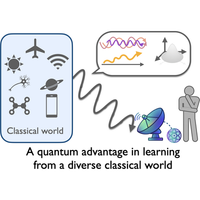
The world’s best sensors—from gravitational-wave observatories to precision radar—detect signals so faint that the dominant noise comes from electromagnetic fluctuations of empty space. Modern experiments now face a trade-off: They can record everything about an incoming signal but pay a quantum noise penalty, or use quantum light to measure one feature with exquisite precision while remaining blind to the rest. We introduce a protocol called Bell quantum signal learning (QSL) that dissolves this trade-off. Bell QSL uses quantum entanglement to push noise below the vacuum level while collecting data that can be used to simultaneously estimate a wide variety of physical properties. In some cases, the resulting speedup exponentially outperforms any strategy for sensing without quantum entanglement. Built from components standard in today’s laboratories, Bell QSL could sharpen searches for gravitational waves, dark matter, and faint electromagnetic signals.
Article Text
Supplemental Material
References (52)
- J. Aasi et al. (LIGO Scientific Collaboration), Advanced LIGO, Classical Quantum Gravity 32, 074001 (2015).
- M. Tse et al. (LIGO Scientific Collaboration), Quantum-enhanced Advanced LIGO detectors in the era of gravitational-wave astronomy, Phys. Rev. Lett. 123, 231107 (2019).
- B. M. Brubaker et al., First results from a microwave cavity axion search at , Phys. Rev. Lett. 118, 061302 (2017).
- K. M. Backes et al., A quantum enhanced search for dark matter axions, Nature (London) 590, 238 (2021).
- C. Macklin, K. O’Brien, D. Hover, M. E. Schwartz, V. Bolkhovsky, X. Zhang, W. D. Oliver, and I. Siddiqi, A near–quantum-limited Josephson traveling-wave parametric amplifier, Science 350, 307 (2015).
- T. P. Purdy, R. W. Peterson, and C. A. Regal, Observation of radiation pressure shot noise on a macroscopic object, Science 339, 801 (2013).
- Ishaan Kannan, Sridhar Prabhu, Saeed A. Khan, Mandar M. Sohoni, Xingrui Song, Saswata Roy, Alen Senanian, Valla Fatemi, Peter L. McMahon, and Jordan Cotler, Exponential quantum advantage for learning signals with a single qubit, arXiv:2608.13521.
- M. Malnou, D. A. Palken, B. M. Brubaker, Leila R. Vale, Gene C. Hilton, and K. W. Lehnert, Squeezed vacuum used to accelerate the search for a weak classical signal, Phys. Rev. X 9, 021023 (2019).
- Daniel W. Gould, Min Jet Yap, Vaishali B. Adya, Bram J. J. Slagmolen, Robert L. Ward, and David E. McClelland, Optimal quantum noise cancellation with an entangled witness channel, Phys. Rev. Res. 3, 043079 (2021).
- Jack Y. Qiu, Arne Grimsmo, Kaidong Peng, Bharath Kannan, Benjamin Lienhard, Youngkyu Sung, Philip Krantz, Vladimir Bolkhovsky, Greg Calusine, David Kim, Alex Melville, Bethany M. Niedzielski, Jonilyn Yoder, Mollie E. Schwartz, Terry P. Orlando, Irfan Siddiqi, Simon Gustavsson, Kevin P. O’Brien, and William D. Oliver, Broadband squeezed microwaves and amplification with a Josephson travelling-wave parametric amplifier, Nat. Phys. 19, 706 (2023).
- Arjen Vaartjes, Anders Kringhøj, Wyatt Vine, Tom Day, Andrea Morello, and Jarryd J. Pla, Strong microwave squeezing above 1 Tesla and 1 Kelvin, Nat. Commun. 15, 4229 (2024).
- Eric Oelker, Tomoki Isogai, John Miller, Maggie Tse, Lisa Barsotti, Nergis Mavalvala, and Matthew Evans, Audio-band frequency-dependent squeezing for gravitational-wave detectors, Phys. Rev. Lett. 116, 041102 (2016).
- L. McCuller, C. Whittle, D. Ganapathy, K. Komori, M. Tse, A. Fernandez-Galiana, L. Barsotti, P. Fritschel, M. MacInnis, F. Matichard, K. Mason, N. Mavalvala, R. Mittleman, Haocun Yu, M. E. Zucker, and M. Evans, Frequency-dependent squeezing for advanced LIGO, Phys. Rev. Lett. 124, 171102 (2020).
- D. Ganapathy, W. Jia, M. Nakano, V. Xu, N. Aritomi, T. Cullen, N. Kijbunchoo, S. E. Dwyer, A. Mullavey, L. McCuller et al., Broadband quantum enhancement of the LIGO detectors with frequency-dependent squeezing, Phys. Rev. X 13, 041021 (2023).
- Wenxuan Jia, Victoria Xu, Kevin Kuns, Masayuki Nakano, Lisa Barsotti, Matthew Evans, Nergis Mavalvala et al., Squeezing the quantum noise of a gravitational-wave detector below the standard quantum limit, Science 385, 1318 (2024).
- Bruce Allen, time-frequency discriminator for gravitational wave detection, Phys. Rev. D 71, 062001 (2005).
- Bruce Allen, Warren G. Anderson, Patrick R. Brady, Duncan A. Brown, and Jolien D. E. Creighton, FINDCHIRP: An algorithm for detection of gravitational waves from inspiraling compact binaries, Phys. Rev. D 85, 122006 (2012).
- S. Babak, R. Biswas, P. R. Brady, D. A. Brown, K. Cannon et al., Searching for gravitational waves from binary coalescence, Phys. Rev. D 87, 024033 (2013).
- Samantha A. Usman, Alexander H. Nitz, Ian W. Harry, Christopher M. Biwer, Duncan A. Brown et al., The PyCBC search for gravitational waves from compact binary coalescence, Classical Quantum Gravity 33, 215004 (2016).
- Cody Messick, Kent Blackburn, Patrick Brady, Patrick Brockill, Kipp Cannon et al., Analysis framework for the prompt discovery of compact binary mergers in gravitational-wave data, Phys. Rev. D 95, 042001 (2017).
- Tito Dal Canton and Ian W. Harry, Designing a template bank to observe compact binary coalescences in advanced LIGO’s second observing run, arXiv:1705.01845.
- Javier Roulet, Liang Dai, Tejaswi Venumadhav, Barak Zackay, and Matias Zaldarriaga, Template bank for compact binary coalescence searches in gravitational wave data: A general geometric placement algorithm, Phys. Rev. D 99, 123022 (2019).
- Debnandini Mukherjee, Sarah Caudill, Ryan Magee, Cody Messick, Stephen Privitera, Surabhi Sachdev, Kent Blackburn, Patrick Brady, Patrick Brockill, Kipp Cannon et al., Template bank for spinning compact binary mergers in the second observation run of Advanced LIGO and the first observation run of Advanced Virgo, Phys. Rev. D 103, 084047 (2021).
- Alessio Serafini, Quantum Continuous Variables: A Primer of Theoretical Methods (CRC Press, Boca Raton, FL, 2017), p. 368.
- Samuel L. Braunstein and H. Jeff Kimble, Teleportation of continuous quantum variables, Phys. Rev. Lett. 80, 869 (1998).
- Akira Furusawa, J. L. Sørensen, Samuel L. Braunstein, C. A. Fuchs, H. J. Kimble, and E. S. Polzik, Unconditional quantum teleportation, Science 282, 706 (1998).
- Samuel L. Braunstein and H. J. Kimble, Dense coding for continuous variables, Phys. Rev. A 61, 042302 (2000).
- Changhun Oh, Senrui Chen, Yat Wong, Sisi Zhou, Hsin-Yuan Huang, Jens A. H. Nielsen, Zheng-Hao Liu, Jonas S. Neergaard-Nielsen, Ulrik L. Andersen, Liang Jiang, and John Preskill, Entanglement-enabled advantage for learning a bosonic random displacement channel, Phys. Rev. Lett. 133, 230604 (2024).
- Dominik Šafránek and Ivette Fuentes, Optimal probe states for the estimation of Gaussian unitary channels, Phys. Rev. A 94 (2016), 10.1103/PhysRevA.94.062313.
- Francesco Anna Mele, Nadine Meister, Haimeng Zhao, Senrui Chen, and Hsin-Yuan Huang, Exponential quantum speedup in sensing time-varying classical fields via squeezed light (to be published).
- See Supplemental Material at http://link.aps.org/supplemental/10.1103/6ps1-mw9l for a survey of related literature, formal statement of the QSL problem and Bell QSL algorithm, general-purpose query-complexity guarantees, and detailed statements and proofs of all main Theorems.
- Charles H. Bennett and Stephen J. Wiesner, Communication via one- and two-particle operators on Einstein-Podolsky–Rosen states, Phys. Rev. Lett. 69, 2881 (1992).
- Charles H. Bennett, Gilles Brassard, Claude Crépeau, Richard Jozsa, Asher Peres, and William K. Wootters, Teleporting an unknown quantum state via dual classical and Einstein-Podolsky-Rosen channels, Phys. Rev. Lett. 70, 1895 (1993).
- Sridhar Prabhu, Vladimir Kremenetski, Saeed A. Khan, Ryotatsu Yanagimoto, and Peter L. McMahon, Exponential advantage in quantum sensing of correlated parameters, Quantum 10, 1963 (2026).
- Zheng-Hao Liu, Romain Brunel, Emil E. B. Østergaard, Oscar Cordero, Senrui Chen, Yat Wong, Jens A. H. Nielsen, Axel B. Bregnsbo, Sisi Zhou, Hsin-Yuan Huang, Changhun Oh, Liang Jiang, John Preskill, Jonas S. Neergaard-Nielsen, and Ulrik L. Andersen, Quantum learning advantage on a scalable photonic platform, Science 389, 1332 (2025).
- E. P. Menzel, F. Deppe, M. Mariantoni, M. A. Araque Caballero, A. Baust, T. Niemczyk, E. Hoffmann, A. Marx, E. Solano, and R. Gross, Dual-path state reconstruction scheme for propagating quantum microwaves and detector noise tomography, Phys. Rev. Lett. 105, 100401 (2010).
- A. A. Clerk, M. H. Devoret, S. M. Girvin, Florian Marquardt, and R. J. Schoelkopf, Introduction to quantum noise, measurement, and amplification, Rev. Mod. Phys. 82, 1155 (2010).
- Mankei Tsang, Howard M. Wiseman, and Carlton M. Caves, Fundamental quantum limit to waveform estimation, Phys. Rev. Lett. 106, 090401 (2011).
- F. Mallet, M. A. Castellanos-Beltran, H. S. Ku, S. Glancy, E. Knill, K. D. Irwin, G. C. Hilton, L. R. Vale, and K. W. Lehnert, Quantum state tomography of an itinerant squeezed microwave field, Phys. Rev. Lett. 106, 220502 (2011).
- Jordan Cotler, Weiyuan Gong, and Ishaan Kannan, Noisy quantum learning theory, Nat. Commun. 17, 6979 (2026).
- Carlton M. Caves and Bonny L. Schumaker, New formalism for two-photon quantum optics. I. Quadrature phases and squeezed states, Phys. Rev. A 31, 3068 (1985).
- Alessandra Buonanno and Yanbei Chen, Quantum noise in second generation, signal-recycled laser interferometric gravitational-wave detectors, Phys. Rev. D 64, 042006 (2001).
- Stefan L. Danilishin and Farid Ya. Khalili, Quantum measurement theory in gravitational-wave detectors, Living Rev. Relativity 15, 5 (2012).
- Min Jet Yap, Paul Altin, Terry G. McRae, Bram J. J. Slagmolen, Robert L. Ward, and David E. McClelland, Generation and control of frequency-dependent squeezing via Einstein-Podolsky-Rosen entanglement, Nat. Photonics 14, 223 (2020).
- Sitan Chen, Jordan Cotler, Hsin-Yuan Huang, and Jerry Li, Exponential separations between learning with and without quantum memory, in Proceedings of the 2021 IEEE 62nd Annual Symposium on Foundations of Computer Science (FOCS), arXiv:2111.05881.
- Dorit Aharonov, Jordan Cotler, and Xiao-Liang Qi, Quantum algorithmic measurement, Nat. Commun. 13, 887 (2022).
- Hsin-Yuan Huang, Michael Broughton, Jordan Cotler, Sitan Chen, Jerry Li, Masoud Mohseni, Hartmut Neven, Ryan Babbush, Richard Kueng, John Preskill, and Jarrod R. McClean, Quantum advantage in learning from experiments, Science 376, 1182 (2022).
- Sitan Chen, Weiyuan Gong, and Qi Ye, Optimal tradeoffs for estimating Pauli observables, arXiv:2404.19105.
- Maximilien Silva-Feaver et al., Design overview of the DM radio pathfinder experiment, IEEE Trans. Appl. Supercond. 27, 1400204 (2017).
- C. W. Sandbo Chang, A. M. Vadiraj, J. Bourassa, B. Balaji, and C. M. Wilson, Quantum-enhanced noise radar, Appl. Phys. Lett. 114, 112601 (2019).
- Jonathan L. Ouellet, Chiara P. Salemi, Joshua W. Foster, Reyco Henning, Zachary Bogorad, Janet M. Conrad, Joseph A. Formaggio, Yonatan Kahn, Joe Minervini, Alexey Radovinsky, Nicholas L. Rodd, Benjamin R. Safdi, Jesse Thaler, Daniel Winklehner, and Lindley Winslow, First results from ABRACADABRA-10 cm: A search for sub- axion dark matter, Phys. Rev. Lett. 122, 121802 (2019).
- A. Romanenko, R. Harnik, A. Grassellino, R. Pilipenko, Y. Pischalnikov, Z. Liu, O. S. Melnychuk, B. Giaccone, O. Pronitchev, T. Khabiboulline, D. Frolov, S. Posen, A. Berlin, and A. Hook, Search for dark photons with superconducting radio-frequency cavities, Phys. Rev. Lett. 130, 261801 (2023).

