

- Open Access
Diagnosing Electronic Phases of Matter Using Photonic Correlation Functions
Phys. Rev. X 15, 041020 – Published 4 November, 2025
DOI: https://doi.org/10.1103/67zs-hqf3
Abstract
In the past couple of decades, there have been significant advances in measuring quantum properties of light, such as quadratures of squeezed light and single-photon counting. Here, we explore whether such tools can be leveraged to probe electronic correlations in the many-body quantum regime. Specifically, we show that it is possible to probe certain spin, charge, and topological orders in an electronic system by measuring the correlation functions of scattered photons. We construct a mapping from the correlators of the scattered photons to those of a correlated insulator, particularly for Mott insulators described by a single-band Fermi-Hubbard model at half filling. We show that frequency filtering before photodetection plays a crucial role in determining this mapping. We find that if the ground state of the insulator is a gapped spin liquid, a photon-pair correlation function, i.e., , can detect the presence of anyonic excitations with fractional mutual statistics. Moreover, we show that correlations between electromagnetic quadratures can be used to detect expectation values of static spin chirality operators on both the kagome and triangular lattices, thus being useful in detecting chiral spin liquids. More generally, we show that a series of hitherto unmeasured spin-spin and spin-charge correlation functions of the material can be extracted from photonic correlations. This work opens up access to probe correlated materials, beyond the linear-response paradigm, by detecting quantum properties of scattered light.
Physics Subject Headings (PhySH)
Popular Summary
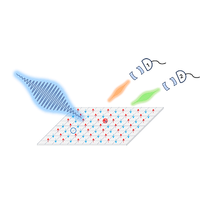
The remarkable behaviors of materials—such as superconductivity and magnetism—arise from complex correlations among electrons. Much of condensed matter physics focuses on uncovering these correlations experimentally and explaining them theoretically. Traditional measurements, such as electrical conductivity or magnetic susceptibility, each probe a specific type of electronic correlation. Yet, given the vast range of electronic systems that remain poorly understood, researchers need new tools that can access many more types of correlations than current techniques allow. We propose an approach that borrows tools from quantum optics to probe electronic correlations that have so far been out of reach.
Typical optical experiments measure only the intensity of light scattered from a material—that is, how many photons are detected. But in quantum optics, far more detailed measurements are possible, including two-photon correlations and phase-sensitive quadrature correlations. We establish a direct “dictionary” linking each of these optical observables to the electronic correlations they reveal. Using this framework, we show how such measurements could, for instance, access spin chirality—a property describing how spins twist collectively—or detect “anyons,” exotic excitations that obey fractional statistics.
Our work opens a new frontier for exploring quantum materials by showing how the quantum properties of light can encode the quantum properties of matter.
Article Text
References (134)
- D. Arovas, J. R. Schrieffer, and F. Wilczek, Fractional statistics and the quantum Hall effect, Phys. Rev. Lett. 53, 722 (1984).
- X.-G. Wen and Q. Niu, Ground-state degeneracy of the fractional quantum Hall states in the presence of a random potential and on high-genus Riemann surfaces, Phys. Rev. B 41, 9377 (1990).
- X. G. Wen, E. Dagotto, and E. Fradkin, Anyons on a torus, Phys. Rev. B 42, 6110 (1990).
- X.-G. Wen, Topological orders and Chern-Simons theory in strongly correlated quantum liquid, Int. J. Mod. Phys. B 05, 1641 (1991).
- J. Nakamura, S. Liang, G. C. Gardner, and M. J. Manfra, Direct observation of anyonic braiding statistics, Nat. Phys. 16, 931 (2020).
- H. Bartolomei, M. Kumar, R. Bisognin, A. Marguerite, J.-M. Berroir, E. Bocquillon, B. Placais, A. Cavanna, Q. Dong, U. Gennser et al., Fractional statistics in anyon collisions, Science 368, 173 (2020).
- M. B. Hastings, Lieb-Schultz-Mattis in higher dimensions, Phys. Rev. B 69, 104431 (2004).
- M. Oshikawa, Commensurability, excitation gap, and topology in quantum many-particle systems on a periodic lattice, Phys. Rev. Lett. 84, 1535 (2000).
- E. Lieb, T. Schultz, and D. Mattis, Two soluble models of an antiferromagnetic chain, Ann. Phys. (N.Y.) 16, 407 (1961).
- A. Kitaev, Anyons in an exactly solved model and beyond, Ann. Phys. (Amsterdam) 321, 2 (2006).
- J. Knolle and R. Moessner, A field guide to spin liquids, Annu. Rev. Condens. Matter Phys. 10, 451 (2019).
- L. Savary and L. Balents, Quantum spin liquids: A review, Rep. Prog. Phys. 80, 016502 (2016).
- P. A. Lee, From high temperature superconductivity to quantum spin liquid: Progress in strong correlation physics, Rep. Prog. Phys. 71, 012501 (2007).
- P. A. Lee, N. Nagaosa, and X.-G. Wen, Doping a Mott insulator: Physics of high-temperature superconductivity, Rev. Mod. Phys. 78, 17 (2006).
- C. Broholm, R. Cava, S. Kivelson, D. Nocera, M. Norman, and T. Senthil, Quantum spin liquids, Science 367, eaay0668 (2020).
- L. Clark and A. H. Abdeldaim, Quantum spin liquids from a materials perspective, Annu. Rev. Mater. Res. 51, 495 (2021).
- B. Keimer, S. A. Kivelson, M. R. Norman, S. Uchida, and J. Zaanen, From quantum matter to high-temperature superconductivity in copper oxides, Nature (London) 518, 179 (2015).
- E. Y. Andrei, D. K. Efetov, P. Jarillo-Herrero, A. H. MacDonald, K. F. Mak, T. Senthil, E. Tutuc, A. Yazdani, and A. F. Young, The Marvels of moiré materials, Nat. Rev. Mater. 6, 201 (2021).
- K. F. Mak and J. Shan, Semiconductor moiré materials, Nat. Nanotechnol. 17, 686 (2022).
- T. P. Devereaux and R. Hackl, Inelastic light scattering from correlated electrons, Rev. Mod. Phys. 79, 175 (2007).
- D. Wulferding, Y. Choi, W. Lee, and K.-Y. Choi, Raman spectroscopic diagnostic of quantum spin liquids, J. Phys. Condens. Matter 32, 043001 (2019).
- B. S. Shastry and B. I. Shraiman, Theory of Raman scattering in Mott-Hubbard systems, Phys. Rev. Lett. 65, 1068 (1990).
- B. S. Shastry and B. I. Shraiman, Raman scattering in Mott-Hubbard systems, Int. J. Mod. Phys. B 05, 365 (1991).
- W.-H. Ko, Z.-X. Liu, T.-K. Ng, and P. A. Lee, Raman signature of the u (1) Dirac spin-liquid state in the spin-1 2 kagome system, Phys. Rev. B 81, 024414 (2010).
- J. Nasu, J. Knolle, D. L. Kovrizhin, Y. Motome, and R. Moessner, Fermionic response from fractionalization in an insulating two-dimensional magnet, Nat. Phys. 12, 912 (2016).
- Y. Wang, G. B. Osterhoudt, Y. Tian, P. Lampen-Kelley, A. Banerjee, T. Goldstein, J. Yan, J. Knolle, H. Ji, R. J. Cava et al., The range of non-Kitaev terms and fractional particles in , npj Quantum Mater. 5, 14 (2020).
- G. Nambiar, D. Bulmash, and V. Galitski, Monopole Josephson effects in a Dirac spin liquid, Phys. Rev. Res. 5, 013169 (2023).
- N. B. Perkins, G.-W. Chern, and W. Brenig, Raman scattering in a Heisenberg antiferromagnet on the anisotropic triangular lattice, Phys. Rev. B 87, 174423 (2013).
- Y. Wan and N. P. Armitage, Resolving continua of fractional excitations by spinon echo in THz 2D coherent spectroscopy, Phys. Rev. Lett. 122, 257401 (2019).
- F. Mahmood, D. Chaudhuri, S. Gopalakrishnan, R. Nandkishore, and N. Armitage, Observation of a marginal Fermi glass, Nat. Phys. 17, 627 (2021).
- M. Fava, S. Biswas, S. Gopalakrishnan, R. Vasseur, and S. Parameswaran, Hydrodynamic nonlinear response of interacting integrable systems, Proc. Natl. Acad. Sci. U.S.A. 118, e2106945118 (2021).
- W. Choi, K. H. Lee, and Y. B. Kim, Theory of two-dimensional nonlinear spectroscopy for the Kitaev spin liquid, Phys. Rev. Lett. 124, 117205 (2020).
- R. M. Nandkishore, W. Choi, and Y. B. Kim, Spectroscopic fingerprints of gapped quantum spin liquids, both conventional and fractonic, Phys. Rev. Res. 3, 013254 (2021).
- O. Hart and R. Nandkishore, Extracting spinon self-energies from two-dimensional coherent spectroscopy, Phys. Rev. B 107, 205143 (2023).
- E. J. König, P. Coleman, and A. M. Tsvelik, Spin magnetometry as a probe of stripe superconductivity in twisted bilayer graphene, Phys. Rev. B 102, 104514 (2020).
- Z.-L. Li, M. Oshikawa, and Y. Wan, Photon echo from lensing of fractional excitations in tomonaga-Luttinger spin liquid, Phys. Rev. X 11, 031035 (2021).
- G. B. Sim, J. Knolle, and F. Pollmann, Nonlinear spectroscopy of bound states in perturbed Ising spin chains, Phys. Rev. B 107, L100404 (2023).
- G. B. Sim, F. Pollmann, and J. Knolle, Microscopic details of two-dimensional spectroscopy of one-dimensional quantum Ising magnets, Phys. Rev. B 108, 134423 (2023).
- M. K. Negahdari and A. Langari, Nonlinear response of the Kitaev honeycomb lattice model in a weak magnetic field, Phys. Rev. B 107, 134404 (2023).
- Q. Gao, Y. Liu, H. Liao, and Y. Wan, Two-dimensional coherent spectrum of interacting spinons from matrix product states, Phys. Rev. B 107, 165121 (2023).
- M. Potts, R. Moessner, and O. Benton, Exploiting polarization dependence in two-dimensional coherent spectroscopy: Examples of and , Phys. Rev. B 109, 104435 (2024).
- Z. Zhang, F. Y. Gao, J. B. Curtis, Z.-J. Liu, Y.-C. Chien, A. von Hoegen, M. T. Wong, T. Kurihara, T. Suemoto, P. Narang et al., Terahertz field-induced nonlinear coupling of two magnon modes in an antiferromagnet, Nat. Phys. 20, 801 (2024).
- S. A. Parameswaran and S. Gopalakrishnan, Asymptotically exact theory for nonlinear spectroscopy of random quantum magnets, Phys. Rev. Lett. 125, 237601 (2020).
- F. Gerken, T. Posske, S. Mukamel, and M. Thorwart, Unique signatures of topological phases in two-dimensional thz spectroscopy, Phys. Rev. Lett. 129, 017401 (2022).
- E. Z. Zhang, C. Hickey, and Y. B. Kim, Disentangling spin excitation continua in classical and quantum magnets using two-dimensional nonlinear spectroscopy, Phys. Rev. B 110, 104415 (2024).
- O. Krupnitska and W. Brenig, Finite-temperature second harmonic generation in Kitaev magnets, Phys. Rev. B 108, 075120 (2023).
- Y. Watanabe, S. Trebst, and C. Hickey, Revealing quadrupolar excitations with nonlinear spectroscopy, Phys. Rev. Lett. 134, 106703 (2025).
- Z. Alpichshev, E. J. Sie, F. Mahmood, G. Cao, and N. Gedik, Origin of the exciton mass in the frustrated Mott insulator , Phys. Rev. B 96, 235141 (2017).
- T. P. Devereaux, M. Claassen, X.-X. Huang, M. Zaletel, J. E. Moore, D. Morr, F. Mahmood, P. Abbamonte, and Z.-X. Shen, Angle-resolved pair photoemission theory for correlated electrons, Phys. Rev. B 108, 165134 (2023).
- M. McGinley, M. Fava, and S. A. Parameswaran, Signatures of fractional statistics in nonlinear pump-probe spectroscopy, Phys. Rev. Lett. 132, 066702 (2024).
- M. McGinley, M. Fava, and S. A. Parameswaran, Anomalous thermal relaxation and pump-probe spectroscopy of two-dimensional topologically ordered systems, Phys. Rev. B 109, 075108 (2024).
- W. T. Tai and M. Claassen, Quantum-geometric light-matter coupling in correlated quantum materials, arXiv:2303.01597.
- Y.-R. Shen, Principles of Nonlinear Optics (Wiley-Interscience, New York, 1984).
- A. Gelzinis, R. Augulis, V. Butkus, B. Robert, and L. Valkunas, Two-dimensional spectroscopy for non-specialists, Biochim. Biophys. Acta (BBA) 1860, 271 (2019).
- C. L. Smallwood and S. T. Cundiff, Multidimensional coherent spectroscopy of semiconductors, Laser Photonics Rev. 12, 1800171 (2018).
- K. Kobayashi and M. Hashisaka, Shot noise in mesoscopic systems: From single particles to quantum liquids, J. Phys. Soc. Jpn. 90, 102001 (2021).
- L. Saminadayar, D. C. Glattli, Y. Jin, and B. Etienne, Observation of the fractionally charged Laughlin quasiparticle, Phys. Rev. Lett. 79, 2526 (1997).
- R. De-Picciotto, M. Reznikov, M. Heiblum, V. Umansky, G. Bunin, and D. Mahalu, Direct observation of a fractional charge, Physica (Amsterdam) 249B, 395 (1998).
- K. M. Bastiaans, D. Chatzopoulos, J.-F. Ge, D. Cho, W. O. Tromp, J. M. van Ruitenbeek, M. H. Fischer, P. J. de Visser, D. J. Thoen, E. F. Driessen et al., Direct evidence for Cooper pairing without a spectral gap in a disordered superconductor above Tc, Science 374, 608 (2021).
- P. Zhou, L. Chen, Y. Liu, I. Sochnikov, A. T. Bollinger, M.-G. Han, Y. Zhu, X. He, I. Bozović, and D. Natelson, Electron pairing in the pseudogap state revealed by shot noise in copper oxide junctions, Nature (London) 572, 493 (2019).
- L. Chen, D. T. Lowder, E. Bakali, A. M. Andrews, W. Schrenk, M. Waas, R. Svagera, G. Eguchi, L. Prochaska, Y. Wang et al., Shot noise in a strange metal, Science 382, 907 (2023).
- D. E. Chang, V. Vuletić, and M. D. Lukin, Quantum nonlinear optics—photon by photon, Nat. Photonics 8, 685 (2014).
- R. H. Brown and R. Q. Twiss, Correlation between photons in two coherent beams of light, Nature (London) 177, 27 (1956).
The correction due to retardation is clarified in Eq. (8) in Sec. 3b.
Strictly speaking, only the many-body states connected through application of local operators on the ground state split into distinct charge and spin sectors.
- V. Kalmeyer and R. B. Laughlin, Equivalence of the resonating-valence-bond and fractional quantum Hall states, Phys. Rev. Lett. 59, 2095 (1987).
- X.-G. Wen, F. Wilczek, and A. Zee, Chiral spin states and superconductivity, Phys. Rev. B 39, 11413 (1989).
- S.-S. Gong, W. Zhu, and D. Sheng, Emergent chiral spin liquid: Fractional quantum Hall effect in a kagome Heisenberg model, Sci. Rep. 4, 6317 (2014).
- Y.-C. He, D. N. Sheng, and Y. Chen, Chiral spin liquid in a frustrated anisotropic kagome Heisenberg model, Phys. Rev. Lett. 112, 137202 (2014).
- C. Hickey, L. Cincio, Z. Papić, and A. Paramekanti, Haldane-Hubbard Mott insulator: From tetrahedral spin crystal to chiral spin liquid, Phys. Rev. Lett. 116, 137202 (2016).
- A. Wietek and A. M. Läuchli, Chiral spin liquid and quantum criticality in extended 2 Heisenberg models on the triangular lattice, Phys. Rev. B 95, 035141 (2017).
- T. Cookmeyer, J. Motruk, and J. E. Moore, Four-spin terms and the origin of the chiral spin liquid in Mott insulators on the triangular lattice, Phys. Rev. Lett. 127, 087201 (2021).
- P. A. Lee and N. Nagaosa, Gauge theory of the normal state of high-Tc superconductors, Phys. Rev. B 46, 5621 (1992).
- X.-Y. Song, C. Wang, A. Vishwanath, and Y.-C. He, Unifying description of competing orders in two-dimensional quantum magnets, Nat. Commun. 10, 4254 (2019).
- M. Hafezi, D. E. Chang, V. Gritsev, E. A. Demler, and M. D. Lukin, Photonic quantum transport in a nonlinear optical fiber, Europhys. Lett. 94, 54006 (2011).
- A. V. Gorshkov, J. Otterbach, M. Fleischhauer, T. Pohl, and M. D. Lukin, Photon-photon interactions via Rydberg blockade, Phys. Rev. Lett. 107, 133602 (2011).
- D. P. Arovas, E. Berg, S. A. Kivelson, and S. Raghu, The Hubbard model, Annu. Rev. Condens. Matter Phys. 13, 239 (2022).
- M. Qin, T. Schäfer, S. Andergassen, P. Corboz, and E. Gull, The Hubbard model: A computational perspective, Annu. Rev. Condens. Matter Phys. 13, 275 (2022).
- Y. Yang, M. Li, I. Rousochatzakis, and N. B. Perkins, Non-Loudon-Fleury Raman scattering in spin-orbit coupled Mott insulators, Phys. Rev. B 104, 144412 (2021).
- J. Dalibard and S. Reynaud, Correlation signals in resonance fluorescence: Interpretation via photon scattering amplitudes, J. Phys. 44, 1337 (1983).
- J. K. Freericks, H. R. Krishnamurthy, and T. Pruschke, Theoretical description of time-resolved photoemission spectroscopy: Application to pump-probe experiments, Phys. Rev. Lett. 102, 136401 (2009).
- Y. Wang, Y. Chen, C. Jia, B. Moritz, and T. P. Devereaux, Time-resolved resonant inelastic x-ray scattering in a pumped Mott insulator, Phys. Rev. B 101, 165126 (2020).
- P. Fleury and R. Loudon, Scattering of light by one-and two-magnon excitations, Phys. Rev. 166, 514 (1968).
- L. Masters, X.-X. Hu, M. Cordier, G. Maron, L. Pache, A. Rauschenbeutel, M. Schemmer, and J. Volz, On the simultaneous scattering of two photons by a single two-level atom, Nat. Photonics 17, 972 (2023).
- V. V. Orre, E. A. Goldschmidt, A. Deshpande, A. V. Gorshkov, V. Tamma, M. Hafezi, and S. Mittal, Interference of temporally distinguishable photons using frequency-resolved detection, Phys. Rev. Lett. 123, 123603 (2019).
- P. A. Lee and N. Nagaosa, Proposal to use neutron scattering to access scalar spin chirality fluctuations in kagome lattices, Phys. Rev. B 87, 064423 (2013).
- F. B. Gallagher and S. Mazumdar, Excitons and optical absorption in one-dimensional extended Hubbard models with short-and long-range interactions, Phys. Rev. B 56, 15025 (1997).
- F. H. L. Essler, F. Gebhard, and E. Jeckelmann, Excitons in one-dimensional Mott insulators, Phys. Rev. B 64, 125119 (2001).
- P. Wróbel and R. Eder, Excitons in Mott insulators, Phys. Rev. B 66, 035111 (2002).
- T. Tohyama, H. Onodera, K. Tsutsui, and S. Maekawa, Resonant two-magnon Raman scattering and photoexcited states in two-dimensional Mott insulators, Phys. Rev. Lett. 89, 257405 (2002).
- A. Maeda, M. Ono, H. Kishida, T. Manako, A. Sawa, M. Kawasaki, Y. Tokura, and H. Okamoto, Third-order nonlinear susceptibility spectra of chain compounds investigated by the Z-scan method, Phys. Rev. B 70, 125117 (2004).
- H. Matsueda, T. Tohyama, and S. Maekawa, Excitonic effect on the optical response in the one-dimensional two-band Hubbard model, Phys. Rev. B 71, 153106 (2005).
- M. Ono, H. Kishida, and H. Okamoto, Direct observation of excitons and a continuum of one-dimensional Mott insulators: A reflection-type third-harmonic-generation study of Ni-halogen chain compounds, Phys. Rev. Lett. 95, 087401 (2005).
- T. Tohyama, Symmetry of photoexcited states and large-shift Raman scattering in two-dimensional Mott insulators, J. Phys. Soc. Jpn. 75, 034713 (2006).
- A. Gössling, R. Schmitz, H. Roth, M. W. Haverkort, T. Lorenz, J. Mydosh, E. Müller-Hartmann, and M. Grüninger, Mott-Hubbard exciton in the optical conductivity of and , Phys. Rev. B 78, 075122 (2008).
- F. Novelli, D. Fausti, J. Reul, F. Cilento, P. H. M. Van Loosdrecht, A. A. Nugroho, T. T. M. Palstra, M. Grüninger, and F. Parmigiani, Ultrafast optical spectroscopy of the lowest energy excitations in the Mott insulator compound YVO3: Evidence for Hubbard-type excitons, Phys. Rev. B 86, 165135 (2012).
- J. Kim, M. Daghofer, A. Said, T. Gog, J. Van den Brink, G. Khaliullin, and B. Kim, Excitonic quasiparticles in a spin–orbit Mott insulator, Nat. Commun. 5, 4453 (2014).
- S. Zhou, Y. Wang, and Z. Wang, Doublon-holon binding, Mott transition, and fractionalized antiferromagnet in the Hubbard model, Phys. Rev. B 89, 195119 (2014).
- T.-S. Huang, C. L. Baldwin, M. Hafezi, and V. Galitski, Spin-mediated Mott excitons, Phys. Rev. B 107, 075111 (2023).
- O. Mehio, X. Li, H. Ning, Z. Lenarčič, Y. Han, M. Buchhold, Z. Porter, N. J. Laurita, S. D. Wilson, and D. Hsieh, A Hubbard exciton fluid in a photo-doped antiferromagnetic Mott insulator, Nat. Phys. 19, 1876 (2023).
- M. L. Goldberger and K. M. Watson, Collision Theory (Courier Corporation, Rockland, ME, 2004).
- J. P. K. Ngaha, Frequency-filtered photon correlations, Ph.D. thesis, ResearchSpace@ Auckland, 2023.
- P. Upadhyay, D. G. Suárez-Forero, T.-S. Huang, M. J. Mehrabad, B. Gao, S. Sarkar, D. Session, K. Watanabe, T. Taniguchi, Y. Zhou et al., Giant enhancement of exciton diffusion near an electronic Mott insulator, arXiv:2409.18357.
- M. O. Scully and M. S. Zubairy, Quantum Optics (Cambridge University Press, Cambridge, England, 1997).
- D. F. Walls and G. J. Milburn, Quantum Optics (Springer, Berlin, Heidelberg, 2008).
- V. Boyer, A. M. Marino, R. C. Pooser, and P. D. Lett, Entangled images from four-wave mixing, Science 321, 544 (2008).
- L. E. De Araujo, Z. Zhou, M. DiMario, B. Anderson, J. Zhao, K. M. Jones, and P. D. Lett, Characterizing two-mode-squeezed light from four-wave mixing in rubidium vapor for quantum sensing and information processing, Opt. Express 32, 1305 (2024).
- B. J. Kim, H. Jin, S. J. Moon, J.-Y. Kim, B.-G. Park, C. S. Leem, J. Yu, T. W. Noh, C. Kim, S.-J. Oh, J. H. Park, V. Durairaj, G. Cao, and E. Rotenberg, Novel Mott state induced by relativistic spin-orbit coupling in , Phys. Rev. Lett. 101, 076402 (2008).
- Y. Tang, L. Li, T. Li, Y. Xu, S. Liu, K. Barmak, K. Watanabe, T. Taniguchi, A. H. MacDonald, J. Shan et al., Simulation of Hubbard model physics in moiré superlattices, Nature (London) 579, 353 (2020).
- J. Li, D. Golez, G. Mazza, A. J. Millis, A. Georges, and M. Eckstein, Electromagnetic coupling in tight-binding models for strongly correlated light and matter, Phys. Rev. B 101, 205140 (2020).
- O. Dmytruk and M. Schiró, Gauge fixing for strongly correlated electrons coupled to quantum light, Phys. Rev. B 103, 075131 (2021).
It may appear from the definition of that this phase is . But this reduces to after using the function that imposes energy conservation and after getting rid of overall phases independent of indices , , and .
For Eqs. (76) and (77) to hold, we want , so that the spin operators () do not interfere with the charge operators (, ). Therefore, the approximation is justified, only if is much greater than the bandwidth of matter excitations. Since this bandwidth can be at most the tunneling , the approximation is justified in our setting.
- A. Christ, K. Laiho, A. Eckstein, K. N. Cassemiro, and C. Silberhorn, Probing multimode squeezing with correlation functions, New J. Phys. 13, 033027 (2011).
- M.-A. Lemonde, N. Didier, and A. A. Clerk, Antibunching and unconventional photon blockade with Gaussian squeezed states, Phys. Rev. A 90, 063824 (2014).
- A. Grankin, E. Brion, R. Boddeda, S. Ćuk, I. Usmani, A. Ourjoumtsev, and P. Grangier, Inelastic photon scattering via the intracavity Rydberg blockade, Phys. Rev. Lett. 117, 253602 (2016).
- T. Holstein and H. Primakoff, Field dependence of the intrinsic domain magnetization of a ferromagnet, Phys. Rev. 58, 1098 (1940).
- A. Altland and B. D. Simons, Condensed Matter Field Theory (Cambridge University Press, Cambridge, England, 2010).
Being in different symmetry channels, cannot annihilate anyons created by and vice versa.
- M. Liu, A. J. Sternbach, and D. Basov, Nanoscale electrodynamics of strongly correlated quantum materials, Rep. Prog. Phys. 80, 014501 (2016).
- T.-S. Huang, A. Grankin, Y.-X. Wang, and M. Hafezi, Optical engineering and detection of magnetism in moir\’e semiconductors, arXiv:2504.13758.
- S. Miao, T. Wang, X. Huang, D. Chen, Z. Lian, C. Wang, M. Blei, T. Taniguchi, K. Watanabe, S. Tongay et al., Strong interaction between interlayer excitons and correlated electrons in moiré superlattice, Nat. Commun. 12, 3608 (2021).
- Z. Lian, Y. Meng, L. Ma, I. Maity, L. Yan, Q. Wu, X. Huang, D. Chen, X. Chen, X. Chen et al., Valley-polarized excitonic Mott insulator in moiré superlattice, Nat. Phys. 20, 34 (2024).
- R. Xiong, J. H. Nie, S. L. Brantly, P. Hays, R. Sailus, K. Watanabe, T. Taniguchi, S. Tongay, and C. Jin, Correlated insulator of excitons in moiré superlattices, Science 380, 860 (2023).
- B. Gao, D. G. Suárez-Forero, S. Sarkar, T.-S. Huang, D. Session, M. J. Mehrabad, R. Ni, M. Xie, P. Upadhyay, J. Vannucci et al., Excitonic Mott insulator in a Bose-Fermi-Hubbard system of moiré heterobilayer, Nat. Commun. 15, 2305 (2024).
- C. Kuhlenkamp, W. Kadow, A. Imamoğlu, and M. Knap, Chiral pseudospin liquids in moiré heterostructures, Phys. Rev. X 14, 021013 (2024).
- F. Glerean, E. M. Rigoni, G. Jarc, S. Y. Mathengattil, A. Montanaro, F. Giusti, M. Mitrano, F. Benatti, and D. Fausti, Ultrafast pump-probe phase-randomized tomography, Light 14, 115 (2025).
- H. Park, J. Cai, E. Anderson, Y. Zhang, J. Zhu, X. Liu, C. Wang, W. Holtzmann, C. Hu, Z. Liu et al., Observation of fractionally quantized anomalous Hall effect, Nature (London) 622, 74 (2023).
- R. Yao, S. Chi, M. Wang, R. J. Fletcher, and M. Zwierlein, Measuring pair correlations in Bose and Fermi gases via atom-resolved microscopy, Phys. Rev. Lett. 134, 183402 (2025).
- T. Graß, U. Bhattacharya, J. Sell, and M. Hafezi, Two-dimensional excitons from twisted light and the fate of the photon’s orbital angular momentum, Phys. Rev. B 105, 205202 (2022).
- D. Session, M. Jalali Mehrabad, N. Paithankar, T. Grass, C. J. Eckhardt, B. Cao, D. Gustavo Suárez Forero, K. Li, M. S. Alam, K. Watanabe et al., Optical pumping of electronic quantum Hall states with vortex light, Nat. Photonics 19, 156 (2025).
- A. Grankin, M. Hafezi, and V. M. Galitski, Enhancement of superconductivity with external phonon squeezing, Phys. Rev. B 104, L220503 (2021).
- L. Grunwald, E. V. n. Boström, M. K. Svendsen, D. M. Kennes, and A. Rubio, Cavity spectroscopy for strongly correlated polaritonic systems, Phys. Rev. Lett. 134, 246901 (2025).
- B. Kass, S. Talkington, A. Srivastava, and M. Claassen, Many-body photon blockade and quantum light generation from cavity quantum materials, arXiv:2411.08964.

