

- Open Access
Eigenstate Thermalization in Thermal First-Order Phase Transitions
Phys. Rev. X 16, 031042 – Published 18 August, 2026
DOI: https://doi.org/10.1103/4zs8-7kf4
Abstract
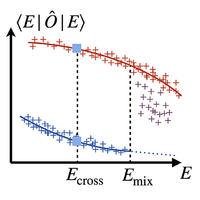
The eigenstate thermalization hypothesis (ETH) posits how isolated quantum many-body systems thermalize, assuming that individual eigenstates at the same energy density have identical expectation values of local observables in the limit of large systems. While the ETH apparently holds across a wide range of interacting quantum systems, in this work, we show that it may require generalization in the presence of thermal first-order phase transitions. We introduce a class of all-to-all spin models, featuring first-order thermal phase transitions that stem from two distinct local maxima of entropy (two mean-field solutions that we dub “branches”) that exchange dominance in the many-body density of states as the energy is varied. We argue that, for energies in the vicinity of the thermal phase transition, eigenstate expectation values do not need to converge to the same thermal value. The system has a regime with coexistence of two classes of eigenstates corresponding to the two branches with distinct expectation values at the same energy density and another regime with Schrödinger-cat-like eigenstates that are interbranch superpositions; these two regimes are separated by an eigenstate phase transition. We propose a more general form of the ETH Ansatz, support our results by semiclassical calculations and an exact diagonalization study of a microscopic spin model, and argue that the structure of eigenstates in the vicinity of thermal first-order phase transitions can be experimentally probed via nonequilibrium dynamics.
Physics Subject Headings (PhySH)
Popular Summary
How does an isolated quantum system, undisturbed by any outside environment, reach thermal equilibrium on its own? The standard explanation, called the eigenstate thermalization hypothesis, assumes that every quantum eigenstate looks like the thermal state with the same energy. We show that this assumption breaks down when the system undergoes a thermal first-order phase transition—the abrupt kind of change seen when water boils. Using a model of many interacting spins, we find, as supported by analytical calculations and numerical simulations, that quantum eigenstates near the transition split into two families with sharply different properties, or merge into Schrödinger-cat states that are macroscopic superpositions of both phases at once. We propose a generalized hypothesis that captures both behaviors, and suggest signatures of such eigenstates in dynamics. Because such phase transitions are common, our results suggest that many quantum systems available in modern quantum simulators may realize this behavior.
Article Text
References (50)
- J. M. Deutsch, Quantum statistical mechanics in a closed system, Phys. Rev. A 43, 2046 (1991).
- M. Srednicki, Chaos and quantum thermalization, Phys. Rev. E 50, 888 (1994).
- M. Rigol, V. Dunjko, and M. Olshanii, Thermalization and its mechanism for generic isolated quantum systems, Nature (London) 452, 854 (2008).
- L. D’Alessio, Y. Kafri, A. Polkovnikov, and M. Rigol, From quantum chaos and eigenstate thermalization to statistical mechanics and thermodynamics, Adv. Phys. 65, 239 (2016).
- A. Nahum, J. Ruhman, S. Vijay, and J. Haah, Quantum entanglement growth under random unitary dynamics, Phys. Rev. X 7, 031016 (2017).
- V. Khemani, A. Vishwanath, and D. A. Huse, Operator spreading and the emergence of dissipative hydrodynamics under unitary evolution with conservation laws, Phys. Rev. X 8, 031057 (2018).
- R. Nandkishore and D. A. Huse, Many-body localization and thermalization in quantum statistical mechanics, Annu. Rev. Condens. Matter Phys. 6, 15 (2015).
- D. A. Abanin, E. Altman, I. Bloch, and M. Serbyn, Colloquium: Many-body localization, thermalization, and entanglement, Rev. Mod. Phys. 91, 021001 (2019).
- M. Serbyn, D. A. Abanin, and Z. Papić, Quantum many-body scars and weak breaking of ergodicity, Nat. Phys. 17, 675 (2021).
- S. Moudgalya, B. A. Bernevig, and N. Regnault, Quantum many-body scars and Hilbert space fragmentation: A review of exact results, Rep. Prog. Phys. 85, 086501 (2022).
- A. Chandran, T. Iadecola, V. Khemani, and R. Moessner, Quantum many-body scars: A quasiparticle perspective, Annu. Rev. Condens. Matter Phys. 14, 443 (2023).
- K. Binder, Theory of first-order phase transitions, Rep. Prog. Phys. 50, 783 (1987).
- W. Thirring, Systems with negative specific heat, Z. Phys. A Hadrons Nucl. 235, 339 (1970).
- D. H. E. Gross, Microcanonical Thermodynamics: Phase Transitions in “Small” Systems (World Scientific, Singapore, 2001).
- H. Lipkin, N. Meshkov, and A. Glick, Validity of many-body approximation methods for a solvable model: (I). Exact solutions and perturbation theory, Nucl. Phys. 62, 188 (1965).
- B. Zhao, M. C. Kerridge, and D. A. Huse, Three species Of Schrödinger cat states in an infinite-range spin model, Phys. Rev. E 90, 022104 (2014).
- K. R. Fratus and M. Srednicki, Eigenstate thermalization in systems with spontaneously broken symmetry, Phys. Rev. E 92, 040103(R) (2015).
- K. R. Fratus and M. Srednicki, Eigenstate thermalization and spontaneous symmetry breaking in the one-dimensional transverse-field ising model with power-law interactions, arXiv:1611.03992.
- R. Mondaini, K. R. Fratus, M. Srednicki, and M. Rigol, Eigenstate thermalization in the two-dimensional transverse field Ising model, Phys. Rev. E 93, 032104 (2016).
- C. L. Baldwin, C. R. Laumann, A. Pal, and A. Scardicchio, Clustering of nonergodic eigenstates in quantum spin glasses, Phys. Rev. Lett. 118, 127201 (2017).
- N. Defenu, T. Donner, T. Macri, G. Pagano, S. Ruffo, and A. Trombettoni, Long-range interacting quantum systems, Rev. Mod. Phys. 95, 035002 (2023).
- O. Castaños, R. López-Peña, J. G. Hirsch, and E. López-Moreno, Classical and quantum phase transitions in the Lipkin-Meshkov-Glick model, Phys. Rev. B 74, 104118 (2006).
- T. Jörg, F. Krzakala, J. Kurchan, A. C. Maggs, and J. Pujos, Energy gaps in quantum first-order mean-field–like transitions: The problems that quantum annealing cannot solve, Europhys. Lett. 89, 40004 (2010).
- M. Filippone, S. Dusuel, and J. Vidal, Quantum phase transitions in fully connected spin models: An entanglement perspective, Phys. Rev. A 83, 022327 (2011).
- Y. Seki and H. Nishimori, Quantum annealing with antiferromagnetic fluctuations, Phys. Rev. E 85, 051112 (2012).
- V. Bapst and G. Semerjian, On quantum mean-field models and their quantum annealing, J. Stat. Mech. (2012) P06007.
- A. Nava and M. Fabrizio, Lindblad dissipative dynamics in the presence of phase coexistence, Phys. Rev. B 100, 125102 (2019).
- A. Morningstar, D. A. Huse, and V. Khemani, Universality classes of thermalization for mesoscopic Floquet systems, Phys. Rev. B 108, 174303 (2023).
- M. Srednicki, The approach to thermal equilibrium in quantized chaotic systems, J. Phys. A 32, 1163 (1999).
- M. Serbyn, Z. Papic, and D. A. Abanin, Thouless energy and multifractality across the many-body localization transition, Phys. Rev. B 96, 104201 (2017).
- C. L. Bertrand and A. M. García-García, Anomalous thouless energy and critical statistics on the metallic side of the many-body localization transition, Phys. Rev. B 94, 144201 (2016).
- M. Sonner, M. Serbyn, Z. Papić, and D. A. Abanin, Thouless energy across the many-body localization transition in Floquet systems, Phys. Rev. B 104, L081112 (2021).
- S. J. Garratt, S. Roy, and J. T. Chalker, Local resonances and parametric level dynamics in the many-body localized phase, Phys. Rev. B 104, 184203 (2021).
- S. J. Garratt and S. Roy, Resonant energy scales and local observables in the many-body localized phase, Phys. Rev. B 106, 054309 (2022).
- C. J. Turner, A. A. Michailidis, D. A. Abanin, M. Serbyn, and Z. Papić, Quantum scarred eigenstates in a Rydberg atom chain: Entanglement, breakdown of thermalization, and stability to perturbations, Phys. Rev. B 98, 155134 (2018).
- T. P. Billam, R. Gregory, F. Michel, and I. G. Moss, Simulating seeded vacuum decay in a cold atom system, Phys. Rev. D 100, 065016 (2019).
- S. Abel and M. Spannowsky, Quantum-field-theoretic simulation platform for observing the fate of the false vacuum, PRX Quantum 2, 010349 (2021).
- K. L. Ng, B. Opanchuk, M. Thenabadu, M. Reid, and P. D. Drummond, Fate of the false vacuum: Finite temperature, entropy, and topological phase in quantum simulations of the early universe, PRX Quantum 2, 010350 (2021).
- G. Lagnese, F. M. Surace, M. Kormos, and P. Calabrese, False vacuum decay in quantum spin chains, Phys. Rev. B 104, L201106 (2021).
- J. Vodeb, J.-Y. Desaules, A. Hallam, A. Rava, G. Humar, D. Willsch, F. Jin, M. Willsch, K. Michielsen, and Z. Papić, Stirring the false vacuum via interacting quantized bubbles on a 5,564-qubit quantum annealer, Nat. Phys. 21, 386 (2025).
- R. Blatt and C. F. Roos, Quantum simulations with trapped ions, Nat. Phys. 8, 277 (2012).
- M. H. Devoret and R. J. Schoelkopf, Superconducting circuits for quantum information: An outlook, Science 339, 1169 (2013).
- Y. Wang et al., Thermal first-order phase transitions in power-law interacting spin chains (to be published).
- S. Pappalardi, L. Foini, and J. Kurchan, Eigenstate thermalization hypothesis and free probability, Phys. Rev. Lett. 129, 170603 (2022).
- C. Yin, F. M. Surace, and A. Lucas, Theory of metastable states in many-body quantum systems, Phys. Rev. X 15, 011064 (2025).
- C.-F. Chen, H.-Y. Huang, J. Preskill, and L. Zhou, Local minima in quantum systems, Nat. Phys. 21, 654 (2025).
- M. Enz and R. Schilling, Spin tunnelling in the semiclassical limit, J. Phys. C 19, 1765 (1986).
- D. Loss, D. P. DiVincenzo, and G. Grinstein, Suppression of tunneling by interference in half-integer-spin particles, Phys. Rev. Lett. 69, 3232 (1992).
- V. I. Belinicher, C. Providencia, and J. da Providencia, Instanton picture of the spin tunnelling in the Lipkin–Meshkov–Glick model, J. Phys. A 30, 5633 (1997).
- A. Garg, E. Kochetov, K. S. Park, and M. Stone, Spin coherent-state path integrals and the instanton calculus, J. Math. Phys. (N.Y.) 44, 48 (2003).

