

- Featured in Physics
- Open Access
Kolmogorov-Arnold Networks Meet Science
Phys. Rev. X 15, 041051 – Published 17 December, 2025
DOI: https://doi.org/10.1103/4t7t-v19l
Abstract
A major challenge of AI plus science lies in its inherent incompatibility: Today’s AI is primarily based on connectionism, while science depends on symbolism. To bridge the two worlds, we propose a framework to seamlessly synergize Kolmogorov-Arnold networks (KANs) and science. The framework highlights KANs’ usage for three aspects of scientific discovery: identifying relevant features, revealing modular structures, and discovering symbolic formulas. The synergy is bidirectional: science to KAN (incorporating scientific knowledge into KANs), and KAN to science (extracting scientific insights from KANs). We highlight major new functionalities in pykan: (1) MultKAN, KANs with multiplication nodes, (2) kanpiler, a KAN compiler that compiles symbolic formulas into KANs; (3) tree converter, convert KANs (or any neural networks) into tree graphs. Based on these tools, we demonstrate KANs’ capability to discover various types of physical laws, including conserved quantities, Lagrangians, symmetries, and constitutive laws.
Physics Subject Headings (PhySH)
 Viewpoint

Advancing Physical Understanding with Interpretable Machine Learning
A new artificial neural-network architecture opens a window into the workings of a tool previously regarded as a black box.
See more in Physics
Popular Summary
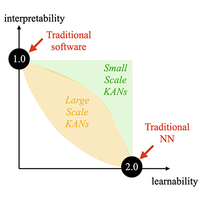
Deep neural networks often achieve excellent predictive performance but struggle with interpretability, making it difficult to use them for generating scientific insights. In this study, we introduce Kolmogorov-Arnold networks (KANs), a new class of neural networks designed to bridge the gap between prediction and explanation. Unlike conventional networks, KANs possess a built-in duality with symbolic formulas, allowing them to both uncover new scientific knowledge and integrate existing theories with ease.
To demonstrate this capability, we apply KANs to a range of physics problems where both data-driven and model-driven approaches are important. By embedding scientific principles directly into the network’s architecture, KANs retain the interpretability of theoretical models while maintaining the expressive power of deep learning. This unique integration enables us to both validate established physical laws and explore potential new ones in ways that were previously out of reach with standard neural networks.
KANs represent a step toward more transparent and scientifically useful machine learning. By combining interpretability with predictive strength, they offer a pathway to transform how we use AI in scientific research. Looking ahead, this framework could accelerate discoveries in physics and beyond, especially in areas where theory and data must be reconciled.
Article Text
References (114)
- J. Jumper, R. Evans, A. Pritzel, T. Green, M. Figurnov, O. Ronneberger, K. Tunyasuvunakool, R. Bates, A. Žídek, A. Potapenko et al., Highly accurate protein structure prediction with alphafold, Nature (London) 596, 583 (2021).
- K. Yang, A. Swope, A. Gu, R. Chalamala, P. Song, S. Yu, S. Godil, R. J. Prenger, and A. Anandkumar, Leandojo: Theorem proving with retrieval-augmented language models, Adv. Neural Inf. Process. Syst. 36, 21573 (2024).
- T. H. Trinh, Y. Wu, Q. V. Le, H. He, and T. Luong, Solving olympiad geometry without human demonstrations, Nature (London) 625, 476 (2024).
- R. Lam, A. Sanchez-Gonzalez, M. Willson, P. Wirnsberger, M. Fortunato, F. Alet, S. Ravuri, T. Ewalds, Z. Eaton-Rosen, W. Hu et al., Learning skillful medium-range global weather forecasting, Science 382, 1416 (2023).
- Z. Liu, Y. Wang, S. Vaidya, F. Ruehle, J. Halverson, M. Soljačić, T. Y. Hou, and M. Tegmark, KAN: Kolmogorov-Arnold networks, arXiv:2404.19756.
- Y. Wang, J. W. Siegel, Z. Liu, and T. Y. Hou, On the expressiveness and spectral bias of KANs, arXiv:2410.01803.
- https://github.com/KindXiaoming/pykan.
If and can be negative, one may choose a large and express . Other constructions include quadratic functions, such as or .
We set for simplicity, but the pykan package allows to be any integer . Users can even set different values for different multiplication nodes. However, if different values are used within the same layer, it can be challenging to parallelize these multiplications.
For subnodes belonging to the multiplication node, the subnodes inherit their scores from the multiplication node.
Other choices can be made based on the perceived importance of each output dimension, though this is less critical when outputs are typically one dimensional.
- Z. Liu, E. Gan, and M. Tegmark, Seeing is believing: Brain-inspired modular training for mechanistic interpretability, Entropy 26, 41 (2023).
- Z. Liu, M. Khona, I. R. Fiete, and M. Tegmark, Growing brains: Co-emergence of anatomical and functional modularity in recurrent neural networks, arXiv:2310.07711.
- S.-M. Udrescu, A. Tan, J. Feng, O. Neto, T. Wu, and M. Tegmark, Ai feynman2.0: Pareto-optimal symbolic regression exploiting graph modularity, Adv. Neural Inf. Process. Syst. 33, 4860 (2020).
- Z. Liu and M. Tegmark, Machine learning conservation laws from trajectories, Phys. Rev. Lett. 126, 180604 (2021).
- Z. Liu, V. Madhavan, and M. Tegmark, Machine learning conservation laws from differential equations, Phys. Rev. E 106, 045307 (2022).
- Z. Liu, P. O. Sturm, S. Bharadwaj, S. J. Silva, and M. Tegmark, Interpretable conservation laws as sparse invariants, Phys. Rev. E 109, L023301 (2024).
- P. Y. Lu, R. Dangovski, and M. Soljačić, Discovering conservation laws using optimal transport and manifold learning, Nat. Commun. 14, 4744 (2023).
- S. Ha and H. Jeong, Discovering conservation laws from trajectories via machine learning, arXiv:2102.04008.
- S. J. Wetzel, R. G. Melko, J. Scott, M. Panju, and V. Ganesh, Discovering symmetry invariants and conserved quantities by interpreting Siamese neural networks, Phys. Rev. Res. 2, 033499 (2020).
- M. Cranmer, S. Greydanus, S. Hoyer, P. Battaglia, D. Spergel, and S. Ho, Lagrangian neural networks, arXiv:2003.04630.
- C. Misner, K. Thorne, and J. Wheeler, Gravitation (Princeton University Press, Princeton, NJ, 2017).
- Z. Liu and M. Tegmark, Machine learning hidden symmetries, Phys. Rev. Lett. 128, 180201 (2022).
- E. J. Michaud, Z. Liu, and M. Tegmark, Precision machine learning, Entropy 25, 175 (2023).
- R. Hooke, Lectures de Potentia Restitutiva, or of Spring Explaining the Power of Springing Bodies (John Martyn, Basel, Switzerland, 2016), 6.
- W. S. Slaughter, The Linearized Theory of Elasticity (Springer Science & Business Media, New York, 2012).
- R. W. Ogden, Non-Linear Elastic Deformations (Courier Corporation, New York, 1997).
- R. v. Mises, Mechanik der festen körper im plastisch-deformablen zustand, Nachr. Ges. Wiss. Gött. Math.-Phys. Klasse 1913, 582 (1913).
- G. K. Batchelor, An Introduction to Fluid Dynamics (Cambridge University Press, Cambridge, England, 2000).
- E. Sifakis and J. Barbic, Fem simulation of 3D deformable solids: A practitioner’s guide to theory, discretization and model reduction, in Acm Siggraph 2012 Courses (Cambridge University Press, Cambridge, England, 2012), pp. 1–50.
- B. Smith, F. D. Goes, and T. Kim, Stable Neo-Hookean flesh simulation, ACM Trans. Graph. 37, 1 (2018).
- E. M. Arruda and M. C. Boyce, A three-dimensional constitutive model for the large stretch behavior of rubber elastic materials, J. Mech. Phys. Solids 41, 389 (1993).
- A. N. Gent, A new constitutive relation for rubber, Rubber Chem. Technol. 69, 59 (1996).
- A. Sanchez-Gonzalez, J. Godwin, T. Pfaff, R. Ying, J. Leskovec, and P. Battaglia, Learning to simulate complex physics with graph networks, in International Conference on Machine Learning (PMLR, Akron, OH, 2020), pp. 8459–8468.
- H. Xu, F. Sin, Y. Zhu, and J. Barbič, Nonlinear material design using principal stretches, ACM Trans. Graph. 34, 1 (2015).
- P. Ma, P. Y. Chen, B. Deng, J. B. Tenenbaum, T. Du, C. Gan, and W. Matusik, Learning neural constitutive laws from motion observations for generalizable PDE dynamics, in International Conference on Machine Learning (PMLR, Cambridge, MA, 2023), pp. 23279–23300.
- P. Ma, T.-H. Wang, M. Guo, Z. Sun, J. B. Tenenbaum, D. Rus, C. Gan, and W. Matusik, Llm and simulation as bilevel optimizers: A new paradigm to advance physical scientific discovery, in Forty-First International Conference on Machine Learning (Proceedings of Machine Learning Research (PMLR), Cambridge, MA, 2024).
- F. Girosi and T. Poggio, Representation properties of networks: Kolmogorov’s theorem is irrelevant, Neural Comput. 1, 465 (1989).
- R. Bresson, G. Nikolentzos, G. Panagopoulos, M. Chatzianastasis, J. Pang, and M. Vazirgiannis, Kagnns: Kolmogorov-Arnold networks meet graph learning, arXiv:2406.18380.
- G. De Carlo, A. Mastropietro, and A. Anagnostopoulos, Kolmogorov-Arnold graph neural networks, arXiv:2406.18354.
- M. Kiamari, M. Kiamari, and B. Krishnamachari, GKAN: Graph Kolmogorov-Arnold networks, arXiv:2406.06470.
- F. Zhang and X. Zhang, GraphKAN: Enhancing feature extraction with graph Kolmogorov Arnold networks, arXiv:2406.13597.
- Y. Wang, J. Sun, J. Bai, C. Anitescu, M. S. Eshaghi, X. Zhuang, T. Rabczuk, and Y. Liu, Kolmogorov Arnold informed neural network: A physics-informed deep learning framework for solving pdes based on Kolmogorov Arnold networks, arXiv:2406.11045.
- K. Shukla, J. D. Toscano, Z. Wang, Z. Zou, and G. E. Karniadakis, A comprehensive and FAIR comparison between MLP and KAN representations for differential equations and operator networks, arXiv:2406.02917.
- D. W. Abueidda, P. Pantidis, and M. E. Mobasher, DeepOKAN: Deep operator network based on Kolmogorov Arnold networks for mechanics problems, arXiv:2405.19143.
- G. Nehma and M. Tiwari, Leveraging KANs for enhanced deep Koopman operator discovery, arXiv:2406.02875.
- J. Lee, Z. Liu, X. Yu, Y. Wang, H. Jeong, M. Y. Niu, and Z. Zhang, KANO: Kolmogorov-Arnold neural operator, arXiv:2509.16825.
- E. Poeta, F. Giobergia, E. Pastor, T. Cerquitelli, and E. Baralis, A benchmarking study of Kolmogorov-Arnold networks on tabular data, arXiv:2406.14529.
- C. J. Vaca-Rubio, L. Blanco, R. Pereira, and M. Caus, Kolmogorov-Arnold networks (KANs) for time series analysis, arXiv:2405.08790.
- R. Genet and H. Inzirillo, TKAN: Temporal Kolmogorov-Arnold networks, arXiv:2405.07344.
- K. Xu, L. Chen, and S. Wang, Kolmogorov-Arnold networks for time series: Bridging predictive power and interpretability, arXiv:2406.02496.
- R. Genet and H. Inzirillo, A temporal Kolmogorov-Arnold transformer for time series forecasting, arXiv:2406.02486.
- M. Liu, S. Bian, B. Zhou, and P. Lukowicz, iKAN: Global incremental learning with KAN for human activity recognition across heterogeneous datasets, arXiv:2406.01646.
- M. Liu, D. Geißler, D. Nshimyimana, S. Bian, B. Zhou, and P. Lukowicz, Initial investigation of Kolmogorov-Arnold networks (KANs) as feature extractors for IMU based human activity recognition, arXiv:2406.11914.
- S. Yang, L. Qin, and X. Yu, Endowing interpretability for neural cognitive diagnosis by efficient Kolmogorov-Arnold networks, arXiv:2405.14399.
- L. F. Herbozo Contreras, J. Cui, L. Yu, Z. Huang, A. Nikpour, and O. Kavehei, KAN-EEG: Towards replacing backbone-MLP for an effective seizure detection system, medRxiv 2024 (2024).
- A. Kundu, A. Sarkar, and A. Sadhu, KANQAS: Kolmogorov Arnold network for quantum architecture search, arXiv:2406.17630.
- X. Li, Z. Feng, Y. Chen, W. Dai, Z. He, Y. Zhou, and S. Jiao, COEFF-KANs: A paradigm to address the electrolyte field with KANs, arXiv:2407.20265.
- T. Ahmed and M. H. R. Sifat, GraphKAN: Graph Kolmogorov Arnold network for small molecule-protein interaction predictions, in ICML’24 Workshop ML for Life and Material Science: From Theory to Industry Applications (2024).
- M. Cheon, Kolmogorov-Arnold network for satellite image classification in remote sensing, arXiv:2406.00600.
- B. Azam and N. Akhtar, Suitability of KANs for computer vision: A preliminary investigation, arXiv:2406.09087.
- C. Li, X. Liu, W. Li, C. Wang, H. Liu, and Y. Yuan, U-KAN makes strong backbone for medical image segmentation and generation, arXiv:2406.02918.
- M. Cheon, Demonstrating the efficacy of Kolmogorov-Arnold networks in vision tasks, arXiv:2406.14916.
- S. T. Seydi, Unveiling the power of wavelets: A wavelet-based Kolmogorov-Arnold network for hyperspectral image classification, arXiv:2406.07869.
- A. D. Bodner, A. S. Tepsich, J. N. Spolski, and S. Pourteau, Convolutional Kolmogorov-Arnold networks, arXiv:2406.13155.
- S. Zinage, S. Mondal, and S. Sarkar, DKL-KAN: Scalable deep kernel learning using Kolmogorov-Arnold networks, arXiv:2407.21176.
- H. Liu, J. Lei, and Z. Ren, From complexity to clarity: Kolmogorov-Arnold networks in nuclear binding energy prediction, arXiv:2407.20737.
- Y. Peng, M. He, F. Hu, Z. Mao, X. Huang, and J. Ding, Predictive modeling of flexible EHD pumps using Kolmogorov-Arnold networks, arXiv:2405.07488.
- P. Pratyush, C. Carrier, S. Pokharel, H. D. Ismail, M. Chaudhari, and D. B. KC, CaLMPhosKAN: Prediction of general phosphorylation sites in proteins via fusion of codon aware embeddings with amino acid aware embeddings and wavelet-based Kolmogorov Arnold network, bioRxiv 2024 (2024).
- J. Erdmann, F. Mausolf, and J. L. Späh, KAN we improve on hep classification tasks? Kolmogorov-Arnold networks applied to an lhc physics example, arXiv:2408.02743.
- Z. Bozorgasl and H. Chen, Wav-KAN: Wavelet Kolmogorov-Arnold networks, arXiv:2405.12832.
- Z. Li, Kolmogorov-Arnold networks are radial basis function networks, arXiv:2405.06721.
- J. Xu, Z. Chen, J. Li, S. Yang, W. Wang, X. Hu, and E. C.-H. Ngai, FourierKAN-GCF: Fourier Kolmogorov-Arnold network–an effective and efficient feature transformation for graph collaborative filtering, arXiv:2406.01034.
- A. A. Howard, B. Jacob, S. H. Murphy, A. Heinlein, and P. Stinis, Finite basis Kolmogorov-Arnold networks: Domain decomposition for data-driven and physics-informed problems, arXiv:2406.19662.
- H.-T. Ta, BSRBF-KAN: A combination of b-splines and radial basic functions in Kolmogorov-Arnold networks, arXiv:2406.11173.
- A. A. Aghaei, fKAN: Fractional Kolmogorov-Arnold networks with trainable Jacobi basis functions, arXiv:2406.07456.
- S. T. Seydi, Exploring the potential of polynomial basis functions in Kolmogorov-Arnold networks: A comparative study of different groups of polynomials, arXiv:2406.02583.
- A. A. Aghaei, rKAN: Rational Kolmogorov-Arnold networks, arXiv:2406.14495.
- M. G. Altarabichi, DropKAN: Regularizing KANs by masking post-activations, arXiv:2407.13044.
- Y. Chen, Z. Zhu, S. Zhu, L. Qiu, B. Zou, F. Jia, Y. Zhu, C. Zhang, Z. Fang, F. Qin et al., SCKansformer: Fine-grained classification of bone marrow cells via Kansformer backbone and hierarchical attention mechanisms, arXiv:2406.09931.
- S. Rigas, M. Papachristou, T. Papadopoulos, F. Anagnostopoulos, and G. Alexandridis, Adaptive training of grid-dependent physics-informed Kolmogorov-Arnold networks, arXiv:2407.17611.
- S. Rigas, D. Verma, G. Alexandridis, and Y. Wang, Initialization schemes for Kolmogorov-Arnold networks: An empirical study, arXiv:2509.03417.
- E. Zeydan, C. J. Vaca-Rubio, L. Blanco, R. Pereira, M. Caus, and A. Aydeger, F-KANs: Federated Kolmogorov-Arnold networks, arXiv:2407.20100.
- T. X. H. Le, T. D. Tran, H. L. Pham, V. T. D. Le, T. H. Vu, V. T. Nguyen, Y. Nakashima et al., Exploring the limitations of Kolmogorov-Arnold networks in classification: Insights to software training and hardware implementation, arXiv:2407.17790.
- H. Shen, C. Zeng, J. Wang, and Q. Wang, Reduced effectiveness of Kolmogorov-Arnold networks on functions with noise, arXiv:2407.14882.
- R. Yu, W. Yu, and X. Wang, KAN or MLP: A fairer comparison, arXiv:2407.16674.
- T. Wu and M. Tegmark, Toward an artificial intelligence physicist for unsupervised learning, Phys. Rev. E 100, 033311 (2019).
- S. L. Brunton, J. L. Proctor, and J. N. Kutz, Discovering governing equations from data by sparse identification of nonlinear dynamical systems, Proc. Natl. Acad. Sci. U.S.A. 113, 3932 (2016).
- P. Lemos, N. Jeffrey, M. Cranmer, S. Ho, and P. Battaglia, Rediscovering orbital mechanics with machine learning, Mach. Learn. 4, 045002 (2023).
- M. Cranmer, A. Sanchez Gonzalez, P. Battaglia, R. Xu, K. Cranmer, D. Spergel, and S. Ho, Discovering symbolic models from deep learning with inductive biases, Adv. Neural Inf. Process. Syst. 33, 17429 (2020).
- S. Krippendorf and M. Syvaeri, Detecting symmetries with neural networks, Mach. Learn. 2, 015010 (2020).
- J. Yang, R. Walters, N. Dehmamy, and R. Yu, Generative adversarial symmetry discovery, in International Conference on Machine Learning (PMLR, Bristol, England, 2023), pp. 39488–39508.
- S. J. Wetzel, Unsupervised learning of phase transitions: From principal component analysis to variational autoencoders, Phys. Rev. E 96, 022140 (2017).
- J. Carrasquilla and R. G. Melko, Machine learning phases of matter, Nat. Phys. 13, 431 (2017).
- S. Greydanus, M. Dzamba, and J. Yosinski, Hamiltonian neural networks, Adv. Neural Inf. Process. Syst. 32 (2019).
- M. Cranmer, Interpretable machine learning for science with pysr and symbolicregression. jl, arXiv:2305.01582.
- G. Martius and C. H. Lampert, Extrapolation and learning equations, arXiv:1610.02995.
- O. Dugan, R. Dangovski, A. Costa, S. Kim, P. Goyal, J. Jacobson, and M. Soljačić, Occamnet: A fast neural model for symbolic regression at scale, arXiv:2007.10784.
- M. Schmidt and H. Lipson, Distilling free-form natural laws from experimental data, Science 324, 81 (2009).
- H. Cunningham, A. Ewart, L. Riggs, R. Huben, and L. Sharkey, Sparse autoencoders find highly interpretable features in language models, arXiv:2309.08600.
- K. Meng, D. Bau, A. J. Andonian, and Y. Belinkov, Locating and editing factual associations in GPT, in Advances in Neural Information Processing Systems, edited by A. H. Oh, A. Agarwal, D. Belgrave, and K. Cho (2022).
- K. R. Wang, A. Variengien, A. Conmy, B. Shlegeris, and J. Steinhardt, Interpretability in the wild: a circuit for indirect object identification in GPT-2 small, in Advances in Neural Information Processing Systems (NeurIPS) Conference, New Orleans, USA (2023).
- N. Elhage, T. Hume, C. Olsson, N. Schiefer, T. Henighan, S. Kravec, Z. Hatfield-Dodds, R. Lasenby, D. Drain, C. Chen et al., Toy models of superposition, arXiv:2209.10652.
- N. Nanda, L. Chan, T. Lieberum, J. Smith, and J. Steinhardt, Progress measures for grokking via mechanistic interpretability, in The Eleventh International Conference on Learning Representations (2023).
- Z. Zhong, Z. Liu, M. Tegmark, and J. Andreas, The clock and the pizza: Two stories in mechanistic explanation of neural networks, in International Conference on Learning Representations (ICLR) Conference, Kigali, Rwanda (2023).
- N. Elhage et al., Softmax linear units, Transformer Circuits Thread (2022). https://transformer-circuits.pub/2022/solu/index.html.
- K. Li, A. K. Hopkins, D. Bau, F. Viégas, H. Pfister, and M. Wattenberg, Emergent world representations: Exploring a sequence model trained on a synthetic task, in The Eleventh International Conference on Learning Representations (2023).
- J. Engels, I. Liao, E. J. Michaud, W. Gurnee, and M. Tegmark, Not all language model features are linear, arXiv:2405.14860.
- M. Takamoto, T. Praditia, R. Leiteritz, D. MacKinlay, F. Alesiani, D. Pflüger, and M. Niepert, Pdebench: An extensive benchmark for scientific machine learning, Adv. Neural Inf. Process. Syst. 35, 1596 (2022).
- V. Sitzmann, J. Martel, A. Bergman, D. Lindell, and G. Wetzstein, Implicit neural representations with periodic activation functions, Adv. Neural Inf. Process. Syst. 33, 7462 (2020).
- L. McClenny and U. Braga-Neto, Self-adaptive physics-informed neural networks using a soft attention mechanism, arXiv:2009.04544.
- S. Wang, S. Sankaran, and P. Perdikaris, Respecting causality is all you need for training physics-informed neural networks, arXiv:2203.07404.
- S. Wang, B. Li, Y. Chen, and P. Perdikaris, Piratenets: Physics-informed deep learning with residual adaptive networks, arXiv:2402.00326.
- Y. Xu, K. Ruan, M. Liu, and H. Sun, Geobench: A new benchmark on symbolic regression with geometric expressions (2025), https://openreview.net/forum?id=TqzNI4v9DT.

