

- Featured in Physics
- Open Access
Closed-Loop Control of Active Nematic Flows
Phys. Rev. X 15, 041053 – Published 19 December, 2025
DOI: https://doi.org/10.1103/4hrx-6rdq
Abstract
Stabilizing and shaping autonomous flows of active fluids is a fundamental challenge and a prerequisite for applications. We embed a light-responsive microtubule-based nematic in a proportional-integral control loop that adjusts the applied light intensity in response to real-time measurements of the spatially averaged flow speed. The self-regulating hardware-software-wetware system maintains a target flow speed against external or internal perturbations, including protein aging and aggregation, sample-to-sample variability, and temperature variation. Varying the controller’s gains reveals antagonistic roles between feedback and intrinsic processes, leading to nontrivial dynamics observed in fluctuation spectra. In particular, oscillations emerge from the interplay between the controller, motor binding kinetics, and active hydrodynamic relaxation. Accounting for the underlying binding timescale, our coarse-grained model and nematohydrodynamics simulations corroborate these observations. This work provides insight into the coupled dynamics of controlled active matter, laying the foundation for spatiotemporal patterning of active stress to generate and stabilize new dynamical configurations.
Physics Subject Headings (PhySH)
 Focus
Focus

Reining In a Chaotic Fluid
Fluid flows mimicking biological flows can be controlled in the lab using a feedback system, which could be useful in robotics and other technologies.
See more in Physics
Popular Summary
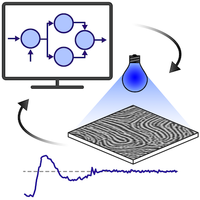
Active fluids—materials made of energy-consuming components such as protein filaments and molecular motors—are notoriously unstable. They often switch unpredictably between different flow states, respond strongly to small temperature changes, and drift over time as their biological components age. In this study, we demonstrate a way to control this chaotic behavior using feedback. By embedding a light-responsive active fluid in a proportional-integral (PI) control loop, we create a system that automatically adjusts the intensity of applied light in real time. This approach allows us to keep the fluid flowing at a target speed despite internal fluctuations and external disturbances.
Our system combines microscopy, data analysis, and optical control into a single feedback platform. We continuously record images of the fluid as it moves, and we use machine learning algorithms to calculate how fast and in what direction the material is flowing. The measured average flow speed is compared to a preset value, and the difference between them is used by the PI controller to decide how much to change the light intensity. Light acts as a trigger for the molecular motors, forming clusters that push and pull on the surrounding filaments to drive motion. As a result, the feedback loop automatically strengthens or weakens the light input to stabilize the overall flow, even when we intentionally apply large temperature changes.
By adjusting the control settings, we observe complex dynamics, including oscillations that arise from the competition between the controller’s timing and the material’s internal response rates. Using these insights, we can design more sophisticated feedback schemes to shape how active fluids move and organize, paving the way for creating new dynamic patterns and self-regulating materials.
Article Text
Supplemental Material
References (107)
- J. Sedzinski, M. Biro, A. Oswald, J.-Y. Tinevez, G. Salbreux, and E. Paluch, Polar actomyosin contractility destabilizes the position of the cytokinetic furrow, Nature (London) 476, 462 (2011).
- S. R. Naganathan, S. Fürthauer, M. Nishikawa, F. Jülicher, and S. W. Grill, Active torque generation by the actomyosin cell cortex drives left–right symmetry breaking, eLife 3, e04165 (2014).
- J. Brugués and D. Needleman, Physical basis of spindle self-organization, Proc. Natl. Acad. Sci. U.S.A. 111, 18496 (2014).
- A. Steffen, T. E. Stradal, and K. Rottner, Signalling pathways controlling cellular actin organization, Actin Cytoskeleton 153 (2017).
- S. J. Streichan, M. F. Lefebvre, N. Noll, E. F. Wieschaus, and B. I. Shraiman, Global morphogenetic flow is accurately predicted by the spatial distribution of myosin motors, eLife 7, e27454 (2018).
- F. Nedelec, T. Surrey, A. C. Maggs, and S. Leibler, Self-organization of microtubules and motors, Nature (London) 389, 305 (1997).
- J. Tabony, N. Glade, J. Demongeot, and C. Papaseit, Biological self-organization by way of microtubule reaction-diffusion processes, Langmuir 18, 7196 (2002).
- V. Schaller, C. Weber, C. Semmrich, E. Frey, and A. R. Bausch, Polar patterns of driven filaments, Nature (London) 467, 73 (2010).
- T. Sanchez, D. T. Chen, S. J. DeCamp, M. Heymann, and Z. Dogic, Spontaneous motion in hierarchically assembled active matter, Nature (London) 491, 431 (2012).
- M. P. Murrell and M. L. Gardel, F-actin buckling coordinates contractility and severing in a biomimetic actomyosin cortex, Proc. Natl. Acad. Sci. U.S.A. 109, 20820 (2012).
- J. Alvarado, M. Sheinman, A. Sharma, F. C. MacKintosh, and G. H. Koenderink, Molecular motors robustly drive active gels to a critically connected state, Nat. Phys. 9, 591 (2013).
- P. J. Foster, S. Fürthauer, M. J. Shelley, and D. J. Needleman, Active contraction of microtubule networks, eLife 4, e10837 (2015).
- J. Berezney, B. L. Goode, S. Fraden, and Z. Dogic, Extensile to contractile transition in active microtubule–actin composites generates layered asters with programmable lifetimes, Proc. Natl. Acad. Sci. U.S.A. 119, e2115895119 (2022).
- B. Lemma, N. P. Mitchell, R. Subramanian, D. J. Needleman, and Z. Dogic, Active microphase separation in mixtures of microtubules and tip-accumulating molecular motors, Phys. Rev. X 12, 031006 (2022).
- G. Livne, S. Gat, S. Armon, and A. Bernheim-Groswasser, Self-assembled active actomyosin gels spontaneously curve and wrinkle similar to biological cells and tissues, Proc. Natl. Acad. Sci. U.S.A. 121, e2309125121 (2024).
- H. Levine and D. I. Goldman, Physics of smart active matter: Integrating active matter and control to gain insights into living systems, Soft Matter 19, 4204 (2023).
- A. J. Tan, E. Roberts, S. A. Smith, U. A. Olvera, J. Arteaga, S. Fortini, K. A. Mitchell, and L. S. Hirst, Topological chaos in active nematics, Nat. Phys. 15, 1033 (2019).
- C. G. Wagner, M. M. Norton, J. S. Park, and P. Grover, Exact coherent structures and phase space geometry of preturbulent 2D active nematic channel flow, Phys. Rev. Lett. 128, 028003 (2022).
- C. G. Wagner, R. H. Pallock, J. S. Park, M. M. Norton, and P. Grover, Exploring regular and turbulent flow states in active nematic channel flow via exact coherent structures and their invariant manifolds, Phys. Rev. Fluids 8, 124401 (2023).
- J. Alvarado, E. Teich, D. A. Sivak, and J. Bechhoefer, Optimal control in soft and active matter, arXiv:2504.08676.
- H. Wioland, F. G. Woodhouse, J. Dunkel, J. O. Kessler, and R. E. Goldstein, Confinement stabilizes a bacterial suspension into a spiral vortex, Phys. Rev. Lett. 110, 268102 (2013).
- E. Lushi, H. Wioland, and R. E. Goldstein, Fluid flows created by swimming bacteria drive self-organization in confined suspensions, Proc. Natl. Acad. Sci. U.S.A. 111, 9733 (2014).
- F. C. Keber, E. Loiseau, T. Sanchez, S. J. DeCamp, L. Giomi, M. J. Bowick, M. C. Marchetti, Z. Dogic, and A. R. Bausch, Topology and dynamics of active nematic vesicles, Science 345, 1135 (2014).
- K.-T. Wu, J. B. Hishamunda, D. T. Chen, S. J. DeCamp, Y.-W. Chang, A. Fernández-Nieves, S. Fraden, and Z. Dogic, Transition from turbulent to coherent flows in confined three-dimensional active fluids, Science 355, eaal1979 (2017).
- A. Opathalage, M. M. Norton, M. P. N. Juniper, B. Langeslay, S. A. Aghvami, S. Fraden, and Z. Dogic, Self-organized dynamics and the transition to turbulence of confined active nematics, Proc. Natl. Acad. Sci. U.S.A. 116, 4788 (2019).
- J. Hardoüin, R. Hughes, A. Doostmohammadi, J. Laurent, T. Lopez-Leon, J. M. Yeomans, J. Ignés-Mullol, and F. Sagués, Reconfigurable flows and defect landscape of confined active nematics, Commun. Phys. 2, 121 (2019).
- S. Uplap, M. F. Hagan, and A. Baskaran, Design principles for transporting vesicles with enclosed active particles, Europhys. Lett. 143, 67001 (2023).
- Y. Fily, A. Baskaran, and M. F. Hagan, Dynamics of self-propelled particles under strong confinement, Soft Matter 10, 5609 (2014).
- Z. Fazli and A. Naji, Active particles with polar alignment in ring-shaped confinement, Phys. Rev. E 103, 022601 (2021).
- P. Iyer, G. Gompper, and D. A. Fedosov, Dynamic shapes of floppy vesicles enclosing active Brownian particles with membrane adhesion, Soft Matter 19, 3436 (2023).
- F. L. Memarian, D. Hammar, Md Mainul Hasan Sabbir, M. Elias, K. A. Mitchell, and L. S. Hirst, Controlling chaos: periodic defect braiding in active nematics confined to a cardioid, Phys. Rev. Lett. 132, 228301 (2024).
- I. Vélez-Cerón, P. Guillamat, F. Sagués, and J. Ignés-Mullol, Probing active nematics with in situ microfabricated elastic inclusions, Proc. Natl. Acad. Sci. U.S.A. 121, e2312494121 (2024).
- I. Vélez-Ceron, R. C. V. Coelho, P. Guillamat, M. T. da Gama, F. Sagués, and J. Ignés-Mullol, Active nematic pumps, arXiv:2407.09960.
- P. Guillamat, J. Ignés-mullol, and F. Sagués, Control of active liquid crystals with a magnetic field, Proc. Natl. Acad. Sci. U.S.A. 113, 5498 (2016).
- K. Thijssen, D. A. Khaladj, S. A. Aghvami, M. A. Gharbi, S. Fraden, J. M. Yeomans, L. S. Hirst, and T. N. Shendruk, Submersed micropatterned structures control active nematic flow, topology, and concentration, Proc. Natl. Acad. Sci. U.S.A. 118, e2106038118 (2021).
- T. E. Bate, M. E. Varney, E. H. Taylor, J. H. Dickie, C.-C. Chueh, M. M. Norton, and K.-T. Wu, Self-mixing in microtubule-kinesin active fluid from nonuniform to uniform distribution of activity, Nat. Commun. 13, 6573 (2022).
- M. Schuppler, F. C. Keber, M. Kröger, and A. R. Bausch, Boundaries steer the contraction of active gels, Nat. Commun. 7, 13120 (2016).
- I. Linsmeier, S. Banerjee, P. W. Oakes, W. Jung, T. Kim, and M. P. Murrell, Disordered actomyosin networks are sufficient to produce cooperative and telescopic contractility, Nat. Commun. 7, 12615 (2016).
- D. P. Rivas, T. N. Shendruk, R. R. Henry, D. H. Reich, and R. L. Leheny, Driven topological transitions in active nematic films, Soft Matter 16, 9331 (2020).
- T. D. Ross, H. J. Lee, Z. Qu, R. A. Banks, R. Phillips, and M. Thomson, Controlling organization and forces in active matter through optically defined boundaries, Nature (London) 572, 224 (2019).
- R. Zhang, S. A. Redford, P. V. Ruijgrok, N. Kumar, A. Mozaffari, S. Zemsky, A. R. Dinner, V. Vitelli, Z. Bryant, M. L. Gardel, and J. J. de Pablo, Spatiotemporal control of liquid crystal structure and dynamics through activity patterning, Nat. Mater. 20, 875 (2021).
- L. M. Lemma, M. Varghese, T. D. Ross, M. Thomson, A. Baskaran, and Z. Dogic, Spatio-temporal patterning of extensile active stresses in microtubule-based active fluids, PNAS Nexus 2, pgad130 (2023).
- Z. Zarei, J. Berezney, A. Hensley, L. Lemma, N. Senbil, Z. Dogic, and S. Fraden, Light-activated microtubule-based two-dimensional active nematic, Soft Matter 19, 6691 (2023).
- F. Yang, S. Liu, H. J. Lee, R. Phillips, and M. Thomson, Dynamic flow control through active matter programming language, Nat. Mater. 24, 615 (2025).
- X. Lei, C. Floyd, L. C. Ferrer, T. Chakrabortty, N. Chandrasekharan, A. R. Dinner, S. Coyle, J. Honts, and S. Bhamla, Light-induced assembly and repeatable actuation in -driven chemomechanical protein networks, 10.1101/2025.03.03.641304.
- T. Litschel, D. Vavylonis, and D. A. Weitz, 3D printing cytoskeletal networks: ROS-induced filament severing leads to surge in actin polymerization, 10.1101/2025.03.19.644260.
- M. M. Norton, P. Grover, M. F. Hagan, and S. Fraden, Optimal control of active nematics, Phys. Rev. Lett. 125, 178005 (2020).
- S. Shankar, V. Raju, and L. Mahadevan, Optimal transport and control of active drops, Proc. Natl. Acad. Sci. U.S.A. 119, e2121985119 (2022).
- C. Sinigaglia, F. Braghin, and M. Serra, Optimal control of short-time attractors in active nematics, Phys. Rev. Lett. 132, 218302 (2024).
- S. Ghosh, C. Joshi, A. Baskaran, and M. F. Hagan, Spatiotemporal control of structure and dynamics in a polar active fluid, arXiv:2405.07942.
- S. Ghosh, A. Baskaran, and M. F. Hagan, Achieving designed texture and flows in bulk active nematics using optimal control theory, arXiv:2408.14596.
- S. Shankar, L. V. D. Scharrer, M. J. Bowick, and M. C. Marchetti, Design rules for controlling active topological defects, Proc. Natl. Acad. Sci. U.S.A. 121, e2400933121 (2024).
- E. Schneider and H. Stark, Optimal steering of a smart active particle, Europhys. Lett. 127, 64003 (2019).
- B. Liebchen and H. Löwen, Optimal navigation strategies for active particles, Europhys. Lett. 127, 34003 (2019).
- L. K. Davis, K. Proesmans, and É. Fodor, Active matter under control: Insights from response theory, Phys. Rev. X 14, 011012 (2024).
- M. J. Falk, V. Alizadehyazdi, H. Jaeger, and A. Murugan, Learning to control active matter, Phys. Rev. Res. 3, 033291 (2021).
- C. Floyd, A. R. Dinner, and S. Vaikuntanathan, Tailoring interactions between active nematic defects with reinforcement learning, Soft Matter 21, 4488 (2025).
- S. Chennakesavalu, S. K. Manikandan, F. Hu, and G. M. Rotskoff, Adaptive nonequilibrium design of actin-based metamaterials: Fundamental and practical limits of control, Proc. Natl. Acad. Sci. U.S.A. 121, e2310238121 (2024).
- T. Quah, S. C. Takatori, and J. B. Rawlings, Learning continuum-level closures for control of interacting active particles, arXiv:2501.18809.
- J. Bechhoefer, Control Theory for Physicists (Cambridge University Press, Cambridge, England, 2021).
- J. Palacci, S. Sacanna, A. P. Steinberg, D. J. Pine, and P. M. Chaikin, Living crystals of light-activated colloidal surfers, Science 339, 936 (2013).
- A. Aubret, M. Youssef, S. Sacanna, and J. Palacci, Targeted assembly and synchronization of self-spinning microgears, Nat. Phys. 14, 1114 (2018).
- G. Frangipane, D. Dell’Arciprete, S. Petracchini, C. Maggi, F. Saglimbeni, S. Bianchi, G. Vizsnyiczai, M. L. Bernardini, and R. Di Leonardo, Dynamic density shaping of photokinetic E. coli, eLife 7, e36608 (2018).
- J. Arlt, V. A. Martinez, A. Dawson, T. Pilizota, and W. C. Poon, Painting with light-powered bacteria, Nat. Commun. 9, 768 (2018).
- A. Repula, C. Gates, J. C. Cameron, and I. I. Smalyukh, Photosynthetically-powered phototactic active nematic liquid crystal fluids and gels, Commun. Mater. 5, 37 (2024).
- G. Volpe, I. Buttinoni, D. Vogt, H.-J. Kümmerer, and C. Bechinger, Microswimmers in patterned environments, Soft Matter 7, 8810 (2011).
- Z. Huang, T. Omori, and T. Ishikawa, Active droplet driven by a collective motion of enclosed microswimmers, Phys. Rev. E 102, 022603 (2020).
- K. Villa and M. Pumera, Fuel-free light-driven micro/nanomachines: Artificial active matter mimicking nature, Chem. Soc. Rev. 48, 4966 (2019).
- Z. Qu, D. Schildknecht, S. Shadkhoo, E. Amaya, J. Jiang, H. J. Lee, D. Larios, F. Yang, R. Phillips, and M. Thomson, Persistent fluid flows defined by active matter boundaries, Commun. Phys. 4, 198 (2021).
- R. A. Simha and S. Ramaswamy, Hydrodynamic fluctuations and instabilities in ordered suspensions of self-propelled particles, Phys. Rev. Lett. 89, 058101 (2002).
- S. P. Thampi, R. Golestanian, and J. M. Yeomans, Instabilities and topological defects in active nematics, Europhys. Lett. 105, 18001 (2014).
- L. Giomi, M. J. Bowick, P. Mishra, R. Sknepnek, and M. Cristina Marchetti, Defect dynamics in active nematics, Phil. Trans. R. Soc. A 372, 20130365 (2014).
- P. N. Tran, S. Ray, L. Lemma, Y. Li, R. Sweeney, A. Baskaran, Z. Dogic, P. Hong, and M. F. Hagan, Deep-learning optical flow for measuring velocity fields from experimental data, Soft Matter 20, 7246 (2024).
- See Supplemental Material at http://link.aps.org/supplemental/10.1103/4hrx-6rdq for experimental methods, PI control implementation, autocorrelation analysis, supporting figures, and fluorescence microscopy movies of active nematic flows under various control conditions.
- R. Alert, A. Martínez-Calvo, and S. S. Datta, Cellular sensing governs the stability of chemotactic fronts, Phys. Rev. Lett. 128, 148101 (2022).
- A. Lamtyugina, Y. Qiu, E. Fodor, A. R. Dinner, and S. Vaikuntanathan, Thermodynamic control of activity patterns in cytoskeletal networks, Phys. Rev. Lett. 129, 128002 (2022).
- C. Floyd, A. R. Dinner, and S. Vaikuntanathan, Learning to control non-equilibrium dynamics using local imperfect gradients, arXiv:2404.03798.
- V. Krishnan, S. Sinha, and L. Mahadevan, Hamiltonian bridge: A physics-driven generative framework for targeted pattern control, arXiv:2410.12665.
- S. Sinha, V. Krishnan, and L. Mahadevan, Optimal control of interacting active particles on complex landscapes, arXiv:2311.17039.
- K. A. Mitchell, M. M. H. Sabbir, S. Ricarte, B. Klein, and D. A. Beller, Modeling active nematics via the nematic locking principle, arXiv:2506.20996.
- C. Joshi, S. Ray, L. M. Lemma, M. Varghese, G. Sharp, Z. Dogic, A. Baskaran, and M. F. Hagan, Data-driven discovery of active nematic hydrodynamics, Phys. Rev. Lett. 129, 258001 (2022).
- M. Golden, R. O. Grigoriev, J. Nambisan, and A. Fernandez-Nieves, Physically informed data-driven modeling of active nematics, Sci. Adv. 9, eabq6120 (2023).
- H. E. Johnson, N. J. Djabrayan, S. Y. Shvartsman, and J. E. Toettcher, Optogenetic rescue of a patterning mutant, Curr. Biol. 30, 3414 (2020).
- R. M. Herrera-Perez, C. Cupo, C. Allan, A. Lin, and K. E. Kasza, Using optogenetics to link myosin patterns to contractile cell behaviors during convergent extension, Biophys. J. 120, 4214 (2021).
- M. Herrera-Perez, C. Cupo, C. Allan, A. B. Dagle, and K. E. Kasza, Optogenetic dissection of actomyosin-dependent mechanics underlying tissue fluidity, https://www.biorxiv.org/content/10.1101/2021.11.07.467642v2.
- A. D. Countryman, C. A. Doherty, R. M. Herrera-Perez, and K. E. Kasza, Endogenous OptoRhoGEFs reveal biophysical principles of epithelial tissue furrowing, 10.1101/2024.05.12.593711.
- K. Suh, R. Thornton, P. E. Farahani, D. Cohen, and J. Toettcher, Large-scale control over collective cell migration using light-controlled epidermal growth factor receptors, 10.1101/2024.05.30.596676.
- S. Kumar, H. M. Beyer, M. Chen, M. D. Zurbriggen, and M. Khammash, Image-guided optogenetic spatiotemporal tissue patterning using PatternScope, Nat. Commun. 15, 10469 (2024).
- N. A. Repina, H. J. Johnson, X. Bao, J. A. Zimmermann, D. A. Joy, S. Z. Bi, R. S. Kane, and D. V. Schaffer, Optogenetic control of Wnt signaling models cell-intrinsic embryogenic patterning using 2D human pluripotent stem cell culture, Development 150, 201386 (2023).
- H. M. Beyer, S. Kumar, M. Nieke, C. M. C. Diehl, K. Tang, S. Shumka, C. S. Koh, C. Fleck, J. A. Davies, M. Khammash, and M. D. Zurbriggen, Genetically-stable engineered optogenetic gene switches modulate spatial cell morphogenesis in two- and three-dimensional tissue cultures, Nat. Commun. 15, 10470 (2024).
- M. Serra, G. Serrano Nájera, M. Chuai, A. M. Plum, S. Santhosh, V. Spandan, C. J. Weijer, and L. Mahadevan, A mechanochemical model recapitulates distinct vertebrate gastrulation modes, Sci. Adv. 9, eadh8152 (2023).
- A. M. Plum, M. Serra, and C. J. Weijer, Advances in mechanochemical modelling of vertebrate gastrulation, Biochem. Soc. Trans. 53, 871 (2025).
- S. A. Redford, J. Colen, J. L. Shivers, S. Zemsky, M. Molaei, C. Floyd, P. V. Ruijgrok, V. Vitelli, Z. Bryant, A. R. Dinner, and M. L. Gardel, Motor crosslinking augments elasticity in active nematics, Soft Matter 20, 2480 (2024).
- P. J. Foster, J. Bae, B. Lemma, J. Zheng, W. Ireland, P. Chandrakar, R. Boros, Z. Dogic, D. J. Needleman, and J. J. Vlassak, Dissipation and energy propagation across scales in an active cytoskeletal material, Proc. Natl. Acad. Sci. U.S.A. 120, e2207662120 (2023).
- H. Dehne, A. Reitenbach, and A. R. Bausch, Reversible and spatiotemporal control of colloidal structure formation, Nat. Commun. 12, 6811 (2021).
- M. M. Norton and P. Grover, Mechanochemical topological defects in an active nematic, Phys. Rev. E 110, 054605 (2024).
- R. Rajasekaran, C.-C. Chang, E. W. Weix, T. M. Galateo, and S. M. Coyle, A programmable reaction-diffusion system for spatiotemporal cell signaling circuit design, Cell 187, 345 (2024).
- G. Leech, L. Melcher, M. Chiu, M. Nugent, S. Juliano, L. Burton, J. Kang, S. J. Kim, S. Roy, L. Farhadi, J. L. Ross, M. Das, M. J. Rust, and R. M. Robertson-Anderson, Programming scheduled self-assembly of circadian materials, Nat. Commun. 16, 176 (2025).
- S. Kumar and M. Khammash, Platforms for optogenetic stimulation and feedback control, Front. Bioeng. Biotechnol. 10 (2022).
- T. Frei, C.-H. Chang, M. Filo, A. Arampatzis, and M. Khammash, A genetic mammalian proportional–integral feedback control circuit for robust and precise gene regulation, Proc. Natl. Acad. Sci. U.S.A. 119, e2122132119 (2022).
- J.-B. Lugagne and M. J. Dunlop, Cell-machine interfaces for characterizing gene regulatory network dynamics, Curr. Opin. Syst. Biol. 14, 1 (2019).
- C. Carrasco-López, S. A. García-Echauri, T. Kichuk, and J. L. Avalos, Optogenetics and biosensors set the stage for metabolic cybergenetics, Curr. Opin. Biotechnol. 65, 296 (2020).
- K. Nishiyama, J. Berezney, M. Norton, A. Aggarwal, S. Ghosh, Z. Zarei, M. Hagan, Z. Dogic, and S. Fraden, Dataset from closed-loop control of active nematic flows, Zenodo, 10.5281/zenodo.14720865 (2025).
- M. Castoldi and A. V. Popov, Purification of brain tubulin through two cycles of polymerization–depolymerization in a high-molarity buffer, Protein Expression Purif. 32, 83 (2003).
- G. Guntas, R. A. Hallett, S. P. Zimmerman, T. Williams, H. Yumerefendi, J. E. Bear, and B. Kuhlman, Engineering an improved light-induced dimer (iLID) for controlling the localization and activity of signaling proteins, Proc. Natl. Acad. Sci. U.S.A. 112, 112 (2015).
- F. Yang, S. Liu, H. J. Lee, R. Phillips, and M. Thomson, Geometry-dependent defect merging induces bifurcated dynamics in active networks, Phys. Rev. Res. 7, L042006 (2025).
- F. Caballero, cupss: A package for pseudo-spectral integration of stochastic PDEs, arXiv:2405.02410.

