

- Open Access
Observing the Spatial and Temporal Evolution of Exciton Wave Functions in Organic Semiconductors
Phys. Rev. X 16, 031054 – Published 28 August, 2026
DOI: https://doi.org/10.1103/3zmg-276c
Abstract
Excitons, the correlated electron-hole pairs governing optical and transport properties in organic semiconductors, have long resisted direct experimental access to their full quantum-mechanical wave functions. Here, we use femtosecond time-resolved photoemission orbital tomography (trPOT) combining high-harmonic probe pulses with time- and momentum-resolved photoelectron spectroscopy to directly image the momentum-space distribution and ultrafast dynamics of excitons in -sexithiophene thin films. We introduce a model that enables reconstruction of the exciton wave function in real space, including both its spatial extent and its internal phase structure. The reconstructed wave function reveals coherent delocalization across approximately three molecular units and exhibits a characteristic phase modulation, consistent with ab initio calculations within the framework of many-body perturbation theory. Time-resolved measurements further indicate an approximately 25% contraction of the exciton radius within 400 fs, suggesting self-trapping driven by exciton-phonon coupling. These results establish trPOT as a general and experimentally accessible approach for resolving exciton wave functions—with spatial, phase, and temporal sensitivity—in a broad class of molecular and low-dimensional materials.
Physics Subject Headings (PhySH)
Popular Summary
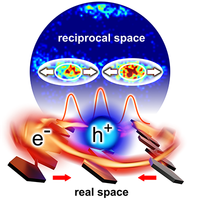
Visualizing the spatial distribution and internal quantum phase of an exciton wave function remains an elusive challenge because conventional spectroscopic tools cannot simultaneously probe both real-space and momentum-space profiles with ultrafast resolution. We addressed this limitation by using femtosecond time-resolved photoemission orbital tomography to record momentum-resolved photoelectron images of excitons evolving in time within thin films of the organic semiconductor sexithiophene. By developing a model that maps these momentum-space fingerprints back to a real-space structure, we reconstructed both the spatial extent and internal phase of the exciton. Our results reveal that the exciton is coherently delocalized across roughly three molecular units and exhibits a specific phase pattern before contracting by about 25% during its lifetime, matching advanced many-body calculations. This method provides an analytical route for imaging electron-hole pairs across a broad range of low-dimensional semiconductor materials. Our work establishes a powerful framework to benchmark theoretical descriptions of excitonic phenomena and optimize energy migration in optoelectronic devices.
Article Text
References (60)
- F. C. Spano, Excitons in Conjugated oligomer aggregates, films, and crystals, Annu. Rev. Phys. Chem. 57, 217 (2006).
- A. Köhler and H. Bässler, Electronic Processes in Organic Semiconductors (Wiley-VCH, New York, 2015).
- H. Bronstein, Z. Chen, R. S. Ashraf, W. Zhang, J. Du, J. R. Durrant, P. Shakya Tuladhar, K. Song, S. E. Watkins, Y. Geerts, M. M. Wienk, R. A. J. Janssen, T. Anthopoulos, H. Sirringhaus, M. Heeney, and I. McCulloch, Thieno[3,2-b]thiophene-diketopyrrolopyrrole-containing polymers for high-performance organic field-effect transistors and organic photovoltaic devices, J. Am. Chem. Soc. 133, 3272 (2011).
- T. R. Nelson, D. Ondarse-Alvarez, N. Oldani, B. Rodriguez-Hernandez, L. Alfonso-Hernandez, J. F. Galindo, V. D. Kleiman, S. Fernandez-Alberti, A. E. Roitberg, and S. Tretiak, Coherent exciton-vibrational dynamics and energy transfer in conjugated organics, Nat. Commun. 9, 2316 (2018).
- A. J. Sneyd et al., Efficient energy transport in an organic semiconductor mediated by transient exciton delocalization, Sci. Adv. 7, eabh4232 (2021).
- G. D. Scholes, A molecular perspective on quantum information, Proc. R. Soc. A 479, 20230599 (2023).
- Y. Zhang, C. P. Oberg, Y. Hu, H. Xu, M. Yan, G. D. Scholes, and M. Wang, Molecular and supramolecular materials: From light-harvesting to quantum information science and technology, J. Phys. Chem. Lett. 15, 3294 (2024).
- A. Yamauchi, K. Tanaka, M. Fuki, S. Fujiwara, N. Kimizuka, T. Ryu, M. Saigo, K. Onda, R. Kusumoto, N. Ueno, H. Sato, Y. Kobori, K. Miyata, and N. Yanai, Room-temperature quantum coherence of entangled multiexcitons in a metal-organic framework, Sci. Adv. 10, eadi3147 (2024).
- R. Wallauer, M. Raths, K. Stallberg, L. Münster, D. Brandstetter, X. Yang, J. Güdde, P. Puschnig, S. Soubatch, C. Kumpf, F. C. Bocquet, F. S. Tautz, and U. Höfer, Tracing orbital images on ultrafast time scales, Science 371, 1056 (2021).
- A. Neef, S. Beaulieu, S. Hammer, S. Dong, J. Maklar, T. Pincelli, R. P. Xian, M. Wolf, L. Rettig, J. Pflaum, and R. Ernstorfer, Orbital-resolved observation of singlet fission, Nature (London) 616, 275 (2023).
- W. Bennecke, A. Windischbacher, D. Schmitt, J. P. Bange, R. Hemm, C. S. Kern, G. D’Avino, X. Blase, D. Steil, S. Steil, M. Aeschlimann, B. Stadtmüller, M. Reutzel, P. Puschnig, G. S. M. Jansen, and S. Mathias, Disentangling the multiorbital contributions of excitons by photoemission exciton tomography, Nat. Commun. 15, 1804 (2024).
- W. Bennecke, I. Gonzalez Oliva, J. P. Bange, P. Werner, D. Schmitt, M. Merboldt, A. M. Seiler, K. Watanabe, T. Taniguchi, D. Steil, R. T. Weitz, P. Puschnig, C. Draxl, G. S. M. Jansen, M. Reutzel, and S. Mathias, Hybrid Frenkel-Wannier excitons facilitate ultrafast energy transfer at a 2D-organic interface, Nat. Phys. 21, 1973 (2025).
- S. Dong, M. Puppin, T. Pincelli, S. Beaulieu, D. Christiansen, H. Hübener, C. W. Nicholson, R. P. Xian, M. Dendzik, Y. Deng, Y. W. Windsor, M. Selig, E. Malic, A. Rubio, A. Knorr, M. Wolf, L. Rettig, and R. Ernstorfer, Direct measurement of key exciton properties: Energy, dynamics, and spatial distribution of the wave function, Nat. Sci. 1, e10010 (2021).
- M. K. L. Man, J. Madeo, C. Sahoo, K. Xie, M. Campbell, V. Pareek, A. Karmakar, E. L. Wong, A. Al-Mahboob, N. S. Chan, D. R. Bacon, X. Zhu, M. M. M. Abdelrasoul, X. Li, T. F. Heinz, F. H. da Jornada, T. Cao, and K. M. Dani, Experimental measurement of the intrinsic excitonic wave function, Sci. Adv. 7, eabg0192 (2021).
- D. Schmitt, J. P. Bange, W. Bennecke, A. AlMutairi, G. Meneghini, K. Watanabe, T. Taniguchi, D. Steil, D. R. Luke, R. T. Weitz, S. Steil, G. S. M. Jansen, S. Brem, E. Malic, S. Hofmann, M. Reutzel, and S. Mathias, Formation of moiré interlayer excitons in space and time, Nature (London) 608, 499 (2022).
- O. Karni et al., Structure of the moiré exciton captured by imaging its electron and hole, Nature (London) 603, 247 (2022).
- K. Mourzidis, V. Jindal, M. Glazov, A. Balocchi, C. Robert, D. Lagarde, P. Renucci, L. Lombez, T. Taniguchi, K. Watanabe, T. Amand, S. Francoeur, and X. Marie, Exciton formation in two-dimensional semiconductors, Phys. Rev. X 15, 031078 (2025).
- S. Roux et al., Exciton self-trapping in twisted hexagonal boron nitride homostructures, Phys. Rev. X 15, 021067 (2025).
- Y. Dong, V. C. Nikolis, F. Talnack, Y.-C. Chin, J. Benduhn, G. Londi, J. Kublitski, X. Zheng, S. C. B. Mannsfeld, D. Spoltore, L. Muccioli, J. Li, X. Blase, D. Beljonne, J.-S. Kim, A. A. Bakulin, G. D’Avino, J. R. Durrant, and K. Vandewal, Orientation dependent molecular electrostatics drives efficient charge generation in homojunction organic solar cells, Nat. Commun. 11, 4617 (2020).
- S. Frolov, C. Kloc, S. Berg, G. Thomas, and B. Batlogg, Transient spectroscopy of Frenkel excitons in α-hexathiophene single crystals, Chem. Phys. Lett. 326, 558 (2000).
- F. Kouki, P. Spearman, P. Valat, G. Horowitz, and F. Garnier, Experimental determination of excitonic levels in -oligothiophenes, J. Chem. Phys. 113, 385 (2000).
- E. Varene, L. Bogner, C. Bronner, and P. Tegeder, Ultrafast exciton population, relaxation, and decay dynamics in thin oligothiophene films, Phys. Rev. Lett. 109, 207601 (2012).
- W. Bronsch, T. Wagner, S. Baum, M. Wansleben, K. Zielke, E. Ghanbari, M. Györök, A. Navarro-Quezada, P. Zeppenfeld, M. Weinelt, and C. Gahl, Interplay between morphology and electronic structure in -Sexithiophene films on , J. Phys. Chem. C 123, 7931 (2019).
- J.-W. van der Horst, P. A. Bobbert, M. A. J. Michels, G. Brocks, and P. J. Kelly, Ab Initio calculation of the electronic and optical excitations in polythiophene: Effects of intra- and interchain screening, Phys. Rev. Lett. 83, 4413 (1999).
- G. Bussi, A. Ruini, E. Molinari, M. J. Caldas, P. Puschnig, and C. Ambrosch-Draxl, Interchain interaction and Davydov splitting in polythiophene crystals: An ab initio approach, Appl. Phys. Lett. 80, 4118 (2002).
- X. Leng, H. Yin, D. Liang, and Y. Ma, Excitons and Davydov splitting in sexithiophene from first-principles many-body Green’s function theory, J. Chem. Phys. 143, 114501 (2015).
- L. Sun, S. Berkebile, G. Weidlinger, M. Denk, R. Denk, M. Hohage, G. Koller, F. P. Netzer, M. G. Ramsey, and P. Zeppenfeld, Layer resolved evolution of the optical properties of α-sexithiophene thin films, Phys. Chem. Chem. Phys. 14, 13651 (2012).
- S. Berkebile, G. Koller, P. Puschnig, C. Ambrosch-Draxl, F. P. Netzer, and M. G. Ramsey, Angle-resolved photoemission of chain-like molecules: the electronic band structure of sexithiophene and sexiphenyl, Appl. Phys. A 95, 101 (2009).
- M. Stettner, S. Kaidisch, A. V. Matetskiy, E. Fackelman, S. Soubatch, C. Kumpf, F. C. Bocquet, M. G. Ramsey, P. Puschnig, and F. S. Tautz, Tracing the film structure of an organic semiconductor with photoemission orbital tomography, arXiv:2603.06204.
- T. Chowdhury, A. Champagne, P. Knüppel, Z. Naqvi, A. Ray, M. Gao, D. A. Muller, N. Guisinger, K. F. Mak, J. B. Neaton, and J. Park, Bright hybrid excitons in molecularly tunable bilayer crystals, arXiv:2502.13460.
- G. Horowitz, B. Bachet, A. Yasser, P. Lang, F. Demanze, J.-L. Fave, and F. Garnier, Growth and Characterization of Sexithiophene Single Crystals, Chem. Mater. 7, 1337 (1995).
- C. Cocchi and C. Draxl, Optical spectra from molecules to crystals: Insight from many-body perturbation theory, Phys. Rev. B 92, 205126 (2015).
- C. S. Kern, A. Windischbacher, and P. Puschnig, Photoemission orbital tomography for excitons in organic molecules, Phys. Rev. B 108, 085132 (2023).
- P. Puschnig, S. Berkebile, A. J. Fleming, G. Koller, K. Emtsev, T. Seyller, J. D. Riley, C. Ambrosch-Draxl, F. P. Netzer, and M. G. Ramsey, Reconstruction of molecular orbital densities from photoemission data, Science 326, 702 (2009).
- M. Theilen, S. Kaidisch, M. Stettner, S. Zajusch, E. Fackelman, A. Adamkiewicz, R. Wallauer, A. Windischbacher, C. S. Kern, M. G. Ramsey, F. C. Bocquet, S. Soubatch, F. S. Tautz, U. Höfer, and P. Puschnig, Data Repository, Jülich DATA, 10.26165/JUELICH-DATA/HEKKRZ, (2026).
- S. Kishimoto, M. Kageshima, Y. Naitoh, Y. Li, and Y. Sugawara, Study of oxidized surface using noncontact atomic force microscopy, Surf. Sci. 602, 2175 (2008).
- F. Cicoira, J. A. Miwa, M. Melucci, G. Barbarella, and F. Rosei, Ordered assembly of α-Quinquethiophene on a copper oxide nanotemplate, Small 2, 1366 (2006).
- S. Berkebile, Epitaxial organic films and their interfaces, Ph.D. thesis; Karl-Franzes Universität Graz—Institute of Physics, 2009.
- F. Neese, The ORCA program system, WIRES Comput. Molec. Sci. 2, 73 (2012).
- F. Neese, Software update: the ORCA program system, version 5.0, WIRES Comput. Molec. Sci. 12, e1606 (2022).
- R. Krishnan, J. S. Binkley, R. Seeger, and J. A. Pople, Self-consistent molecular orbital methods. XX. A basis set for correlated wave functions, J. Chem. Phys. 72, 650 (1980).
- A. McLean and G. Chandler, Contracted Gaussian basis sets for molecular calculations. I. Second row atoms, , J. Chem. Phys. 72, 5639 (1980).
- A. D. Becke, Density-functional thermochemistry. III. The role of exact exchange, J. Chem. Phys. 98, 5648 (1993).
- P. J. Stephens, F. J. Devlin, C. F. Chabalowski, and M. J. Frisch, Ab initio calculation of vibrational absorption and circular dichroism spectra using density functional force fields, J. Phys. Chem. 98, 11623 (1994).
- D. Jacquemin, I. Duchemin, and X. Blase, Is the Bethe-Salpeter formalism accurate for excitation energies? Comparisons with TD-DFT, CASPT2, and EOM-CCSD, J. Phys. Chem. Lett. 8, 1524 (2017).
- M. Rohlfing and S. G. Louie, Electron-hole excitations and optical spectra from first-principles, Phys. Rev. B 62, 4927 (2000).
- X. Blase, I. Duchemin, D. Jacquemin, and P.-F. Loos, The Bethe-Salpeter equation formalism: From physics to chemistry, J. Phys. Chem. Lett. 11, 7371 (2020).
- P. Giannozzi et al., quantum espresso: a modular and open-source software project for quantum simulations of materials, J. Phys. Condens. Matter 21, 395502 (2009).
- P. Giannozzi et al., Advanced capabilities for materials modelling with quantum espresso, J. Phys. Condens. Matter 29, 465901 (2017).
- P. Giannozzi, O. Baseggio, P. Bonfà, D. Brunato, R. Car, I. Carnimeo, C. Cavazzoni, S. de Gironcoli, P. Delugas, F. Ferrari Ruffino, A. Ferretti, N. Marzari, I. Timrov, A. Urru, and S. Baroni, quantum espresso toward the exascale, J. Chem. Phys. 152, 154105 (2020).
- J. P. Perdew, K. Burke, and M. Ernzerhof, Generalized gradient approximation made simple, Phys. Rev. Lett. 77, 3865 (1996).
- T. Sohier, M. Calandra, and F. Mauri, Density functional perturbation theory for gated two-dimensional heterostructures: Theoretical developments and application to flexural phonons in graphene, Phys. Rev. B 96, 075448 (2017).
- M. S. Hybertsen and S. G. Louie, Electron correlation in semiconductors and insulators: Band gaps and quasiparticle energies, Phys. Rev. B 34, 5390 (1986).
- J. Deslippe, G. Samsonidze, D. A. Strubbe, M. Jain, M. L. Cohen, and S. G. Louie, BerkeleyGW: A massively parallel computer package for the calculation of the quasiparticle and optical properties of materials and nanostructures, Comput. Phys. Commun. 183, 1269 (2012).
- A. R. Altman, S. Kundu, and F. H. da Jornada, Mixed stochastic-deterministic approach for many-body perturbation theory calculations, Phys. Rev. Lett. 132, 086401 (2024).
- F. H. da Jornada, D. Y. Qiu, and S. G. Louie, Nonuniform sampling schemes of the Brillouin zone for many-electron perturbation-theory calculations in reduced dimensionality, Phys. Rev. B 95, 035109 (2017).
- S. Kaidisch, A. Kleiner, S. Refaely-Abramson, P. Puschnig, and C. S. Kern, Photoemission tomography of excitons in 2D systems: momentum-space signatures of correlated electron-hole wave functions, arXiv:2511.14956.
- M. Dauth, M. Wiessner, V. Feyer, A. Schöll, P. Puschnig, F. Reinert, and S. Kümmel, Angle resolved photoemission from organic semiconductors: orbital imaging beyond the molecular orbital interpretation, New J. Phys. 16, 103005 (2014).
- G. H. Wannier, The structure of electronic excitation levels in insulating crystals, Phys. Rev. 52, 191 (1937).
- Z. Tao, J. B. Habe, and J. B. Neaton, Real-space quantification of exciton localization in acene crystals using Wannier function decomposition, arXiv:2510.06539.

