

- Open Access
Temporal Complexity Hierarchies in Solvable Quantum Many-Body Dynamics
Phys. Rev. X 16, 041041 – Published 13 November, 2026
DOI: https://doi.org/10.1103/3v7h-7dx9
Abstract
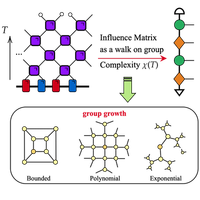
The influence matrix (IM) provides a powerful framework for characterizing nonequilibrium quantum many-body dynamics by encoding multitime correlations into tensor-network states. Understanding how its computational complexity relates to underlying dynamics is crucial for both theoretical insight and practical utility yet remains largely unexplored despite a few case studies. Here, we address this question for a family of brickwork quantum circuits ranging from integrable to chaotic regimes. Using tools from geometric group theory, we identify three qualitatively distinct scalings of temporal entanglement entropy, establishing a hierarchy of computational resources required for accurate tensor-network representations of the IM for these models. We further analyze the memory structure of the IM and distinguish between classical and quantum temporal correlations. In particular, for certain examples, we identify effectively classical IMs that admit an efficient Monte Carlo algorithm for computing multitime correlations. In more generic settings without an explicit classical description of the IM, we introduce an operational measure of quantum memory with an experimental protocol and discuss examples exhibiting long-time genuinely quantum correlations. Our results establish a new connection between quantum many-body dynamics and group theory, providing fresh insights into the complexity of the IM and its intricate connection to the physical characteristics of the dynamics.
Physics Subject Headings (PhySH)
Popular Summary
Simulating out-of-equilibrium dynamics of interacting quantum particles is notoriously difficult, even when we care about the evolution of a small subsystem. The influence matrix describes how the rest of the system affects a subsystem over time, effectively storing the environmental quantum memory. How complex can this memory become? We construct exactly solvable influence matrices for a family of quantum models. By connecting their complexity to the growth of mathematical groups, we uncover several scenarios: The cost of influence-matrix representation can remain bounded, grow polynomially, or even grow exponentially with time. In some cases, this memory becomes purely classical, even for a genuinely quantum underlying system, allowing efficient predictions of local observables. In others, genuinely quantum memory persists for long times, and we propose a quantum teleportation protocol to detect it. Our findings reveal how memory shapes the complexity of quantum dynamics and suggest new strategies for efficient simulation.
Article Text
References (171)
- M. Rigol, V. Dunjko, and M. Olshanii, Thermalization and its mechanism for generic isolated quantum systems, Nature (London) 452, 854 (2008).
- A. Polkovnikov, K. Sengupta, A. Silva, and M. Vengalattore, Colloquium: Nonequilibrium dynamics of closed interacting quantum systems, Rev. Mod. Phys. 83, 863 (2011).
- R. Kosloff, Quantum thermodynamics: A dynamical viewpoint, Entropy 15, 2100 (2013).
- D. A. Abanin, E. Altman, I. Bloch, and M. Serbyn, Colloquium: Many-body localization, thermalization, and entanglement, Rev. Mod. Phys. 91, 021001 (2019).
- A. J. Daley, I. Bloch, C. Kokail, S. Flannigan, N. Pearson, M. Troyer, and P. Zoller, Practical quantum advantage in quantum simulation, Nature (London) 607, 667 (2022).
- G. Vidal, Efficient simulation of one-dimensional quantum many-body systems, Phys. Rev. Lett. 93, 040502 (2004).
- S. R. White and A. E. Feiguin, Real-time evolution using the density matrix renormalization group, Phys. Rev. Lett. 93, 076401 (2004).
- G. Vidal, Classical simulation of infinite-size quantum lattice systems in one spatial dimension, Phys. Rev. Lett. 98, 070201 (2007).
- R. Orús and G. Vidal, Infinite time-evolving block decimation algorithm beyond unitary evolution, Phys. Rev. B 78, 155117 (2008).
- M. M. Wolf, F. Verstraete, M. B. Hastings, and J. I. Cirac, Area laws in quantum systems: Mutual information and correlations, Phys. Rev. Lett. 100, 070502 (2008).
- J. Haegeman, J. I. Cirac, T. J. Osborne, I. Pižorn, H. Verschelde, and F. Verstraete, Time-dependent variational principle for quantum lattices, Phys. Rev. Lett. 107, 070601 (2011).
- J. Haegeman and F. Verstraete, Diagonalizing transfer matrices and matrix product operators: A medley of exact and computational methods, Annu. Rev. Condens. Matter Phys. 8, 355 (2017).
- S. Paeckel, T. Köhler, A. Swoboda, S. R. Manmana, U. Schollwöck, and C. Hubig, Time-evolution methods for matrix-product states, Ann. Phys. (Amsterdam) 411, 167998 (2019).
- J. I. Cirac, D. Pérez-García, N. Schuch, and F. Verstraete, Matrix product states and projected entangled pair states: Concepts, symmetries, theorems, Rev. Mod. Phys. 93, 045003 (2021).
- P. Calabrese and J. Cardy, Evolution of entanglement entropy in one-dimensional systems, J. Stat. Mech. (2005) P04010.
- H. Kim and D. A. Huse, Ballistic spreading of entanglement in a diffusive nonintegrable system, Phys. Rev. Lett. 111, 127205 (2013).
- A. Lerose, M. Sonner, and D. A. Abanin, Influence matrix approach to many-body Floquet dynamics, Phys. Rev. X 11, 021040 (2021).
- M. Sonner, A. Lerose, and D. A. Abanin, Influence functional of many-body systems: Temporal entanglement and matrix-product state representation, Ann. Phys. (Amsterdam) 435, 168677 (2021).
- E. Ye and G. K.-L. Chan, Constructing tensor network influence functionals for general quantum dynamics, J. Chem. Phys. 155, 044104 (2021).
- S. Cerezo-Roquebrún, A. Bou-Comas, J. T. Schneider, E. López, L. Tagliacozzo, and S. Carignano, Spatio-temporal tensor-network approaches to out-of-equilibrium dynamics bridging open and closed systems, Front. Quantum Sci. Technol. 4, 1568471 (2025).
- R. Feynman and F. Vernon, The theory of a general quantum system interacting with a linear dissipative system, Ann. Phys. (N.Y.) 24, 118 (1963).
- J. Berges, S. Borsányi, and C. Wetterich, Prethermalization, Phys. Rev. Lett. 93, 142002 (2004).
- S. R. Manmana, S. Wessel, R. M. Noack, and A. Muramatsu, Strongly correlated fermions after a quantum quench, Phys. Rev. Lett. 98, 210405 (2007).
- M. Schreiber, S. S. Hodgman, P. Bordia, H. P. Lüschen, M. H. Fischer, R. Vosk, E. Altman, U. Schneider, and I. Bloch, Observation of many-body localization of interacting fermions in a quasirandom optical lattice, Science 349, 842 (2015).
- M. Schiulaz, E. J. Torres-Herrera, and L. F. Santos, Thouless and relaxation time scales in many-body quantum systems, Phys. Rev. B 99, 174313 (2019).
- S. J. Garratt and J. T. Chalker, Local pairing of Feynman histories in many-body Floquet models, Phys. Rev. X 11, 021051 (2021).
- M. C. Bañuls, M. B. Hastings, F. Verstraete, and J. I. Cirac, Matrix product states for dynamical simulation of infinite chains, Phys. Rev. Lett. 102, 240603 (2009).
- A. Müller-Hermes, J. I. Cirac, and M. C. Bañuls, Tensor network techniques for the computation of dynamical observables in one-dimensional quantum spin systems, New J. Phys. 14, 075003 (2012).
- M. B. Hastings and R. Mahajan, Connecting entanglement in time and space: Improving the folding algorithm, Phys. Rev. A 91, 032306 (2015).
- M. Frías-Pérez and M. C. Bañuls, Light cone tensor network and time evolution, Phys. Rev. B 106, 115117 (2022).
- G. Chiribella, G. M. D’Ariano, and P. Perinotti, Quantum circuit architecture, Phys. Rev. Lett. 101, 060401 (2008).
- G. Chiribella, G. M. D’Ariano, and P. Perinotti, Theoretical framework for quantum networks, Phys. Rev. A 80, 022339 (2009).
- F. A. Pollock, C. Rodríguez-Rosario, T. Frauenheim, M. Paternostro, and K. Modi, Non-Markovian quantum processes: Complete framework and efficient characterization, Phys. Rev. A 97, 012127 (2018).
- F. A. Pollock, C. Rodríguez-Rosario, T. Frauenheim, M. Paternostro, and K. Modi, Operational Markov condition for quantum processes, Phys. Rev. Lett. 120, 040405 (2018).
- S. Milz and K. Modi, Quantum stochastic processes and quantum non-Markovian phenomena, PRX Quantum 2, 030201 (2021).
- J. Keeling, E. M. Stoudenmire, M.-C. Bañuls, and D. R. Reichman, Process tensor approaches to non-Markovian quantum dynamics, Phys. Rev. X 16, 020502 (2026).
- P. Taranto, S. Milz, M. Murao, M. T. Quintino, and K. Modi, A guide to higher-order quantum operations, PRX Quantum (2026), 10.1103/92c4-g7qs.
- A. Strathearn, P. Kirton, D. Kilda, J. Keeling, and B. W. Lovett, Efficient non-Markovian quantum dynamics using time-evolving matrix product operators, Nat. Commun. 9, 3322 (2018).
- I. A. Luchnikov, S. V. Vintskevich, H. Ouerdane, and S. N. Filippov, Simulation complexity of open quantum dynamics: Connection with tensor networks, Phys. Rev. Lett. 122, 160401 (2019).
- M. Cygorek and E. M. Gauger, Understanding and utilizing the inner bonds of process tensors, SciPost Phys. 18, 024 (2025).
- A. Lerose, M. Sonner, and D. A. Abanin, Scaling of temporal entanglement in proximity to integrability, Phys. Rev. B 104, 035137 (2021).
- J. Thoenniss, M. Sonner, A. Lerose, and D. A. Abanin, Efficient method for quantum impurity problems out of equilibrium, Phys. Rev. B 107, L201115 (2023).
- J. Thoenniss, A. Lerose, and D. A. Abanin, Nonequilibrium quantum impurity problems via matrix-product states in the temporal domain, Phys. Rev. B 107, 195101 (2023).
- J. Thoenniss, I. Vilkoviskiy, and D. A. Abanin, Efficient pseudomode representation and complexity of quantum impurity models, Phys. Rev. B 112, 155114 (2025).
- M. R. Jørgensen and F. A. Pollock, Exploiting the causal tensor network structure of quantum processes to efficiently simulate non-Markovian path integrals, Phys. Rev. Lett. 123, 240602 (2019).
- M. Cygorek, J. Keeling, B. W. Lovett, and E. M. Gauger, Sublinear scaling in non-Markovian open quantum systems simulations, Phys. Rev. X 14, 011010 (2024).
- V. Link, H.-H. Tu, and W. T. Strunz, Open quantum system dynamics from infinite tensor network contraction, Phys. Rev. Lett. 132, 200403 (2024).
- I. Vilkoviskiy and D. A. Abanin, Bound on approximating non-Markovian dynamics by tensor networks in the time domain, Phys. Rev. B 109, 205126 (2024).
- K. Klobas, M. Vanicat, J. P. Garrahan, and T. Prosen, Matrix product state of multi-time correlations, J. Phys. A 53, 335001 (2020).
- K. Klobas and T. Prosen, Space-like dynamics in a reversible cellular automaton, SciPost Phys. Core 2, 010 (2020).
- K. Klobas, B. Bertini, and L. Piroli, Exact thermalization dynamics in the “rule 54” quantum cellular automaton, Phys. Rev. Lett. 126, 160602 (2021).
- K. Klobas and B. Bertini, Exact relaxation to Gibbs and non-equilibrium steady states in the quantum cellular automaton rule 54, SciPost Phys. 11, 106 (2021).
- G. Giudice, G. Giudici, M. Sonner, J. Thoenniss, A. Lerose, D. A. Abanin, and L. Piroli, Temporal entanglement, quasiparticles, and the role of interactions, Phys. Rev. Lett. 128, 220401 (2022).
- S. Carignano, C. R. Marimón, and L. Tagliacozzo, Temporal entropy and the complexity of computing the expectation value of local operators after a quench, Phys. Rev. Res. 6, 033021 (2024).
- B. Bertini, P. Kos, and T. Prosen, Exact correlation functions for dual-unitary lattice models in dimensions, Phys. Rev. Lett. 123, 210601 (2019).
- S. Gopalakrishnan and A. Lamacraft, Unitary circuits of finite depth and infinite width from quantum channels, Phys. Rev. B 100, 064309 (2019).
- B. Bertini, P. W. Claeys, and T. c. v. Prosen, Exactly solvable quantum many-body dynamics from space-time duality, Rev. Mod. Phys. 98, 025001 (2026).
- B. Bertini, P. Kos, and T. Prosen, Exact spectral form factor in a minimal model of many-body quantum chaos, Phys. Rev. Lett. 121, 264101 (2018).
- B. Bertini and L. Piroli, Scrambling in random unitary circuits: Exact results, Phys. Rev. B 102, 064305 (2020).
- B. Bertini, P. Kos, and T. Prosen, Random matrix spectral form factor of dual-unitary quantum circuits, Commun. Math. Phys. 387, 597 (2021).
- T. Zhou and A. W. Harrow, Maximal entanglement velocity implies dual unitarity, Phys. Rev. B 106, L201104 (2022).
- A. Foligno and B. Bertini, Growth of entanglement of generic states under dual-unitary dynamics, Phys. Rev. B 107, 174311 (2023).
- M. A. Rampp and P. W. Claeys, Hayden-Preskill recovery in chaotic and integrable unitary circuit dynamics, Quantum 8, 1434 (2024).
- H. J. Chen and J. Kudler-Flam, Free independence and the noncrossing partition lattice in dual-unitary quantum circuits, Phys. Rev. B 111, 014311 (2025).
- P. W. Claeys and G. De Tomasi, Fock-space delocalization and the emergence of the Porter-Thomas distribution from dual-unitary dynamics, Phys. Rev. Lett. 134, 050405 (2025).
- F. Fritzsch, M. F. I. Kieler, and A. Bäcker, Eigenstate correlations in dual-unitary quantum circuits: Partial spectral form factor, Quantum 9, 1709 (2025).
- L. Piroli, B. Bertini, J. I. Cirac, and T. Prosen, Exact dynamics in dual-unitary quantum circuits, Phys. Rev. B 101, 094304 (2020).
- P. W. Claeys, A. Lamacraft, and J. Vicary, From dual-unitary to biunitary: A 2-categorical model for exactly-solvable many-body quantum dynamics, J. Phys. A 57, 335301 (2024).
- A. Foligno, T. Zhou, and B. Bertini, Temporal entanglement in chaotic quantum circuits, Phys. Rev. X 13, 041008 (2023).
- B. Bertini, C. De Fazio, J. P. Garrahan, and K. Klobas, Exact quench dynamics of the Floquet quantum east model at the deterministic point, Phys. Rev. Lett. 132, 120402 (2024).
- X.-H. Yu, Z. Wang, and P. Kos, Hierarchical generalization of dual unitarity, Quantum 8, 1260 (2024).
- H.-R. Wang, X.-Y. Yang, and Z. Wang, Exact hidden Markovian dynamics in quantum circuits, Phys. Rev. Lett. 133, 170402 (2024).
- A. Foligno, P. Kos, and B. Bertini, Quantum information spreading in generalized dual-unitary circuits, Phys. Rev. Lett. 132, 250402 (2024).
- C. Liu and W. W. Ho, Solvable entanglement dynamics in quantum circuits with generalized space-time duality, Phys. Rev. Res. 7, L012011 (2025).
- A. Foligno, P. Calabrese, and B. Bertini, Nonequilibrium dynamics of charged dual-unitary circuits, PRX Quantum 6, 010324 (2025).
- M. Sonner, V. Link, and D. A. Abanin, Semigroup influence matrices for nonequilibrium quantum impurity models, Phys. Rev. Lett. 135, 170402 (2025).
- I. Vilkoviskiy, M. Sonner, Q. C. Huang, W. W. Ho, A. Lerose, and D. A. Abanin, Temporal entanglement transition in chaotic quantum many-body dynamics, arXiv:2511.03846.
- F. Verstraete, V. Murg, and J. Cirac, Matrix product states, projected entangled pair states, and variational renormalization group methods for quantum spin systems, Adv. Phys. 57, 143 (2008).
- M. Kliesch, D. Gross, and J. Eisert, Matrix-product operators and states: Np-hardness and undecidability, Phys. Rev. Lett. 113, 160503 (2014).
- S. R. White, Minimally entangled typical quantum states at finite temperature, Phys. Rev. Lett. 102, 190601 (2009).
- E. M. Stoudenmire and S. R. White, Minimally entangled typical thermal state algorithms, New J. Phys. 12, 055026 (2010).
- A. Iwaki and C. Hotta, Sample complexity of matrix product states at finite temperature, Phys. Rev. B 109, 224410 (2024).
- J. Kudler-Flam, V. Narovlansky, and N. Sopenko, Optimal bound on long-range distillable entanglement, Phys. Rev. Lett. 135, 060403 (2025).
- N. Dowling, P. Figueroa-Romero, F. A. Pollock, P. Strasberg, and K. Modi, Equilibration of multitime quantum processes in finite time intervals, SciPost Phys. Core 6, 043 (2023).
- P. W. Claeys and A. Lamacraft, Ergodic and nonergodic dual-unitary quantum circuits with arbitrary local Hilbert space dimension, Phys. Rev. Lett. 126, 100603 (2021).
- Z. Wang, Hopf algebras and solvable unitary circuits, Phys. Rev. B 111, 104315 (2025).
- J. Bylander, S. Gustavsson, F. Yan, F. Yoshihara, K. Harrabi, G. Fitch, D. G. Cory, Y. Nakamura, J.-S. Tsai, and W. D. Oliver, Noise spectroscopy through dynamical decoupling with a superconducting flux qubit, Nat. Phys. 7, 565 (2011).
- E. Paladino, Y. M. Galperin, G. Falci, and B. L. Altshuler, noise: Implications for solid-state quantum information, Rev. Mod. Phys. 86, 361 (2014).
- P. O’Donovan, N. Dowling, K. Modi, and M. T. Mitchison, Diagnosing chaos with projected ensembles of process tensors, PRX Quantum 7, 020322 (2026).
- A. Lerose, M. Sonner, and D. A. Abanin, Overcoming the entanglement barrier in quantum many-body dynamics via space-time duality, Phys. Rev. B 107, L060305 (2023).
- R. I. Grigorchuk, Cancellative semigroups of power growth, Mat. Zametki 43, 305 (1988).
- J. Okniński and A. Salwa, Generalised tits alternative for linear semigroups, J. Pure Appl. Algebra 103, 211 (1995).
- J. Okniński, Growth of linear semigroups, J. Aust. Math. Soc. 60, 18 (1996).
- J. Okniński, Growth of linear semigroups II, J. Algebra 178, 561 (1995).
- J. A. Wolf, Growth of finitely generated solvable groups and curvature of Riemannian manifolds, J. Diff. Geom. 2, 421 (1968).
- J. W. Milnor, Growth of finitely generated solvable groups, J. Diff. Geom. 2, 447 (1968).
- M. Gromov, Groups of polynomial growth and expanding maps (with an appendix by Jacques tits), Publ. Math. IHES 53, 53 (1981).
- S. Balasubramanian, S. Gopalakrishnan, A. Khudorozhkov, and E. Lake, Glassy word problems: Ultraslow relaxation, Hilbert space jamming, and computational complexity, Phys. Rev. X 14, 021034 (2024).
- D. B. A. Epstein, Almost all subgroups of a Lie group are free, J. Algebra 19, 261 (1971).
- X. Mi et al., Information scrambling in quantum circuits, Science 374, 1479 (2021).
- E. Rosenberg et al., Dynamics of magnetization at infinite temperature in a Heisenberg spin chain, Science 384, 48 (2024).
- L. B. Nguyen, Y. Kim, A. Hashim, N. Goss, B. Marinelli, B. Bhandari, D. Das, R. K. Naik, J. M. Kreikebaum, A. N. Jordan, D. I. Santiago, and I. Siddiqi, Programmable heisenberg interactions between Floquet qubits, Nat. Phys. 20, 240 (2024).
- L. E. Fischer, M. Leahy, A. Eddins, N. Keenan, D. Ferracin, M. A. C. Rossi, Y. Kim, A. He, F. Pietracaprina, B. Sokolov, S. Dooley, Z. Zimborás, F. Tacchino, S. Maniscalco, J. Goold, G. García-Pérez, I. Tavernelli, A. Kandala, and S. N. Filippov, Dynamical simulations of many-body quantum chaos on a quantum computer, Nat. Phys. 22, 302 (2026).
- M. Vanicat, L. Zadnik, and T. c. v. Prosen, Integrable trotterization: Local conservation laws and boundary driving, Phys. Rev. Lett. 121, 030606 (2018).
- N. Dowling, P. Kos, and K. Modi, Scrambling is necessary but not sufficient for chaos, Phys. Rev. Lett. 131, 180403 (2023).
- J. A. Montañà López and P. Kos, Exact solution of long-range stabilizer Rényi entropy in the dual-unitary XXZ model*, J. Phys. A 57, 475301 (2024).
- N. Dowling, P. Kos, and X. Turkeshi, Magic resources of the Heisenberg picture, Phys. Rev. Lett. 135, 050401 (2025).
- G. O. Alves, F. Fritzsch, and P. W. Claeys, Probes of full eigenstate thermalization in ergodicity-breaking quantum circuits, Quantum 9, 1949 (2025).
- P. Figueroa-Romero, K. Modi, and F. A. Pollock, Almost Markovian processes from closed dynamics, Quantum 3, 136 (2019).
- E. P. Wigner, Random matrices in physics, SIAM Rev. 9, 1 (1967).
- F. J. Dyson, Correlations between eigenvalues of a random matrix, Commun. Math. Phys. 19, 235 (1970).
- O. Bohigas, M. J. Giannoni, and C. Schmit, Characterization of chaotic quantum spectra and universality of level fluctuation laws, Phys. Rev. Lett. 52, 1 (1984).
- F. M. Izrailev, Limiting quasienergy statistics for simple quantum systems, Phys. Rev. Lett. 56, 541 (1986).
- F. Haake, M. Kuś, and R. Scharf, Classical and quantum chaos for a kicked top, Z. Phys. B 65, 381 (1987).
- M. V. Berry and M. Tabor, Level clustering in the regular spectrum, Proceedings A 356, 375 (1977).
- V. Oganesyan and D. A. Huse, Localization of interacting fermions at high temperature, Phys. Rev. B 75, 155111 (2007).
- Y. Y. Atas, E. Bogomolny, O. Giraud, and G. Roux, Distribution of the ratio of consecutive level spacings in random matrix ensembles, Phys. Rev. Lett. 110, 084101 (2013).
- L. D’Alessio and M. Rigol, Long-time behavior of isolated periodically driven interacting lattice systems, Phys. Rev. X 4, 041048 (2014).
- B. Bertini, P. Kos, and T. Prosen, Operator entanglement in local quantum circuits II: Solitons in chains of qubits, SciPost Phys. 8, 068 (2020).
- T. Gombor and B. Pozsgay, Superintegrable cellular automata and dual unitary gates from Yang-Baxter maps, SciPost Phys. 12, 102 (2022).
- B. Pozsgay (private communication).
- M. V. Berry and M. Robnik, Semiclassical level spacings when regular and chaotic orbits coexist, J. Phys. A 17, 2413 (1984).
- T. Prosen and M. Robnik, Energy level statistics in the transition region between integrability and chaos, J. Phys. A 26, 2371 (1993).
- T. Gorin, H. Korsch, and B. Mirbach, Phase-space localization and level spacing distributions for a driven rotor with mixed regular/chaotic dynamics, Chem. Phys. 217, 145 (1997).
- H. Yan, Spacing ratios in mixed-type systems, Phys. Rev. E 111, 054213 (2025).
- P. Siegle, I. Goychuk, P. Talkner, and P. Hänggi, Markovian embedding of non-Markovian superdiffusion, Phys. Rev. E 81, 011136 (2010).
- S. Kretschmer, K. Luoma, and W. T. Strunz, Collision model for non-Markovian quantum dynamics, Phys. Rev. A 94, 012106 (2016).
- S. Campbell, F. Ciccarello, G. M. Palma, and B. Vacchini, System-environment correlations and Markovian embedding of quantum non-Markovian dynamics, Phys. Rev. A 98, 012142 (2018).
- D. Tamascelli, A. Smirne, S. F. Huelga, and M. B. Plenio, Nonperturbative treatment of non-Markovian dynamics of open quantum systems, Phys. Rev. Lett. 120, 030402 (2018).
This construction can be generalized to a product of arbitrary two-site states .
- C. Giarmatzi and F. Costa, Witnessing quantum memory in non-Markovian processes, Quantum 5, 440 (2021).
- M. Nery, M. T. Quintino, P. A. Guérin, T. O. Maciel, and R. O. Vianna, Simple and maximally robust processes with no classical common-cause or direct-cause explanation, Quantum 5, 538 (2021).
- P. Taranto, M. T. Quintino, M. Murao, and S. Milz, Characterising the hierarchy of multi-time quantum processes with classical memory, Quantum 8, 1328 (2024).
- J. S. Rosenthal, Convergence rates for Markov chains, SIAM Rev. 37, 387 (1995).
- C. H. Bennett, D. P. DiVincenzo, J. A. Smolin, and W. K. Wootters, Mixed-state entanglement and quantum error correction, Phys. Rev. A 54, 3824 (1996).
- M. Popp, F. Verstraete, M. A. Martín-Delgado, and J. I. Cirac, Localizable entanglement, Phys. Rev. A 71, 042306 (2005).
- S. Milz, D. Egloff, P. Taranto, T. Theurer, M. B. Plenio, A. Smirne, and S. F. Huelga, When is a non-Markovian quantum process classical?, Phys. Rev. X 10, 041049 (2020).
- S. Milz, C. Spee, Z.-P. Xu, F. A. Pollock, K. Modi, and O. Gühne, Genuine multipartite entanglement in time, SciPost Phys. 10, 141 (2021).
- C. Bäcker, K. Beyer, and W. T. Strunz, Local disclosure of quantum memory in non-Markovian dynamics, Phys. Rev. Lett. 132, 060402 (2024).
- R. Gangwar, T. Pandit, K. Goswami, S. Das, and M. N. Bera, Squashed quantum non-Markovianity: A measure of genuine quantum non-Markovianity in states, Quantum 9, 1646 (2025).
- A. Peres, Separability criterion for density matrices, Phys. Rev. Lett. 77, 1413 (1996).
- M. Horodecki, P. Horodecki, and R. Horodecki, Separability of mixed states: Necessary and sufficient conditions, Phys. Lett. A 223, 1 (1996).
- G. Vidal and R. F. Werner, Computable measure of entanglement, Phys. Rev. A 65, 032314 (2002).
- M. B. Plenio, Logarithmic negativity: A full entanglement monotone that is not convex, Phys. Rev. Lett. 95, 090503 (2005).
- F. Verstraete, M. Popp, and J. I. Cirac, Entanglement versus correlations in spin systems, Phys. Rev. Lett. 92, 027901 (2004).
- F. Verstraete, M. A. Martín-Delgado, and J. I. Cirac, Diverging entanglement length in gapped quantum spin systems, Phys. Rev. Lett. 92, 087201 (2004).
- H. J. Briegel and R. Raussendorf, Persistent entanglement in arrays of interacting particles, Phys. Rev. Lett. 86, 910 (2001).
- F. Verstraete and J. I. Cirac, Valence-bond states for quantum computation, Phys. Rev. A 70, 060302(R) (2004).
- I. Affleck, T. Kennedy, E. H. Lieb, and H. Tasaki, Valence bond ground states in isotropic quantum antiferromagnets, Commun. Math. Phys. 115, 477 (1988).
- R. Raussendorf and H. J. Briegel, A one-way quantum computer, Phys. Rev. Lett. 86, 5188 (2001).
- R. Raussendorf, D. E. Browne, and H. J. Briegel, Measurement-based quantum computation on cluster states, Phys. Rev. A 68, 022312 (2003).
- D. Gross and J. Eisert, Novel schemes for measurement-based quantum computation, Phys. Rev. Lett. 98, 220503 (2007).
- A. Miyake, Quantum computation on the edge of a symmetry-protected topological order, Phys. Rev. Lett. 105, 040501 (2010).
- T. B. Wahl, D. Pérez-García, and J. I. Cirac, Matrix product states with long-range localizable entanglement, Phys. Rev. A 86, 062314 (2012).
- D. T. Stephen, D.-S. Wang, A. Prakash, T.-C. Wei, and R. Raussendorf, Computational power of symmetry-protected topological phases, Phys. Rev. Lett. 119, 010504 (2017).
- C. Bäcker, K. Beyer, and W. T. Strunz, Entropic witness for quantum memory in open system dynamics, Phys. Rev. Res. 7, 033256 (2025).
- P. Kos, B. Bertini, and T. c. v. Prosen, Correlations in perturbed dual-unitary circuits: Efficient path-integral formula, Phys. Rev. X 11, 011022 (2021).
- P. Kos and G. Styliaris, Circuits of space and time quantum channels, Quantum 7, 1020 (2023).
- C. Jonay, V. Khemani, and M. Ippoliti, Triunitary quantum circuits, Phys. Rev. Res. 3, 043046 (2021).
- R. M. Milbradt, L. Scheller, C. Aßmus, and C. B. Mendl, Ternary unitary quantum lattice models and circuits in dimensions, Phys. Rev. Lett. 130, 090601 (2023).
- G. Park, J. Gray, and G. K.-L. Chan, Simulating quantum dynamics in two-dimensional lattices with tensor network influence functional belief propagation, Phys. Rev. B 112, 174310 (2025).
- T. Prosen, Many-body quantum chaos and dual-unitarity round-a-face, Chaos 31 (2021).
- M. T. Tan and T. c. v. Prosen, Logarithmic growth of operator entanglement in a clean nonintegrable circuit, Phys. Rev. B 113, 224316 (2026).
- I. A. Aloisio, G. A. L. White, C. D. Hill, and K. Modi, Sampling complexity of open quantum systems, PRX Quantum 4, 020310 (2023).
- P. Figueroa-Romero, F. A. Pollock, and K. Modi, Markovianization with approximate unitary designs, Commun. Phys. 4, 127 (2021).
- A. Tanggara, M. Gu, and K. Bharti, Strategic code: A unified spatio-temporal framework for quantum error-correction, arXiv:2405.17567.
- F. Kobayashi, H. Manabe, G. A. L. White, T. Farrelly, K. Modi, and T. M. Stace, Tensor-network decoders for process tensor descriptions of non-Markovian noise, arXiv:2412.13739.
- J. F Kam, S. Gicev, K. Modi, A. Southwell, and M. Usman, Detrimental non-Markovian errors for surface code memory, Quantum Sci. Technol. 10, 035060 (2025).
- A. Bakshi, S. Choi, and S. Pilatowsky-Cameo, Entanglement in quantum spin chains is strictly finite at any temperature, arXiv:2602.13386.
- S. Carignano, G. Lami, J. D. Nardis, and L. Tagliacozzo, Overcoming the entanglement barrier with sampled tensor networks, arXiv:2505.09714.
- H.-R. Wang, I. Vilkoviskiy, and D. Abanin, Temporal complexity hierarchies in solvable quantum many-body dynamics, 10.5281/zenodo.17596990 (2025).

