

- Open Access
Hydrogenated : A layered Metallic Oxide with Robust Room-Temperature Ferromagnetism
Phys. Rev. X 15, 041030 – Published 14 November, 2025
DOI: https://doi.org/10.1103/3mgc-z9wv
Abstract
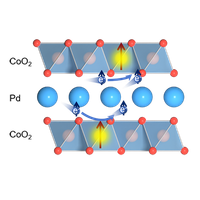
Layered oxide materials, with their two-dimensional crystalline architectures and tunable interlayer interaction, serve as a fertile field for harnessing emergent quantum phenomena. Among these materials, metallic delafossites (e.g., ) have emerged as a prominent system with extraordinary two-dimensional electronic properties, though their intrinsic lack of ferromagnetism has remained a fundamental constraint. Here, we report the creation of robust, bulk high-temperature ferromagnetism () in inherently nonmagnetic through controlled hydrogenation while preserving the delafossite structure. This process induces layer-selective electron doping into layers, stabilizing Ising-type ferromagnetism with pronounced perpendicular magnetic anisotropy while preserving the material’s exceptional metallicity. Remarkably, the system self-assembles into a superlattice of alternating metallic Pd and insulating ferromagnetic hydrogenated layers, enabling an unconventional anomalous Hall effect mediated by interlayer spin-charge coupling. These findings demonstrate that bulk ferromagnetism can be achieved in delafossite oxides while preserving their structural integrity, positioning hydrogenated delafossites as a versatile platform for exploring correlated quantum effects and designing multifunctional devices.
Physics Subject Headings (PhySH)
Popular Summary
Layered oxide materials, made of stacked 2D sheets, offer a powerful platform for exploring exotic quantum behaviors such as superconductivity and ferroelectricity. Among these, metallic delafossites are especially intriguing because they combine remarkable electronic properties with naturally layered crystal structures. A prime example is , which exhibits electrical conductivity rivaling that of noble metals such as gold, silver, and platinum. However, its application potential has been limited by a lack of magnetism—its cobalt ions normally exist in a nonmagnetic state. We show that a delafossite can show ferromagnetism at room temperature.
We successfully introduce strong ferromagnetism in by carefully heating the material at moderate temperature in a hydrogen-rich environment. This treatment intercalates hydrogen atoms into the lattice that trigger a chemical transformation within the cobalt oxide layers, converting nonmagnetic cobalt ions into magnetic ones through a spin-state transition. As a result, the system develops a robust magnetic order that persists well above room temperature. Despite this change, the material retains its excellent electrical conductivity because the conductive palladium layers remain largely unaffected. The process also causes the layers to reorganize into a natural superlattice of alternating metallic and magnetic sheets, giving rise to some exotic electronic effects.
By activating hidden magnetic behavior in , we demonstrate a way to engineer magnetism in materials that were previously considered nonmagnetic. This paves the way for designing delafossites with a unique electronic dichotomy with coupled spin and charge degrees of freedom, expanding opportunities for next-generation spintronic devices.
Article Text
Supplemental Material
References (57)
- D. Li et al., Superconductivity in an infinite-layer nickelate, Nature (London) 572, 624 (2019).
- Y. Maeno et al., Superconductivity in a layered perovskite without copper, Nature (London) 372, 532 (1994).
- H. Sun et al., Signatures of superconductivity near 80 K in a nickelate under high pressure, Nature (London) 621, 493 (2023).
- E. K. Ko et al., Signatures of ambient pressure superconductivity in thin film , Nature (London) 638, 935 (2025).
- Y. S. Oh, X. Luo, F. T. Huang, Y. Wang, and S. W. Cheong, Experimental demonstration of hybrid improper ferroelectricity and the presence of abundant charged walls in crystals, Nat. Mater. 14, 407 (2015).
- M. J. Pitcher et al., Tilt engineering of spontaneous polarization and magnetization above 300 K in a bulk layered perovskite, Science 347, 420 (2015).
- Y. Lyu et al., An overview on the advances of cathodes for lithium-ion batteries, Adv. Energy Mater. 11, 2000982 (2020).
- C. A. P. de Araujo, J. D. Cuchiaro, L. D. McMillan, M. C. Scott, and J. F. Scott, Fatigue-free ferroelectric capacitors with platinum electrodes, Nature (London) 374, 627 (1995).
- B. H. Park et al., Lanthanum-substituted bismuth titanate for use in non-volatile memories, Nature (London) 401, 682 (1999).
- A. P. Mackenzie, The properties of ultrapure delafossite metals, Rep. Prog. Phys. 80, 032501 (2017).
- P. J. W. Moll, P. Kushwaha, N. Nandi, B. Schmidt, and A. P. Mackenzie, Evidence for hydrodynamic electron flow in , Science 351, 1061 (2016).
- V. Sunko et al., Rashba-like spin splitting via kinetic-energy-coupled inversion-symmetry breaking, Nature (London) 549, 492 (2017).
- T. Harada, Thin-film growth and application prospects of metallic delafossites, Mater. Today Adv. 11, 100146 (2021).
- M. D. Bachmann et al., Directional ballistic transport in the two-dimensional metal , Nat. Phys. 18, 819 (2022).
- C. W. Hicks, A. S. Gibbs, A. P. Mackenzie, H. Takatsu, Y. Maeno, and E. A. Yelland, Quantum oscillations and high carrier mobility in the delafossite , Phys. Rev. Lett. 109, 116401 (2012).
- Y. Zhang et al., Crystal-chemical origins of the ultrahigh conductivity of metallic delafossites, Nat. Commun. 15, 1399 (2024).
- M. Tanaka et al., Origin of the metallic conductivity in with delafossite structure, Physica (Amsterdam) 245B, 157 (1998).
- V. Eyert, R. Frésard, and A. Maignan, On the metallic conductivity of the delafossites and , Chem. Mater. 20, 2370 (2008).
- T. Harada, S. Ito, and A. Tsukazaki, Electric dipole effect in Schottky diodes for high-temperature operation, Sci. Adv. 5, eaax5733 (2019).
- T. Harada, K. Fujiwara, and A. Tsukazaki, Highly conductive ultrathin films for transparent electrodes, APL Mater. 6, 046107 (2018).
- P. Yordanov et al., Generation of terahertz radiation via the transverse thermoelectric effect, Adv. Mater. 35, 2305622 (2023).
- J. F. Mendez-Valderrama et al., T-linear resistivity from magneto-elastic scattering: Application to , Proc. Natl. Acad. Sci. U.S.A. 120, e2305609120 (2023).
- Q. Song et al., Growth of films with controlled termination by molecular-beam epitaxy and determination of their electronic structure by angle-resolved photoemission spectroscopy, APL Mater. 10, 091113 (2022).
- F. Mazzola et al., Itinerant ferromagnetism of the -terminated polar surface of , Proc. Natl. Acad. Sci. U.S.A. 115, 12956 (2018).
- T. Harada et al., Anomalous Hall effect at the spontaneously electron-doped polar surface of ultrathin films, Phys. Rev. Res. 2, 0132282 (2020).
- M. Brahlek et al., Emergent magnetism with continuous control in the ultrahigh-conductivity layered oxide , Nano Lett. 23, 7279 (2023).
- G. Rimal et al., Effective reduction of thin films via hydrogenation and sign tunable anomalous Hall effect, Phys. Rev. Mater. 5, L052001 (2021).
- C. Gong and X. Zhang, Two-dimensional magnetic crystals and emergent heterostructure devices, Science 363, eaav4450 (2019).
- Q. H. Wang et al., The magnetic genome of two-dimensional van der Waals materials, ACS Nano 16, 6960 (2022).
- K. S. Burch, D. Mandrus, and J. G. Park, Magnetism in two-dimensional van der Waals materials, Nature (London) 563, 47 (2018).
- M. Gibertini, M. Koperski, A. F. Morpurgo, and K. S. Novoselov, Magnetic 2D materials and heterostructures, Nat. Nanotechnol. 14, 408 (2019).
- B. Huang et al., Emergent phenomena and proximity effects in two-dimensional magnets and heterostructures, Nat. Mater. 19, 1276 (2020).
- Y. Zhou et al., Strongly correlated perovskite fuel cells, Nature (London) 534, 231 (2016).
- H. Yoon et al., Reversible phase modulation and hydrogen storage in multivalent epitaxial thin films, Nat. Mater. 15, 1113 (2016).
- N. Lu et al., Enhanced low-temperature proton conductivity in hydrogen-intercalated brownmillerite oxide, Nat. Energy 7, 1208 (2022).
- H. Han et al., Reversal of anomalous Hall effect and octahedral tilting in thin films via hydrogen spillover, Adv. Mater. 35, 2370020 (2023).
- N. Lu et al., Electric-field control of tri-state phase transformation with a selective dual-ion switch, Nature (London) 546, 124 (2017).
- C. Leighton, Electrolyte-based ionic control of functional Oxides, Nat. Mater. 18, 13 (2019).
- F. Lloret, M. Julve, J. Cano, R. Ruiz-García, and E. Pardo, Magnetic properties of six-coordinated high-spin cobalt(II) complexes: Theoretical background and its application, Inorg. Chim. Acta 361, 3432 (2008).
- See Supplemental Material at http://link.aps.org/supplemental/10.1103/3mgc-z9wv for Figs. S1–S10, which provide details of the sample preparation, experimental measurements, and theoretical calculations.
- G. Li et al., In situ modification of a delafossite-type bulk single crystal for reversible hydrogen sorption and fast hydrogen evolution, ACS Energy Lett. 4, 2185 (2019).
- E. Ising, Beitrag zur theorie des ferromagnetismus, Z. Phys. 31, 253 (1925).
- H.-J. Noh et al., Orbital character of the conduction band of delafossite studied by polarization-dependent soft x-ray absorption spectroscopy, Phys. Rev. B 80, 073104 (2009).
- M. Wang et al., Manipulate the electronic and magnetic states in films through electric-field-induced protonation at elevated temperature, Adv. Mater. 31, 1900458 (2019).
- M. Mekata, T. Sugino, A. Oohara, Y. Oohara, and H. Yoshizawa, Magnetic structure of antiferromagnetic Possible degenerate helices on a rhombohedral lattice, Physica (Amsterdam) 213–214B, 221 (1995).
- C. T. Chen, Y. U. Idzerda, H. J. Lin, N. V. Smith, G. Meigs, E. Chaban, G. H. Ho, E. Pellegrin, and F. Sette, Experimental confirmation of the x-ray magnetic circular dichroism sum rules for iron and cobalt, Phys. Rev. Lett. 75, 152 (1995).
- H. J. Noh, J. Jeong, J. Jeong, E. J. Cho, S. B. Kim, K. Kim, B. I. Min, and H. D. Kim, Anisotropic electric conductivity of delafossite studied by angle-resolved photoemission spectroscopy, Phys. Rev. Lett. 102, 256404 (2009).
- N. Nagaosa, J. Sinova, S. Onoda, A. H. MacDonald, and N. P. Ong, Anomalous Hall effect, Rev. Mod. Phys. 82, 1539 (2010).
- H. Toyosaki et al., Anomalous Hall effect governed by electron doping in a room-temperature transparent ferromagnetic semiconductor, Nat. Mater. 3, 221 (2004).
- T. Miyasato, N. Abe, T. Fujii, A. Asamitsu, S. Onoda, Y. Onose, N. Nagaosa, and Y. Tokura, Crossover behavior of the anomalous Hall effect and anomalous Nerznst effect in itinerant ferromagnets, Phys. Rev. Lett. 99, 086602 (2007).
- Z. Chen et al., Electron ptychography achieves atomic-resolution limits set by lattice vibrations, Science 372, 826 (2021).
- Z. Dong et al., Visualization of oxygen vacancies and self-doped ligand holes in , Nature (London) 630, 847 (2024).
- P. Hohenberg and W. Kohn, Inhomogeneous electron gas, Phys. Rev. 136, B864 (1964).
- W. Kohn and L. J. Sham, Self-consistent equations including exchange and correlation effects, Phys. Rev. 140, A1133 (1965).
- J. P. Perdew, K. Burke, and M. Ernzerhof, Generalized gradient approximation made simple, Phys. Rev. Lett. 77, 3865 (1996).
- H. J. Monkhorst and J. D. Pack, Special points for Brillouin-zone integrations, Phys. Rev. B 13, 5188 (1976).
- S. L. Dudarev, G. A. Botton, S. Y. Savrasov, C. J. Humphreys, and A. P. Sutton, Electron-energy-loss spectra and the structural stability of nickel oxide: An LSDA+U study, Phys. Rev. B 57, 1505 (1998).

