Recent Articles

Thermal rectification in a qubit-resonator system

L. Magazzù, E. Paladino, J. P. Pekola, and M. Grifoni

Phys. Rev. Research 7, 043102 (2025) - Published 27 October, 2025

Redefining the dielectric response of nanoconfined liquids: Insights from water

Jon Zubeltzu, Fernando Bresme, Matthew Dawber, Marivi Fernandez-Serra, and Emilio Artacho

Phys. Rev. Research 7, 043101 (2025) - Published 27 October, 2025

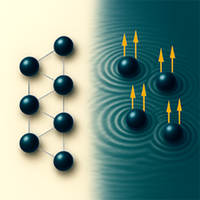
Theory of charge-to-spin conversion under quantum confinement

Alfonso Maiellaro, Francesco Romeo, Mattia Trama, Irene Gaiardoni, Jacopo Settino, Claudio Guarcello, Nicolas Bergeal, Manuel Bibes, and Roberta Citro

Phys. Rev. Research 7, 043100 (2025) - Published 24 October, 2025

Design principles of deep translationally symmetric neural quantum states for frustrated magnets

Rajah P. Nutakki, Ahmedeo Shokry, and Filippo Vicentini

Phys. Rev. Research 7, 043099 (2025) - Published 24 October, 2025

Synthetic fractional flux quanta in a ring of superconducting qubits

Luca Chirolli, Juan Polo, Gianluigi Catelani, and Luigi Amico

Phys. Rev. Research 7, 043098 (2025) - Published 24 October, 2025

Loss-resistant verification of quantum non-Gaussian photon statistics

Riccardo Checchinato, Jan-Heinrich Littmann, Lukáš Lachman, Jaewon Lee, Sven Höfling, Christian Schneider, Radim Filip, and Ana Predojević

Phys. Rev. Research 7, 043097 (2025) - Published 24 October, 2025

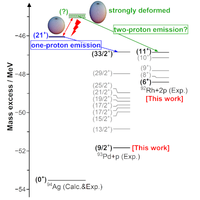
Direct mass measurement of Pd93 and implications for the isomer structures in Ag94: Tracing the two-proton decay branch

Gabriella Kripkó-Koncz et al. (for the Super-FRS Experiment Collaboration)

Phys. Rev. Research 7, L042022 (2025) - Published 23 October, 2025

A direct mass measurement of 93Pd has been performed and shows that there is an incompatibility in the previously reported decay scheme of the (21+) high-spin isomer in 94Ag, which calls into question the observation of the two-proton decay in 94Ag. State-of-the-art mean-field calculations support the idea of two high-spin isomeric states in 94Ag with strongly differing deformations, which would resolve this incompatibility.

Analytic solution for a class of multiscale long-range potentials

Haixiang Fu, Xiaoji Zhou, and Mingzhe Li

Phys. Rev. Research 7, 043096 (2025) - Published 23 October, 2025

Rotational stability in nanorotor and spin contrast in one-loop interferometry in the Stern-Gerlach setup

Ryan Rizaldy, Tian Zhou, Sougato Bose, and Anupam Mazumdar

Phys. Rev. Research 7, 043095 (2025) - Published 23 October, 2025

Parameter-efficient quantum anomaly detection method on a superconducting quantum processor

Maida Wang, Jinyang Jiang, and Peter V. Coveney

Phys. Rev. Research 7, 043094 (2025) - Published 23 October, 2025

Wetting transition: Macroscopic roughness, static friction, and energy barrier

Lisen Bi, Fei Wang, and Britta Nestler

Phys. Rev. Research 7, 043093 (2025) - Published 23 October, 2025

Cascade of magnetic phase transitions and large topological Hall effect in the noncentrosymmetric antiferromagnet Eu2Pd3Bi4

Kaibao Fan, Mengzhu Shi, Houpu Li, Jiaqiang Cai, Yaolong Bian, Zhiwei Wang, Mei Du, Jinglei Zhang, Yuyan Han, Chuanying Xi, Ziji Xiang, and Xianhui Chen

Phys. Rev. Research 7, 043092 (2025) - Published 23 October, 2025

Typical reconstruction limit and phase transition of maximum entropy method

Masaru Hitomi and Masayuki Ohzeki

Phys. Rev. Research 7, 043091 (2025) - Published 23 October, 2025

How quantum fluctuations freeze a classical liquid and then melt it into a topological one

Hao Chen, Dan Mao, Andrea Kouta Dagnino, Glenn Wagner, Mark H. Fischer, Juraj Hasik, Eun-Ah Kim, and Titus Neupert

Phys. Rev. Research 7, L042021 (2025) - Published 22 October, 2025

Spinless fermions on a honeycomb lattice with cluster-charging interactions are analyzed using exact diagonalization and high-order perturbation theory. The model features a kinetic-energy-driven sequence: a classical liquid freezes into charge order and subsequently transforms into a fractional Chern insulator as kinematic constraints are gradually lifted.

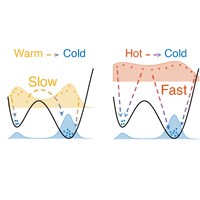
Experimental study of Mpemba effect in an energy Langevin system

Yuan Tian, Yu Zheng, Lyu-Hang Liu, Long Wang, Guang-Can Guo, and Fang-Wen Sun

Phys. Rev. Research 7, L042020 (2025) - Published 22 October, 2025

The ability to arbitrarily control the energy distribution of optically levitated nanoparticles provides an ideal platform for studying the Mpemba effect. This work confirms that during thermal relaxation following a temperature change, the potential-well crossing events determine the manifestation of the Mpemba effect.

Two-dimensional subwavelength topological dark state lattices

D. Burba and G. Juzeliūnas

Phys. Rev. Research 7, 043090 (2025) - Published 22 October, 2025

Arrested phase separation and chiral symmetry breaking in active dumbbells under shear

Lucio Mauro Carenza, Giuseppe Negro, Pasquale Digregorio, Antonio Suma, and Giuseppe Gonnella

Phys. Rev. Research 7, 043089 (2025) - Published 22 October, 2025

Competition between simple and complex contagion on temporal networks

Elsa Andres, Romualdo Pastor-Satorras, Michele Starnini, and Márton Karsai

Phys. Rev. Research 7, 043088 (2025) - Published 22 October, 2025

Entanglement generation and scaling from noisy quenches across a quantum critical point

R. Jafari, J. Naji, A. Langari, Vahid Karimipour, and Henrik Johannesson

Phys. Rev. Research 7, 043087 (2025) - Published 22 October, 2025

Local ergotropy dynamically witnesses many-body localized phases

F. Formicola, G. Di Bello, G. De Filippis, V. Cataudella, D. Farina, and C. A. Perroni

Phys. Rev. Research 7, 043086 (2025) - Published 22 October, 2025

Sign In to Your Journals Account

Filter

Recent Issues

Vol. 8, Iss. 4
October - December 2026
Vol. 8, Iss. 3
July - September 2026
Vol. 8, Iss. 2
April - June 2026
Vol. 8, Iss. 1
January - March 2026
Category
Article Type

Filter

Article Lookup

Enter a citation