Recent Articles

Tipping point for pulsatile oscillations in dynamical networks

Bo-Wei Qin (秦伯韡) and Wei Lin (林伟)

Phys. Rev. Research 5, 043209 (2023) - Published 6 December, 2023

Majorana scars as group singlets

Zimo Sun, Fedor K. Popov, Igor R. Klebanov, and Kiryl Pakrouski

Phys. Rev. Research 5, 043208 (2023) - Published 6 December, 2023

Probing vacuum field fluctuations and source radiation separately in space and time

Frieder Lindel, Alexa Marina Herter, Jérôme Faist, and Stefan Yoshi Buhmann

Phys. Rev. Research 5, 043207 (2023) - Published 6 December, 2023

Quantum-secured covert sensing for the Doppler effect

Shuhong Hao and Zheshen Zhang

Phys. Rev. Research 5, 043206 (2023) - Published 5 December, 2023

Efficient population coding of sensory stimuli

Shuai Shao, Markus Meister, and Julijana Gjorgjieva

Phys. Rev. Research 5, 043205 (2023) - Published 5 December, 2023

A generalized theoretical framework of neuronal coding is developed. The theory assumes that neuronal populations implement efficient coding that maximizes the Shannon mutual information between stimuli and spikes. The resulting optimal neuronal activation functions partition the stimulus space equally, and the mutual information is independent of the fraction of ON and OFF neurons.

Noncoplanar magnetic order in classical square-kagome antiferromagnets

Martin Gembé, Heinz-Jürgen Schmidt, Ciarán Hickey, Johannes Richter, Yasir Iqbal, and Simon Trebst

Phys. Rev. Research 5, 043204 (2023) - Published 5 December, 2023

Universal productivity patterns in research careers

Andre S. Sunahara, Matjaž Perc, and Haroldo V. Ribeiro

Phys. Rev. Research 5, 043203 (2023) - Published 5 December, 2023

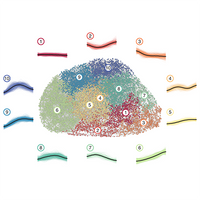
Methods from time series analysis, dimensionality reduction, and network science are combined to show evidence for the natural emergence of six universal patterns of productivity in scientific careers: constant, u-shaped, decreasing, periodic, increasing, and canonical curves. Canonical curves are the most prevalent pattern, but contrary to expectations, productivity peaks occur much more frequently around midcareer rather than early.

Context-aware fidelity estimation

Dripto M. Debroy, Élie Genois, Jonathan A. Gross, Wojciech Mruczkiewicz, Kenny Lee, Sabrina Hong, Zijun Chen, Vadim Smelyanskiy, and Zhang Jiang

Phys. Rev. Research 5, 043202 (2023) - Published 5 December, 2023

Laser cooling and trapping of 224Ra+

M. Fan, Roy A. Ready, H. Li, S. Kofford, R. Kwapisz, C. A. Holliman, M. S. Ladabaum, A. N. Gaiser, J. R. Griswold, and A. M. Jayich

Phys. Rev. Research 5, 043201 (2023) - Published 5 December, 2023

Robust and efficient network reconstruction in complex system via adaptive signal lasso

Lei Shi, Jie Hu, Libin Jin, Chen Shen, Huaiyu Tan, and Dalei Yu

Phys. Rev. Research 5, 043200 (2023) - Published 5 December, 2023

Double exchange, itinerant ferromagnetism, and topological Hall effect in moiré heterobilayer

Haichen Jia, Bowen Ma, Rui Leonard Luo, and Gang Chen

Phys. Rev. Research 5, L042033 (2023) - Published 4 December, 2023

In the MoTe2/WSe2 moiré heterobilayer, the itinerant ferromagnetism can be induced from the double exchange mechanism for the itinerant holes on the WSe2 layer and the local moments on the MoTe2 layer. Together with the antiferromagnetic exchange on the MoTe2 layer, the itinerant ferromagnetism generates the scalar spin chirality, leading to the topological Hall effect for the itinerant holes in the presence of the noncollinear spin configurations.

Metaheuristic conditional neural network for harvesting skyrmionic metastable states

Qichen Xu, I. P. Miranda, Manuel Pereiro, Filipp N. Rybakov, Danny Thonig, Erik Sjöqvist, Pavel F. Bessarab, Anders Bergman, Olle Eriksson, Pawel Herman, and Anna Delin

Phys. Rev. Research 5, 043199 (2023) - Published 4 December, 2023

StrainTensorNet: Predicting crystal structure elastic properties using SE(3)-equivariant graph neural networks

Teerachote Pakornchote, Annop Ektarawong, and Thiparat Chotibut

Phys. Rev. Research 5, 043198 (2023) - Published 4 December, 2023

Synchronization by magnetostriction

Jiong Cheng, Wenlin Li, and Jie Li

Phys. Rev. Research 5, 043197 (2023) - Published 4 December, 2023

Escape of a sticky particle

Yuval Scher, Shlomi Reuveni, and Denis S. Grebenkov

Phys. Rev. Research 5, 043196 (2023) - Published 4 December, 2023

Qubit entanglement generated by classical light driving an optical cavity

Seongjin Ahn, Andrey S. Moskalenko, Vladimir Y. Chernyak, and Shaul Mukamel

Phys. Rev. Research 5, 043195 (2023) - Published 4 December, 2023

Implementing two-qubit gates at the quantum speed limit

Joel Howard, Alexander Lidiak, Casey Jameson, Bora Basyildiz, Kyle Clark, Tongyu Zhao, Mustafa Bal, Junling Long, David P. Pappas, Meenakshi Singh, and Zhexuan Gong

Phys. Rev. Research 5, 043194 (2023) - Published 1 December, 2023

Many-body Szilárd engine with giant number fluctuations

Omer Chor, Amir Sohachi, Rémi Goerlich, Eran Rosen, Saar Rahav, and Yael Roichman

Phys. Rev. Research 5, 043193 (2023) - Published 1 December, 2023

Modeling particle loss in open systems using Keldysh path integral and second order cumulant expansion

Chen-How Huang, Thierry Giamarchi, and Miguel A. Cazalilla

Phys. Rev. Research 5, 043192 (2023) - Published 1 December, 2023

Understanding the dynamics of randomly positioned dipolar spin ensembles

Timo Gräßer, Kristine Rezai, Alexander O. Sushkov, and Götz S. Uhrig

Phys. Rev. Research 5, 043191 (2023) - Published 1 December, 2023

Sign In to Your Journals Account

Filter

Recent Issues

Vol. 8, Iss. 4
October - December 2026
Vol. 8, Iss. 3
July - September 2026
Vol. 8, Iss. 2
April - June 2026
Vol. 8, Iss. 1
January - March 2026
Category
Article Type

Filter

Article Lookup

Enter a citation