Recent Articles

Coupled dimerized alternating-bond quantum spin chains in the distorted honeycomb-lattice magnet Cu5SbO6

C. Piyakulworawat, K. Morita, Y. Fukumoto, W.-Y. Hsieh, W.-T. Chen, K. Nakajima, S. Ohira-Kawamura, Y. Zhao, S. Wannapaiboon, P. Piyawongwatthana, T. J. Sato, and K. Matan

Phys. Rev. Research 8, 013247 (2026) - Published 6 March, 2026

Research on Cu5SbO6, a material in which Cu2+ ions are arranged in distorted honeycomb lattices, reveals a magnetic scheme of interacting ferromagnetic-antiferromagnetic quantum spin chains residing in the honeycomb layers. Unlike similar materials, the interchain interaction in this compound is dominated by the interlayer antiferromagnetic coupling rather than the intralayer coupling.

Molecular spin qudits to test generalized Bell inequalities

Silvia Macedonio, Luca Lepori, Alessandro Chiesa, Simone Chicco, Laura Bersani, Marcos Rubin-Osanz, Lukas Bradley Woodcock, Athanasios Mavromagoulos, Giuseppe Allodi, Elena Garlatti, Stergios Piligkos, Augusto Smerzi, and Stefano Carretta

Phys. Rev. Research 8, 013138 (2026) - Published 9 February, 2026

This work studies generalized Bell inequalities in molecular spin qudits, focusing on qubit-qudit and qudit-qudit systems. Numerical simulations using experimentally measured parameters on an a Yb(trensal) molecule, featuring a nuclear spin qudit coupled to an electronic spin qubit, demonstrate that violations of Bell inequalities can be achieved with realistic control protocols and decoherence times.

Understanding decoherence in molecular spin qudits

Leonardo Ratini, Giacomo Sansone, Elena Garlatti, Francesco Petiziol, Stefano Carretta, and Paolo Santini

Phys. Rev. Research 7, 043125 (2025) - Published 3 November, 2025

The primary source of error in molecular spin qudits under spin-echo control at low-temperature is pure dephasing, caused by their interactions with surrounding nuclear spins. This work demonstrates that coherence is preserved over time if and only if the expectation values of local spin operators on the involved eigenstates are identical. The analytic result is corroborated by numerical simulations performed using the cluster correlation expansion method to model the non-Markovian dynamics of these systems, providing a strategy to engineer robust qudits for quantum technologies.

Quantum and classical spin dynamics across temperature scales in the S=1/2 Heisenberg antiferromagnet

Pyeongjae Park, G. Sala, Daniel M. Pajerowski, Andrew F. May, James A. Kolopus, D. Dahlbom, Matthew B. Stone, Gábor B. Halász, and Andrew D. Christianson

Phys. Rev. Research 6, 033184 (2024) - Published 19 August, 2024

A new approach utilizing thermal fluctuations to investigate the spin dynamics of quantum magnets is introduced. It successfully identifies the spin Hamiltonian of a quantum antiferromagnet and elucidates the temperature-induced dissipation of quantum spin dynamics, which are challenging to assess using conventional spin-wave theories.

Hybrid coherent control of magnons in a ferromagnetic phononic resonator excited by laser pulses

Alexey V. Scherbakov, Alex D. Carr, Tetiana L. Linnik, Serhii M. Kukhtaruk, Andrew D. Armour, Achim Nadzeyka, Andrew W. Rushforth, Andrey V. Akimov, and Manfred Bayer

Phys. Rev. Research 6, L012019 (2024) - Published 23 January, 2024

A femtosecond laser pulse triggers hybrid excitation of magnons in a ferromagnetic nanostructure via an instant broadband kick and also through quasiharmonic driving by phonons. By tuning the external magnetic field and exploiting the dependence of the phase of the broadband excitation on the laser fluence, the phase and amplitude of the coherent magnon response is manipulated.

Hyperpolarization of nuclear spins: Polarization blockade

O. T. Whaites, C. I. Ioannou, B. J. Pingault, G. L. van de Stolpe, T. H. Taminiau, and T. S. Monteiro

Phys. Rev. Research 5, 043291 (2023) - Published 26 December, 2023

Sequences of periodic microwave pulses are used to efficiently transfer polarization from an NV defect electronic spin in diamond to surrounding nuclei, at specific resonant periods. It’s theoretically and experimentally demonstrated that the presence of a “blocking spin,” a nuclear spin with similar precession frequency but stronger coupling, leads to expulsion of polarization resonances of other nuclear spins from the central resonant period region, affecting the efficiency of the polarization protocol.

Pressure-enhanced fractional Chern insulators along a magic line in moiré transition metal dichalcogenides

Nicolás Morales-Durán, Jie Wang, Gabriel R. Schleder, Mattia Angeli, Ziyan Zhu, Efthimios Kaxiras, Cécile Repellin, and Jennifer Cano

Phys. Rev. Research 5, L032022 (2023) - Published 17 August, 2023

The effect of applied pressure on fractional Chern insulators (FCIs) in moiré TMDs is numerically studied, indicating that pressure can enhance the many-body gap of these topologically ordered phases. This is supported by showing that, within the region of stability of the FCI, the quantum geometry of the topmost moiré flat band almost satisfies the ideal condition.

Single-spin qubit magnetic spectroscopy of two-dimensional superconductivity

Shubhayu Chatterjee, Pavel E. Dolgirev, Ilya Esterlis, Alexander A. Zibrov, Mikhail D. Lukin, Norman Y. Yao, and Eugene Demler

Phys. Rev. Research 4, L012001 (2022) - Published 10 January, 2022

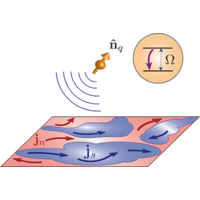
The authors propose a technique to detect and characterize superconductivity in two-dimensional materials via magnetic noise detected by a single-spin qubit placed proximate to the material sample.

Revealing the phase diagram of Kitaev materials by machine learning: Cooperation and competition between spin liquids

Ke Liu (刘科 子竞), Nicolas Sadoune, Nihal Rao, Jonas Greitemann, and Lode Pollet

Phys. Rev. Research 3, 023016 (2021) - Published 5 April, 2021

The authors propose an unsupervised and interpretable machine learning scheme and apply it to uncover properties in Kitaev materials.

Magnetic field-induced vortex triplet and vortex lattice in a liquid crystal cell

Enrique Calisto, Marcel G. Clerc, and Valeska Zambra

Phys. Rev. Research 2, 042026(R) (2020) - Published 10 November, 2020

The authors show the emergence of a vortex triplet and a topological vortex lattice as a consequence of the combined effect of a magnetic ring and the uniform electric field onto a homeotropic nematic liquid crystal.

Microscopic origin of the anomalous Hall effect in noncollinear kagome magnets

Oliver Busch, Börge Göbel, and Ingrid Mertig

Phys. Rev. Research 2, 033112 (2020) - Published 21 July, 2020

The authors establish a microscopic understanding of the anomalous Hall effect of electrons in several Kagome magnets. The spin-orbit coupling together with the inversion-symmetry breaking in these materials can effectively be described by a virtual texture that is canted out of the Kagome plane, even though the actual magnetic texture is coplanar. The uncompensated virtual texture has a finite scalar spin chirality effectively giving rise to a topologically induced Hall effect.

Layer-dependent electronic and magnetic properties of Nb3I8

Felice Conte, Domenico Ninno, and Giovanni Cantele

Phys. Rev. Research 2, 033001 (2020) - Published 1 July, 2020

This work studies the electronic and magnetic properties of few-layer Nb3I8 using first principles. The authors observe layer-dependent magnetism and compare their results with experimental work function measurements.

Unconventional spin currents in magnetic films

Dmytro A. Bozhko, Halyna Yu. Musiienko-Shmarova, Vasyl S. Tiberkevich, Andrei N. Slavin, Ihor I. Syvorotka, Burkard Hillebrands, and Alexander A. Serga

Phys. Rev. Research 2, 023324 (2020) - Published 12 June, 2020

This work uses wavevector-resolved Brillouin light scattering spectroscopy in combination with a theory of dipole-exchange spin-wave spectra to show that, in obliquely magnetized free magnetic films, the in-plane propagation of spin waves is accompanied by a transverse spin current along the film normal without any corresponding transverse transport of energy.

Quantifying the inverse spin-Hall effect in highly doped PEDOT:PSS

Mohammad M. Qaid, M. R. Mahani, J. Sinova, and G. Schmidt

Phys. Rev. Research 2, 013207 (2020) - Published 25 February, 2020

The authors provide experimental results that show the onset of the Nernst effect, thermovoltages and an inverse spin-Hall effect in the polymer PEDOT:PSS. Specifically, the observed inverse spin-Hall effect appears to be smaller than other measurements, but in better agreement with theoretical calculations.

Magnonic Weyl states in Cu2OSeO3

L.-C. Zhang, Y. A. Onykiienko, P. M. Buhl, Y. V. Tymoshenko, P. Čermák, A. Schneidewind, J. R. Stewart, A. Henschel, M. Schmidt, S. Blügel, D. S. Inosov, and Y. Mokrousov

Phys. Rev. Research 2, 013063 (2020) - Published 21 January, 2020

The emergence of topologically non-trivial Weyl points is found in the magnonic spectrum of a key multiferroic compound exhibiting skyrmions. This opens the way to exploring the physics of intertwined complex real space and magnonic topologies

Sign In to Your Journals Account

Filter

Recent Issues

Vol. 8, Iss. 4
October - December 2026
Vol. 8, Iss. 3
July - September 2026
Vol. 8, Iss. 2
April - June 2026
Vol. 8, Iss. 1
January - March 2026
Category
Article Type

Filter

Article Lookup

Enter a citation