Recent Articles

Characterization of growth and structure of TCNQ phases on Ag(111)

P. J. Blowey, A. Haags, L. A. Rochford, J. Felter, D. A. Warr, D. A. Duncan, T.-L. Lee, G. Costantini, C. Kumpf, and D. P. Woodruff

Phys. Rev. Materials 3, 116001 (2019) - Published 5 November, 2019

Generalized Kanzaki force field of extended defects in crystals with applications to the modeling of edge dislocations

B. Gurrutxaga-Lerma and J. Verschueren

Phys. Rev. Materials 3, 113801 (2019) - Published 4 November, 2019

Microscopic toy model for magnetoelectric effect in polar Fe2Mo3O8

I. V. Solovyev and S. V. Streltsov

Phys. Rev. Materials 3, 114402 (2019) - Published 4 November, 2019

Quantum yield measurements by thermal lens in highly absorbing samples: The case of highly doped rhodamine B organic/silica xerogels

J. F. M. dos Santos, V. S. Zanuto, M. Ventura, C. B. Bramorski, T. Catunda, D. S. Manoel, L. C. Malacarne, and F. S. de Vicente

Phys. Rev. Materials 3, 115201 (2019) - Published 4 November, 2019

Enhancement of magnetodielectric coupling in 6H-perovskites Ba3RRu2O9 for heavier rare-earth cations (R=Ho,Tb)

Tathamay Basu, Vincent Caignaert, Somnath Ghara, Xianglin Ke, Alain Pautrat, Stephan Krohns, Alois Loidl, and Bernard Raveau

Phys. Rev. Materials 3, 114401 (2019) - Published 1 November, 2019

Thermodynamic model for metalorganic vapor-phase epitaxy of N-polar group-III nitrides in step-flow growth mode: Hydrogen, competitive adsorption, and configuration entropy

Takashi Hanada

Phys. Rev. Materials 3, 103404 (2019) - Published 31 October, 2019

Formation window of gas bubble superlattice in molybdenum under ion implantation

Cheng Sun, David J. Sprouster, Yongfeng Zhang, Di Chen, Yongqiang Wang, Lynne E. Ecker, and Jian Gan

Phys. Rev. Materials 3, 103607 (2019) - Published 31 October, 2019

Magnetic domain structure within half-metallic ferromagnetic kagome compound Co3Sn2S2

Akira Sugawara, Tetsuya Akashi, Mohamed A. Kassem, Yoshikazu Tabata, Takeshi Waki, and Hiroyuki Nakamura

Phys. Rev. Materials 3, 104421 (2019) - Published 30 October, 2019

Ion intercalation engineering of electronic properties of two-dimensional crystals of 2H−TaSe2

Yueshen Wu, Hui Xing, Chao-Sheng Lian, Hailong Lian, Jiaming He, Wenhui Duan, Jinyu Liu, Zhiqiang Mao, and Ying Liu

Phys. Rev. Materials 3, 104003 (2019) - Published 28 October, 2019

Magnetic frustration control through tunable stereochemically driven disorder in entropy-stabilized oxides

Peter B. Meisenheimer, Logan D. Williams, Suk Hyun Sung, Jiseok Gim, Padraic Shafer, George N. Kotsonis, Jon-Paul Maria, Morgan Trassin, Robert Hovden, Emmanouil Kioupakis, and John T. Heron

Phys. Rev. Materials 3, 104420 (2019) - Published 28 October, 2019

Giant perpendicular magnetic anisotropy in Ir/Co/Pt multilayers

Yong-Chang Lau, Zhendong Chi, Tomohiro Taniguchi, Masashi Kawaguchi, Goro Shibata, Naomi Kawamura, Motohiro Suzuki, Shunsuke Fukami, Atsushi Fujimori, Hideo Ohno, and Masamitsu Hayashi

Phys. Rev. Materials 3, 104419 (2019) - Published 25 October, 2019

Emerging proton conductivity at the interface between insulating NdGaO3 and BaZrO3

Francesca Zarotti, Roberto Felici, Vittorio Foglietti, Zhao Liu, Nan Yang, and Giuseppe Balestrino

Phys. Rev. Materials 3, 103606 (2019) - Published 24 October, 2019

Less-ordered structures of silicene on Ag(111) surface revealed by atomic force microscopy

Jo Onoda, Lingyu Feng, Keisuke Yabuoshi, and Yoshiaki Sugimoto

Phys. Rev. Materials 3, 104002 (2019) - Published 24 October, 2019

There has been a puzzling less-ordered phase in silicene formed on Ag surface—the T phase. Using high-resolution atomic force microscopy, the authors revealed that the T phase has a continuous Si honeycomb arrangement, thus forming a complete silicene sheet. They also found two types of T phase; one of which is identified by the tessellation with four different rhombi. Finding such a quasiperiodic phase of silicene might open new prospects in the field of monolayer materials.

Band gap evolution in Ruddlesden-Popper phases

Wei Li, Shanyuan Niu, Boyang Zhao, Ralf Haiges, Zhiqiang Zhang, Jayakanth Ravichandran, and Anderson Janotti

Phys. Rev. Materials 3, 101601(R) (2019) - Published 23 October, 2019

Stability and electronic properties of GaN phases with inversion symmetry to inherently inhibit polarization

Anan Sun, Shang-Peng Gao, and Gong Gu

Phys. Rev. Materials 3, 104604 (2019) - Published 23 October, 2019

Characterization and control of vortex and antivortex domain defects in quadrilateral ferroelectric nanodots

L. L. Ding, Ye Ji, X. Y. Zhang, W. M. Xiong, W. J. Chen, B. M. Zhang, Biao Wang, and Yue Zheng

Phys. Rev. Materials 3, 104417 (2019) - Published 22 October, 2019

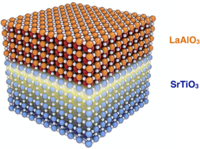
Exploring possible ferromagnetism of the LaAlO3/SrTiO3 interface

P. Wittlich, H. Boschker, T. Asaba, L. Li, H. M. L. Noad, C. A. Watson, K. A. Moler, D. Daraselia, D. Japaridze, A. Shengelaya, J. Wang, J. Xia, and J. Mannhart

Phys. Rev. Materials 3, 104418 (2019) - Published 22 October, 2019

The conducting interfaces between the insulators LaAlO3 and SrTiO3 generate a variety of phenomena that are entirely unexpected for insulators. These phenomena include two-dimensional superconductivity and ferromagnetism. A variety of models for mechanisms causing the ferromagnetism has been proposed. By applying a broad set of local and integral measurement techniques to series of samples fabricated to be virtually free of magnetic contaminations, authors’ studies conclusively show that the LaAlO3-SrTiO3 interfaces do not intrinsically induce ferromagnetism. The magnetism is caused by defects such as oxygen vacancies generated at the interfaces.

Band engineering of a magnetic thin film rare-earth monopnictide: A platform for high Chern number

Hisashi Inoue, Minyong Han, Mengli Hu, Takehito Suzuki, Junwei Liu, and Joseph G. Checkelsky

Phys. Rev. Materials 3, 101202(R) (2019) - Published 21 October, 2019

This paper reports the first realization of epitaxial GdBi thin films by molecular beam epitaxy. By systematically studying the electronic and magnetic properties with varying film thicknesses from 40 nm to 5 nm, the authors found that the semimetallicity of GdBi is lifted below 9 nm while the antiferromagnetic order is maintained down to the minimum thickness. Combined with the method they have developed to stabilize an ultra-thin GdBi against atmospheric degradation, this is a step towards realizing the novel Chern insulating state with the Chern number 2 in the monolayer limit, which the authors predict by analysis of the band structure calculated by first-principles methods.

Discovery of ω-free high-temperature Ti-Ta-X shape memory alloys from first-principles calculations

Alberto Ferrari, Alexander Paulsen, Dennis Langenkämper, David Piorunek, Christoph Somsen, Jan Frenzel, Jutta Rogal, Gunther Eggeler, and Ralf Drautz

Phys. Rev. Materials 3, 103605 (2019) - Published 21 October, 2019

The high-temperature shape memory effect in conventional Ti-Ta alloys is compromised by the formation of the detrimental ω phase. This combined computational and experimental research presents the theory-guided discovery of the high-temperature shape memory alloy Ti-Ta-Sc, which, in contrast to existing state-of-the-art analogs, does not evidence any traces of ω phase and thus exhibits a much more stable shape memory effect. The alloy design methodology outlined by the authors provides a viable and general strategy to eliminate the formation of this undesirable phase from the large class of technologically relevant Ti alloys.

Cation role in the thermal properties of layered materials M1+M3+P2(S,Se)6(M1+=Cu,Ag;M3+=In,Bi)

V. Liubachko, A. Oleaga, A. Salazar, A. Kohutych, K. Glukhov, A. Pogodin, and Yu. Vysochanskii

Phys. Rev. Materials 3, 104415 (2019) - Published 21 October, 2019

Sign In to Your Journals Account

Filter

Recent Issues

Vol. 10, Iss. 11
November 2026
Vol. 10, Iss. 10
October 2026
Vol. 10, Iss. 9
September 2026
Vol. 10, Iss. 8
August 2026
Category
Article Type
Section

Filter

Article Lookup

Enter a citation