Recent Articles

Electronic structure of the bond disproportionated bismuthate Ag2BiO3

Mohamed Oudah, Minu Kim, Ksenia S. Rabinovich, Kateryna Foyevtsova, Graham McNally, Berkay Kilic, Kathrin Küster, Robert Green, Alexander V. Boris, George Sawatzky, Andreas P. Schnyder, D. A. Bonn, Bernhard Keimer, and Hidenori Takagi

Phys. Rev. Materials 5, 064202 (2021) - Published 24 June, 2021

Large nonlinear electrostrain and piezoelectric response in nonergodic (Na,K)0.5Bi0.5TiO3: Synergy of structural disorder and tetragonal phase in proximity to a morphotropic phase boundary

Gobinda Das Adhikary, Vivek Dwij, Anatoliy Senyshyn, Vasant Sathe, and Rajeev Ranjan

Phys. Rev. Materials 5, 064414 (2021) - Published 24 June, 2021

Role of oxygen vacancies on the low-temperature dielectric relaxor behavior in epitaxial Ba0.85Ca0.15Ti0.9Zr0.1O3 thin films

Subhashree Chatterjee, Abhisikta Barman, Shubhankar Barman, Tanmay Chabri, Sohini Kar-Narayan, Anuja Datta, and Devajyoti Mukherjee

Phys. Rev. Materials 5, 064415 (2021) - Published 24 June, 2021

Cation and anion topotactic transformations in cobaltite thin films leading to Ruddlesden-Popper phases

I-Ting Chiu, Min-Han Lee, Shaobo Cheng, Shenli Zhang, Larry Heki, Zhen Zhang, Yahya Mohtashami, Pavel N. Lapa, Mingzhen Feng, Padraic Shafer, Alpha T. N'Diaye, Apurva Mehta, Jon A. Schuller, Giulia Galli, Shriram Ramanathan, Yimei Zhu, Ivan K. Schuller, and Yayoi Takamura

Phys. Rev. Materials 5, 064416 (2021) - Published 24 June, 2021

The ability to control a material’s physical properties by ion migration is particularly important for the design of devices for emerging applications such as neuromorphic computing, magnetoionic switches, and next-generation memory and logic devices. The perovskite oxide LaSrCoO3 is an ideal system for investigating ion migration due to its high oxygen vacancy conductivity, relatively low oxygen vacancy formation energy, and strong coupling of the magnetic and electronic properties to its oxygen stoichiometry. This paper shows that it is possible to obtain a series of electronic and magnetic phases by systematically exposing the parent perovskite oxide to highly reducing annealing conditions. Under these conditions, the movement of both oxygen and cobalt ions in and out of the lattice represents a new direction for discovery of functional materials for brain-inspired computing.

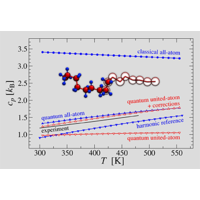
Comparing simulated specific heat of liquid polymers and oligomers to experiments

Hongyu Gao, Thalia J. L. Menzel, Martin H. Müser, and Debashish Mukherji

Phys. Rev. Materials 5, 065605 (2021) - Published 23 June, 2021

The field of atomistic simulations of polymers is in a mature stage, yet accurate predictions of their specific heat are very rare. The main difficulty stems from the quantum-mechanical nature of intramolecular vibrations. They call for either full, tedious quantum-mechanical treatments, or, for proper corrections of classical simulations. Here, the authors adopt an existing method, which defines a specific heat for a harmonic reference, to estimate the specific heat difference between classical and quantum-mechanical systems and use this as a correction factor. Thereby, they predominantly correct the stiff, high-frequency harmonic modes, while leaving the specific-heat contributions of the slow (anharmonic) modes intact. The results compare well to experimental data.

Modeling the Ga/As binary system across temperatures and compositions from first principles

Giulio Imbalzano and Michele Ceriotti

Phys. Rev. Materials 5, 063804 (2021) - Published 22 June, 2021

Highly sensitive spin-flop transition in antiferromagnetic van der Waals material MPS3 (M=Ni and Mn)

Rabindra Basnet, Aaron Wegner, Krishna Pandey, Stephen Storment, and Jin Hu

Phys. Rev. Materials 5, 064413 (2021) - Published 22 June, 2021

Origin of hydrogen passivation in 4H-SiC

Xuefen Cai, Yang Yang, Hui-Xiong Deng, and Su-Huai Wei

Phys. Rev. Materials 5, 064604 (2021) - Published 22 June, 2021

Tuning superconductivity in Ge:Ga using Ga+ implantation energy

Kasra Sardashti, Tri D. Nguyen, Wendy L. Sarney, Asher C. Leff, Mehdi Hatefipour, Matthieu C. Dartiailh, Joseph Yuan, William Mayer, and Javad Shabani

Phys. Rev. Materials 5, 064802 (2021) - Published 22 June, 2021

Multiscale modeling of electrical conductivity of R-BAPB polyimide plus carbon nanotubes nanocomposites

S. V. Larin, S. V. Lyulin, P. A. Likhomanova, K. Yu. Khromov, A. A. Knizhnik, and B. V. Potapkin

Phys. Rev. Materials 5, 066002 (2021) - Published 22 June, 2021

Relative stabilities of Si polytypes under biaxial stress: A first-principles study

Reo Kita, Masayuki Toyoda, and Susumu Saito

Phys. Rev. Materials 5, 063402 (2021) - Published 21 June, 2021

Opening band gaps of low-dimensional materials at the meta-GGA level of density functional approximations

Bimal Neupane, Hong Tang, Niraj K. Nepal, Santosh Adhikari, and Adrienn Ruzsinszky

Phys. Rev. Materials 5, 063803 (2021) - Published 21 June, 2021

CrI3 revisited with a many-body ab initio theoretical approach

Tom Ichibha, Allison L. Dzubak, Jaron T. Krogel, Valentino R. Cooper, and Fernando A. Reboredo

Phys. Rev. Materials 5, 064006 (2021) - Published 21 June, 2021

Large spin-to-charge conversion in ultrathin gold-silicon multilayers

Mohammed Salah El Hadri, Jonathan Gibbons, Yuxuan Xiao, Haowen Ren, Hanu Arava, Yuzi Liu, Zhaowei Liu, Amanda Petford-Long, Axel Hoffmann, and Eric E. Fullerton

Phys. Rev. Materials 5, 064410 (2021) - Published 21 June, 2021

Spin-wave localization and guiding by magnon band structure engineering in yttrium iron garnet

Rouven Dreyer, Niklas Liebing, Eric R. J. Edwards, Andreas Müller, and Georg Woltersdorf

Phys. Rev. Materials 5, 064411 (2021) - Published 21 June, 2021

Magnetocaloric properties and specifics of the hysteresis at the first-order metamagnetic transition in Ni-doped FeRh

A. M. Chirkova, K. P. Skokov, Y. Skourski, F. Scheibel, A. Y. Karpenkov, A. S. Volegov, N. V. Baranov, K. Nielsch, L. Schultz, K.-H. Müller, T. G. Woodcock, and O. Gutfleisch

Phys. Rev. Materials 5, 064412 (2021) - Published 21 June, 2021

Technological implementation of a photonic Bier-Glas cavity

Jonathan Jurkat, Magdalena Moczała-Dusanowska, Martin Arentoft Jacobsen, Ana Predojević, Tobias Huber, Niels Gregersen, Sven Höfling, and Christian Schneider

Phys. Rev. Materials 5, 064603 (2021) - Published 21 June, 2021

Reaction kinetics of the thermal decomposition of MAPbI3 thin films

Thomas Burwig and Paul Pistor

Phys. Rev. Materials 5, 065405 (2021) - Published 21 June, 2021

Glass transition in gels

Rui Xiao and Hai Li

Phys. Rev. Materials 5, 065604 (2021) - Published 21 June, 2021

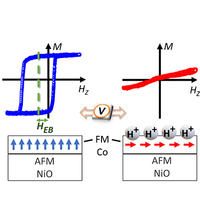
Magnetoionic control of perpendicular exchange bias

J. Zehner, D. Wolf, M. U. Hasan, M. Huang, D. Bono, K. Nielsch, K. Leistner, and G. S. D. Beach

Phys. Rev. Materials 5, L061401 (2021) - Published 21 June, 2021

Voltage control of magnetism via ionic motion (magnetoionic control) is currently a thriving approach for low-power magnetic nanodevices. Recently, fast switching and high reversibility have been achieved for proton (H+)-based magnetoionic control in all-solid devices. In this work, the authors extend such (H+)-based magnetoionic control to a perpendicular exchange bias (EB) systems by functionalizing the ferromagnetic Co layer with an underlying antiferromagnetic NiO layer. They reveal the importance of an interfacial Pd layer for the existence of perpendicular EB in this system. Importantly, they demonstrate reversible (H+)-based magnetoionic control of remanence and coercivity in such a perpendicular EB system and thoroughly discuss the underlying mechanism.

Sign In to Your Journals Account

Filter

Recent Issues

Vol. 10, Iss. 11
November 2026
Vol. 10, Iss. 10
October 2026
Vol. 10, Iss. 9
September 2026
Vol. 10, Iss. 8
August 2026
Category
Article Type
Section

Filter

Article Lookup

Enter a citation