Highlights

Squeezed Light from a Levitated Nanoparticle at Room Temperature

Lorenzo Magrini, Victor A. Camarena-Chávez, Constanze Bach, Aisling Johnson, and Markus Aspelmeyer

Phys. Rev. Lett. 129, 053601 (2022) - Published 25 July, 2022

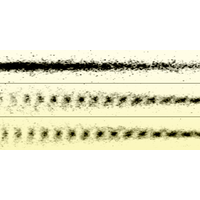
A trapped nanoparticle interacting with a laser provides a simple way to generate squeezed light, which has an unusually low level of fluctuations.

Ponderomotive Squeezing of Light by a Levitated Nanoparticle in Free Space

Andrei Militaru, Massimiliano Rossi, Felix Tebbenjohanns, Oriol Romero-Isart, Martin Frimmer, and Lukas Novotny

Phys. Rev. Lett. 129, 053602 (2022) - Published 25 July, 2022

A trapped nanoparticle interacting with a laser provides a simple way to generate squeezed light, which has an unusually low level of fluctuations.

Force Generation in Confined Active Fluids: The Role of Microstructure

Shuvojit Paul, Ashreya Jayaram, N Narinder, Thomas Speck, and Clemens Bechinger

Phys. Rev. Lett. 129, 058001 (2022) - Published 25 July, 2022

Measurements of the attractive force experienced by a passive particle in a bath of active ones and of the microstructure of that system, raise the tantalizing possibility of simple and generic quantitative descriptions of the organization of objects within active and living systems.

Subpromille Measurements and Calculations of CO (3–0) Overtone Line Intensities

Katarzyna Bielska, Aleksandra A. Kyuberis, Zachary D. Reed, Gang Li, Agata Cygan, Roman Ciuryło, Erin M. Adkins, Lorenzo Lodi, Nikolay F. Zobov, Volker Ebert, Daniel Lisak, Joseph T. Hodges, Jonathan Tennyson, and Oleg L. Polyansky

Phys. Rev. Lett. 129, 043002 (2022) - Published 21 July, 2022

Two independent laboratories measure the intensity of spectral lines in the second overtone band of 12C16O to an unprecedented degree of precision and accuracy, thereby enabling the definition of new intensity standards and reducing the biases in future measurements of spectroscopic peak areas.

Anomalous Crystal Shapes of Topological Crystalline Insulators

Yutaro Tanaka, Tiantian Zhang, Makio Uwaha, and Shuichi Murakami

Phys. Rev. Lett. 129, 046802 (2022) - Published 21 July, 2022

The crystal shape of a topological crystalline insulator is affected by the dependence of its surface energy on surface orientations.

Mass Changes the Diffusion Coefficient of Particles with Ligand-Receptor Contacts in the Overdamped Limit

Sophie Marbach and Miranda Holmes-Cerfon

Phys. Rev. Lett. 129, 048003 (2022) - Published 21 July, 2022

The diffusion constant of sticky particles can depend on particle mass in the overdamped limit.

Optimizing Thermalization

Kamil Korzekwa and Matteo Lostaglio

Phys. Rev. Lett. 129, 040602 (2022) - Published 20 July, 2022

By combining continuous and discrete theoretical approaches, researchers show how to plot an optimal path from one nonequilibrium quantum state to another.

Precision Determination of the Neutral Weak Form Factor of Ca48

D. Adhikari et al. (CREX Collaboration)

Phys. Rev. Lett. 129, 042501 (2022) - Published 20 July, 2022

A precision measurement of the neutral weak form factor of 48Ca provides a determination of its neutron skin thickness and constrains the symmetry energy of nuclear matter.

Magic-Angle Twisted Bilayer Graphene as a Topological Heavy Fermion Problem

Zhi-Da Song and B. Andrei Bernevig

Phys. Rev. Lett. 129, 047601 (2022) - Published 19 July, 2022

Parallels are predicted between the behavior of electrons in twisted bilayer graphene and in a class of materials known as heavy fermion materials

Holography in de Sitter Space via Chern-Simons Gauge Theory

Yasuaki Hikida, Tatsuma Nishioka, Tadashi Takayanagi, and Yusuke Taki

Phys. Rev. Lett. 129, 041601 (2022) - Published 18 July, 2022

Theorists have modeled an expanding spacetime—akin to our Universe—by taking inspiration from a string theory framework in which spacetime is emergent.

Robustness of Bilayer Hexagonal Ice against Surface Symmetry and Corrugation

Pu Yang, Chen Zhang, Wenyu Sun, Jia Dong, Duanyun Cao, Jing Guo, and Ying Jiang

Phys. Rev. Lett. 129, 046001 (2022) - Published 18 July, 2022

AFM imaging shows how hexagonal ice forms on the surface of gold.

Chaos in a Many-String Scattering Amplitude

Vladimir Rosenhaus

Phys. Rev. Lett. 129, 031601 (2022) - Published 14 July, 2022

Scattering amplitudes of Bosonic string theory display characteristics of chaotic behavior.

Anisotropic Two-Dimensional Disordered Wigner Solid

Md. S. Hossain, M. K. Ma, K. A. Villegas-Rosales, Y. J. Chung, L. N. Pfeiffer, K. W. West, K. W. Baldwin, and M. Shayegan

Phys. Rev. Lett. 129, 036601 (2022) - Published 13 July, 2022

Researchers have made electrons crystallize into an anisotropic structure, which could lead to new insights into quantum many-body systems.

Ultimate Accuracy of Frequency to Power Conversion by Single-Electron Injection

Jukka P. Pekola, Marco Marín-Suárez, Tuomas Pyhäranta, and Bayan Karimi

Phys. Rev. Lett. 129, 037702 (2022) - Published 12 July, 2022

Analytic expressions explain error and noise in power conversion using single-electron emission in a device with a normal island and a superconducting lead.

Realization of an Error-Correcting Surface Code with Superconducting Qubits

Youwei Zhao et al.

Phys. Rev. Lett. 129, 030501 (2022) - Published 11 July, 2022

Two independent groups have experimentally demonstrated surface-code quantum error correction—an approach for remedying errors in quantum computations.

Enhanced Spin Coherence of a Self-Assembled Quantum Dot Molecule at the Optimal Electrical Bias

Kha X. Tran, Allan S. Bracker, Michael K. Yakes, Joel Q. Grim, and Samuel G. Carter

Phys. Rev. Lett. 129, 027403 (2022) - Published 7 July, 2022

Two studies improve the status of artificial atoms—called quantum dots—as qubit candidates for quantum technologies.

Joint Cosmic Microwave Background and Big Bang Nucleosynthesis Constraints on Light Dark Sectors with Dark Radiation

Cara Giovanetti, Mariangela Lisanti, Hongwan Liu, and Joshua T. Ruderman

Phys. Rev. Lett. 129, 021302 (2022) - Published 6 July, 2022

Combining constraints from the cosmic microwave background and Big Bang nucleosynthesis yields generic lower bounds on light dark matter candidates.

Controlled Growth of the Self-Modulation of a Relativistic Proton Bunch in Plasma

L. Verra et al. (AWAKE Collaboration)

Phys. Rev. Lett. 129, 024802 (2022) - Published 6 July, 2022

Researchers demonstrate that the self-modulation of a proton bunch can be controlled if the protons are preceded by a bunch of relativistic electrons.

Scaling Collapse of Longitudinal Conductance near the Integer Quantum Hall Transition

Elizabeth J. Dresselhaus, Björn Sbierski, and Ilya A. Gruzberg

Phys. Rev. Lett. 129, 026801 (2022) - Published 6 July, 2022

Using longitudinal conductance as a scaling observable gets around making irrelevant corrections to critical properties of the integer quantum Hall effect.

High-Throughput Investigations of Topological and Nodal Superconductors

Feng Tang, Seishiro Ono, Xiangang Wan, and Haruki Watanabe

Phys. Rev. Lett. 129, 027001 (2022) - Published 6 July, 2022

Building a database of nonmagnetic topological superconductors by combining symmetry indicators with the first-principles calculations

Sign In to Your Journals Account

Filter

Section

Filter

Article Lookup

Enter a citation