Highlights

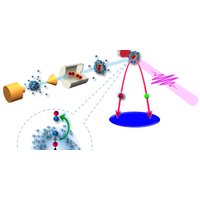
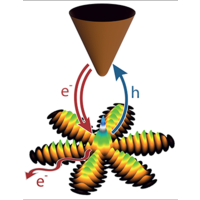
Femtosecond Rotational Dynamics of D2 Molecules in Superfluid Helium Nanodroplets

Junjie Qiang, Lianrong Zhou, Peifen Lu, Kang Lin, Yongzhe Ma, Shengzhe Pan, Chenxu Lu, Wenyu Jiang, Fenghao Sun, Wenbin Zhang, Hui Li, Xiaochun Gong, Ilya Sh. Averbukh, Yehiam Prior, Constant A. Schouder, Henrik Stapelfeldt, Igor N. Cherepanov, Mikhail Lemeshko, Wolfgang Jäger, and Jian Wu

Phys. Rev. Lett. 128, 243201 (2022) - Published 16 June, 2022

A laser nudges deuterium molecules into friction-free motion within a superfluid.

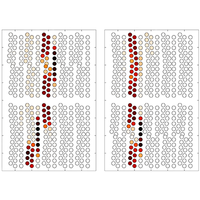
Observation of Non-Abelian Thouless Pump

Oubo You, Shanjun Liang, Biye Xie, Wenlong Gao, Weimin Ye, Jie Zhu, and Shuang Zhang

Phys. Rev. Lett. 128, 244302 (2022) - Published 16 June, 2022

An acoustic waveguide array makes it possible to observe non-Abelian Thouless pumping.

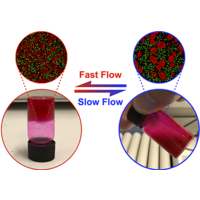
Flow-Switched Bistability in a Colloidal Gel with Non-Brownian Grains

Yujie Jiang, Soichiro Makino, John R. Royer, and Wilson C. K. Poon

Phys. Rev. Lett. 128, 248002 (2022) - Published 16 June, 2022

Non-Brownian grains dispersed in a colloidal gel render the system rheologically bistable, switching between distinct solidlike and liquidlike states depending on shear rate.

Experimental Realization of a Fermionic Spin-Momentum Lattice

Paul Lauria, Wei-Ting Kuo, Nigel R. Cooper, and Julio T. Barreiro

Phys. Rev. Lett. 128, 245301 (2022) - Published 15 June, 2022

Defining a fermionic lattice using spin and momentum instead of spatial coordinates opens the door for interacting-fermion simulations with more complex lattice geometries.

Coherent and Incoherent Tunneling into Yu-Shiba-Rusinov States Revealed by Atomic Scale Shot-Noise Spectroscopy

U. Thupakula, V. Perrin, A. Palacio-Morales, L. Cario, M. Aprili, P. Simon, and F. Massee

Phys. Rev. Lett. 128, 247001 (2022) - Published 15 June, 2022

Scanning tunneling spectroscopy combined with shot-noise measurements provides a method to probe the elusive energy and time scales of coherent transfers of charge 2e through Yu-Shiba-Rusinov states in a 2H-NbSe2 superconductor.

Cerium Ruthenium Low-Energy Antineutrino Measurements for Safeguarding Military Naval Reactors

Bernadette K. Cogswell and Patrick Huber

Phys. Rev. Lett. 128, 241803 (2022) - Published 14 June, 2022

Monitoring the fissile material aboard nuclear-powered submarines is notoriously difficult. Researchers may now have a way to safeguard this weapons-grade substance.

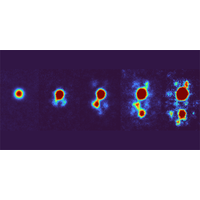
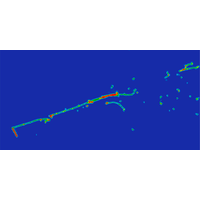
Search for an Excess of Electron Neutrino Interactions in MicroBooNE Using Multiple Final-State Topologies

P. Abratenko et al. (MicroBooNE Collaboration)

Phys. Rev. Lett. 128, 241801 (2022) - Published 13 June, 2022

New neutrino-oscillation data show no sign of an anomalous signal seen in previous studies, but the analyses can’t yet fully rule out its presence.

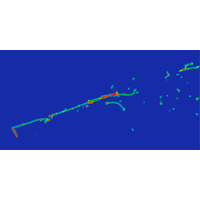
MicroBooNE and the νe Interpretation of the MiniBooNE Low-Energy Excess

C. A. Argüelles, I. Esteban, M. Hostert, K. J. Kelly, J. Kopp, P. A. N. Machado, I. Martinez-Soler, and Y. F. Perez-Gonzalez

Phys. Rev. Lett. 128, 241802 (2022) - Published 13 June, 2022

New neutrino-oscillation data show no sign of an anomalous signal seen in previous studies, but the analyses can’t yet fully rule out its presence.

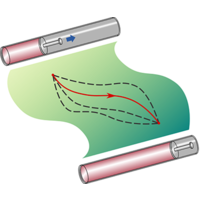
Geodesic Path for the Minimal Energy Cost in Shortcuts to Isothermality

Geng Li, Jin-Fu Chen, C. P. Sun, and Hui Dong

Phys. Rev. Lett. 128, 230603 (2022) - Published 10 June, 2022

The equivalence between minimizing the energy cost and finding the geodesic path solves the optimization problem in thermodynamics through methods developed in Riemannian geometry.

Floquet Spin Amplification

Min Jiang, Yushu Qin, Xin Wang, Yuanhong Wang, Haowen Su, Xinhua Peng, and Dmitry Budker

Phys. Rev. Lett. 128, 233201 (2022) - Published 9 June, 2022

Floquet amplifiers based on periodically-driven xenon spins provide femtotesla-level precision in magnetic field measurements and broad bandwidth.

Quantum Flicker Noise in Atomic and Molecular Junctions

Ofir Shein-Lumbroso, Junjie Liu, Abhay Shastry, Dvira Segal, and Oren Tal

Phys. Rev. Lett. 128, 237701 (2022) - Published 9 June, 2022

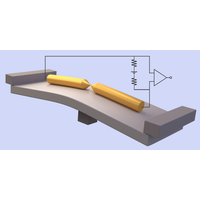
Measurements of so-called flicker noise can shed light on quantum effects that govern charge transport in nanoscale conductors.

Geometric Bound on the Efficiency of Irreversible Thermodynamic Cycles

Adam G. Frim and Michael R. DeWeese

Phys. Rev. Lett. 128, 230601 (2022) - Published 8 June, 2022

Applying the classical isoperimetric inequalities to thermodynamic spaces yields a novel universal bound on the efficiency of any closed thermodynamic cycle for a generic system.

Dissipative Parametric Gain in a GaAs/AlGaAs Superlattice

Vladislovas Čižas, Liudvikas Subačius, Natalia V. Alexeeva, Dalius Seliuta, Timo Hyart, Klaus Köhler, Kirill N. Alekseev, and Gintaras Valušis

Phys. Rev. Lett. 128, 236802 (2022) - Published 8 June, 2022

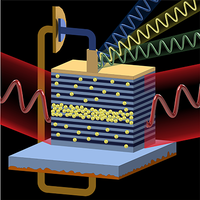
Dissipative parametric gain is observed in a GaAs/AlGaAs superlattice at room temperature and GHz microwave temperatures.

Quantum-Coherent Light-Electron Interaction in a Scanning Electron Microscope

R. Shiloh, T. Chlouba, and P. Hommelhoff

Phys. Rev. Lett. 128, 235301 (2022) - Published 6 June, 2022

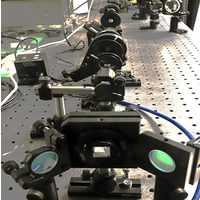
Scanning electron microscopes using laser-engineered electron quantum states enter the quantum optics ring.

Candidate Tidal Disruption Event AT2019fdr Coincident with a High-Energy Neutrino

Simeon Reusch et al.

Phys. Rev. Lett. 128, 221101 (2022) - Published 3 June, 2022

Researchers have found new evidence that high-energy neutrinos are emitted when a black hole gobbles up a hapless star.

Chiral Ising Gross-Neveu Criticality of a Single Dirac Cone: A Quantum Monte Carlo Study

S. Mojtaba Tabatabaei, Amir-Reza Negari, Joseph Maciejko, and Abolhassan Vaezi

Phys. Rev. Lett. 128, 225701 (2022) - Published 3 June, 2022

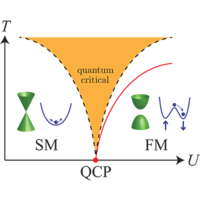
The first large-scale numerical study of the N=2 chiral Ising Gross-Neveu model allows the pinpointing of the quantum critical point and the identification of the critical exponents for this theory with great accuracy.

Smallest Stable Si/SiO2 Interface that Suppresses Quantum Tunneling from Machine-Learning-Based Global Search

Ye-Fei Li and Zhi-Pan Liu

Phys. Rev. Lett. 128, 226102 (2022) - Published 3 June, 2022

Researchers have identified the best silicon and silicon dioxide materials for the next generation of transistors, which are expected to be just a nanometer long.

Magnetoelectric Classification of Skyrmions

Sayantika Bhowal and Nicola A. Spaldin

Phys. Rev. Lett. 128, 227204 (2022) - Published 3 June, 2022

A general theory of classification of magnetic skyrmions and other related spin textures by utilizing their magnetoelectric multipoles broadens the technical methods for studying spin textures.

Negative Quasiprobabilities Enhance Phase Estimation in Quantum-Optics Experiment

Noah Lupu-Gladstein, Y. Batuhan Yilmaz, David R. M. Arvidsson-Shukur, Aharon Brodutch, Arthur O. T. Pang, Aephraim M. Steinberg, and Nicole Yunger Halpern

Phys. Rev. Lett. 128, 220504 (2022) - Published 2 June, 2022

The precision of phase estimation can be increased by the careful application of postselection, and can be quantified by negative quasiprobabilities.

Sharp Signals of Boson Clouds in Black Hole Binary Inspirals

Daniel Baumann, Gianfranco Bertone, John Stout, and Giovanni Maria Tomaselli

Phys. Rev. Lett. 128, 221102 (2022) - Published 2 June, 2022

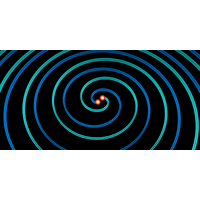
Distinctive features of gravitational-wave signals from black hole mergers could reveal the existence of long-sought ultralight bosons.

Sign In to Your Journals Account

Filter

Section

Filter

Article Lookup

Enter a citation