Highlights

Discovering Quantum Phase Transitions with Fermionic Neural Networks

Gino Cassella, Halvard Sutterud, Sam Azadi, N. D. Drummond, David Pfau, James S. Spencer, and W. M. C. Foulkes

Phys. Rev. Lett. 130, 036401 (2023) - Published 20 January, 2023

A specific neural network based on a representation of the wave function guided by the quantum mechanical variational principle alone without reference to experimental data predicts electronic ground states in condensed matter without a priori knowledge of the system.

Search for Cosmic-Ray Boosted Sub-GeV Dark Matter Using Recoil Protons at Super-Kamiokande

K. Abe et al. (Super-Kamiokande Collaboration)

Phys. Rev. Lett. 130, 031802 (2023) - Published 18 January, 2023

Interactions with cosmic rays could make low-mass dark matter particles detectable by neutrino observatories. But an analysis of two decades’ worth of data shows no signs of the particles.

Unsupervised Data-Driven Classification of Topological Gapped Systems with Symmetries

Yang Long and Baile Zhang

Phys. Rev. Lett. 130, 036601 (2023) - Published 18 January, 2023

An unsupervised learning approach leads to the classification of topological gapped systems without a priori knowledge of topological invariants.

Experimental Mode-Pairing Measurement-Device-Independent Quantum Key Distribution without Global Phase Locking

Hao-Tao Zhu, Yizhi Huang, Hui Liu, Pei Zeng, Mi Zou, Yunqi Dai, Shibiao Tang, Hao Li, Lixing You, Zhen Wang, Yu-Ao Chen, Xiongfeng Ma, Teng-Yun Chen, and Jian-Wei Pan

Phys. Rev. Lett. 130, 030801 (2023) - Published 17 January, 2023

A series of demonstrations considerably ease the requirements for implementing quantum cryptography protocols over large distances.

Kerr Enhanced Backaction Cooling in Magnetomechanics

D. Zoepfl, M. L. Juan, N. Diaz-Naufal, C. M. F. Schneider, L. F. Deeg, A. Sharafiev, A. Metelmann, and G. Kirchmair

Phys. Rev. Lett. 130, 033601 (2023) - Published 17 January, 2023

Photons in a nonlinear cavity perform “negative” work on a mechanical oscillator, cooling it toward its ground state.

Solution of the BEC to BCS Quench in One Dimension

Colin Rylands, Pasquale Calabrese, and Bruno Bertini

Phys. Rev. Lett. 130, 023001 (2023) - Published 12 January, 2023

An exact solution for the BEC-BCS quench in one dimension is modeled using the attractive Yang-Gaudin model quenched from a molecular BEC initial state.

Observation of Vibrational Dynamics of Orientated Rydberg-Atom-Ion Molecules

Yi-Quan Zou, Moritz Berngruber, Viraatt S. V. Anasuri, Nicolas Zuber, Florian Meinert, Robert Löw, and Tilman Pfau

Phys. Rev. Lett. 130, 023002 (2023) - Published 12 January, 2023

Researchers have recorded for the first time the dynamics of vibrating Rydberg molecules, the slow-motion counterparts of regular molecules.

Quantum Phase Transition in the One-Dimensional Water Chain

T. Serwatka, R. G. Melko, A. Burkov, and P.-N. Roy

Phys. Rev. Lett. 130, 026201 (2023) - Published 11 January, 2023

Water molecules that are close enough to “see” each other but far enough apart to be gas-like can undergo a quantum phase transition, a finding of relevance for making future water-based quantum devices.

Rhythms from Two Competing Periodic Sources Embedded in an Excitable Medium

Khady Diagne, Thomas M. Bury, Marc W. Deyell, Zachary Laksman, Alvin Shrier, Gil Bub, and Leon Glass

Phys. Rev. Lett. 130, 028401 (2023) - Published 11 January, 2023

Computer simulations and experiments with cardiac cells identify signatures of a condition in which two sets of pacemaker cells lead to an abnormal heartbeat.

Origin of the Reactor Antineutrino Anomalies in Light of a New Summation Model with Parametrized β− Transitions

A. Letourneau, V. Savu, D. Lhuillier, T. Lasserre, T. Materna, G. Mention, X. Mougeot, A. Onillon, L. Perisse, and M. Vivier

Phys. Rev. Lett. 130, 021801 (2023) - Published 10 January, 2023

A new analysis finds that discrepancies between reactor neutrino experiments and theory may be the result of errors in the analysis of electron data that form the basis of the neutrino predictions.

Buoyancy-Induced Convection Driven by Frontal Polymerization

Y. Gao, J. E. Paul, M. Chen, L. Hong, L. P. Chamorro, N. R. Sottos, and P. H. Geubelle

Phys. Rev. Lett. 130, 028101 (2023) - Published 9 January, 2023

A model of frontal polymerization for a reaction-diffusion-convection fluid enables fabrication of polymeric materials with controllable patterns and heterogeneous properties in closed-mold systems.

Robustness and Universality in Organelle Size Control

Kiandokht Panjtan Amiri, Asa Kalish, and Shankar Mukherji

Phys. Rev. Lett. 130, 018401 (2023) - Published 6 January, 2023

A new “bursty growth” model for organelles—internal components of biological cells—helps explain observed size fluctuations.

Exploring the Regime of Fragmentation in Strongly Tilted Fermi-Hubbard Chains

Thomas Kohlert, Sebastian Scherg, Pablo Sala, Frank Pollmann, Bharath Hebbe Madhusudhana, Immanuel Bloch, and Monika Aidelsburger

Phys. Rev. Lett. 130, 010201 (2023) - Published 5 January, 2023

A strongly tilted 1D Fermi-Hubbard model shows signatures of Hilbert-space fragmentation in its relaxation dynamics.

Observation of Acoustic Non-Hermitian Bloch Braids and Associated Topological Phase Transitions

Qicheng Zhang, Yitong Li, Huanfa Sun, Xun Liu, Luekai Zhao, Xiling Feng, Xiying Fan, and Chunyin Qiu

Phys. Rev. Lett. 130, 017201 (2023) - Published 5 January, 2023

Topologically braided non-Hermitian Bloch bands in acoustics are synthesized by a simple binary cavity-tube system.

Topological Speed Limit

Tan Van Vu and Keiji Saito

Phys. Rev. Lett. 130, 010402 (2023) - Published 4 January, 2023

Quantum speed limits due to underlying topological structure are derived and applied to chemical reactions and interacting bosons.

Control over Berry Curvature Dipole with Electric Field in WTe2

Xing-Guo Ye, Huiying Liu, Peng-Fei Zhu, Wen-Zheng Xu, Shengyuan A. Yang, Nianze Shang, Kaihui Liu, and Zhi-Min Liao

Phys. Rev. Lett. 130, 016301 (2023) - Published 4 January, 2023

Charge transport experiments in thin exfoliated flakes of WTe2 suggest the existence of an electric-field tunable Berry curvature.

Anomalous Diffusion of Deformable Particles in a Honeycomb Network

Zaiyi Shen, Franck Plouraboué, Juho S. Lintuvuori, Hengdi Zhang, Mehdi Abbasi, and Chaouqi Misbah

Phys. Rev. Lett. 130, 014001 (2023) - Published 3 January, 2023

Researchers have studied how irregularly shaped particles travel through microchannels. Their work could have relevance to the transport of red blood cells through capillaries.

Resonant Nanopumps: ac Gate Voltages in Conical Nanopores Induce Directed Electrolyte Flow

Aaron D. Ratschow, Doyel Pandey, Benno Liebchen, Somnath Bhattacharyya, and Steffen Hardt

Phys. Rev. Lett. 129, 264501 (2022) - Published 22 December, 2022

A design for a nanopump that uses an alternating electric field could allow researchers greater control over nanoscale fluid flows.

Constraints on Heavy Decaying Dark Matter from 570 Days of LHAASO Observations

Zhen Cao et al. (LHAASO Collaboration)

Phys. Rev. Lett. 129, 261103 (2022) - Published 21 December, 2022

The first measurements from a newly built gamma-ray observatory have been analyzed for signs of the decay of heavy dark matter, putting a lower limit on the hypothetical particles’ lifetime.

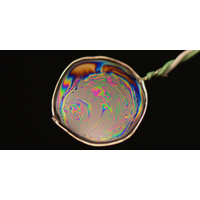
Measurement of the Temperature Decrease in Evaporating Soap Films

François Boulogne, Frédéric Restagno, and Emmanuelle Rio

Phys. Rev. Lett. 129, 268001 (2022) - Published 19 December, 2022

The film surrounding a soap bubble can be up to 8 °C cooler than the environment, a finding that has implications for bubble stability.

Sign In to Your Journals Account

Filter

Section

Filter

Article Lookup

Enter a citation