Highlights

Proof-of-Principle Experiment on the Dynamic Shell Formation for Inertial Confinement Fusion

I. V. Igumenshchev et al.

Phys. Rev. Lett. 131, 015102 (2023) - Published 7 July, 2023

A laser experiment provides a proof-of-principle test for an alternative fusion concept that uses targets made with liquid fuel rather than conventional frozen fuel.

Measuring Topological Entanglement Entropy Using Maxwell Relations

Sarath Sankar, Eran Sela, and Cheolhee Han

Phys. Rev. Lett. 131, 016601 (2023) - Published 7 July, 2023

A new scheme that combines a quantum point contact with a quantum dot may enable the elusive measurement of topological entanglement entropy in systems such the fractional quantum Hall state.

Probing Heavy Majorana Neutrinos and the Weinberg Operator through Vector Boson Fusion Processes in Proton-Proton Collisions at s=13  TeV

A. Tumasyan et al. (CMS Collaboration)

Phys. Rev. Lett. 131, 011803 (2023) - Published 6 July, 2023

Collider experiments have set new direct limits on the existence of hypothetical heavy neutrinos, helping to constrain how ordinary neutrinos get their mass.

General Bound States in the Continuum in Momentum Space

Qiao Jiang, Peng Hu, Jun Wang, Dezhuan Han, and Jian Zi

Phys. Rev. Lett. 131, 013801 (2023) - Published 6 July, 2023

A graph-theory-based approach reveals a new kind of bound state in the continuum at an arbitrary point in momentum space, useful for the classification and evolution of polarization singularities in the whole momentum space.

Photonic Realization of a Generic Type of Graphene Edge States Exhibiting Topological Flat Band

Shiqi Xia, Yongsheng Liang, Liqin Tang, Daohong Song, Jingjun Xu, and Zhigang Chen

Phys. Rev. Lett. 131, 013804 (2023) - Published 6 July, 2023

A photonic version of graphene hosts never-before-seen “twig” edge states—which could provide new avenues for realizing topological phases in graphene-like materials.

Orbital Fulde-Ferrell Pairing State in Moiré Ising Superconductors

Ying-Ming Xie and K. T. Law

Phys. Rev. Lett. 131, 016001 (2023) - Published 5 July, 2023

An orbital field-driven Fulde–Ferrell (FF) pairing state can be driven by the orbital effects of in-plane magnetic fields (different from the conventional Zeeman effects-driven FF state), such a pairing makes possible a giant and gate-tunable superconducting diode effect.

Cosmography Using Strongly Lensed Gravitational Waves from Binary Black Holes

Souvik Jana, Shasvath J. Kapadia, Tejaswi Venumadhav, and Parameswaran Ajith

Phys. Rev. Lett. 130, 261401 (2023) - Published 30 June, 2023

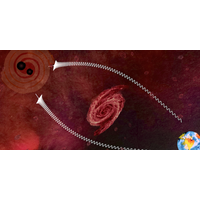
The path of a gravitational wave passing near a galaxy can be bent, producing multiple signals that could help next-generation detectors measure the expansion of the Universe.

Millisecond Coherence in a Superconducting Qubit

Aaron Somoroff, Quentin Ficheux, Raymond A. Mencia, Haonan Xiong, Roman Kuzmin, and Vladimir E. Manucharyan

Phys. Rev. Lett. 130, 267001 (2023) - Published 29 June, 2023

Researchers demonstrate a fluxonium qubit that retains its quantum information for 1.43 milliseconds, 10 times longer than the previous best lifetime for this system.

Observation of Exceptional Points in Thermal Atomic Ensembles

Chao Liang, Yuanjiang Tang, An-Ning Xu, and Yong-Chun Liu

Phys. Rev. Lett. 130, 263601 (2023) - Published 28 June, 2023

Two experimental studies realized enhanced atomic sensing and chiral heat transport near exceptional points—singularities inherent to open, non-Hermitian systems.

Antiferromagnetic Spin Fluctuations and Unconventional Superconductivity in Topological Superconductor Candidate YPtBi Revealed by Pt195-NMR

Y. Z. Zhou, J. Chen, Z. X. Li, J. Luo, J. Yang, Y. F. Guo, W. H. Wang, R. Zhou, and Guo-qing Zheng

Phys. Rev. Lett. 130, 266002 (2023) - Published 28 June, 2023

Nuclear magnetic resonance spectroscopy offers strong evidence that YPtBi can exhibit topological superconductivity, a property that could be harnessed to build quantum computers.

Non-Hermitian Chiral Heat Transport

Guoqiang Xu, Xue Zhou, Ying Li, Qitao Cao, Weijin Chen, Yunfeng Xiao, Lan Yang, and Cheng-Wei Qiu

Phys. Rev. Lett. 130, 266303 (2023) - Published 28 June, 2023

Two experimental studies realized enhanced atomic sensing and chiral heat transport near exceptional points—singularities inherent to open, non-Hermitian systems.

Search for Light Dark Matter with Ionization Signals in the PandaX-4T Experiment

Shuaijie Li et al. (PandaX Collaboration)

Phys. Rev. Lett. 130, 261001 (2023) - Published 27 June, 2023

A measurement of ionization-only signals in a liquid xenon detector place world-leading bounds on dark matter lighter than 10 GeV.

Stoichiometric Ternary Superhydride LaBeH8 as a New Template for High-Temperature Superconductivity at 110 K under 80 GPa

Yinggang Song, Jingkai Bi, Yuki Nakamoto, Katsuya Shimizu, Hanyu Liu, Bo Zou, Guangtao Liu, Hongbo Wang, and Yanming Ma

Phys. Rev. Lett. 130, 266001 (2023) - Published 27 June, 2023

Researchers have achieved superconductivity in a ternary hydride, widening the material possibilities for high-temperature superconductivity studies.

Two-Dimensional Reconfigurable Non-Hermitian Gauged Laser Array

Zihe Gao, Xingdu Qiao, Mingsen Pan, Shuang Wu, Jieun Yim, Kaiyuan Chen, Bikashkali Midya, Li Ge, and Liang Feng

Phys. Rev. Lett. 130, 263801 (2023) - Published 26 June, 2023

The first experimental report on a unique topological skin effect and boundary sensitivity could be attractive for building high-brightness light sources with arbitrary intensity profiles.

Measuring the Electrical Resistivity of Liquid Iron to 1.4 Mbar

Kenji Ohta, Sho Suehiro, Saori I. Kawaguchi, Yoshiyuki Okuda, Tatsuya Wakamatsu, Kei Hirose, Yasuo Ohishi, Manabu Kodama, Shuichiro Hirai, and Shintaro Azuma

Phys. Rev. Lett. 130, 266301 (2023) - Published 26 June, 2023

Researchers have measured the electrical resistivity of liquid iron at a pressure of 1.4 megabars, the most extreme conditions under which this material has been studied.

Resonant Elastic X-Ray Scattering of Antiferromagnetic Superstructures in EuPtSi3

Wolfgang Simeth, Andreas Bauer, Christian Franz, Aisha Aqeel, Pablo J. Bereciartua, Jennifer A. Sears, Sonia Francoual, Christian H. Back, and Christian Pfleiderer

Phys. Rev. Lett. 130, 266701 (2023) - Published 26 June, 2023

A comprehensive determination of antiferromagnetic superstructures across the entire magnetic phase diagram of EuPtSi3 showcases the potential of resonant elastic x-ray scattering for research on complex magnetic and electronic quantum phenomena.

Observation of Nuclear Wave-Packet Interference in Ultrafast Interatomic Energy Transfer

Meng Han, Jacqueline Fedyk, Jia-Bao Ji, Victor Despré, Alexander I. Kuleff, and Hans Jakob Wörner

Phys. Rev. Lett. 130, 253202 (2023) - Published 23 June, 2023

Quantum interference in the nuclear dynamics driving interatomic excitation-energy transfer, also known as frustrated interatomic Coulombic decay, acts as an electronic-relaxation mechanism in many forms of matter, including clusters and liquids.

Improved Limits on the Coupling of Ultralight Bosonic Dark Matter to Photons from Optical Atomic Clock Comparisons

M. Filzinger, S. Dörscher, R. Lange, J. Klose, M. Steinel, E. Benkler, E. Peik, C. Lisdat, and N. Huntemann

Phys. Rev. Lett. 130, 253001 (2023) - Published 22 June, 2023

A search for oscillations in the frequencies of optical clocks has set new bounds on ultralight dark matter particles.

Multiversality and Unnecessary Criticality in One Dimension

Abhishodh Prakash, Michele Fava, and S. A. Parameswaran

Phys. Rev. Lett. 130, 256401 (2023) - Published 22 June, 2023

Two new concepts, multiversality and unnecessary criticality, useful for the quantum field theoretic description of topological properties, have been demonstrated using one-dimensional quantum spin systems.

Spin-Derived Electric Polarization and Chirality Density Inherent in Localized Electron Orbitals

Shintaro Hoshino, Michi-To Suzuki, and Hiroaki Ikeda

Phys. Rev. Lett. 130, 256801 (2023) - Published 22 June, 2023

The relation between the spin current tensor, electric toroidal multipole, and chirality based on a relativistic quantum mechanical formalism, shows that the spin-derived polarization associated with the spin current tensor serves as a fundamental physical quantity that characterizes electric toroidal multipoles.

Sign In to Your Journals Account

Filter

Section

Filter

Article Lookup

Enter a citation