Highlights

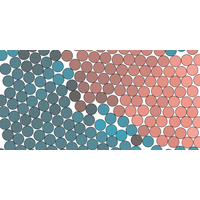
On-Demand Breaking of Action-Reaction Reciprocity between Magnetic Microdisks Using Global Stimuli

Gaurav Gardi and Metin Sitti

Phys. Rev. Lett. 131, 058301 (2023) - Published 4 August, 2023

A model system of floating disks can be tuned to execute a variety of behaviors by controlling the interactions between the disks.

Discovery of Gamma Rays from the Quiescent Sun with HAWC

A. Albert et al. (HAWC Collaboration)

Phys. Rev. Lett. 131, 051201 (2023) - Published 3 August, 2023

Measurements of the highest-energy radiation from the Sun ever seen highlight the need for better solar models.

Composition Dependent Instabilities in Mixtures with Many Components

Filipe C. Thewes, Matthias Krüger, and Peter Sollich

Phys. Rev. Lett. 131, 058401 (2023) - Published 3 August, 2023

A new form of demixing instability may explain the strong dependence of phase separation in biological mixtures on their composition.

Test of Lepton Universality in b→sℓ+ℓ− Decays

R. Aaij et al. (LHCb Collaboration)

Phys. Rev. Lett. 131, 051803 (2023) - Published 2 August, 2023

New data from observations of B-meson decay again vindicate the standard model of particle physics.

Test of Light-Lepton Universality in the Rates of Inclusive Semileptonic B-Meson Decays at Belle II

L. Aggarwal et al. (Belle II Collaboration)

Phys. Rev. Lett. 131, 051804 (2023) - Published 2 August, 2023

New data from observations of B-meson decay again vindicate the standard model of particle physics.

Super Interferometric Range Resolution

John C. Howell, Andrew N. Jordan, Barbara Šoda, and Achim Kempf

Phys. Rev. Lett. 131, 053803 (2023) - Published 2 August, 2023

A low-frequency radar method with improved resolution could aid in the detection of landmines and archeological objects.

Interrelated Thermalization and Quantum Criticality in a Lattice Gauge Simulator

Han-Yi Wang, Wei-Yong Zhang, Zhiyuan Yao, Ying Liu, Zi-Hang Zhu, Yong-Guang Zheng, Xuan-Kai Wang, Hui Zhai, Zhen-Sheng Yuan, and Jian-Wei Pan

Phys. Rev. Lett. 131, 050401 (2023) - Published 1 August, 2023

Atoms trapped in a one-dimensional optical lattice can mimic how—in a basic quantum field theory—massive particles reach, or fail to reach, thermal equilibrium.

Topological Superconductivity in Doped Magnetic Moiré Semiconductors

Valentin Crépel, Daniele Guerci, Jennifer Cano, J. H. Pixley, and Andrew Millis

Phys. Rev. Lett. 131, 056001 (2023) - Published 1 August, 2023

Robust attraction and low-energy symmetry properties in transition metal dichalcogenide twisted bilayers may produce topologically protected superconductivity.

Robust Fermi-Liquid Instabilities in Sign Problem-Free Models

Ori Grossman and Erez Berg

Phys. Rev. Lett. 131, 056501 (2023) - Published 1 August, 2023

For all known symmetry-classes that generate a sign-problem free model within the determinant quantum Monte Carlo method, the Fermi liquid is unstable at zero temperature.

Rare K40 Decay with Implications for Fundamental Physics and Geochronology

M. Stukel et al. (KDK Collaboration)

Phys. Rev. Lett. 131, 052503 (2023) - Published 31 July, 2023

Researchers revisit a neglected decay mode with implications for fundamental physics and for dating some of the oldest rocks on Earth and in the Solar System.

Generation of Near-Equipartition Magnetic Fields in Turbulent Collisionless Plasmas

Lorenzo Sironi, Luca Comisso, and Ryan Golant

Phys. Rev. Lett. 131, 055201 (2023) - Published 31 July, 2023

Weibel-generated magnetic fields can be dynamo amplified and reach near equipartition under the continuous action of turbulent gravitational forces generated by the large-scale structure in the universe.

First Dark Matter Search Results from the LUX-ZEPLIN (LZ) Experiment

J. Aalbers et al. (LUX-ZEPLIN Collaboration)

Phys. Rev. Lett. 131, 041002 (2023) - Published 28 July, 2023

Two mammoth underground detectors have delivered more stringent upper limits on how strongly a putative dark matter candidate interacts with normal matter.

First Dark Matter Search with Nuclear Recoils from the XENONnT Experiment

E. Aprile et al. (XENON Collaboration)

Phys. Rev. Lett. 131, 041003 (2023) - Published 28 July, 2023

Two mammoth underground detectors have delivered more stringent upper limits on how strongly a putative dark matter candidate interacts with normal matter.

Phonon Laser in the Quantum Regime

T. Behrle, T. L. Nguyen, F. Reiter, D. Baur, B. de Neeve, M. Stadler, M. Marinelli, F. Lancellotti, S. F. Yelin, and J. P. Home

Phys. Rev. Lett. 131, 043605 (2023) - Published 28 July, 2023

A laser for vibrational energy, rather than for light, operating in the quantum regime could teach researchers about the interplay between spin, vibration, and dissipation in quantum mechanics.

First Observation of a Doubly Charged Tetraquark and Its Neutral Partner

R. Aaij et al. (LHCb Collaboration)

Phys. Rev. Lett. 131, 041902 (2023) - Published 27 July, 2023

CERN’s Large Hadron Collider has detected the signals of two new four-quark states that are unusual because of their charges and their quark compositions.

Magnetic Susceptibility of Andreev Bound States in Superfluid He3−B

J. W. Scott, M. D. Nguyen, D. Park, and W. P. Halperin

Phys. Rev. Lett. 131, 046001 (2023) - Published 27 July, 2023

The magnetic susceptibility of superfluid Helium-3 in an anisotropic stretched aerogel exhibits behavior indicative of surface Andreev bound states within the planar aerogel structure.

Nonmonotonous Translocation Time of Polymers across Pores

Emanuele Locatelli, Valentino Bianco, Chantal Valeriani, and Paolo Malgaretti

Phys. Rev. Lett. 131, 048101 (2023) - Published 27 July, 2023

The translocation time of linear polymers across a varying-section channel shows a nonmonotonous dependence on the polymer size, that may be a useful tool to design channels for polymer sorting.

Electroassociation of Ultracold Dipolar Molecules into Tetramer Field-Linked States

Goulven Quéméner, John L. Bohn, and James F. E. Croft

Phys. Rev. Lett. 131, 043402 (2023) - Published 26 July, 2023

A proposed method uses electric fields to form tetramers from two ultracold dipolar molecules, analogous to the magnetic field association between two atoms to form molecules.

Flat Γ Moiré Bands in Twisted Bilayer WSe2

G. Gatti, J. Issing, L. Rademaker, F. Margot, T. A. de Jong, S. J. van der Molen, J. Teyssier, T. K. Kim, M. D. Watson, C. Cacho, P. Dudin, J. Avila, K. Cordero Edwards, P. Paruch, N. Ubrig, I. Gutiérrez-Lezama, A. F. Morpurgo, A. Tamai, and F. Baumberger

Phys. Rev. Lett. 131, 046401 (2023) - Published 25 July, 2023

Combined real- and momentum-space mapping of moire superlattices reveals intriguing flat-band physics of certain van der Waals materials.

Two-Dimensional Crystals far from Equilibrium

Leonardo Galliano, Michael E. Cates, and Ludovic Berthier

Phys. Rev. Lett. 131, 047101 (2023) - Published 25 July, 2023

Crystals cannot form in two-dimensional particle systems at equilibrium. A new study has found a regime where a crystal can form if the system is driven out of equilibrium.

Sign In to Your Journals Account

Filter

Section

Filter

Article Lookup

Enter a citation