Highlights

Spin-Peierls Transition in the Frustrated Spinels ZnCr2O4 and MgCr2O4

Ludovic D. C. Jaubert, Yasir Iqbal, and Harald O. Jeschke

Phys. Rev. Lett. 134, 086702 (2025) - Published 24 February, 2025

Classical Monte Carlo calculations of the specific heat and energy per spin for the frustrated spinels ZnCr2O4 and MgCr2O4 show evidence of a phase transition around the experimentally observed Néel temperatures in both cubic and tetragonal phases of both spinels.

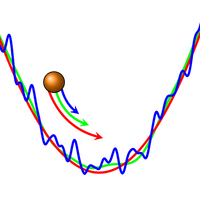
Exponential Change of Relaxation Rate by Quenched Disorder

Jan Meibohm and Sabine H. L. Klapp

Phys. Rev. Lett. 134, 087101 (2025) - Published 24 February, 2025

The asymptotic relaxation rate of a Brownian particle in a harmonic potential perturbed by quenched Gaussian disorder may either increase or decrease exponentially depending on the properties of the disorder.

Experimental Quantum Advantage in the Odd-Cycle Game

P. Drmota, D. Main, E. M. Ainley, A. Agrawal, G. Araneda, D. P. Nadlinger, B. C. Nichol, R. Srinivas, A. Cabello, and D. M. Lucas

Phys. Rev. Lett. 134, 070201 (2025) - Published 21 February, 2025

A two-player team that shares a pair of entangled particles can outplay a team that uses only classical strategies.

Minimum Neutron Star Mass in Neutrino-Driven Supernova Explosions

Bernhard Müller, Alexander Heger, and Jade Powell

Phys. Rev. Lett. 134, 071403 (2025) - Published 21 February, 2025

A realistic 3D supernova simulation shows that neutron stars with masses as low as 1.192 solar masses are possible, resolving the tension between observed low mass neutron stars and theory’s inability to account for them.

Paradigm for Finding d-Electron Heavy Fermions: The Case of Cr-doped CsFe2As2

Matteo Crispino, Pablo Villar Arribi, Anmol Shukla, Frédéric Hardy, Amir-Abbas Haghighirad, Thomas Wolf, Rolf Heid, Michael Merz, Christoph Meingast, Tommaso Gorni, Adolfo Avella, and Luca de’ Medici

Phys. Rev. Lett. 134, 076504 (2025) - Published 20 February, 2025

A new strategy allows scientists to find and make materials that host so-called heavy electrons without requiring rare-earth or actinide elements.

Infrared Magnetopolaritons in MoTe2 Monolayers and Bilayers

Bo Han, Jamie M. Fitzgerald, Lukas Lackner, Roberto Rosati, Martin Esmann, Falk Eilenberger, Takashi Taniguchi, Kenji Watanabe, Marcin Syperek, Ermin Malic, and Christian Schneider

Phys. Rev. Lett. 134, 076902 (2025) - Published 20 February, 2025

Magneto-optical studies of exciton polaritons in monolayer and bilayer MoTe2 show strong coupling and exciton-polariton resonances close to the telecom window.

Transverse Force Distributions in the Proton from Lattice QCD

J. A. Crawford, K. U. Can, R. Horsley, P. E. L Rakow, G. Schierholz, H. Stüben, R. D. Young, and J. M. Zanotti (QCDSF Collaboration)

Phys. Rev. Lett. 134, 071901 (2025) - Published 19 February, 2025

A lattice QCD calculation infers the spatial distribution of the chromodynamic Lorentz force on quarks within a proton through a computation of twist-3 form factors.

Ground State of the S=1 Antiferromagnetic Heisenberg Chain Is Topologically Nontrivial if Gapped

Hal Tasaki

Phys. Rev. Lett. 134, 076602 (2025) - Published 19 February, 2025

Theoretical work indicates that a realistic model of a one-dimensional quantum magnet has a topologically nontrivial ground state.

Hunting Dark Matter Lines in the Infrared Background with the James Webb Space Telescope

Ryan Janish and Elena Pinetti

Phys. Rev. Lett. 134, 071002 (2025) - Published 18 February, 2025

Measurements made by the JWST observatory could be used to detect photons emitted by the decay of a hypothetical form of dark matter particle known as the axion.

Sensitivity of JWST to eV-Scale Decaying Axion Dark Matter

Sandip Roy, Carlos Blanco, Christopher Dessert, Anirudh Prabhu, and Tea Temim

Phys. Rev. Lett. 134, 071003 (2025) - Published 18 February, 2025

Measurements made by the JWST observatory could be used to detect photons emitted by the decay of a hypothetical form of dark matter particle known as the axion.

Quantumlike Product States Constructed from Classical Networks

Gregory D. Scholes and Graziano Amati

Phys. Rev. Lett. 134, 060202 (2025) - Published 13 February, 2025

A one-to-one map between the product basis of quantum states and eigenstates of a classical-network-based construction could be used to mimic quantumlike product states.

Unveiling Resilient Superconducting Fluctuations in Atomically Thin NbSe2 through Higgs Mode Spectroscopy

Yu Du, Gan Liu, Wei Ruan, Zhi Fang, Kenji Watanabe, Takashi Taniguchi, Ronghua Liu, Jian-Xin Li, and Xiaoxiang Xi

Phys. Rev. Lett. 134, 066002 (2025) - Published 13 February, 2025

An enigmatic and anomalous metallic state turns out to be intrinsic rather than a consequence of crystalline defects.

Thermal Properties of the Superconductor–Quantum Hall Interface

Lingfei Zhao, Trevyn F. Q. Larson, Zubair Iftikhar, John Chiles, Kenji Watanabe, Takashi Taniguchi, François Amet, and Gleb Finkelstein

Phys. Rev. Lett. 134, 066001 (2025) - Published 12 February, 2025

Investigation of current fluctuations in the thermal properties of superconductor-quantum Hall interfaces reveals a significant amount of excess noise when the interface is biased.

Revisiting the Formulation of Charged Defect in Solids

Hanzhi Shang, Zeyu Jiang, Yiyang Sun, D. West, and Shengbai Zhang

Phys. Rev. Lett. 134, 066401 (2025) - Published 12 February, 2025

A one-shot linear response-based method accurately estimates the defect formation energy of smaller supercells.

Room-Temperature Amplified Spontaneous Emission in Two-Dimensional WS2 beyond Exciton Mott Transition

Yan Xu, Yihan Xiang, Meng Shi, Baoxing Zhai, Wei Dai, Ti Wang, Xiaoze Liu, Yiling Yu, and Jun He

Phys. Rev. Lett. 134, 066904 (2025) - Published 12 February, 2025

Amplified spontaneous emission from a degenerate electron-hole plasma in a 2D semiconductor has been demonstrated for the first time.

Anderson Transition at Complex Energies in One-Dimensional Parity-Time-Symmetric Disordered Systems

Wei Wang, Xulong Wang, and Guancong Ma

Phys. Rev. Lett. 134, 066301 (2025) - Published 10 February, 2025

One-dimensional disordered rings with chiral hopping can host Anderson localized modes which exhibit complex energies, a phenomenon previously associated exclusively with extended modes.

Tunable Spatiotemporal Orders in Driven Insulators

Daniel Kaplan, Pavel A. Volkov, Ahana Chakraborty, Zekun Zhuang, and Premala Chandra

Phys. Rev. Lett. 134, 066902 (2025) - Published 10 February, 2025

A new method can use light to generate incommensurate order, spatial as well as temporal, in insulators of any symmetry.

Multiplet Supercurrents in a Josephson Circuit

Ethan G. Arnault, John Chiles, Trevyn F. Q. Larson, Chun-Chia Chen, Lingfei Zhao, Kenji Watanabe, Takashi Taniguchi, François Amet, and Gleb Finkelstein

Phys. Rev. Lett. 134, 067001 (2025) - Published 10 February, 2025

Multiplet supercurrents mediated by two Cooper pairs have been observed in graphene-based Josephson junctions.

Interaction-Induced Topological Phase Transition at Finite Temperature

Ze-Min Huang and Sebastian Diehl

Phys. Rev. Lett. 134, 053002 (2025) - Published 7 February, 2025

The one-dimensional Su-Schrieffer-Heeger model with Hubbard interactions exhibits a defect-driven topological phase transition at finite temperatures.

Supersolidity of Polariton Condensates in Photonic Crystal Waveguides

Davide Nigro, Dimitrios Trypogeorgos, Antonio Gianfrate, Daniele Sanvitto, Iacopo Carusotto, and Dario Gerace

Phys. Rev. Lett. 134, 056002 (2025) - Published 7 February, 2025
Prediction of a polariton supersolid state whose periodicity can be tuned by the input power, providing a novel platform to explore exotic states of matter.

Sign In to Your Journals Account

Filter

Section

Filter

Article Lookup

Enter a citation