Highlights

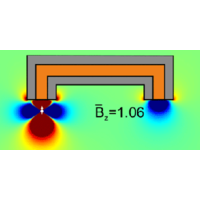
Long-Distance Transfer and Routing of Static Magnetic Fields

C. Navau, J. Prat-Camps, O. Romero-Isart, J. I. Cirac, and A. Sanchez

Phys. Rev. Lett. 112, 253901 (2014) - Published 23 June, 2014

Magnetic fields could be funneled over longer distances than currently possible using a magnetic “hose” made of ferromagnetic and superconductor materials.

Search for Low-Mass Weakly Interacting Massive Particles with SuperCDMS

R. Agnese et al. (SuperCDMS Collaboration)

Phys. Rev. Lett. 112, 241302 (2014) - Published 20 June, 2014

The first search for low-mass dark-matter particles has been carried out using the SuperCDMS detector, an upgrade of the CDMS detector with improved background-rejection capability, with new parameter space being excluded.

Detection of B-Mode Polarization at Degree Angular Scales by BICEP2

P. A. R. Ade et al. (BICEP2 Collaboration)

Phys. Rev. Lett. 112, 241101 (2014) - Published 19 June, 2014

The BICEP2 collaboration reports the detection of B-mode polarization of the cosmic microwave background—a signal that might originate from gravitational waves created by inflation during the very earliest moments in the evolution of our Universe.

ϕ2 or Not ϕ2: Testing the Simplest Inflationary Potential

Paolo Creminelli, Diana López Nacir, Marko Simonović, Gabriele Trevisan, and Matias Zaldarriaga

Phys. Rev. Lett. 112, 241303 (2014) - Published 19 June, 2014

Several theorists discuss the next steps for testing inflation theory following the BICEP2 observations of polarization in the cosmic microwave background.

Osmotic Flow through Fully Permeable Nanochannels

C. Lee, C. Cottin-Bizonne, A.-L. Biance, P. Joseph, L. Bocquet, and C. Ybert

Phys. Rev. Lett. 112, 244501 (2014) - Published 19 June, 2014

Salinity gradients are used to control water flow through nano-channels with flow control sensitivity on the order of femtoliters per minute.

Competing Channels for Hot-Electron Cooling in Graphene

Qiong Ma, Nathaniel M. Gabor, Trond I. Andersen, Nityan L. Nair, Kenji Watanabe, Takashi Taniguchi, and Pablo Jarillo-Herrero

Phys. Rev. Lett. 112, 247401 (2014) - Published 19 June, 2014

The photocurrent generated in graphene p-n junctions has a non-monotonic temperature dependence with a peak at 60 K.

Neutron Skin of Pb208 from Coherent Pion Photoproduction

C. M. Tarbert et al. (Crystal Ball at MAMI and A2 Collaboration)

Phys. Rev. Lett. 112, 242502 (2014) - Published 18 June, 2014

Nuclear experiments using photons as probes find that the outer, neutron-dominated layer of a nucleus is soft and wispy, rather than hard and well defined.

Repulsive DNA-DNA Interactions Accelerate Viral DNA Packaging in Phage Phi29

Nicholas Keller, Damian delToro, Shelley Grimes, Paul J. Jardine, and Douglas E. Smith

Phys. Rev. Lett. 112, 248101 (2014) - Published 17 June, 2014

The motor that packs DNA into a virus works best if the DNA has some self-repulsion.

Novel Phase of Solid Oxygen Induced by Ultrahigh Magnetic Fields

T. Nomura, Y. H. Matsuda, S. Takeyama, A. Matsuo, K. Kindo, J. L. Her, and T. C. Kobayashi

Phys. Rev. Lett. 112, 247201 (2014) - Published 16 June, 2014

A large applied magnetic field can bring solid oxygen into a novel phase—a consequence of the strong spin-lattice coupling in the molecular crystal.

Hyperfine Splitting of the 2s1/2 and 2p1/2 Levels in Li- and Be-like Ions of Pr59141

P. Beiersdorfer, E. Träbert, G. V. Brown, J. Clementson, D. B. Thorn, M. H. Chen, K. T. Cheng, and J. Sapirstein

Phys. Rev. Lett. 112, 233003 (2014) - Published 13 June, 2014

Extreme ultraviolet spectroscopic measurements of the hyperfine splittings in high-Z ions provide insight into the fundamental interactions between light and atoms in strong fields.

Localization-Delocalization Transitions in Turbophoresis of Inertial Particles

S. Belan, I. Fouxon, and G. Falkovich

Phys. Rev. Lett. 112, 234502 (2014) - Published 13 June, 2014

A theoretical study of particles diffusing in a fluid subject to temperature or turbulent gradients, shows that, due to their inertia, heavy particles can escape local minima, such as walls, ‘flying’ away, where lighter particles will accumulate.

Numerical Evidence for Nucleated Self-Assembly of DNA Brick Structures

Aleks Reinhardt and Daan Frenkel

Phys. Rev. Lett. 112, 238103 (2014) - Published 11 June, 2014

Computer simulations suggest that mixtures of hundreds of distinct nanoparticles or colloids can self-assemble into well-defined structures.

Room Temperature Electrically Injected Polariton Laser

Pallab Bhattacharya, Thomas Frost, Saniya Deshpande, Md Zunaid Baten, Arnab Hazari, and Ayan Das

Phys. Rev. Lett. 112, 236802 (2014) - Published 10 June, 2014

A new polariton laser is electrically powered and operates at room temperatures, making it more useful for optical electronic application than previous designs.

Observation of the Associated Production of a Single Top Quark and a W Boson in pp Collisions at s=8  TeV

S. Chatrchyan et al. (CMS Collaboration)

Phys. Rev. Lett. 112, 231802 (2014) - Published 9 June, 2014

Separate collider experiments observe the top quark without its usual antiparticle partner in unique processes that could give insight into new physics, such as additional sets of quarks.

Observation of s-Channel Production of Single Top Quarks at the Tevatron

T. Aaltonen et al. (CDF Collaboration†, D0 Collaboration‡)

Phys. Rev. Lett. 112, 231803 (2014) - Published 9 June, 2014

Separate collider experiments observe the top quark without its usual antiparticle partner in unique processes that could give insight into new physics, such as additional sets of quarks.

Single-Shot Readout and Relaxation of Singlet and Triplet States in Exchange-Coupled P31 Electron Spins in Silicon

Juan P. Dehollain, Juha T. Muhonen, Kuan Y. Tan, Andre Saraiva, David N. Jamieson, Andrew S. Dzurak, and Andrea Morello

Phys. Rev. Lett. 112, 236801 (2014) - Published 9 June, 2014

Time-resolved measurements of the exchange coupling between pairs of phosphorous dopants in silicon give concrete ideas of what would be needed to implement 2-qubit quantum logic gates in this system.

Value of H0 in the Inhomogeneous Universe

Ido Ben-Dayan, Ruth Durrer, Giovanni Marozzi, and Dominik J. Schwarz

Phys. Rev. Lett. 112, 221301 (2014) - Published 6 June, 2014

Local measurements of the Hubble constant, for example from nearby supernovae, are shown to be affected by structures such as galaxy clusters, or voids, with the uncertainty that is introduced being comparable to current observational errors.

Self-Referenced Single-Electron Quantized Current Source

Lukas Fricke, Michael Wulf, Bernd Kaestner, Frank Hohls, Philipp Mirovsky, Brigitte Mackrodt, Ralf Dolata, Thomas Weimann, Klaus Pierz, Uwe Siegner, and Hans W. Schumacher

Phys. Rev. Lett. 112, 226803 (2014) - Published 6 June, 2014

A circuit of multiple quantum dot single electron pumps could serve as a quantized-current standard for the SI unit of Ampere.

Possible Origin of Stagnation and Variability of Earth’s Biodiversity

Frank Stollmeier, Theo Geisel, and Jan Nagler

Phys. Rev. Lett. 112, 228101 (2014) - Published 5 June, 2014

Researchers have constructed a model of species dependence that shows how marine biodiversity could have grown and then leveled off.

Observation of the Resonant Character of the Z(4430)− State

R. Aaij et al. (LHCb Collaboration)

Phys. Rev. Lett. 112, 222002 (2014) - Published 4 June, 2014

The LHCb experiment provides conclusive evidence for the existence of the four-quark particle called Z(4430).

Sign In to Your Journals Account

Filter

Section

Filter

Article Lookup

Enter a citation