Highlights

Simplest Molecules as Candidates for Precise Optical Clocks

S. Schiller, D. Bakalov, and V. I. Korobov

Phys. Rev. Lett. 113, 023004 (2014) - Published 8 July, 2014

Researchers propose using one-electron molecules for a new class of ultrahigh precision clocks.

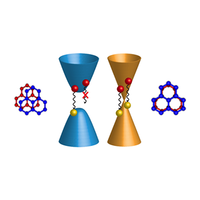
Experimental Realization of a Three-Dimensional Dirac Semimetal

Sergey Borisenko, Quinn Gibson, Danil Evtushinsky, Volodymyr Zabolotnyy, Bernd Büchner, and Robert J. Cava

Phys. Rev. Lett. 113, 027603 (2014) - Published 8 July, 2014

Using angle-resolved photoemission spectroscopy, a 3D Dirac semimetal phase has been observed in Cadmium Arsenide for the first time.

Collision Time Measurements in a Sonoluminescing Microplasma with a Large Plasma Parameter

A. Bataller, B. Kappus, C. Camara, and S. Putterman

Phys. Rev. Lett. 113, 024301 (2014) - Published 7 July, 2014

Sound-stimulated gas bubbles in liquid become tiny plasmas and may provide a test bed for plasma physics theories.

Emergence of Decoupled Surface Transport Channels in Bulk Insulating Bi2Se3 Thin Films

Matthew Brahlek, Nikesh Koirala, Maryam Salehi, Namrata Bansal, and Seongshik Oh

Phys. Rev. Lett. 113, 026801 (2014) - Published 7 July, 2014

By doping with copper, bulk conduction, which usually obscures surface states in topological insulators, is suppressed in bismuth selenide films.

Observation of the Spin Peltier Effect for Magnetic Insulators

J. Flipse, F. K. Dejene, D. Wagenaar, G. E. W. Bauer, J. Ben Youssef, and B. J. van Wees

Phys. Rev. Lett. 113, 027601 (2014) - Published 7 July, 2014

Researchers demonstrate for the first time the spin Peltier effect, in which a spin current in a metal causes heat flow in an adjoining magnet.

Harnessing Buckling to Design Tunable Locally Resonant Acoustic Metamaterials

Pai Wang, Filippo Casadei, Sicong Shan, James C. Weaver, and Katia Bertoldi

Phys. Rev. Lett. 113, 014301 (2014) - Published 3 July, 2014

A novel type of acoustic metamaterial made of rubber and metal absorbs or transmits sound waves depending on how the material is squeezed.

Tensor Interpretation of BICEP2 Results Severely Constrains Axion Dark Matter

David J. E. Marsh, Daniel Grin, Renée Hlozek, and Pedro G. Ferreira

Phys. Rev. Lett. 113, 011801 (2014) - Published 2 July, 2014

If the excess B-mode polarization measured by BICEP2 comes from inflationary gravitational waves then there are severe constraints on the mass and abundance of axionlike particles making up cold dark matter.

Axion Cold Dark Matter in View of BICEP2 Results

Paolo Gondolo and Luca Visinelli

Phys. Rev. Lett. 113, 011802 (2014) - Published 2 July, 2014

If the excess B-mode polarization measured by BICEP2 comes from inflationary gravitational waves then there are severe constraints on the mass and abundance of axionlike particles making up cold dark matter.

Evidence for Polarization of Gluons in the Proton

Daniel de Florian, Rodolfo Sassot, Marco Stratmann, and Werner Vogelsang

Phys. Rev. Lett. 113, 012001 (2014) - Published 2 July, 2014

A new analysis of high-energy data shows that gluons may provide some of the proton’s missing spin.

Exploring a New Regime for Processing Optical Qubits: Squeezing and Unsqueezing Single Photons

Yoshichika Miwa, Jun-ichi Yoshikawa, Noriaki Iwata, Mamoru Endo, Petr Marek, Radim Filip, Peter van Loock, and Akira Furusawa

Phys. Rev. Lett. 113, 013601 (2014) - Published 2 July, 2014

A single photon is reversibly transformed from a particle-like state to a continuous wave state via a squeezing gate, which operates by reducing fluctuations in one Heisenberg variable at the expense of another.

Nonlinear Inverse Synthesis and Eigenvalue Division Multiplexing in Optical Fiber Channels

Jaroslaw E. Prilepsky, Stanislav A. Derevyanko, Keith J. Blow, Ildar Gabitov, and Sergei K. Turitsyn

Phys. Rev. Lett. 113, 013901 (2014) - Published 1 July, 2014

Researchers propose a new way to eliminate the signal distortions in optical fibers that are caused by nonlinear effects.

Dielectric Effects in the Self-Assembly of Binary Colloidal Aggregates

Kipton Barros and Erik Luijten

Phys. Rev. Lett. 113, 017801 (2014) - Published 1 July, 2014

The dielectric polarizability of mobile charged colloidal particles in a solvent is successfully included in molecular dynamics simulations, and shown to alter the predicted self-assembled structures of the particles.

Search for Gravitational Waves Associated with γ-ray Bursts Detected by the Interplanetary Network

J. Aasi et al. (LIGO Scientific Collaboration, Virgo Collaboration, and IPN Collaboration)

Phys. Rev. Lett. 113, 011102 (2014) - Published 30 June, 2014

A five-year search for gravitational waves by two large-scale experiments results in no detection—but suggests an observation may soon be within reach.

Evidence for Triangular D3h Symmetry in C12

D. J. Marín-Lámbarri, R. Bijker, M. Freer, M. Gai, Tz. Kokalova, D. J. Parker, and C. Wheldon

Phys. Rev. Lett. 113, 012502 (2014) - Published 30 June, 2014

The discovery of a new excited state in carbon-12 hints at this nucleus’s triangular symmetry.

Universal Density Profile for Cosmic Voids

Nico Hamaus, P. M. Sutter, and Benjamin D. Wandelt

Phys. Rev. Lett. 112, 251302 (2014) - Published 27 June, 2014

A simple equation can describe the large-scale bubbles that appear in the dark matter distributed throughout the Universe, and it applies to voids of a wide range of sizes and ages.

Two-Photon Rotational Action Spectroscopy of Cold OH− at 1 ppb Accuracy

Pavol Jusko, Oskar Asvany, Ann-Christin Wallerstein, Sandra Brünken, and Stephan Schlemmer

Phys. Rev. Lett. 112, 253005 (2014) - Published 26 June, 2014

By cooling OH- ions to 15 K in a cold ion trap the lowest rotational transition frequency of OH- is measured to an accuracy of one part per billion.

Simultaneous Measurement of Complementary Observables with Compressive Sensing

Gregory A. Howland, James Schneeloch, Daniel J. Lum, and John C. Howell

Phys. Rev. Lett. 112, 253602 (2014) - Published 26 June, 2014

Coincident high-resolution position and momentum imaging of optical photons is achieved using a sequence of weak and strong measurements.

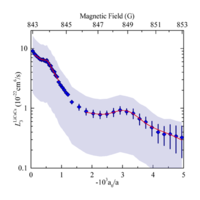
Observation of Efimov Resonances in a Mixture with Extreme Mass Imbalance

R. Pires, J. Ulmanis, S. Häfner, M. Repp, A. Arias, E. D. Kuhnle, and M. Weidemüller

Phys. Rev. Lett. 112, 250404 (2014) - Published 25 June, 2014

Two consecutive Efimov resonances – a three body bound state where the two-body subsystem is unbound – have been measured in an ultracold Li-Cs mixture.

Ultrafast Dynamics of Massive Dirac Fermions in Bilayer Graphene

Søren Ulstrup, Jens Christian Johannsen, Federico Cilento, Jill A. Miwa, Alberto Crepaldi, Michele Zacchigna, Cephise Cacho, Richard Chapman, Emma Springate, Samir Mammadov, Felix Fromm, Christian Raidel, Thomas Seyller, Fulvio Parmigiani, Marco Grioni, Phil D. C. King, and Philip Hofmann

Phys. Rev. Lett. 112, 257401 (2014) - Published 25 June, 2014

Time-resolved experiments visualize the motion of electrons in bilayer graphene, confirming the material behaves as a semiconductor that has potential for electronics applications.

Experimental Realization of a New Type of Crystalline Undulator

Tobias N. Wistisen, Kristoffer K. Andersen, Serdar Yilmaz, Rune Mikkelsen, John Lundsgaard Hansen, Ulrik I. Uggerhøj, Werner Lauth, and Hartmut Backe

Phys. Rev. Lett. 112, 254801 (2014) - Published 24 June, 2014

The periodically varying electromagnetic field inside a crystal can be exploited to build an undulator that emits gamma rays.

Sign In to Your Journals Account

Filter

Section

Filter

Article Lookup

Enter a citation