Highlights

Observing Inflationary Reheating

Jérôme Martin, Christophe Ringeval, and Vincent Vennin

Phys. Rev. Lett. 114, 081303 (2015) - Published 26 February, 2015

Recently available high-precision measurements of the cosmic microwave background constrain the kinematic properties of the reheating era for most of the inflationary scenarios proposed so far.

Search for Higgs Boson Pair Production in the γγbb¯ Final State Using pp Collision Data at s=8  TeV from the ATLAS Detector

G. Aad et al. (ATLAS Collaboration)

Phys. Rev. Lett. 114, 081802 (2015) - Published 26 February, 2015

A search for new physics in production of a pair of Higgs bosons finds a modest excess of events, 2.4 standard deviations above the background-only hypothesis.

Quantum Thermodynamics: A Nonequilibrium Green’s Function Approach

Massimiliano Esposito, Maicol A. Ochoa, and Michael Galperin

Phys. Rev. Lett. 114, 080602 (2015) - Published 25 February, 2015

A thermodynamic description for an open quantum system coupled to its surroundings is provided using nonequilibrium Green’s functions.

Gravitational Casimir Effect

James Q. Quach

Phys. Rev. Lett. 114, 081104 (2015) - Published 25 February, 2015

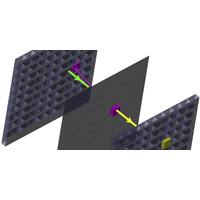
Evidence that gravitational waves induce an attractive force between two closely spaced mirrors could confirm gravity’s quantum nature.

Two Fermions in a Double Well: Exploring a Fundamental Building Block of the Hubbard Model

Simon Murmann, Andrea Bergschneider, Vincent M. Klinkhamer, Gerhard Zürn, Thomas Lompe, and Selim Jochim

Phys. Rev. Lett. 114, 080402 (2015) - Published 23 February, 2015

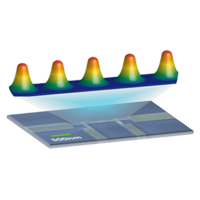
A simple system consisting of a pair of atoms in a two-site “minicrystal” is able to reproduce the physics of a widely used model of electrons in a solid.

Turbulent Black Holes

Huan Yang, Aaron Zimmerman, and Luis Lehner

Phys. Rev. Lett. 114, 081101 (2015) - Published 23 February, 2015

A rapidly rotating black hole can have a horizon instability, where certain modes become excited and grow. The behavior is analogous to turbulence in high Reynolds number fluids.

Directional Antineutrino Detection

Benjamin R. Safdi and Burkhant Suerfu

Phys. Rev. Lett. 114, 071802 (2015) - Published 20 February, 2015

A proposed detector for low-energy antineutrinos would reveal the particles’ trajectories, potentially allowing more detailed studies of Earth’s radioactivity and of nuclear reactors.

Constraint on a Varying Proton-Electron Mass Ratio 1.5 Billion Years after the Big Bang

J. Bagdonaite, W. Ubachs, M. T. Murphy, and J. B. Whitmore

Phys. Rev. Lett. 114, 071301 (2015) - Published 19 February, 2015

The spectrum of a distant quasar reveals no sign of changes in the mass ratio of the proton and the electron over 12 billion years, constraining dark energy theories.

Measurement of Critical Currents of Superconducting Aluminum Nanowires in External Magnetic Fields: Evidence for a Weber Blockade

Tyler Morgan-Wall, Benjamin Leith, Nikolaus Hartman, Atikur Rahman, and Nina Marković

Phys. Rev. Lett. 114, 077002 (2015) - Published 18 February, 2015

An applied field can control the entry and exit of single quanta of magnetic flux (vortices) in superconducting nanowires.

Kinesin-8 Motors Improve Nuclear Centering by Promoting Microtubule Catastrophe

Matko Glunčić, Nicola Maghelli, Alexander Krull, Vladimir Krstić, Damien Ramunno-Johnson, Nenad Pavin, and Iva M. Tolić

Phys. Rev. Lett. 114, 078103 (2015) - Published 18 February, 2015

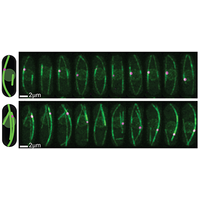
A motor protein called kinesin-8 helps keep a cell’s nucleus centered by controlling the length of the tubular structures that connect it with the cell wall.

Neutral Naturalness from Orbifold Higgs Models

Nathaniel Craig, Simon Knapen, and Pietro Longhi

Phys. Rev. Lett. 114, 061803 (2015) - Published 13 February, 2015

A new class of models, rooted in ideas of extra dimensions of space, is proposed that protect the Higgs mass from large loop corrections.

Laser Filamentation as a New Phase Transition Universality Class

W. Ettoumi, J. Kasparian, and J.-P. Wolf

Phys. Rev. Lett. 114, 063903 (2015) - Published 13 February, 2015

A powerful laser beam separates into many smaller filaments that undergo a phase transition similar to fluid percolating through a porous material.

Bending of Light in Quantum Gravity

N. E. J. Bjerrum-Bohr, John F. Donoghue, Barry R. Holstein, Ludovic Planté, and Pierre Vanhove

Phys. Rev. Lett. 114, 061301 (2015) - Published 12 February, 2015

Theorists calculate how quantum gravity effects could alter the bending of light induced by massive objects.

Postinflationary Higgs Relaxation and the Origin of Matter-Antimatter Asymmetry

Alexander Kusenko, Lauren Pearce, and Louis Yang

Phys. Rev. Lett. 114, 061302 (2015) - Published 11 February, 2015

A new explanation for why matter dominates in our Universe rests on the idea that the Higgs field hasn’t been constant in time.

Universality Far from Equilibrium: From Superfluid Bose Gases to Heavy-Ion Collisions

J. Berges, K. Boguslavski, S. Schlichting, and R. Venugopalan

Phys. Rev. Lett. 114, 061601 (2015) - Published 10 February, 2015

A new universality class for many-body systems far from equilibrium is conjectured, providing a link between disparate physical systems ranging from hot plasmas to cold gases.

Observation of Two New Ξb− Baryon Resonances

R. Aaij et al. (LHCb Collaboration)

Phys. Rev. Lett. 114, 062004 (2015) - Published 10 February, 2015

Researchers report the detection of two new subatomic particles made of three quarks from each of the possible quark families.

Classical-to-Quantum Transition with Broadband Four-Wave Mixing

Rafi Z. Vered, Yaakov Shaked, Yelena Ben-Or, Michael Rosenbluh, and Avi Pe’er

Phys. Rev. Lett. 114, 063902 (2015) - Published 10 February, 2015

Experimentalists watch a classical to quantum phase transition by ramping up the number of photons in an optical fiber.

Composite-Light-Pulse Technique for High-Precision Atom Interferometry

P. Berg, S. Abend, G. Tackmann, C. Schubert, E. Giese, W. P. Schleich, F. A. Narducci, W. Ertmer, and E. M. Rasel

Phys. Rev. Lett. 114, 063002 (2015) - Published 9 February, 2015

By keeping its atomic components in the same state, a team was able to reduce one typical source of noise in a rotation-measuring device.

Measuring the Transverse Spin Density of Light

Martin Neugebauer, Thomas Bauer, Andrea Aiello, and Peter Banzer

Phys. Rev. Lett. 114, 063901 (2015) - Published 9 February, 2015

Under certain conditions the spin of photons can acquire an unusual transverse component. Using intensity differences in the far-field, the transverse spin density is experimentally measured.

Synthesis of Programmable Reaction-Diffusion Fronts Using DNA Catalyzers

Anton S. Zadorin, Yannick Rondelez, Jean-Christophe Galas, and André Estevez-Torres

Phys. Rev. Lett. 114, 068301 (2015) - Published 9 February, 2015

Strands of DNA can be used to generate waves of chemical reactions with programmable shape and velocity.

Sign In to Your Journals Account

Filter

Section

Filter

Article Lookup

Enter a citation