Highlights

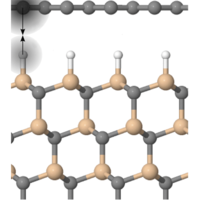
Approaching Truly Freestanding Graphene: The Structure of Hydrogen-Intercalated Graphene on 6H−SiC(0001)

J. Sforzini, L. Nemec, T. Denig, B. Stadtmüller, T.-L. Lee, C. Kumpf, S. Soubatch, U. Starke, P. Rinke, V. Blum, F. C. Bocquet, and F. S. Tautz

Phys. Rev. Lett. 114, 106804 (2015) - Published 10 March, 2015

X-ray measurements of its vertical absorption height indicate that hydrogen-intercalated graphene on silicon carbide is effectively free-standing.

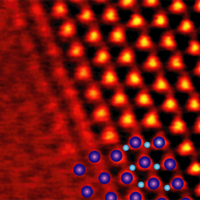
Detection of a Superconducting Phase in a Two-Atom Layer of Hexagonal Ga Film Grown on Semiconducting GaN(0001)

Hui-Min Zhang, Yi Sun, Wei Li, Jun-Ping Peng, Can-Li Song, Ying Xing, Qinghua Zhang, Jiaqi Guan, Zhi Li, Yanfei Zhao, Shuaihua Ji, Lili Wang, Ke He, Xi Chen, Lin Gu, Langsheng Ling, Mingliang Tian, Lian Li, X. C. Xie, Jianping Liu, Hui Yang, Qi-Kun Xue, Jian Wang, and Xucun Ma

Phys. Rev. Lett. 114, 107003 (2015) - Published 10 March, 2015

Two-dimensional Gallium grown on an insulating GaN substrate has a superconductor transition temperature of 5.4 K, five times larger than that of a bulk Ga sample.

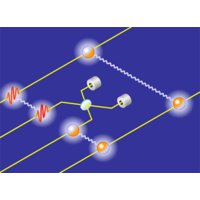
Entanglement Swapping between Discrete and Continuous Variables

Shuntaro Takeda, Maria Fuwa, Peter van Loock, and Akira Furusawa

Phys. Rev. Lett. 114, 100501 (2015) - Published 9 March, 2015

Using a hybrid optical setup, entanglement swapping is demonstrated between a discrete two-qubit and a continuous two-mode system.

Joint Analysis of BICEP2/Keck Array and Planck Data

P. A. R. Ade et al. (BICEP2/Keck and Planck Collaborations)

Phys. Rev. Lett. 114, 101301 (2015) - Published 9 March, 2015

A signal in the cosmic microwave background thought to be evidence of inflation in the early Universe can be explained by interstellar dust.

Signatures of Fractional Exclusion Statistics in the Spectroscopy of Quantum Hall Droplets

Nigel R. Cooper and Steven H. Simon

Phys. Rev. Lett. 114, 106802 (2015) - Published 9 March, 2015

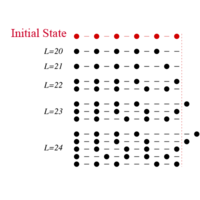
Fractional statistics of quantum particles could be measured in rotating droplets of atomic gasses by simply counting spectral lines, according to this theoretical proposal.

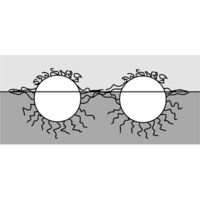
Interactions and Stress Relaxation in Monolayers of Soft Nanoparticles at Fluid-Fluid Interfaces

Valeria Garbin, Ian Jenkins, Talid Sinno, John C. Crocker, and Kathleen J. Stebe

Phys. Rev. Lett. 114, 108301 (2015) - Published 9 March, 2015

The interactions between soft deformable colloids are measured for ligand coated nanoparticles trapped at an oil-water interface. The ligand layer is seen to dominate the interparticle interactions and the stress relaxation of the system.

Functional Metamirrors Using Bianisotropic Elements

V. S. Asadchy, Y. Ra’di, J. Vehmas, and S. A. Tretyakov

Phys. Rev. Lett. 114, 095503 (2015) - Published 6 March, 2015

A mirror made with metamaterials reflects at a selected angle and only responds to radiation of a specific frequency, while being transparent to other radiation.

Prediction and Retrodiction for a Continuously Monitored Superconducting Qubit

D. Tan, S. J. Weber, I. Siddiqi, K. Mølmer, and K. W. Murch

Phys. Rev. Lett. 114, 090403 (2015) - Published 5 March, 2015

Predictions for a quantum measurement are improved by probing the system after the measurement and evolving a model backward in time.

Characterizing Quantum Dynamics with Initial System-Environment Correlations

M. Ringbauer, C. J. Wood, K. Modi, A. Gilchrist, A. G. White, and A. Fedrizzi

Phys. Rev. Lett. 114, 090402 (2015) - Published 4 March, 2015

Using an experimental photonic setup, a quantum system initially correlated with its environment is fully characterized for the first time.

Cooper Pair Splitting by Means of Graphene Quantum Dots

Z. B. Tan, D. Cox, T. Nieminen, P. Lähteenmäki, D. Golubev, G. B. Lesovik, and P. J. Hakonen

Phys. Rev. Lett. 114, 096602 (2015) - Published 4 March, 2015

A pair of quantum dots fabricated on graphene can split Cooper pairs providing a natural source of entangled electrons for quantum information solid state devices.

Current-Induced Forces and Hot Spots in Biased Nanojunctions

Jing-Tao Lü, Rasmus B. Christensen, Jian-Sheng Wang, Per Hedegård, and Mads Brandbyge

Phys. Rev. Lett. 114, 096801 (2015) - Published 4 March, 2015

Current-induced forces in nanoconductor junctions control the spatial heat dissipation in the conductor, leading to unexpected heat transport across the junction.

Dynamically Controlled Resonance Fluorescence Spectra from a Doubly Dressed Single InGaAs Quantum Dot

Y. He, Y.-M. He, J. Liu, Y.-J. Wei, H. Y. Ramírez, M. Atatüre, C. Schneider, M. Kamp, S. Höfling, C.-Y. Lu, and J.-W. Pan

Phys. Rev. Lett. 114, 097402 (2015) - Published 4 March, 2015

A bichromatic laser can dynamically control the resonant optical emission of an InGaAs quantum dot demonstrating the complete cancellation of spontaneous emission spectral lines from the quantum dot for the first time.

Giant Enhancement of the Optical Second-Harmonic Emission of WSe2 Monolayers by Laser Excitation at Exciton Resonances

G. Wang, X. Marie, I. Gerber, T. Amand, D. Lagarde, L. Bouet, M. Vidal, A. Balocchi, and B. Urbaszek

Phys. Rev. Lett. 114, 097403 (2015) - Published 4 March, 2015

A three-order of magnitude increase in the optical second-harmonic emission of WSe2 monolayers is detected by tuning the exciting laser beam to the WSe2 exciton resonances.

Magnetic Flattening of Stem-Cell Spheroids Indicates a Size-Dependent Elastocapillary Transition

Francois Mazuel, Myriam Reffay, Vicard Du, Jean-Claude Bacri, Jean-Paul Rieu, and Claire Wilhelm

Phys. Rev. Lett. 114, 098105 (2015) - Published 4 March, 2015

Magnetic nanoparticles can be used to prepare and characterize multicellular aggregates that serve as model systems for biological tissues.

Accelerating Cosmological Expansion from Shear and Bulk Viscosity

Stefan Floerchinger, Nikolaos Tetradis, and Urs Achim Wiedemann

Phys. Rev. Lett. 114, 091301 (2015) - Published 3 March, 2015

Shear viscosity can lead to an accelerating cosmological expansion without the assumption of a negative effective pressure.

Tuning Bulk and Surface Conduction in the Proposed Topological Kondo Insulator SmB6

Paul Syers, Dohun Kim, Michael S. Fuhrer, and Johnpierre Paglione

Phys. Rev. Lett. 114, 096601 (2015) - Published 3 March, 2015

Transport measurements in samarium hexaboride - a material expected to behave as a topological Kondo insulator - indicate an insulating bulk material with metallic surface states, with the ability to tune both surface and bulk conduction.

Macroscopic Discontinuous Shear Thickening versus Local Shear Jamming in Cornstarch

A. Fall, F. Bertrand, D. Hautemayou, C. Mezière, P. Moucheront, A. Lemaître, and G. Ovarlez

Phys. Rev. Lett. 114, 098301 (2015) - Published 3 March, 2015

Discontinuous shear thickening (an abrupt increase in viscosity) of corn starch is accompanied by a change in structure. Density inhomogeneities develop with a low density flowing layer forming around a high density jammed region.

Three-Dimensional Reconstruction of the Giant Mimivirus Particle with an X-Ray Free-Electron Laser

Tomas Ekeberg et al.

Phys. Rev. Lett. 114, 098102 (2015) - Published 2 March, 2015

An x-ray laser has imaged the three-dimensional structure of the mimivirus by combining hundreds of measurements on single virus particles.

Microwave Quantum Illumination

Shabir Barzanjeh, Saikat Guha, Christian Weedbrook, David Vitali, Jeffrey H. Shapiro, and Stefano Pirandola

Phys. Rev. Lett. 114, 080503 (2015) - Published 27 February, 2015

A proposed device would extend a quantum entanglement scheme previously demonstrated for visible photons into the microwave regime, where it could boost radar performance.

Possible Indication of Momentum-Dependent Asymmetric Dark Matter in the Sun

Aaron C. Vincent, Pat Scott, and Aldo Serenelli

Phys. Rev. Lett. 114, 081302 (2015) - Published 26 February, 2015

The presence of a certain type of dark matter in the Sun’s core may solve discrepancies between standard solar models and observations.

Sign In to Your Journals Account

Filter

Section

Filter

Article Lookup

Enter a citation