Highlights

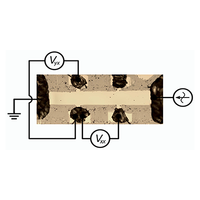
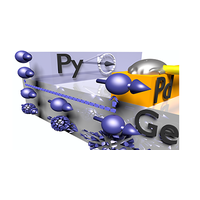
Experimental Demonstration of Room-Temperature Spin Transport in n-Type Germanium Epilayers

S. Dushenko, M. Koike, Y. Ando, T. Shinjo, M. Myronov, and M. Shiraishi

Phys. Rev. Lett. 114, 196602 (2015) - Published 13 May, 2015

Germanium layers can carry spin-polarized currents over several hundred nanometers at room temperature, a key asset for spintronic applications.

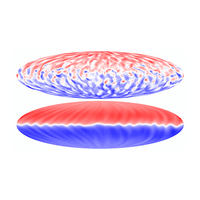
Three Dimensional Simulation of the Magnetic Stress in a Neutron Star Crust

T. S. Wood and R. Hollerbach

Phys. Rev. Lett. 114, 191101 (2015) - Published 12 May, 2015

Simulations of the magnetic field of a neutron star show that shear stresses induced by the field are strong enough to fracture the star’s crust.

Measurement of Long-Range Angular Correlation and Quadrupole Anisotropy of Pions and (Anti)Protons in Central d+Au Collisions at sNN=200 GeV

A. Adare et al. (PHENIX Collaboration)

Phys. Rev. Lett. 114, 192301 (2015) - Published 12 May, 2015

Particle correlations in deuteron-gold collisions at RHIC reveal patterns reminiscent of those generated by the quark-gluon plasma in larger heavy-ion collisions.

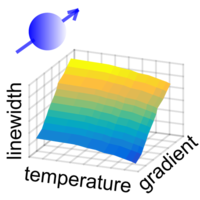
Motional Averaging of Nuclear Resonance in a Field Gradient

Nanette N. Jarenwattananon and Louis-S. Bouchard

Phys. Rev. Lett. 114, 197601 (2015) - Published 12 May, 2015

A revised theory for diffusion-based nuclear magnetic resonance shows that the linewidth decreases with temperature for gasses. This finding is contrary to the behavior seen in fluids and therefore allows gasses and liquids to be distinguished by their linewidth behavior.

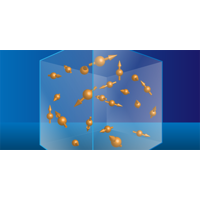
Pressure and Phase Equilibria in Interacting Active Brownian Spheres

Alexandre P. Solon, Joakim Stenhammar, Raphael Wittkowski, Mehran Kardar, Yariv Kafri, Michael E. Cates, and Julien Tailleur

Phys. Rev. Lett. 114, 198301 (2015) - Published 11 May, 2015

An equation of state for a gas of self-propelled spheres is a step towards a thermodynamic description of “active” matter, such as bird flocks and tissue.

Demonstration of a Memory for Tightly Guided Light in an Optical Nanofiber

B. Gouraud, D. Maxein, A. Nicolas, O. Morin, and J. Laurat

Phys. Rev. Lett. 114, 180503 (2015) - Published 7 May, 2015

Light signals propagating down an ultrathin fiber can be temporarily stored in a cloud of cold atoms surrounding the fiber.

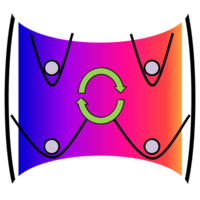
All-Optical Nanomechanical Heat Engine

Andreas Dechant, Nikolai Kiesel, and Eric Lutz

Phys. Rev. Lett. 114, 183602 (2015) - Published 6 May, 2015

A nanoparticle levitated in an optical cavity is proposed as a Stirling type heat engine – where the particle is driven through a cooling-heating sequence that changes the mechanical oscillations of the systems and generates heat.

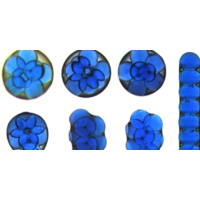
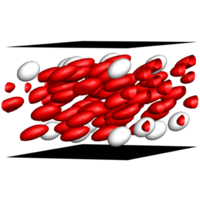
Droplet Clusters: Exploring the Phase Space of Soft Mesoscale Atoms

Jan Guzowski and Piotr Garstecki

Phys. Rev. Lett. 114, 188302 (2015) - Published 6 May, 2015

Water droplets can self-assemble into a range of structures inside larger drops of oil, with potential uses in targeted drug delivery and biological tissue engineering.

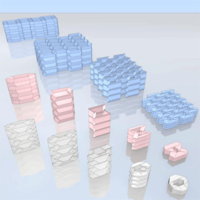
Reentrant Origami-Based Metamaterials with Negative Poisson’s Ratio and Bistability

H. Yasuda and J. Yang

Phys. Rev. Lett. 114, 185502 (2015) - Published 5 May, 2015

Structures made solely from folded rigid planes exhibit both tunable negative Poisson’s ratio and structural bistability allowing for the construction of new types of mechanical metamaterials.

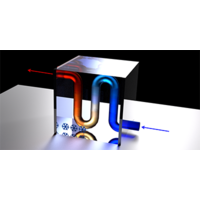
Exciton-Polariton Gas as a Nonequilibrium Coolant

Sebastian Klembt, Emilien Durupt, Sanjoy Datta, Thorsten Klein, Augustin Baas, Yoan Léger, Carsten Kruse, Detlef Hommel, Anna Minguzzi, and Maxime Richard

Phys. Rev. Lett. 114, 186403 (2015) - Published 5 May, 2015

A gas of polaritons can serve as a coolant fluid that transports heat away from a semiconductor microcavity.

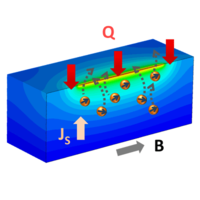
Paramagnetic Spin Seebeck Effect

Stephen M. Wu, John E. Pearson, and Anand Bhattacharya

Phys. Rev. Lett. 114, 186602 (2015) - Published 5 May, 2015

A spin current is experimentally generated in various insulating paramagnets using thermal gradients, a surprising result as, unlike ferromagnetic insulators, paramagnets do not hold their magnetization when the applied field is removed.

Precise Quantization of the Anomalous Hall Effect near Zero Magnetic Field

A. J. Bestwick, E. J. Fox, Xufeng Kou, Lei Pan, Kang L. Wang, and D. Goldhaber-Gordon

Phys. Rev. Lett. 114, 187201 (2015) - Published 4 May, 2015

Thin films of magnetic topological insulators can exhibit a nearly ideal quantum Hall effect without requiring an applied magnetic field.

Margination Regimes and Drainage Transition in Confined Multicomponent Suspensions

Rafael G. Henríquez Rivera, Kushal Sinha, and Michael D. Graham

Phys. Rev. Lett. 114, 188101 (2015) - Published 4 May, 2015

During blood flow, white blood cells and platelets segregate near vessel walls, a phenomenon known as margination. A new kinetic theory allows the different segregation regimes to be defined, showing that, under certain conditions, the concentration of cells at the walls goes to zero.

Field-Dependent Size and Shape of Single Magnetic Skyrmions

Niklas Romming, André Kubetzka, Christian Hanneken, Kirsten von Bergmann, and Roland Wiesendanger

Phys. Rev. Lett. 114, 177203 (2015) - Published 1 May, 2015

Atomic-scale imaging reveals the shape and size of a technologically interesting magnetic quasiparticle.

Precision Measurement of the Proton Flux in Primary Cosmic Rays from Rigidity 1 GV to 1.8 TV with the Alpha Magnetic Spectrometer on the International Space Station

M. Aguilar et al. (AMS Collaboration)

Phys. Rev. Lett. 114, 171103 (2015) - Published 30 April, 2015

Higher accuracy measurements of the proton cosmic ray spectrum at high energies show that it deviates from the long held single power law behavior.

Topological Properties of Linear Circuit Lattices

Victor V. Albert, Leonid I. Glazman, and Liang Jiang

Phys. Rev. Lett. 114, 173902 (2015) - Published 30 April, 2015

Systems with nontrivial topological properties can be constructed from electric circuits consisting of capacitors and inductors.

Liquid Ropes: A Geometrical Model for Thin Viscous Jet Instabilities

P.-T. Brun, Basile Audoly, Neil M. Ribe, T. S. Eaves, and John R. Lister

Phys. Rev. Lett. 114, 174501 (2015) - Published 30 April, 2015

A new model can predict the patterns formed by a viscous jet falling onto a moving surface.

Electric Field Controlled Columnar and Planar Patterning of Cholesteric Colloids

G. D’Adamo, D. Marenduzzo, C. Micheletti, and E. Orlandini

Phys. Rev. Lett. 114, 177801 (2015) - Published 30 April, 2015

An applied electric field could reconfigure the structure of colloidal defects dispersed within a liquid crystal.

Quantum Random Access Codes Using Single d-Level Systems

Armin Tavakoli, Alley Hameedi, Breno Marques, and Mohamed Bourennane

Phys. Rev. Lett. 114, 170502 (2015) - Published 29 April, 2015

A significant gain in the success probability of recovering bits from an encoded sequence has been achieved with quantum random access codes, outperforming their classical counterparts.

What is the Flavor of the Cosmic Neutrinos Seen by IceCube?

A. Palladino, G. Pagliaroli, F. L. Villante, and F. Vissani

Phys. Rev. Lett. 114, 171101 (2015) - Published 28 April, 2015
The highest energy neutrinos ever recorded have a flavor distribution of neutrinos that is consistent with the particles having a cosmic origin.

Sign In to Your Journals Account

Filter

Section

Filter

Article Lookup

Enter a citation