Highlights

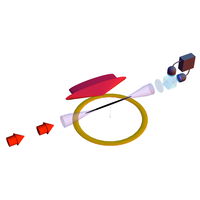
Optical Control of the Resonant Dipole-Dipole Interaction between Rydberg Atoms

Sylvain de Léséleuc, Daniel Barredo, Vincent Lienhard, Antoine Browaeys, and Thierry Lahaye

Phys. Rev. Lett. 119, 053202 (2017) - Published 2 August, 2017

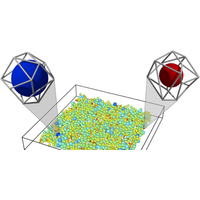
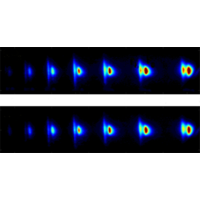
The interaction between two Rydberg atoms is modified experimentally by addressing one of the two atoms with a laser beam.

Frictional Magneto-Coulomb Drag in Graphene Double-Layer Heterostructures

Xiaomeng Liu, Lei Wang, Kin Chung Fong, Yuanda Gao, Patrick Maher, Kenji Watanabe, Takashi Taniguchi, James Hone, Cory Dean, and Philip Kim

Phys. Rev. Lett. 119, 056802 (2017) - Published 2 August, 2017

The first experimental study of frictional drag effect between two monolayer sheets of graphene separated by a boron nitride spacer shows on strong magneto- and Hall-drag signals that depend on the Landau level filling of each graphene layer.

Designing Kitaev Spin Liquids in Metal-Organic Frameworks

Masahiko G. Yamada, Hiroyuki Fujita, and Masaki Oshikawa

Phys. Rev. Lett. 119, 057202 (2017) - Published 1 August, 2017

Versatile materials called metal-organic frameworks might be good systems in which to search for quantum spin liquids.

Mass and Moment of Inertia Govern the Transition in the Dynamics and Wakes of Freely Rising and Falling Cylinders

Varghese Mathai, Xiaojue Zhu, Chao Sun, and Detlef Lohse

Phys. Rev. Lett. 119, 054501 (2017) - Published 31 July, 2017

The oscillations of neutrally buoyant cylinders depend on rotational freedom of the objects, as well as their mass.

Evidence for Weakly Correlated Oxygen Holes in the Highest-Tc Cuprate Superconductor HgBa2Ca2Cu3O8+δ

A. Chainani, M. Sicot, Y. Fagot-Revurat, G. Vasseur, J. Granet, B. Kierren, L. Moreau, M. Oura, A. Yamamoto, Y. Tokura, and D. Malterre

Phys. Rev. Lett. 119, 057001 (2017) - Published 31 July, 2017

Oxygen-hole correlations in HgBa2Ca2Cu3O8+δ, the highest Tc mercury-based cuprate superconductor, are found to be weaker than those seen in any other cuprate superconductor.

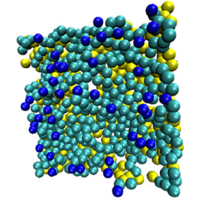
Size-Dependent Localization in Polydisperse Colloidal Glasses

D. Heckendorf, K. J. Mutch, S. U. Egelhaaf, and M. Laurati

Phys. Rev. Lett. 119, 048003 (2017) - Published 28 July, 2017

Imaging of the individual particles of a glass reveals the different behaviors of slightly smaller vs slightly larger particles, suggesting new ways to adjust the properties of commercial glasses.

Superadditivity of the Classical Capacity with Limited Entanglement Assistance

Elton Yechao Zhu, Quntao Zhuang, and Peter W. Shor

Phys. Rev. Lett. 119, 040503 (2017) - Published 27 July, 2017

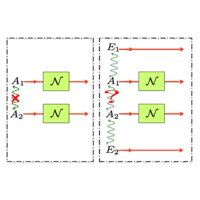
The capacity of quantum communication channels is predicted to switch from additive to superadditive when entanglement assistance is limited.

Excitation and Control of Plasma Wakefields by Multiple Laser Pulses

J. Cowley, C. Thornton, C. Arran, R. J. Shalloo, L. Corner, G. Cheung, C. D. Gregory, S. P. D. Mangles, N. H. Matlis, D. R. Symes, R. Walczak, and S. M. Hooker

Phys. Rev. Lett. 119, 044802 (2017) - Published 27 July, 2017

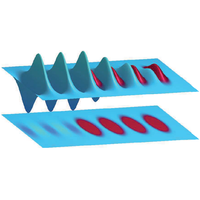
Trains of laser pulses can be used to accelerate high-repetition-rate electron bunches to high energies.

In-Plane Propagation of Light in Transition Metal Dichalcogenide Monolayers: Optical Selection Rules

G. Wang, C. Robert, M. M. Glazov, F. Cadiz, E. Courtade, T. Amand, D. Lagarde, T. Taniguchi, K. Watanabe, B. Urbaszek, and X. Marie

Phys. Rev. Lett. 119, 047401 (2017) - Published 26 July, 2017

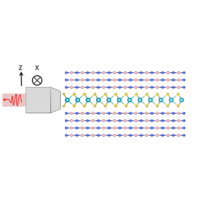
The electric field of light emitted from transition metal dichalcogenide monolayers is found to be oriented perpendicularly to the monolayer plane.

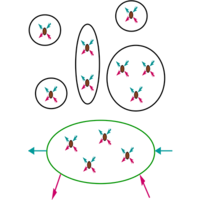
Entanglement-Enhanced Radio-Frequency Field Detection and Waveform Sensing

F. Martin Ciurana, G. Colangelo, L. Slodička, R. J. Sewell, and M. W. Mitchell

Phys. Rev. Lett. 119, 043603 (2017) - Published 25 July, 2017

A new design for an atomic magnetometer utilizes so-called quantum nondemolition measurements to detect very weak magnetic-field signals.

Tailoring Correlations of the Local Density of States in Disordered Photonic Materials

F. Riboli, F. Uccheddu, G. Monaco, N. Caselli, F. Intonti, M. Gurioli, and S. E. Skipetrov

Phys. Rev. Lett. 119, 043902 (2017) - Published 25 July, 2017

The frequency correlations of local density of states of a material are linked to its microscopic features.

Determinant Diagrammatic Monte Carlo Algorithm in the Thermodynamic Limit

Riccardo Rossi

Phys. Rev. Lett. 119, 045701 (2017) - Published 25 July, 2017

High-order diagrammatic expansions for fermionic systems can be computed by considering the sum of all connected Feynman diagrams at fixed positions of interaction vertices. The method is an improvement over conventional diagrammatic Monte Carlo computations.

Deconstructing Temperature Gradients across Fluid Interfaces: The Structural Origin of the Thermal Resistance of Liquid-Vapor Interfaces

Jordan Muscatello, Enrique Chacón, Pedro Tarazona, and Fernando Bresme

Phys. Rev. Lett. 119, 045901 (2017) - Published 25 July, 2017

The interfacial structure responsible for thermal resistance across liquid-vapor interfaces is shown to be connected to a low density fluid layer adsorbed at the liquid surface.

Superradiant Instability and Backreaction of Massive Vector Fields around Kerr Black Holes

William E. East and Frans Pretorius

Phys. Rev. Lett. 119, 041101 (2017) - Published 24 July, 2017

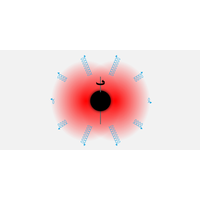
A spinning black hole may lose up to 9% of its mass by spontaneously growing “hair” in the form of excitations of a hypothetical particle field with a tiny mass.

Search for Neutrinoless Quadruple-β Decay of Nd150 with the NEMO-3 Detector

R. Arnold et al. (NEMO-3 Collaboration)

Phys. Rev. Lett. 119, 041801 (2017) - Published 24 July, 2017

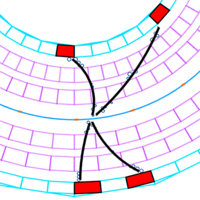
The NEMO collaboration has performed the first experimental search for the rare neutrinoless quadruple beta decay.

Plasma versus Drude Modeling of the Casimir Force: Beyond the Proximity Force Approximation

Michael Hartmann, Gert-Ludwig Ingold, and Paulo A. Maia Neto

Phys. Rev. Lett. 119, 043901 (2017) - Published 24 July, 2017

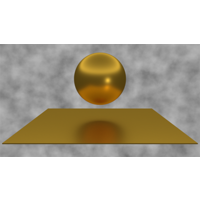
Numerical results for experimentally measurable parameters are presented for the Casimir force between a sphere and a planar surface both made of gold.

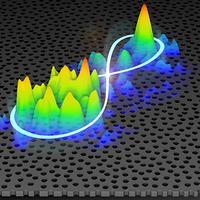
Scanning Gate Microscope for Cold Atomic Gases

Samuel Häusler, Shuta Nakajima, Martin Lebrat, Dominik Husmann, Sebastian Krinner, Tilman Esslinger, and Jean-Philippe Brantut

Phys. Rev. Lett. 119, 030403 (2017) - Published 21 July, 2017

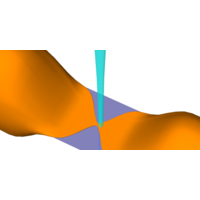
A new technique produces an image of the flow of cold atoms through a channel, a potentially important tool for future cold-atom technology.

Attosecond Probing of Nuclear Dynamics with Trajectory-Resolved High-Harmonic Spectroscopy

Pengfei Lan, Marc Ruhmann, Lixin He, Chunyang Zhai, Feng Wang, Xiaosong Zhu, Qingbin Zhang, Yueming Zhou, Min Li, Manfred Lein, and Peixiang Lu

Phys. Rev. Lett. 119, 033201 (2017) - Published 21 July, 2017

Laser-induced proton dynamics of molecular hydrogen are probed with attosecond precision using a trajectory-resolved high-harmonic spectroscopy scheme.

Streaming from the Equator of a Drop in an External Electric Field

Quentin Brosseau and Petia M. Vlahovska

Phys. Rev. Lett. 119, 034501 (2017) - Published 20 July, 2017

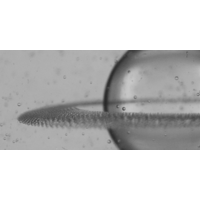
An electric field can pull apart a millimeter-sized oil drop, causing it to shed thin rings from its equator that then break up into tiny droplets.

Hippocampal Spike-Timing Correlations Lead to Hexagonal Grid Fields

Mauro M. Monsalve-Mercado and Christian Leibold

Phys. Rev. Lett. 119, 038101 (2017) - Published 19 July, 2017

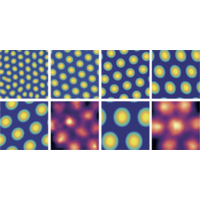
A model explains why grid cells—neurons that are part of the brain’s positioning system—fire electrical pulses in hexagonal patterns.

Sign In to Your Journals Account

Filter

Section

Filter

Article Lookup

Enter a citation