Highlights

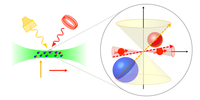
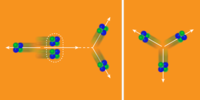
Long-Lived Ultracold Molecules with Electric and Magnetic Dipole Moments

Timur M. Rvachov, Hyungmok Son, Ariel T. Sommer, Sepehr Ebadi, Juliana J. Park, Martin W. Zwierlein, Wolfgang Ketterle, and Alan O. Jamison

Phys. Rev. Lett. 119, 143001 (2017) - Published 2 October, 2017

The creation of ultracold molecules that have both an electric and a magnetic dipole moment offers new ways to explore physics in the many-body quantum regime.

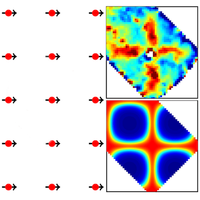
Effective One-Dimensional Coupling in the Highly Frustrated Square-Lattice Itinerant Magnet CaCo2−yAs2

A. Sapkota, B. G. Ueland, V. K. Anand, N. S. Sangeetha, D. L. Abernathy, M. B. Stone, J. L. Niedziela, D. C. Johnston, A. Kreyssig, A. I. Goldman, and R. J. McQueeney

Phys. Rev. Lett. 119, 147201 (2017) - Published 2 October, 2017

A rare example of a highly frustrated metal is identified, where the frustration is due to competing exchange interactions of spins, and not due to the spin geometry.

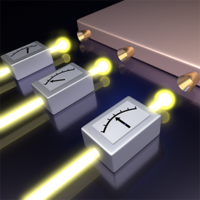
Optimal Measurements for Simultaneous Quantum Estimation of Multiple Phases

Luca Pezzè, Mario A. Ciampini, Nicolò Spagnolo, Peter C. Humphreys, Animesh Datta, Ian A. Walmsley, Marco Barbieri, Fabio Sciarrino, and Augusto Smerzi

Phys. Rev. Lett. 119, 130504 (2017) - Published 29 September, 2017

The conditions for simultaneous quantum estimation of multiple parameters are derived, a desired step forward for the design of future quantum imaging and metrology devices.

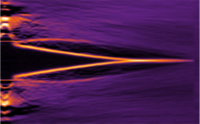
Search for Invisible Decays of a Dark Photon Produced in e+e− Collisions at BaBar

J. P. Lees et al. (BaBar Collaboration)

Phys. Rev. Lett. 119, 131804 (2017) - Published 28 September, 2017

The lack of so-called “dark photons” in electron-positron collision data rules out scenarios in which these hypothetical particles explain the muon’s magnetic moment

Ultimate Stable Underwater Superhydrophobic State

Yaolei Xiang, Shenglin Huang, Pengyu Lv, Yahui Xue, Qiang Su, and Huiling Duan

Phys. Rev. Lett. 119, 134501 (2017) - Published 27 September, 2017

Researchers find tricks to prolong the typically short-lived water repellency of a superhydrophobic surface.

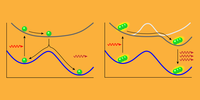
Many-Molecule Reaction Triggered by a Single Photon in Polaritonic Chemistry

Javier Galego, Francisco J. Garcia-Vidal, and Johannes Feist

Phys. Rev. Lett. 119, 136001 (2017) - Published 27 September, 2017

Using an optical cavity to couple several molecules can potentially set up a chemical chain reaction that requires just one photon to initiate.

Scaling of Majorana Zero-Bias Conductance Peaks

Fabrizio Nichele, Asbjørn C. C. Drachmann, Alexander M. Whiticar, Eoin C. T. O’Farrell, Henri J. Suominen, Antonio Fornieri, Tian Wang, Geoffrey C. Gardner, Candice Thomas, Anthony T. Hatke, Peter Krogstrup, Michael J. Manfra, Karsten Flensberg, and Charles M. Marcus

Phys. Rev. Lett. 119, 136803 (2017) - Published 27 September, 2017

Under certain conditions, conductance peaks at zero electrical bias may be considered as signatures of Majorana bound states.

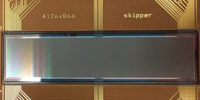
Single-Electron and Single-Photon Sensitivity with a Silicon Skipper CCD

Javier Tiffenberg, Miguel Sofo-Haro, Alex Drlica-Wagner, Rouven Essig, Yann Guardincerri, Steve Holland, Tomer Volansky, and Tien-Tien Yu

Phys. Rev. Lett. 119, 131802 (2017) - Published 26 September, 2017

A CCD design relying on multiple charge measurements has achieved a precision that allows the detection of a single electron per pixel.

Exposing the QCD Splitting Function with CMS Open Data

Andrew Larkoski, Simone Marzani, Jesse Thaler, Aashish Tripathee, and Wei Xue

Phys. Rev. Lett. 119, 132003 (2017) - Published 26 September, 2017

The first analysis of public data from the CMS experiment at the LHC probes the substructures of jets produced in proton-proton collisions recorded in 2010.

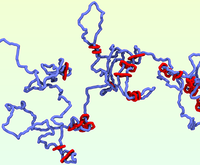
Nonequilibrium Chromosome Looping via Molecular Slip Links

C. A. Brackley, J. Johnson, D. Michieletto, A. N. Morozov, M. Nicodemi, P. R. Cook, and D. Marenduzzo

Phys. Rev. Lett. 119, 138101 (2017) - Published 26 September, 2017

A nonequilibrium mechanism based on diffusive sliding of molecules that bind to DNA is proposed for loop formation in chromosomes.

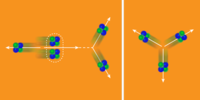
High-Precision Probe of the Fully Sequential Decay Width of the Hoyle State in C12

D. Dell’Aquila et al.

Phys. Rev. Lett. 119, 132501 (2017) - Published 25 September, 2017

Two experiments provide the most precise picture to date of how an excited state of carbon decays into three helium nuclei.

New Measurement of the Direct 3α Decay from the C12 Hoyle State

R. Smith, Tz. Kokalova, C. Wheldon, J. E. Bishop, M. Freer, N. Curtis, and D. J. Parker

Phys. Rev. Lett. 119, 132502 (2017) - Published 25 September, 2017

Two experiments provide the most precise picture to date of how an excited state of carbon decays into three helium nuclei.

Low-Field-Triggered Large Magnetostriction in Iron-Palladium Strain Glass Alloys

Shuai Ren, Dezhen Xue, Yuanchao Ji, Xiaolian Liu, Sen Yang, and Xiaobing Ren

Phys. Rev. Lett. 119, 125701 (2017) - Published 22 September, 2017

FePd alloys exhibit a large magnetostriction at low fields, which can eventually lead to smaller magnetomechanical devices.

Can Hail and Rain Nucleate Cloud Droplets?

Prasanth Prabhakaran, Stephan Weiss, Alexei Krekhov, Alain Pumir, and Eberhard Bodenschatz

Phys. Rev. Lett. 119, 128701 (2017) - Published 22 September, 2017

Experiments with a simplified version of the atmosphere show that falling drops seed many smaller droplets in their wake.

Generalized Magnetic Mirrors

Wei Liu

Phys. Rev. Lett. 119, 123902 (2017) - Published 21 September, 2017

Magnetic fields could be reflected in metamaterials using a mirror created from electrical resonances, rather than the normally used magnetic resonances.

Emergence of Type-II Dirac Points in Graphynelike Photonic Lattices

Georgios G. Pyrialakos, Nicholas S. Nye, Nikolaos V. Kantartzis, and Demetrios N. Christodoulides

Phys. Rev. Lett. 119, 113901 (2017) - Published 15 September, 2017

The band structure of an all-dielectric, non-centrosymmetric photonic lattice is predicted to exhibit both type-I and type-II Dirac points.

Spontaneous Formation of Vector Vortex Beams in Vertical-Cavity Surface-Emitting Lasers with Feedback

Jesus Jimenez-Garcia, Pedro Rodriguez, T. Guillet, and T. Ackemann

Phys. Rev. Lett. 119, 113902 (2017) - Published 15 September, 2017

A simple laser setup has spontaneously produced nonuniform polarization patterns called vector vortices.

Temperature Scaling Law for Quantum Annealing Optimizers

Tameem Albash, Victor Martin-Mayor, and Itay Hen

Phys. Rev. Lett. 119, 110502 (2017) - Published 14 September, 2017

Calculations show that quantum annealing—the quantum computing method used in a commercially available device—is hampered by thermal effects.

Self-Interacting Dark Matter Can Explain Diverse Galactic Rotation Curves

Ayuki Kamada, Manoj Kaplinghat, Andrew B. Pace, and Hai-Bo Yu

Phys. Rev. Lett. 119, 111102 (2017) - Published 13 September, 2017

Dark matter that interacts with itself provides a better description of the speeds of stars in galaxies than dark matter that doesn’t self-interact.

Improved Noninterferometric Test of Collapse Models Using Ultracold Cantilevers

A. Vinante, R. Mezzena, P. Falferi, M. Carlesso, and A. Bassi

Phys. Rev. Lett. 119, 110401 (2017) - Published 12 September, 2017

Oscillations of a microcantilever at milliKelvin temperature have been accurately measured, leading to more stringent limits on the collapse parameters of wave functions and revealing a noise source of unknown origin.

Sign In to Your Journals Account

Filter

Section

Filter

Article Lookup

Enter a citation