Highlights

Quantum Optomechanics in a Liquid

A. B. Shkarin, A. D. Kashkanova, C. D. Brown, S. Garcia, K. Ott, J. Reichel, and J. G. E. Harris

Phys. Rev. Lett. 122, 153601 (2019) - Published 15 April, 2019

Quantum optomechanical effects have been observed for the first time using a liquid—superfluid helium—confined in an optical cavity.

Low-Scaling Algorithm for Nudged Elastic Band Calculations Using a Surrogate Machine Learning Model

José A. Garrido Torres, Paul C. Jennings, Martin H. Hansen, Jacob R. Boes, and Thomas Bligaard

Phys. Rev. Lett. 122, 156001 (2019) - Published 15 April, 2019

A machine-learning-accelerated method for transition-state search greatly accelerates the rate of convergence of computationally expensive Nudged Elastic Band calculations.

Flexoelectret: An Electret with a Tunable Flexoelectriclike Response

Xin Wen, Dongfan Li, Kai Tan, Qian Deng, and Shengping Shen

Phys. Rev. Lett. 122, 148001 (2019) - Published 12 April, 2019

The voltage generated by bending a flexible material is usually small, but a new trick can dramatically increase the effect.

Operational Advantage of Quantum Resources in Subchannel Discrimination

Ryuji Takagi, Bartosz Regula, Kaifeng Bu, Zi-Wen Liu, and Gerardo Adesso

Phys. Rev. Lett. 122, 140402 (2019) - Published 10 April, 2019

New measures are defined which quantify the power of quantum resources in channel discrimination and the informativeness of quantum measurements.

Robustness of Measurement, Discrimination Games, and Accessible Information

Paul Skrzypczyk and Noah Linden

Phys. Rev. Lett. 122, 140403 (2019) - Published 10 April, 2019

New measures are defined which quantify the power of quantum resources in channel discrimination and the informativeness of quantum measurements.

Four-Body Scale in Universal Few-Boson Systems

B. Bazak, J. Kirscher, S. König, M. Pavón Valderrama, N. Barnea, and U. van Kolck

Phys. Rev. Lett. 122, 143001 (2019) - Published 10 April, 2019

New numerical and analytical results highlight the need of a four-body force to accurately describe the interaction of four-body scale universal systems governed by large scattering lengths.

Phonon Magnetochiral Effect

T. Nomura, X.-X. Zhang, S. Zherlitsyn, J. Wosnitza, Y. Tokura, N. Nagaosa, and S. Seki

Phys. Rev. Lett. 122, 145901 (2019) - Published 10 April, 2019

A chiral material exposed to a magnetic field allows phonons to travel faster in one direction than another, an effect that might be used to create an acoustic diode.

Terahertz Oscilloscope for Recording Time Information of Ultrashort Electron Beams

Lingrong Zhao, Zhe Wang, Heng Tang, Rui Wang, Yun Cheng, Chao Lu, Tao Jiang, Pengfei Zhu, Long Hu, Wei Song, Huida Wang, Jiaqi Qiu, Roman Kostin, Chunguang Jing, Sergey Antipov, Peng Wang, Jia Qi, Ya Cheng, Dao Xiang, and Jie Zhang

Phys. Rev. Lett. 122, 144801 (2019) - Published 9 April, 2019

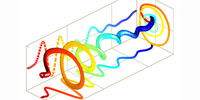
Driving an electron beam into a helical pattern with terahertz electromagnetic pulses allows researchers to measure the beam’s complete shape with femtosecond resolution.

Many-Body Chern Number without Integration

Koji Kudo, Haruki Watanabe, Toshikaze Kariyado, and Yasuhiro Hatsugai

Phys. Rev. Lett. 122, 146601 (2019) - Published 9 April, 2019

Numerical calculations show that an integration previously thought to be essential for obtaining the many-body Chern number is not necessary for large systems, which could significantly reduce the numerical cost in computing the many-body Chern number.

Constraining the Spin-Dependent WIMP-Nucleon Cross Sections with XENON1T

E. Aprile et al. (XENON Collaboration)

Phys. Rev. Lett. 122, 141301 (2019) - Published 8 April, 2019

The most stringent limits yet are placed on the spin-dependent coupling of neutrons to hypothetical weakly interacting dark matter particles.

Superfluid Helium in Three-Dimensional Counterflow Differs Strongly from Classical Flows: Anisotropy on Small Scales

L. Biferale, D. Khomenko, V. L’vov, A. Pomyalov, I. Procaccia, and G. Sahoo

Phys. Rev. Lett. 122, 144501 (2019) - Published 8 April, 2019

Isotropy analysis shows that, while turbulence in classical fluids tends towards isotropy and homogeneity with decreasing scales, the opposite trend is true for superfluid helium flows.

Single-Photon Distillation via a Photonic Parity Measurement Using Cavity QED

Severin Daiss, Stephan Welte, Bastian Hacker, Lin Li, and Gerhard Rempe

Phys. Rev. Lett. 122, 133603 (2019) - Published 5 April, 2019

High-fidelity photon states are distilled from a weak coherent state through a photonic parity measurement using cavity QED.

Probing the in situ Elastic Nonlinearity of Rocks with Earth Tides and Seismic Noise

Christoph Sens-Schönfelder and Tom Eulenfeld

Phys. Rev. Lett. 122, 138501 (2019) - Published 5 April, 2019

Seismic measurements reveal the influences of lunar gravitational forces and solar heat on the properties of rocks.

Sustained Neutron Production from a Sheared-Flow Stabilized Z Pinch

Y. Zhang, U. Shumlak, B. A. Nelson, R. P. Golingo, T. R. Weber, A. D. Stepanov, E. L. Claveau, E. G. Forbes, Z. T. Draper, J. M. Mitrani, H. S. McLean, K. K. Tummel, D. P. Higginson, and C. M. Cooper

Phys. Rev. Lett. 122, 135001 (2019) - Published 4 April, 2019

Researchers spot the signatures of nuclear fusion in a table-top-sized setup commonly used to study the plasmas found in stars and other astrophysical objects.

Observation of a Dipolar Quantum Gas with Metastable Supersolid Properties

L. Tanzi, E. Lucioni, F. Famà, J. Catani, A. Fioretti, C. Gabbanini, R. N. Bisset, L. Santos, and G. Modugno

Phys. Rev. Lett. 122, 130405 (2019) - Published 3 April, 2019

A novel regime of ultracold atoms is found in which a stable density modulation, known as stripes, is observed simultaneously with quantum droplets, resulting in an important advance in the search for a dipolar supersolid.

First Direct Search for Inelastic Boosted Dark Matter with COSINE-100

C. Ha et al. (COSINE-100 Collaboration)

Phys. Rev. Lett. 122, 131802 (2019) - Published 3 April, 2019

The first search for relativistically boosted dark matter particles using a terrestrial detector yields new bounds on these hypothetical particles.

Correlations from Ion Pairing and the Nernst-Einstein Equation

Arthur France-Lanord and Jeffrey C. Grossman

Phys. Rev. Lett. 122, 136001 (2019) - Published 3 April, 2019

A reliable and computationally cheap way of calculating the ionic conductivity of a concentrated electrolyte in a battery involves modeling ion clusters.

Observation of Two Excited Bc+ States and Measurement of the Bc+(2S) Mass in pp Collisions at s=13  TeV

A. M. Sirunyan et al. (CMS Collaboration)

Phys. Rev. Lett. 122, 132001 (2019) - Published 2 April, 2019

A huge dataset recorded at the highest particle collision energy so-far observed resolves a puzzle by revealing two meson excited states.

Results of a Search for Sub-GeV Dark Matter Using 2013 LUX Data

D. S. Akerib et al. (LUX Collaboration)

Phys. Rev. Lett. 122, 131301 (2019) - Published 1 April, 2019

Liquid-xenon-detector searches for weakly interacting dark matter particles have been extended down to 0.4 GeV by taking into account contributions from Bremsstrahlung and Migdal effects.

Nuclear Magnetic Resonance Spectroscopy as a Dynamical Structural Probe of Hydrogen under High Pressure

Bartomeu Monserrat, Sharon E. Ashbrook, and Chris J. Pickard

Phys. Rev. Lett. 122, 135501 (2019) - Published 1 April, 2019

NMR unambiguously resolves the structure of the observed high pressure phases of hydrogen, a task which has evaded experimental determination.

Sign In to Your Journals Account

Filter

Section

Filter

Article Lookup

Enter a citation