Highlights

Interfacial Rashba-Effect-Induced Anisotropy in Nonmagnetic-Material–Ferrimagnetic-Insulator Bilayers

Aidan J. Lee, Adam S. Ahmed, Brendan A. McCullian, Side Guo, Menglin Zhu, Sisheng Yu, Patrick M. Woodward, Jinwoo Hwang, P. Chris Hammel, and Fengyuan Yang

Phys. Rev. Lett. 124, 257202 (2020) - Published 23 June, 2020

A systematic study of a ferrimagnetic insulator in a bilayer structure with a succession of nonmagnetic metals opens a possibility of tuning magnetic anisotropy, and also highlights a clear distinction between transition metals and non-transition metals.

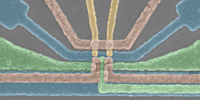
Giant Anisotropy of Spin Relaxation and Spin-Valley Mixing in a Silicon Quantum Dot

Xin Zhang, Rui-Zi Hu, Hai-Ou Li, Fang-Ming Jing, Yuan Zhou, Rong-Long Ma, Ming Ni, Gang Luo, Gang Cao, Gui-Lei Wang, Xuedong Hu, Hong-Wen Jiang, Guang-Can Guo, and Guo-Ping Guo

Phys. Rev. Lett. 124, 257701 (2020) - Published 23 June, 2020

The rate at which electron spins relax in silicon quantum dots is controlled by the strength and direction of external magnetic fields.

Quantum Information Scrambling in a Trapped-Ion Quantum Simulator with Tunable Range Interactions

Manoj K. Joshi, Andreas Elben, Benoît Vermersch, Tiff Brydges, Christine Maier, Peter Zoller, Rainer Blatt, and Christian F. Roos

Phys. Rev. Lett. 124, 240505 (2020) - Published 19 June, 2020

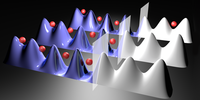
Quantum scrambling is simulated using a ten-qubit trapped-ion quantum simulator.

Physical Implications of a Fundamental Period of Time

Garrett Wendel, Luis Martínez, and Martin Bojowald

Phys. Rev. Lett. 124, 241301 (2020) - Published 19 June, 2020

Theorists have determined 10−33 seconds as the upper limit for the period of a universal oscillator, which could help in constructing a quantum theory of gravity.

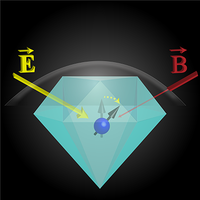
Nanoscale Electrometry Based on a Magnetic-Field-Resistant Spin Sensor

Rui Li, Fei Kong, Pengju Zhao, Zhi Cheng, Zhuoyang Qin, Mengqi Wang, Qi Zhang, Pengfei Wang, Ya Wang, Fazhan Shi, and Jiangfeng Du

Phys. Rev. Lett. 124, 247701 (2020) - Published 19 June, 2020

A novel electrometry method using a nitrogen-vacancy center in diamond as a probe is insensitive to magnetic fields but maximally sensitive to electric ones.

St. Petersburg Paradox and Failure Probability

Jake Fontana and Peter Palffy-Muhoray

Phys. Rev. Lett. 124, 245501 (2020) - Published 18 June, 2020

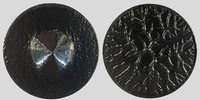
Stretching fibers until they fail reveals a correspondence between material strength and a 300-year-old math puzzle involving coin flips.

Criterion for Fingering Instabilities in Colloidal Gels

Thibaut Divoux, Asheesh Shukla, Badis Marsit, Yacouba Kaloga, and Irmgard Bischofberger

Phys. Rev. Lett. 124, 248006 (2020) - Published 18 June, 2020

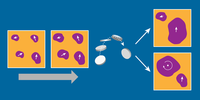
Experiments show that when a non-Newtonian fluid is displaced by air, the input energy determines whether the fluid surface forms simple or elaborate patterns.

Full Counting Statistics of Topological Defects after Crossing a Phase Transition

Fernando J. Gómez-Ruiz, Jack J. Mayo, and Adolfo del Campo

Phys. Rev. Lett. 124, 240602 (2020) - Published 17 June, 2020

A theoretical study of phase transitions reveals new universal nonequilibrium features in the statistics of topological defects.

Sound Propagation and Quantum-Limited Damping in a Two-Dimensional Fermi Gas

Markus Bohlen, Lennart Sobirey, Niclas Luick, Hauke Biss, Tilman Enss, Thomas Lompe, and Henning Moritz

Phys. Rev. Lett. 124, 240403 (2020) - Published 16 June, 2020

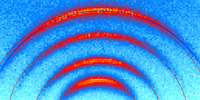
Measurements of the speed and damping of sound waves in a homogeneous 2D Fermi gas across the BEC-BCS crossover probe the thermodynamic and transport properties of this gas and reveals that it realizes a nearly perfect fluid.

Evidence for Unbounded Growth of the Number Entropy in Many-Body Localized Phases

Maximilian Kiefer-Emmanouilidis, Razmik Unanyan, Michael Fleischhauer, and Jesko Sirker

Phys. Rev. Lett. 124, 243601 (2020) - Published 16 June, 2020

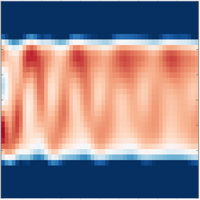
Simulations show that an isolated quantum system—previously thought to remain out of equilibrium indefinitely—may thermalize after all.

Shape-Anisotropy-Induced Ordered Packings in Cylindrical Confinement

Weiwei Jin (金炜炜), Ho-Kei Chan (陈浩基), and Zheng Zhong (仲政)

Phys. Rev. Lett. 124, 248002 (2020) - Published 16 June, 2020

Packing prolate and oblate spheroids into cylinders creates new types of packings not seen for perfect spheres.

Origin of Pulsar Radio Emission

Alexander Philippov, Andrey Timokhin, and Anatoly Spitkovsky

Phys. Rev. Lett. 124, 245101 (2020) - Published 15 June, 2020

Calculations link coherent pulsar emission to fluctuations in electron-positron production.

Massive Suppression of Proximity Pairing in Topological (Bi1−xSbx)2Te3 Films on Niobium

Joseph A. Hlevyack, Sahand Najafzadeh, Meng-Kai Lin, Takahiro Hashimoto, Tsubaki Nagashima, Akihiro Tsuzuki, Akiko Fukushima, Cédric Bareille, Yang Bai, Peng Chen, Ro-Ya Liu, Yao Li, David Flötotto, José Avila, James N. Eckstein, Shik Shin, Kozo Okazaki, and T.-C. Chiang

Phys. Rev. Lett. 124, 236402 (2020) - Published 12 June, 2020

Massive attenuation of surface superconductivity in (Bi1−xSbx)2Te3/Nb compared to Bi2Se3/Nb suggests that quantum-mechanical coupling between bulk and surface states largely dominates the proximity effect in topological insulator films on Nb.

Topological Singularity Induced Chiral Kohn Anomaly in a Weyl Semimetal

Thanh Nguyen, Fei Han, Nina Andrejevic, Ricardo Pablo-Pedro, Anuj Apte, Yoichiro Tsurimaki, Zhiwei Ding, Kunyan Zhang, Ahmet Alatas, Ercan E. Alp, Songxue Chi, Jaime Fernandez-Baca, Masaaki Matsuda, David Alan Tennant, Yang Zhao, Zhijun Xu, Jeffrey W. Lynn, Shengxi Huang, and Mingda Li

Phys. Rev. Lett. 124, 236401 (2020) - Published 11 June, 2020

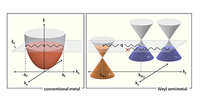
Combining field-theory with x-ray and neutron scattering shows a novel Kohn anomaly in TaP, a Weyl semimetal, occurs at the Weyl points with power-law divergence and chirality selection.

Vibrational Properties of Hard and Soft Spheres Are Unified at Jamming

Francesco Arceri and Eric I. Corwin

Phys. Rev. Lett. 124, 238002 (2020) - Published 11 June, 2020

A new way to use the hard sphere model lets researchers connect the jammed states of grains and the glass transition of molecules.

Observation of Photoion Backward Emission in Photoionization of He and N2

Sven Grundmann, Max Kircher, Isabel Vela-Perez, Giammarco Nalin, Daniel Trabert, Nils Anders, Niklas Melzer, Jonas Rist, Andreas Pier, Nico Strenger, Juliane Siebert, Philipp V. Demekhin, Lothar Ph. H. Schmidt, Florian Trinter, Markus S. Schöffler, Till Jahnke, and Reinhard Dörner

Phys. Rev. Lett. 124, 233201 (2020) - Published 9 June, 2020

Experiments confirm that photonionized molecules get a backward kick, as predicted by theory.

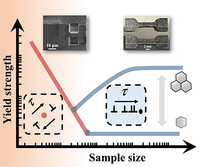
Unified Model for Size-Dependent to Size-Independent Transition in Yield Strength of Crystalline Metallic Materials

Wenbin Liu, Ying Liu, Yangyang Cheng, Lirong Chen, Long Yu, Xin Yi, and Huiling Duan

Phys. Rev. Lett. 124, 235501 (2020) - Published 9 June, 2020

A unified model reveals the underlying mechanism for the yield strength transition in crystalline metals as they shrink from bulk to nanoscale.

Noncontact Spin Pumping by Microwave Evanescent Fields

Tao Yu and Gerrit E. W. Bauer

Phys. Rev. Lett. 124, 236801 (2020) - Published 8 June, 2020

Contactless spin pumping is proposed to eliminate the systematic difficulties endemic in contact spin pumping methods.

Ice Coverage of Dust Grains in Cold Astrophysical Environments

Alexey Potapov, Cornelia Jäger, and Thomas Henning

Phys. Rev. Lett. 124, 221103 (2020) - Published 5 June, 2020

Dust particles in space may be surprisingly porous, so their surfaces could carry thinner ice coatings and support different chemical reactions than previously supposed.

Observation of New Ξc0 Baryons Decaying to Λc+K−

R. Aaij et al. (LHCb Collaboration)

Phys. Rev. Lett. 124, 222001 (2020) - Published 4 June, 2020

The LHCb experiment has discovered at least two new excited states of the Ξc baryon, a finding that could improve understanding of how quarks bind together.

Sign In to Your Journals Account

Filter

Section

Filter

Article Lookup

Enter a citation