Highlights

Information-Theoretic Bounds on Quantum Advantage in Machine Learning

Hsin-Yuan Huang, Richard Kueng, and John Preskill

Phys. Rev. Lett. 126, 190505 (2021) - Published 14 May, 2021

On average, classical and quantum machine learning techniques are comparable, but for accurate predictions on all inputs, there can be exponential quantum advantage.

Nuclear Spin Gyroscope based on the Nitrogen Vacancy Center in Diamond

Vladimir V. Soshenko, Stepan V. Bolshedvorskii, Olga Rubinas, Vadim N. Sorokin, Andrey N. Smolyaninov, Vadim V. Vorobyov, and Alexey V. Akimov

Phys. Rev. Lett. 126, 197702 (2021) - Published 14 May, 2021

A small device performs rotational measurements using nuclear spins in a diamond wafer, paving the way for microchip-sized gyroscopes.

Distinguishing a Mott Insulator from a Trivial Insulator with Atomic Adsorbates

Jinwon Lee, Kyung-Hwan Jin, and Han Woong Yeom

Phys. Rev. Lett. 126, 196405 (2021) - Published 13 May, 2021

A new experimental method based on adsorption can indicate whether a material is a Mott insulator or a common insulator.

Roton Excitations in an Oblate Dipolar Quantum Gas

J.-N. Schmidt, J. Hertkorn, M. Guo, F. Böttcher, M. Schmidt, K. S. H. Ng, S. D. Graham, T. Langen, M. Zwierlein, and T. Pfau

Phys. Rev. Lett. 126, 193002 (2021) - Published 12 May, 2021

Radial and angular roton excitations are observed in an oblate dipolar Bose-Einstein condensate around the phase transition to a 2D droplet crystal.

X-Ray Ptychography with a Laboratory Source

Darren J. Batey, Frederic Van Assche, Sander Vanheule, Matthieu N. Boone, Andrew J. Parnell, Oleksandr O. Mykhaylyk, Christoph Rau, and Silvia Cipiccia

Phys. Rev. Lett. 126, 193902 (2021) - Published 12 May, 2021

Researchers have scaled down x-ray ptychography—a high-resolution imaging technique that used to require large, expensive facilities—for use in the lab.

Self-Organized Multifrequency Clusters in an Oscillating Electrochemical System with Strong Nonlinear Coupling

Maximilian Patzauer and Katharina Krischer

Phys. Rev. Lett. 126, 194101 (2021) - Published 10 May, 2021

Self-organized multifrequency clusters in n-doped silicon wafers emerge from a uniform oscillatory state during electrodissolution at low-intensity photoexcitation.

Geometric Photon-Drag Effect and Nonlinear Shift Current in Centrosymmetric Crystals

Li-kun Shi, Dong Zhang, Kai Chang, and Justin C. W. Song

Phys. Rev. Lett. 126, 197402 (2021) - Published 10 May, 2021

The nonlinear shift current (associated with the bulk photovoltaic effect) in centrosymmetric crystals, known to be absent in crystals with inversion symmetry, could still be activated by a photon-drag effect.

Chiral Anomaly in Interacting Condensed Matter Systems

Colin Rylands, Alireza Parhizkar, Anton A. Burkov, and Victor Galitski

Phys. Rev. Lett. 126, 185303 (2021) - Published 7 May, 2021

Anomalous chiral symmetry breaking is affected by interactions.

Phase Diagram of Active Brownian Spheres: Crystallization and the Metastability of Motility-Induced Phase Separation

Ahmad K. Omar, Katherine Klymko, Trevor GrandPre, and Phillip L. Geissler

Phys. Rev. Lett. 126, 188002 (2021) - Published 7 May, 2021

Under the right conditions, self-propelled particles collectively transition from a state of liquid-gas coexistence to one where the particles can crystalize, according to simulations.

Machine Learning Conservation Laws from Trajectories

Ziming Liu and Max Tegmark

Phys. Rev. Lett. 126, 180604 (2021) - Published 6 May, 2021

A machine learning algorithm for auto-discovering conserved quantities has been tested on five Hamiltonian systems, including the gravitational 3-body problem.

Microscale Hydrodynamic Cloaking and Shielding via Electro-Osmosis

Evgeniy Boyko, Vesna Bacheva, Michael Eigenbrod, Federico Paratore, Amir D. Gat, Steffen Hardt, and Moran Bercovici

Phys. Rev. Lett. 126, 184502 (2021) - Published 6 May, 2021

By injecting momentum into the fluid around an object, researchers can freely switch between obscuring the object’s presence and cancelling hydrodynamic forces on it.

GW190521 from the Merger of Ultradwarf Galaxies

Antonella Palmese and Christopher J. Conselice

Phys. Rev. Lett. 126, 181103 (2021) - Published 5 May, 2021

The hard-to-explain masses of two coalescing black holes could be accounted for if they were the central black holes in two distant, tiny galaxies that merged.

Cooperative Chain Dynamics of Tracer Chains in Highly Entangled Polyethylene Melts

M. Zamponi, M. Kruteva, M. Monkenbusch, L. Willner, A. Wischnewski, I. Hoffmann, and D. Richter

Phys. Rev. Lett. 126, 187801 (2021) - Published 4 May, 2021

According to the results of new neutron scattering experiments, polymer molecules in plastics move in ways that aren’t captured by commonly used models.

Astrophysical and Theoretical Physics Implications from Multimessenger Neutron Star Observations

Hector O. Silva, A. Miguel Holgado, Alejandro Cárdenas-Avendaño, and Nicolás Yunes

Phys. Rev. Lett. 126, 181101 (2021) - Published 3 May, 2021

The combination of gravitational-wave and x-ray observations of neutron stars provides new information on the mass distribution in these stars as well as new confirmation of Einstein’s theory of gravity.

3D Imaging from Multipath Temporal Echoes

Alex Turpin, Valentin Kapitany, Jack Radford, Davide Rovelli, Kevin Mitchell, Ashley Lyons, Ilya Starshynov, and Daniele Faccio

Phys. Rev. Lett. 126, 174301 (2021) - Published 30 April, 2021

With a one-pixel detector and a pulsed emitting device, researchers are able to produce a 3D image of a room from multiple echoes.

Measuring Density Functional Parameters from Electron Diffraction Patterns

Ding Peng and Philip N. H. Nakashima

Phys. Rev. Lett. 126, 176402 (2021) - Published 29 April, 2021

Density functional theory has been integrated into quantitative convergent beam electron diffraction to refine density functional model parameters using electron densities exclusively.

Atomtronic Matter-Wave Lensing

Saurabh Pandey, Hector Mas, Georgios Vasilakis, and Wolf von Klitzing

Phys. Rev. Lett. 126, 170402 (2021) - Published 28 April, 2021

A new “lensing” technique counters the spreading of an ultracold cloud of atoms inside a tiny waveguide.

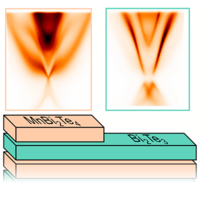
Orbital Complexity in Intrinsic Magnetic Topological Insulators MnBi4Te7 and MnBi6Te10

R. C. Vidal, H. Bentmann, J. I. Facio, T. Heider, P. Kagerer, C. I. Fornari, T. R. F. Peixoto, T. Figgemeier, S. Jung, C. Cacho, B. Büchner, J. van den Brink, C. M. Schneider, L. Plucinski, E. F. Schwier, K. Shimada, M. Richter, A. Isaeva, and F. Reinert

Phys. Rev. Lett. 126, 176403 (2021) - Published 28 April, 2021

Dirac-like dispersion in topological surface states is strongly perturbed by hybridization with valence-band states for Bi2Te3-terminated surfaces, but remains preserved for MnBi2Te4-terminated surfaces.

Chirality Memory Stored in Magnetic Domain Walls in the Ferromagnetic State of MnP

N. Jiang, Y. Nii, H. Arisawa, E. Saitoh, J. Ohe, and Y. Onose

Phys. Rev. Lett. 126, 177205 (2021) - Published 28 April, 2021

Magnetic chirality persists as the handedness of domain walls in an itinerant helimagnet even after being driven into a ferromagnetic state and back.

Phonon-Assisted Ballistic Current from First-Principles Calculations

Zhenbang Dai, Aaron M. Schankler, Lingyuan Gao, Liang Z. Tan, and Andrew M. Rappe

Phys. Rev. Lett. 126, 177403 (2021) - Published 28 April, 2021

The ab initio calculation of the ballistic current using the full electronic structure and phonon dispersion shows that much larger current responses can exist away from the band-edge, and provides a qualitatively different understanding of ballistic current for real materials.

Sign In to Your Journals Account

Filter

Section

Filter

Article Lookup

Enter a citation