Recent Articles

Experimental investigation of twin pulsed jets in a hemispheric elastic cavity

L. S. Merlo, L. Kadem, W. Saleh, H. D. Ng, and G. Di Labbio

Phys. Rev. Fluids 11, 054701 (2026) - Published 11 May, 2026

Twin pulsed jets are highly efficient at transferring energy, making them particularly attractive for applications ranging from underwater propulsion and maneuvering to the filling of heart cavities. However, little is known about their dynamic interactions within a hemispherical elastic cavity. Distinct flow regimes are identified here based on formation time and jet spacing. These regimes include short-time decay, decay at the lower wall, wall rebound, and wall rebound with secondary vortices. These findings enhance our understanding of the complex flow patterns generated by certain medical devices and pathological conditions, as well as their effects on cardiac function and performance.

Beyond Tate's law: Geometric control of pendant drop detachment

Bauyrzhan K. Primkulov

Phys. Rev. Fluids 11, L051601 (2026) - Published 11 May, 2026

The size of a detaching pendant drop is set by Tate’s law and depends only weakly on the nozzle radius. Here, we show that simple geometric confinement can trigger early detachment at significantly reduced volumes by introducing an additional capillary force. A minimal scaling law collapses the data across geometries, providing a robust and passive route to tune drop size without external actuation.

Osmotic motion of a semipermeable vesicle

Ehud Yariv

Phys. Rev. Fluids 11, 053603 (2026) - Published 7 May, 2026

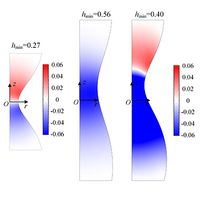
When the solute concentration is different in the two sides of a semipermeable membrane, solvent flows from the solute-depleted side to the solute-enriched side. More generally, when a vesicle is placed in a solute-concentration gradient, it experiences inward osmosis on the low-concentration side and outward osmosis on the high-concentration side. This paper investigates the resulting motion of the vesicle down the gradient.

Asymptotically exact formulation of superfluid turbulence with discrete topological defects at all continuum scales

Demosthenes Kivotides

Phys. Rev. Fluids 11, 054602 (2026) - Published 7 May, 2026

Quantized vortex filaments in Bose superfluids act as line-like sources for microhydrodynamic (low Reynolds number) normal-fluid motion on scales that standard turbulence grids cannot resolve. We develop a two-level multiscale framework that couples a filtered normal-fluid solver to an explicit microhydrodynamic Stokes Linear Response (LRT), incorporating these effects self-consistently into both vortex dynamics and the resolved normal-fluid equations. The approach enables efficient superfluid-turbulence computations for laboratory, cryogenic, and astrophysical settings.

Electro-vortex flows in cylindrical cells: Theoretical estimate and flow characteristics

Swapnil Soni and Avishek Ranjan

Phys. Rev. Fluids 11, 053701 (2026) - Published 6 May, 2026

We derive a new theoretical estimate of the root mean square velocity of the electro-vortex flow (EVF) – a current-driven MHD flow – for high Reynolds number regime using an inertia-Lorentz balance in the vorticity transport equation. This estimate accounts for the dimension of the current collector, an important parameter that governs the EVF. There is an excellent agreement between the theory and numerical simulations performed using the custom-built code in OpenFOAM. We also explain the EVF characteristics using these results. Our numerical results reveal a distinct flow feature stemming from the domain finiteness at relatively higher current collector radii.

Newtonian die-swell phenomenon revisited: Theory and simulations

W.-P. Breugem and Y. E. Kamis

Phys. Rev. Fluids 11, 054101 (2026) - Published 6 May, 2026

We investigated the dynamics of a Newtonian liquid jet issued from a long circular nozzle into a gaseous environment. While the jet contracts at high Reynolds number, it swells at low Reynolds number. To analyze this, we derived an integral momentum balance for the flow in both the nozzle and jet. The swell at low Reynolds number is associated with an excess integral wall shear stress near nozzle exit relative to perfect Poiseuille flow. Numerical simulations revealed self-similar behavior of the flow within the nozzle, which is explained from the stick-slip transition at the nozzle lip and the subsequent development of a boundary layer along the jet interface.

Turbulent heat transfer enhancement by compliant walls

Morie Koseki and Marco Edoardo Rosti

Phys. Rev. Fluids 11, 054301 (2026) - Published 6 May, 2026

This study investigates the effect of compliant walls on the turbulent heat transfer in channel flows over viscous-hyperelastic walls. We show that the compliant wall leads to an increase not only of the momentum transfer but also of the heat transfer, and that the heat transfer enhancement is favorable compared to the momentum one

Isothermal twin-swirl flows with bluff-swirl, bubble, and conical vortex breakdown: Flow field and coherent structures

Pabitra Badhuk, Atanu Dolai, and R. V. Ravikrishna

Phys. Rev. Fluids 11, 054601 (2026) - Published 6 May, 2026

Twin-swirl flows can generate various vortex breakdown structures depending on the swirling direction, strength, and the momentum ratio between the swirling streams. The present study uses scale-resolving simulations to analyze the mechanism of radial pressure gradient formation, role of entrainment in mixing, and identification of coherent structures in such flows. We show that while the centripetal acceleration dominates the radial pressure gradient formation with a single swirler, the contribution of advection and turbulence components are also significant in twin-swirl flows. We also show that the entrainment velocity is better estimated by the rms components than the mean velocity.

Erratum: GPU-accelerated simulations of turbulence: Review of current applications and future perspectives [Phys. Rev. Fluids 11, 034905 (2026)]

A. Roccon, G. Amati, L. Brandt, D. Calhoun, P. Costa, W. Lu, S. Pirozzoli, D. Richter, M. Umair, D. You, T. Zahtila, and C. Marchioli

Phys. Rev. Fluids 11, 059901 (2026) - Published 6 May, 2026

Retraction dynamics of surfactant-covered liquid sheets with surface rheological effects

Naresh K. Dhanwani, Ajay Harishankar Kumar, Hansol Wee, and Osman A. Basaran

Phys. Rev. Fluids 11, 053602 (2026) - Published 4 May, 2026

Using theory and simulation we analyze the retraction of a highly slender Newtonian liquid sheet with surface covered by a surfactant monolayer surrounded by air primarily in the Stokes limit with 1/Oh=0 where Oh is the Ohnesorge number. As the two surfaces of the sheet remain planar for long times after retraction is initiated, a control volume analysis is used to analytically calculate the maximum film thickness and retraction velocity. The role of finite inertia is also studied and it is shown that rim formation is suppressed if Oh (1+B0Γ0)≫L0 where B0 and L0 are the Boussinesq-Scriven number and initial sheet aspect ratio and Γ0 the initial surfactant concentration.

Hysteresis in the freeze-thaw cycle of emulsions and suspensions

Wilfried Raffi, Jochem G. Meijer, and Detlef Lohse

Phys. Rev. Fluids 11, 054001 (2026) - Published 4 May, 2026

Freeze–thaw cycles drive complex interactions between objects and moving solid–liquid interfaces. Using experimental model systems of oil-in-water emulsions and polystyrene particle suspensions, we reveal the occurence of hysteresis: Solid particles drift from their initial positions after one freeze-thaw cycle, while deformable oil droplets largely return to their initial positions with reversible shape changes. Our theoretical model captures these trends, highlighting the complexity of freeze–thaw dynamics.

Bubble dissolution kinetics in porous media

Yuehongjiang Yu, Yang Yang, Jie Qi, Yu Qiu, Mengdi Sun, and Ke Xu

Phys. Rev. Fluids 11, 053601 (2026) - Published 1 May, 2026

Bubble dissolution in porous media controls key applications including geological carbon sequestration, groundwater remediation, and energy engineering. The classic Epstein-Plesset model for bubble dissolution in open space is invalid in porous medium. We reveal how porous structure fundamentally reshapes dissolution, and derive analytical solutions for three typical bubble morphologies (single-pore, strip-shaped, and block-shaped). Analytical solutions are well verified by experiments and numerical simulations. Our new theory offers critical theoretical support for optimizing subsurface gas storage and gaseous pollutant removal technologies.

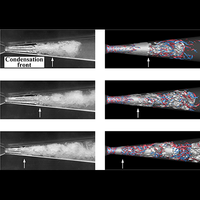
Condensation front mechanism of partial cavitation in an axisymmetric Venturi

Xun Sun (孙逊), Zhizhong Zhou (周智忠), Weibin You (游炜彬), Sivakumar Manickam, Yunqiao Liu (刘筠乔), Wenlong Wang (王文龙), and Benlong Wang (王本龙)

Phys. Rev. Fluids 11, 044304 (2026) - Published 30 April, 2026

We show that the incompressible Large eddy simulations of the condensation fronts (also referred to as bubbly shocks or condensation shocks) in partial cavitation within a three-dimensional Venturi agree well with the experiments. The condensation front is fundamentally different from traditional shock waves. The density variations due to evaporation and condensation of cavitation, rather than fluid compressibility, govern its formation and propagation. Hence, a compressible solver is unnecessary for simulating condensation fronts. These findings offer a new understanding of the shedding mechanism of partial cavitation.

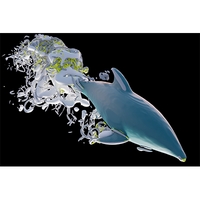
Swimming mechanism of a dolphin on the basis of the hierarchy of vortices

Yutaro Motoori, Hideki Murahata, and Susumu Goto

Phys. Rev. Fluids 11, L042601 (2026) - Published 30 April, 2026

We numerically investigate the swimming mechanism of a dolphin by focusing on the hierarchy of vortices in its turbulent wake. Using direct numerical simulations of a self-propelled dolphin and scale decomposition of the flow, we show that the caudal fin generates large vortex rings that contribute most of propulsion, whereas smaller vortices are created through the energy cascade but contribute little to propulsion. We also show that this mechanism remains robust regardless of the Reynolds number.

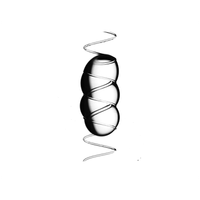
Capillary slinky: Equilibrium and dynamics of a droplet in a soft spring

Bidisha Bhatt and Andreas Carlson

Phys. Rev. Fluids 11, 043607 (2026) - Published 29 April, 2026

A droplet adopts a complex shape in a spring and can create significant spring compression, potentially functioning as a capillary weight-lifting system. By tuning the ratio between the pitch of the soft spring and the droplet size reveals a range of distinct droplet flow regimes, in which the vertical velocity is directly linked to the droplet’s rotational motion. Active control of the spring’s extension and compression demonstrates how both the static and dynamic states of the droplet can be controlled.

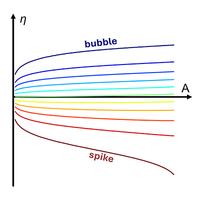
Theoretical one-dimensional model for variable-density Rayleigh-Taylor turbulence

Chian Yeh Goh and Guillaume Blanquart

Phys. Rev. Fluids 11, 044501 (2026) - Published 29 April, 2026

We revisit a largely overlooked theoretical model from Belen’kii and Fradkin (1965) and show that it captures many key features of non-Boussinesq Rayleigh-Taylor mixing observed in modern studies. By extending the analysis of this pioneering study, we uncover new physical insight and develop a practical, analytically tractable representation. Calibrated with DNS data, this work bridges classical theory and modern turbulence modeling, offering a compact tool for understanding and predicting variable-density turbulent flows.

Transitions in unsteady capillary-gravity wakes of surface swimmers

Max Roccuzzo and Johann Herault

Phys. Rev. Fluids 11, 044805 (2026) - Published 29 April, 2026

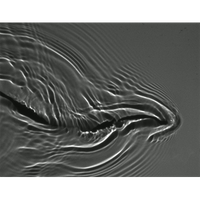
Surface-swimming organisms generate a rich variety of wave patterns. By studying the wakes produced by two juvenile snakes, we show that their surface waves strongly deviate from classical predictions for uniform straight-line motion. A simple slaloming-source model reproduces these patterns and shows they emerge from the superposition of translating, pulsating wave sources. Overall, our results provide a new framework for understanding capillary-gravity waves generated by non-uniform motion and enable the construction of a phase diagram describing these regimes.

Integral modeling and reinforcement learning control of three-dimensional liquid metal coating on a moving substrate

Fabio Pino, Edoardo Fracchia, Benoit Scheid, and Miguel A. Mendez

Phys. Rev. Fluids 11, 044003 (2026) - Published 28 April, 2026

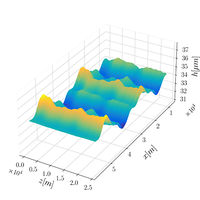
Metallic coatings play a vital role in protecting metal surfaces from corrosion, but achieving uniform, defect-free layers remain a major challenge due to undulation instabilities. This work investigates a novel control strategy for liquid films on moving substrates using coordinated gas jets and electromagnetic actuators. By extending integral film models and embedding them in a reinforcement-learning framework, a proximal policy optimization (PPO) algorithm learns to actively suppress instabilities. The resulting control exploits a new physical mechanism: gas jets damp wave crests while electromagnetic forces lift troughs, leading to smoother coatings.

Spontaneous breakup and satellite formation of an inviscid liquid bridge

Jinshun Gao, Xiaofeng Wei, Dege Li, Dongyao Wu, Lulu Pan, Dongyun Wang, Mingbo Li, Yuliang Zhang, and Benoit Scheid

Phys. Rev. Fluids 11, 043606 (2026) - Published 27 April, 2026

We investigate the breakup dynamics of an inviscid liquid bridge under slow drainage. The transition from symmetric to asymmetric breakup occurs at a length-to-radius ratio of 4.1, corresponding to a shift from even-mode to odd-mode dominance. Contrary to previous experimental conclusions, we show that satellite droplet momentum originates from capillary impulses beginning at the flattening moment before the first pinch-off. A new scaling law is proposed and validated.

Influence of temporally varying canopy drag force on turbulence characteristics in open-channel flow

Jialiang Sun, Ning Huang, Binbin Pei, and Jie Zhang

Phys. Rev. Fluids 11, 044610 (2026) - Published 27 April, 2026

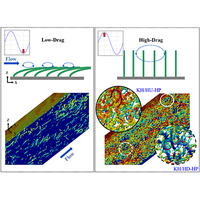
Vegetation canopies in open-channel flows often experience time-dependent drag that reshapes turbulence near the canopy top. Using large-eddy simulation with a variable-drag model, we show that oscillatory drag reorganizes coherent vortices and shifts turbulent kinetic energy activity from the canopy-top shear layer into the canopy interior. The framework provides an efficient way to isolate how prescribed canopy drag affects turbulence structure and energy transport in large-domain simulations.

Sign In to Your Journals Account

Filter

Recent Issues

Vol. 11, Iss. 10
October 2026
Vol. 11, Iss. 9
September 2026
Vol. 11, Iss. 8
August 2026
Vol. 11, Iss. 7
July 2026
Category
Article Type
Section

Filter

Article Lookup

Enter a citation