Multiple minimum-energy paths and scenarios of unwinding transitions in chiral nematic liquid crystals
Semen S. Tenishchev, Alexei D. Kiselev, Aleksei V. Ivanov, and Valery M. Uzdin
Phys. Rev. E 100, 062704 (2019) - Published 31 December, 2019
Semen S. Tenishchev, Alexei D. Kiselev, Aleksei V. Ivanov, and Valery M. Uzdin
Phys. Rev. E 100, 062704 (2019) - Published 31 December, 2019
We apply the minimum-energy paths (MEPs) approach to study the helix unwinding transition in chiral nematic liquid crystals. A mechanism of the transition is determined by a MEP passing through a first order saddle point on the free energy surface. The energy difference between the saddle point and the initial state gives the energy barrier of the transition. Two starting approximations for the paths are used to find the MEPs representing different transition scenarios: (a) the director slippage approximation with in-plane helical structures and (b) the anchoring breaking approximation that involves the structures with profound out-of-plane director deviations. It is shown that, at sufficiently low voltages, the unwinding transition is solely governed by the director slippage mechanism with the planar saddle-point structures. When the applied voltage exceeds its critical value below the threshold of the Fréedericksz transition, the additional scenario through the anchoring breaking transitions is found to come into play. For these transitions, the saddle-point structure is characterized by out-of-plane deformations localized near the bounding surface. The energy barriers for different paths of transitions are computed as a function of the voltage and the anchoring energy strengths.
Avanish Kumar, Chaitanya Narayanam, Rajesh Khanna, and Sanjay Puri
Phys. Rev. E 100, 062803 (2019) - Published 31 December, 2019
Dynamics of pattern formation in self-organizing systems subjected to spontaneous suppression of diffusion through a recently proposed source-sink-boundary templating technique is presented based on three-dimensional numerical simulations. This template disorder is introduced to divide the system into three different subregions, i.e., a source (outer subregion) at higher potential and a sink (inner subregion) region at a lower potential with the help of a boundary which is at the highest potential. The boundary allows only one-way diffusion from source to sink so diffusion stops completely whenever the sink is filled to its capacity. This technique was shown to be able to spontaneously form stable and complex patterns in the source and the sink parts. While the technique is applicable to any self-organizing or phase-separating system whenever certain conditions are met, a physically realizable system of liquid films supported on chemically heterogeneous substrates which self-organizes through morphological phase separation is chosen to study the dynamics. Free-energy functional of this system shows an asymmetric double-well potential and the Maxwell's double tangent construction on this free energy gives rise to two distinct and finite equilibrium phases. Disorder is introduced in the form of chemical heterogeneity to divide the whole system into different subregions each consisting of two equilibrium phases, thus enabling more finite equilibrium points in the same system. The dynamics uncovers two different pathways for stable localized structures, viz., the defect and the direct pathway. Thinner films are likely to favor the defect pathway whereby the equilibrium pattern forms after coarsening, whereas thicker films will predominantly choose the direct pathway of pattern formation by phase separation. The final localized structure is same irrespective of the chosen pathway. The dynamics also shows that the patterns formed in the inner subregion part can be seen as a result of “localization” and those formed in the outer subregion are due to arrested diffusion under geometric or curvature constraints. Simple measures of localization in terms of free energy and its constituents are also presented. The identification of localization in the above systems opens up the possibility of a systematic approach to create controlled structures at nano- and submicrometer scales with desired shape and size. These structures constitute new building blocks of advanced and tailored materials.
Yong Wang (王勇), Chengwen Zhong (钟诚文), and Sha Liu (刘沙)
Phys. Rev. E 100, 063310 (2019) - Published 31 December, 2019
In this paper, the original discrete unified gas kinetic scheme (DUGKS) is extended to the arbitrary Lagrangian–Eulerian (ALE) framework to enable simulation of low-speed continuum and rarefied flows with moving boundaries. For the proposed ALE-type DUGKS, the mesh motion velocity is introduced in the Boltzmann–BGK equation and a remapping-free scheme is used to discretize the governing equation. Under this coupling framework, the complex rezoning and remapping phases implemented in the traditional ALE method are avoided. In some application areas, large discretization errors are introduced in the simulation if the geometric conservation law (GCL) is not guaranteed. Therefore, three GCL-compliant approaches are discussed, and a uniform flow test case is conducted to validate these schemes. Further, to illustrate the performance of the proposed method, four test cases are simulated, including the continuum flow around an oscillating circular cylinder, the continuum flow around a pitching NACA0012 airfoil, a moving piston driven by a rarefied gas, and the rarefied flow caused by a plate oscillating in the normal direction. Finally, an extended test case considering the rarefied flow over an oscillating circular cylinder is also studied, as this condition is not sufficiently researched. Consistent and good results obtained from the above test cases demonstrate the capability of the proposed ALE-type DUGKS to simulate moving boundary problems in different flow regimes.
Chrysovalantis Tsigginos, Jianping Meng (孟剑平), Xiao-Jun Gu, and David R. Emerson
Phys. Rev. E 100, 063311 (2019) - Published 31 December, 2019
In this work, we derive a lattice Boltzmann model for fluid-particle interaction by considering the system as a two-phase mixture. A partially saturated type scheme is achieved rigorously without any viscosity-dependent weight parameter. The scheme is of second-order accuracy in both space and time including the body-force term. Moreover, we devise a scheme suitable for the scenario where two or more particles intersect a single computational cell, typically occurring for particles in contact or close to contact. Good performance is found when the present scheme is validated against three classic problems, namely the flow past a stationary cylinder, a cylindrical particle settling in a channel under gravity, and the flow around two impacting cylinders.
Yao Chen, Xudong Wang, and Weihua Deng
Phys. Rev. E 100, 062141 (2019) - Published 30 December, 2019
Lévy walk is a practical model and has wide applications in various fields. Here we focus on the effect of an external constant force on the Lévy walk with the exponent of the power-law-distributed flight time . We add the term [ is the Lévy noise] on a subordinated Langevin system to characterize such a constant force, as it is effective on the velocity process for all physical time after the subordination. We clearly show the effect of the constant force on this Langevin system and find this system is like the continuous limit of the collision model. The first moments of velocity processes for these two models are consistent. In particular, based on the velocity correlation function derived from our subordinated Langevin equation, we investigate more interesting statistical quantities, such as the ensemble- and time-averaged mean-squared displacements. Under the influence of constant force, the diffusion of particles becomes faster. Finally, the superballistic diffusion and the nonergodic behavior are verified by the simulations with different .
Helmut H. Strey
Phys. Rev. E 100, 062142 (2019) - Published 30 December, 2019
In this article, we develop a Bayesian approach to estimate parameters from time traces that originate from an overdamped Brownian particle in a harmonic potential, or Ornstein-Uhlenbeck process (OU). We show that least-square fitting the autocorrelation function, which is often the standard way of analyzing such data, is significantly underestimating the confidence intervals of the fitted parameters. Here, we develop a rigorous maximum likelihood theory that properly captures the underlying statistics. From the analytic solution, we found that there exists an optimal measurement spacing that maximizes the statistical accuracy of the estimate for the decay-time of the process for a fixed number of samples , which plays a similar role than the Nyquist-Shannon theorem for the OU process. To support our claims, we simulated time series with subsequent application of least-square and our maximum likelihood method. Our results suggest that it is quite dangerous to apply least-squares to autocorrelation functions both in terms of systematic deviations from the true parameter values and an order-of-magnitude underestimation of confidence intervals. To see whether our findings apply to other methods where autocorrelation functions are typically fitted by least-squares, we explored the analysis of membrane fluctuations and fluorescence correlation spectroscopy. In both cases, least-square fits exhibit systematic deviations from the true parameter values and significantly underestimate their confidence intervals. This fact emphasizes the need for the development of proper maximum likelihood approaches for such methods. In summary, our results have strong implications for parameter estimation for processes that result in a single exponential decay in the autocorrelation function. Our analysis can directly be applied to single-component dynamic light scattering experiments or optical trap calibration experiments.
Davide Squizzato and Léonie Canet
Phys. Rev. E 100, 062143 (2019) - Published 30 December, 2019
We investigate the universal behavior of the Kardar-Parisi-Zhang (KPZ) equation with temporally correlated noise. The presence of time correlations in the microscopic noise breaks the statistical tilt symmetry, or Galilean invariance, of the original KPZ equation with -correlated noise (denoted SR-KPZ). Thus, it is not clear whether the KPZ universality class is preserved in this case. Conflicting results exist in the literature, some advocating that it is destroyed even in the limit of infinitesimal temporal correlations, while others find that it persists up to a critical range of such correlations. Using nonperturbative and functional renormalization group techniques, we study the influence of two types of temporal correlators of the noise: a short-range one with a typical timescale , and a power-law one with a varying exponent . We show that for the short-range noise with any finite , the symmetries (the Galilean symmetry, and the time-reversal one in dimension) are dynamically restored at large scales, such that the long-distance and long-time properties are governed by the SR-KPZ fixed point. In the presence of a power-law noise, we find that the SR-KPZ fixed point is still stable for below a critical value , in accordance with previous renormalization group results, while a long-range fixed point controls the critical scaling for , and we evaluate the -dependent critical exponents at this long-range fixed point, in both and dimensions. While the results in dimension can be compared with previous studies, no other prediction was available in dimension. We finally report in dimension the emergence of anomalous scaling in the long-range phase.
Mariusz Tarnopolski
Phys. Rev. E 100, 062144 (2019) - Published 30 December, 2019
Closed-form expressions, parametrized by the Hurst exponent and the length of a time series, are derived for paths of fractional Brownian motion (fBm) and fractional Gaussian noise (fGn) in the plane, composed of the fraction of turning points and the Abbe value . The exact formula for is expressed via Riemann and Hurwitz functions. A very accurate approximation, yielding a simple exponential form, is obtained. Finite-size effects, introduced by the deviation of fGn's variance from unity, and asymptotic cases are discussed. Expressions for for fBm, fGn, and differentiated fGn are also presented. The same methodology, valid for any Gaussian process, is applied to autoregressive moving average processes, for which regions of availability of the plane are derived and given in analytic form. Locations in the plane of some real-world examples as well as generated data are discussed for illustration.
Ken Tokunaga and Ryo Akiyama
Phys. Rev. E 100, 062608 (2019) - Published 30 December, 2019
The motions of a solvation motor in a Lennard-Jones solvent were calculated by using molecular dynamics simulation. The results were analyzed considering the large spatial scale effects caused by the motion of the solvation motor. A reaction site was located on the surface of the solvation motor and the attraction between the reaction site and the solvent molecules was varied for 100 fs. The motion of the motor was driven by solvation changes near the reaction site on the motor. Two finite-size effects were observed in the motion. One was the hydrodynamic effect and the other was the increase in solvent viscosity caused by heat generation. The latter affected not only the displacement of the motor caused by the reaction but also the wave propagation phenomena. Both effects reduced the motor displacement. Heat generation affects the displacement, in particular for small systems. By contrast, the hydrodynamic effect remained even for large systems. An extrapolation method was proposed for the displacement.
Kamran Karimi
Phys. Rev. E 100, 063003 (2019) - Published 30 December, 2019
We report on a particle-based numerical study of sheared amorphous solids in the dense slow flow regime. In this framework, deformation and flow are accompanied by critical fluctuation patterns associated with the macroscopic plastic response. The former is commonly attributed to the collective slip patterns that relax internal stresses within the bulk material and give rise to an effective mechanical noise governing the latter particle-level process. In this paper, the avalanche-type dynamics between plastic events is shown to have a strong relevance on the self-diffusion of tracer particles in the Fickian regime. As a consequence, strong size effects emerge in the effective diffusion coefficient that is rationalized in terms of avalanche size distributions and the relevant temporal occurrence.
P. S. Casas, M. Garzon, L. J. Gray, and J. A. Sethian
Phys. Rev. E 100, 063111 (2019) - Published 30 December, 2019
We present a numerical study of inviscid multiple droplet coalescence and break-up under the action of electric forces. Using an embedded potential flow model for the droplet hydrodynamics, coupled with an unbounded exterior electrostatic problem, we are able to perform computations through various singular events and analyze the effects of the electrical field intensity on droplet interactions. Laboratory experiments on the electrodynamics of droplet pairs show a much richer, and sometimes unexpected, behavior than that of isolated droplets. For example, it has been found that opposite charged droplets tend to repel each other when the electric field intensity is above a certain critical value. Although the mathematical model employed in this work incorporates very simple flow and electric assumptions, many of the droplet coalescence patterns seen in laboratory experiments can be reproduced. In this model, the interaction pattern of two droplets of radii separated a distance , depends on the ratio and the applied uniform electric field intensity, . By performing a vast number of numerical simulations we are able to characterize the coalescence modes before and after drop merging as a function of these two parameters. The simulations predict that droplet repulsion occurs within a narrow interval of values, different for each . Surprisingly, in this interval, a sharp transition between two power-law precoalescence flow regimes is seen. The evolution of several flow characteristics before and after coalescence, and the shape of the deformed droplets at coalescing time and the double cone angle, are also addressed and analyzed in detail. Cone angles below lead to droplet coalescence for any value, which is in accordance with previously reported studies. Finally, it is shown that the model and algorithm can handle multiple droplet interactions. The simulations qualitatively match results from water in oil experiments in microchannels, despite the fact that the exterior fluid is not considered in the mathematical model.
Yunyoung Park, Yongsam Kim, and Sookkyung Lim
Phys. Rev. E 100, 063112 (2019) - Published 30 December, 2019
The rotation of bacterial flagella driven by rotary motors enables the cell to swim through fluid. Bacteria run and reorient by changing the rotational direction of the motor for survival. Fluid environmental conditions also change the course of swimming; for example, cells near a solid boundary draw circular trajectories rather than straight runs. We present a bacterium model with a single flagellum that is attached to the cell body and investigate the effect of the solid wall on bacterial locomotion. The cell body of the bacterium is considered to be a rigid body and is linked via a rotary motor to the elastic flagellum which is modeled by the Kirchhoff rod theory. The hydrodynamic interaction of the cell near a solid boundary is described using the regularized Stokes formulation combined with the image system. We show that the trajectories of the bacteria near a solid boundary are influenced by the rotation rate of the motor, the shape of the cell body, helical geometry, and elastic properties of the flagellum.
Jin-Fu Chen, Chang-Pu Sun, and Hui Dong
Phys. Rev. E 100, 062140 (2019) - Published 27 December, 2019
The optimization of heat engines was intensively explored to achieve higher efficiency while maintaining the output power. However, most investigations were limited to a few finite-time cycles, e.g., the Carnot-like cycle, due to the complexity of the finite-time thermodynamics. In this paper, we propose a class of finite-time engine with quantum Otto cycle, and demonstrate a higher achievable efficiency at maximum power. The current model can be widely utilized, benefitting from the general scaling of extra work for a finite-time adiabatic process with long control time . We apply the adiabatic perturbation method to the quantum piston model and calculate the efficiency at maximum power, which is validated with an exact solution.
Vladimir Klinshov and Igor Franović
Phys. Rev. E 100, 062211 (2019) - Published 27 December, 2019
We consider the macroscopic regimes and the scenarios for the onset and the suppression of collective oscillations in a heterogeneous population of active rotators composed of excitable or oscillatory elements. We analyze the system in the continuum limit within the framework of Ott-Antonsen reduction method, determining the states with a constant mean field and their stability boundaries in terms of the characteristics of the rotators' frequency distribution. The system is established to display three macroscopic regimes, namely the homogeneous stationary state, where all the units lie at the resting state, the global oscillatory state, characterized by the partially synchronized local oscillations, and the heterogeneous stationary state, which includes a mixture of resting and asynchronously oscillating units. The transitions between the characteristic domains are found to involve a complex bifurcation structure, organized around three codimension-two bifurcation points: a Bogdanov-Takens point, a cusp point, and a fold-homoclinic point. Apart from the monostable domains, our study also reveals two domains admitting bistable behavior, manifested as coexistence between the two stationary solutions or between a stationary and a periodic solution. It is shown that the collective mode may emerge via two generic scenarios, guided by a saddle-node of infinite period or the Hopf bifurcation, such that the transition from the homogeneous to the heterogeneous stationary state under increasing diversity may follow the classical paradigm, but may also be hysteretic. We demonstrate that the basic bifurcation structure holds qualitatively in the presence of small noise or small coupling delay, with the boundaries of the characteristic domains shifted compared to the noiseless and the delay-free case.

Sveinung Erland, Jevgenijs Kaupužs, Vidar Frette, Rami Pugatch, and Eitan Bachmat
Phys. Rev. E 100, 062313 (2019) - Published 27 December, 2019
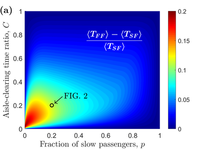
We study airplane boarding in the limit of a large number of passengers using geometric optics in a Lorentzian metric. The airplane boarding problem is naturally embedded in a ()-dimensional space-time with a flat Lorentzian metric. The duration of the boarding process can be calculated based on a representation of the one-dimensional queue of passengers attempting to reach their seats in a two-dimensional space-time diagram. The ability of a passenger to delay other passengers depends on their queue positions and row designations. This is equivalent to the causal relationship between two events in space-time, whereas two passengers are timelike separated if one is blocking the other and spacelike if both can be seated simultaneously. Geodesics in this geometry can be utilized to compute the asymptotic boarding time, since space-time geometry is the many-particle (passengers) limit of airplane boarding. Our approach naturally leads to the introduction of an effective refractive index that enables an analytical calculation of the average boarding time for groups of passengers with different aisle-clearing time distribution. In the past, airline companies attempted to shorten the boarding times by trying boarding policies that allow either slow or fast passengers to board first. Our analytical calculations, backed by discrete-event simulations, support the counterintuitive result that the total boarding time is shorter with the slow passengers boarding before the fast passengers. This is a universal result, valid for any combination of the parameters that characterize the problem: the percentage of slow passengers, the ratio between aisle-clearing times of the fast and the slow group, and the density of passengers along the aisle. We find an improvement of up to 28% compared with the fast-first boarding policy. Our approach opens up the possibility to unify numerous simulation-based case studies under one framework.
Nathann T. Rodrigues, Tiago J. Oliveira, Thomas Prellberg, and Aleksander L. Owczarek
Phys. Rev. E 100, 062504 (2019) - Published 27 December, 2019
Using extensive Monte Carlo simulations, we investigate the surface adsorption of self-avoiding trails on the triangular lattice with two- and three-body on-site monomer-monomer interactions. In the parameter space of two-body, three-body, and surface interaction strengths, the phase diagram displays four phases: swollen (coil), globule, crystal, and adsorbed. For small values of the surface interaction, we confirm the presence of swollen, globule, and crystal bulk phases. For sufficiently large values of the surface interaction, the system is in an adsorbed state, and the adsorption transition can be continuous or discontinuous, depending on the bulk phase. As such, the phase diagram contains a rich phase structure with transition surfaces that meet in multicritical lines joining in a single special multicritical point. The adsorbed phase displays two distinct regions with different characteristics, dominated by either single- or double-layer adsorbed ground states. Interestingly, we find that there is no finite-temperature phase transition between these two regions though rather a smooth crossover.
A. Ciach
Phys. Rev. E 100, 062607 (2019) - Published 27 December, 2019
Mesoscopic theory for self-assembling systems near a planar confining surface is developed. Euler-Lagrange equations and the boundary conditions (BCs) for the local volume fraction and the correlation function are derived from the density functional theory expression for the grand thermodynamic potential. Various levels of approximation can be considered for the obtained equations. The lowest-order nontrivial approximation [generic model (GM)] resembles the Landau-Brazovskii-type theory for a semi-infinite system. Unlike in the original phenomenological theory, however, all coefficients in our equations and BCs are expressed in terms of the interaction potential and the thermodynamic state. Analytical solutions of the linearized equations in the GM are presented and discussed on a general level and for a particular example of the double-Yukawa potential. We show exponentially damped oscillations of the volume fraction and the correlation function in the direction perpendicular to the confining surface. The correlations show oscillatory decay in directions parallel to this surface too, with the decay length increasing significantly when the system boundary is approached. The framework of our theory allows for a systematic improvement of the accuracy of the results.
Tyler LeBlond, Krishnanand Mallayya, Lev Vidmar, and Marcos Rigol
Phys. Rev. E 100, 062134 (2019) - Published 26 December, 2019
We study the bipartite von Neumann entanglement entropy and matrix elements of local operators in the eigenstates of an interacting integrable Hamiltonian (the paradigmatic spin-1/2 XXZ chain), and we contrast their behavior with that of quantum chaotic systems. We find that the leading term of the average (over all eigenstates in the zero magnetization sector) eigenstate entanglement entropy has a volume-law coefficient that is smaller than the universal (maximal entanglement) one in quantum chaotic systems. This establishes the entanglement entropy as a powerful measure to distinguish integrable models from generic ones. Remarkably, our numerical results suggest that the volume-law coefficient of the average entanglement entropy of eigenstates of the spin-1/2 XXZ Hamiltonian is very close to, or the same as, the one for translationally invariant quadratic fermionic models. We also study matrix elements of local operators in the eigenstates of the spin-1/2 XXZ Hamiltonian at the center of the spectrum. For the diagonal matrix elements, we show evidence that the support does not vanish with increasing system size, while the average eigenstate-to-eigenstate fluctuations vanish in a power-law fashion. For the off-diagonal matrix elements, we show that they follow a distribution that is close to (but not quite) log-normal, and that their variance is a well-defined function of ( are the eigenenergies) proportional to , where is the Hilbert space dimension.
Velimir M. Ilić, Antonio Maria Scarfone, and Tatsuaki Wada
Phys. Rev. E 100, 062135 (2019) - Published 26 December, 2019
The class of strongly pseudoadditive (SPA) entropies, which can be represented as an increasing continuous transformation of Shannon and Rényi entropies, have intensively been studied in previous decades. Although their mathematical structure has thoroughly been explored and established by generalized Shannon-Khinchin axioms, the analysis of their thermostatistical properties have mostly been limited to special cases which belong to two parameter Sharma-Mittal entropy class, such as Tsallis, Renyi and Gaussian entropies. In this paper we present a general analysis of the strongly pseudoadditive entropies thermostatistics by taking into account both linear and escort constraints on internal energy. We develop two types of dualities between the thermostatistics formalisms. By the first one, the formalism of Rényi entropy is transformed in the formalism of SPA entropy under general energy constraint and, by the second one, the generalized thermostatistics which corresponds to the linear constraint is transformed into the one which corresponds to the escort constraint. Thus, we establish the equivalence between four different thermostatistics formalisms based on Rényi and SPA entropies coupled with linear and escort constraints and we provide the transformation formulas. In this way we obtain a general framework which is applicable to the wide class of entropies and constraints previously discussed in the literature. As an example, we rederive maximum entropy distributions for Sharma-Mittal entropy and we establish new relationships between the corresponding thermodynamic potentials. We obtain, as special cases, previously developed expressions for maximum entropy distributions and thermodynamic quantities for Tsallis, Rényi, and Gaussian entropies. In addition, the results are applied for derivation of thermostatistical relationships for supraextensive entropy, which has not previously been considered.
Laurens Vanderstraeten, Bram Vanhecke, Andreas M. Läuchli, and Frank Verstraete
Phys. Rev. E 100, 062136 (2019) - Published 26 December, 2019
We apply variational tensor-network methods for simulating the Kosterlitz-Thouless phase transition in the classical two-dimensional model. In particular, using uniform matrix product states (MPS) with non-Abelian symmetry, we compute the universal drop in the spin stiffness at the critical point. In the critical low-temperature regime, we focus on the MPS entanglement spectrum to characterize the Luttinger-liquid phase. In the high-temperature phase, we confirm the exponential divergence of the correlation length and estimate the critical temperature with high precision. Our MPS approach can be used to study generic two-dimensional phase transitions with continuous symmetries.