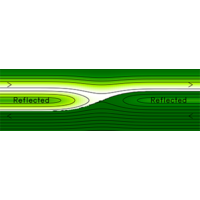
Consider the short-time probability distribution of the one-point interface height difference of the stationary interface described by the Kardar-Parisi-Zhang (KPZ) equation. It was previously shown that the optimal path, the most probable history of the interface which dominates the upper tail of , is described by any of two ramplike structures of traveling either to the left, or to the right. These two solutions emerge, at a critical value of , via a spontaneous breaking of the mirror symmetry of the optimal path, and this symmetry breaking is responsible for a second-order dynamical phase transition in the system. We simulate the interface configurations numerically by employing a large-deviation Monte Carlo sampling algorithm in conjunction with the mapping between the KPZ interface and the directed polymer in a random potential at high temperature. This allows us to observe the optimal paths, which determine each of the two tails of , down to probability densities as small as . At short times we observe mirror-symmetry-broken traveling optimal paths for the upper tail, and a single mirror-symmetric path for the lower tail, in good quantitative agreement with analytical predictions. At long times, even at moderate values of , where the optimal fluctuation method is not supposed to apply, we still observe two well-defined dominating paths. Each of them violates the mirror symmetry and is a mirror image of the other.