Recent Articles

Jammed solids with pins: Thresholds, force networks, and elasticity

Andy L. Zhang, Sean A. Ridout, Celia Parts, Aarushi Sachdeva, Cacey S. Bester, Katharina Vollmayr-Lee, Brian C. Utter, Ted Brzinski, and Amy L. Graves

Phys. Rev. E 106, 034902 (2022) - Published 6 September, 2022

High-order flux reconstruction thermal lattice Boltzmann flux solver for simulation of incompressible thermal flows

Chao Ma, Jie Wu, Xiangyu Gu, and Liming Yang

Phys. Rev. E 106, 035301 (2022) - Published 6 September, 2022

Rotational synchronization of pinned spiral waves

Hrishikesh Kalita, Parvej Khan, and Sumana Dutta

Phys. Rev. E 106, 034201 (2022) - Published 2 September, 2022

Effective submodularity of influence maximization on temporal networks

Şirag Erkol, Dario Mazzilli, and Filippo Radicchi

Phys. Rev. E 106, 034301 (2022) - Published 2 September, 2022

Large-scale frictionless jamming with power-law particle size distributions

Joseph M. Monti, Joel T. Clemmer, Ishan Srivastava, Leonardo E. Silbert, Gary S. Grest, and Jeremy B. Lechman

Phys. Rev. E 106, 034901 (2022) - Published 2 September, 2022

Powerful laser-produced quasi-half-cycle THz pulses

A. S. Kuratov, A. V. Brantov, V. F. Kovalev, and V. Yu. Bychenkov

Phys. Rev. E 106, 035201 (2022) - Published 2 September, 2022

Microscopic kinetic theory of the mean collision force of a particle moving in rarefied gases

Tongli Wei, Xiansheng Cao, Decheng Ma, Yaojin Li, and Chenglong Jia

Phys. Rev. E 106, 034101 (2022) - Published 1 September, 2022

Colloidal transport in twisted lattices of optical tweezers

Nex C. X. Stuhlmüller, Thomas M. Fischer, and Daniel de las Heras

Phys. Rev. E 106, 034601 (2022) - Published 1 September, 2022

Lower bound for entropy production rate in stochastic systems far from equilibrium

Domingos S. P. Salazar

Phys. Rev. E 106, L032101 (2022) - Published 1 September, 2022

Diversity-induced decoherence

Marius E. Yamakou, Els Heinsalu, Marco Patriarca, and Stefano Scialla

Phys. Rev. E 106, L032401 (2022) - Published 1 September, 2022

Beyond quality and quantity: Spatial distribution of contact encodes frictional strength

Sam Dillavou, Yohai Bar-Sinai, Michael P. Brenner, and Shmuel M. Rubinstein

Phys. Rev. E 106, L033001 (2022) - Published 1 September, 2022

Unified trade-off optimization of quantum harmonic Otto engine and refrigerator

Varinder Singh, Satnam Singh, Obinna Abah, and Özgür E. Müstecaplıoğlu

Phys. Rev. E 106, 024137 (2022) - Published 31 August, 2022

Additional complex conjugate feedback-induced explosive death and multistabilities

K. Sathiyadevi, D. Premraj, Tanmoy Banerjee, and M. Lakshmanan

Phys. Rev. E 106, 024215 (2022) - Published 31 August, 2022

Kerr nonlinearity hinders symmetry-breaking states of coupled quantum oscillators

Biswabibek Bandyopadhyay and Tanmoy Banerjee

Phys. Rev. E 106, 024216 (2022) - Published 31 August, 2022

Charge transfer mechanisms in DNA at finite temperatures: From quasiballistic to anomalous subdiffusive charge transfer

R. P. A. Lima and A. V. Malyshev

Phys. Rev. E 106, 024414 (2022) - Published 31 August, 2022

Upper bound of fragility from spatial fluctuations of shear modulus and boson peak in glasses

V. N. Novikov

Phys. Rev. E 106, 024611 (2022) - Published 31 August, 2022

Consistent and conservative phase-field-based lattice Boltzmann method for incompressible two-phase flows

Chengjie Zhan, Zhenhua Chai, and Baochang Shi

Phys. Rev. E 106, 025319 (2022) - Published 31 August, 2022

Rate equation limit for a combinatorial solution of a stochastic aggregation model

F. Leyvraz

Phys. Rev. E 106, 024133 (2022) - Published 30 August, 2022

Necessity of feedback control for the quantum Maxwell demon in a finite-time steady feedback cycle

Kenta Koshihara and Kazuya Yuasa

Phys. Rev. E 106, 024134 (2022) - Published 30 August, 2022

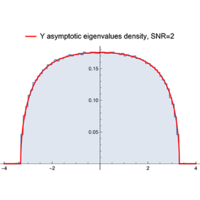
Statistical limits of dictionary learning: Random matrix theory and the spectral replica method

Jean Barbier and Nicolas Macris

Phys. Rev. E 106, 024136 (2022) - Published 30 August, 2022

Dictionary learning, a machine learning technique using a representation in terms of dictionary elements, is commonly used for problems where the number of elements is small. Here, the authors use a replica method to address the case where the number of elements is large and scales with the system size, resulting in a more tractable calculation.

Sign In to Your Journals Account

Filter

Recent Issues

Vol. 114, Iss. 5
November 2026
Vol. 114, Iss. 4
October 2026
Vol. 114, Iss. 3
September 2026
Vol. 114, Iss. 2
August 2026
Category
Article Type
Section

Filter

Article Lookup

Enter a citation