Recent Articles

Finite-size scaling to resolve spurious multifractality in the two-dimensional Ising model

S. Jaroszewicz, N. Mendez, Maria P. Beccar-Varela, and Maria Cristina Mariani

Phys. Rev. E 114, 014139 (2026) - Published 20 July, 2026

Dynamics-induced activity patterns of active-inactive clusters in complex networks

Anil Kumar, V. K. Chandrasekar, and D. V. Senthilkumar

Phys. Rev. E 114, 014219 (2026) - Published 20 July, 2026

Phenomenological renormalization group in neuronal models near criticality

Kaio F. R. Nascimento, Daniel M. Castro, Gustavo G. Cambrainha, and Mauro Copelli

Phys. Rev. E 114, 014310 (2026) - Published 20 July, 2026

Reduced-order model for solute transport in mixed electro-osmotic and pressure-driven flows of viscoelastic fluids in microchannels

Morteza Dejam and Hassan Hassanzadeh

Phys. Rev. E 114, 015105 (2026) - Published 20 July, 2026

Erratum: Conformal invariance constraints in the O(N) models: A study within the nonperturbative renormalization group [Phys. Rev. E 111, 054126 (2025)]

Santiago Cabrera, Gonzalo De Polsi, and Nicolás Wschebor

Phys. Rev. E 114, 019902 (2026) - Published 20 July, 2026

Absence of O(2) symmetry in the Vicsek model

Yushin Takahashi, Kota Mitsui, Tsuyoshi Mizohata, and Hideyuki Miyahara

Phys. Rev. E 114, 014134 (2026) - Published 17 July, 2026

Extended thermodynamics of optimal networks

Amilcare Porporato, Shashank Kumar Anand, Salvatore Calabrese, Luca Ridolfi, and Lamberto Rondoni

Phys. Rev. E 114, 014135 (2026) - Published 17 July, 2026

First-passage times for the space-fractional Fokker-Planck equation

Christopher N. Angstmann, Daniel S. Han, Bruce I. Henry, and Boris Z. Huang

Phys. Rev. E 114, 014136 (2026) - Published 17 July, 2026

Optimal navigation in two-dimensional flows: Control theory and reinforcement learning

Vladimir Parfenyev

Phys. Rev. E 114, 015104 (2026) - Published 17 July, 2026

Avalanches of a granular medium reinforced with flexible fibers

Ladislas Wierzchalek, Georges Gauthier, and Baptiste Darbois Texier

Phys. Rev. E 114, 015414 (2026) - Published 17 July, 2026

Localization-delocalization transition in low-dimensional asymmetric resetting random walks

Reza Sepehrinia

Phys. Rev. E 114, 014128 (2026) - Published 16 July, 2026

Continuous-time random walks with asymmetric waiting-time and jump-length distributions as a model of biased anomalous transport

Guohua Li, Andrey G. Cherstvy, Hong Zhang, Zeyu Tu, and Ralf Metzler

Phys. Rev. E 114, 014129 (2026) - Published 16 July, 2026

Universality of order statistics for Brownian reshuffling

Zdzislaw Burda, Mario Kieburg, and Tomasz Maciocha

Phys. Rev. E 114, 014130 (2026) - Published 16 July, 2026

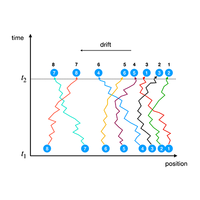
In a one-dimensional gas of particles confined by an asymptotically power-law potential, the ordering of the particles changes as they perform Brownian motion. The authors show that the order statistics that describe how the particles are reshuffled are universal and independent of the potential’s exponent, while the timescale of the reshuffling does depend on it.

#UniversalBehavior #AdvancingField

Restoring detailed balance in non-Hermitian Markov processes

Tim Van Wesemael, Gilberto Nakamura, Jan Baetens, Odemir M. Bruno, Alexandre S. Martinez, and Christophe Deroulers

Phys. Rev. E 114, 014131 (2026) - Published 16 July, 2026

Caloric phenomena and Stirling-cycle performance in Heisenberg-Kitaev magnon systems

Bastian Castorene, Martin HvE Groves, Francisco J. Peña, Nicolas Vidal-Silva, Miguel Letelier, Roberto E. Troncoso, Felipe Barra, and Patricio Vargas

Phys. Rev. E 114, 014132 (2026) - Published 16 July, 2026

Work and heat exchanged during sudden quenches of strongly coupled quantum systems

Zohreh Davoudi, Christopher Jarzynski, Niklas Mueller, Greeshma Oruganti, Connor Powers, and Nicole Yunger Halpern

Phys. Rev. E 114, 014133 (2026) - Published 16 July, 2026

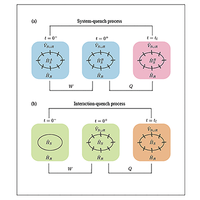
The authors examine three definitions of internal energy, work, and heat that have been used for quantum systems coupled strongly to the environment. Their study focuses on quenches, processes in which the Hamiltonian changes abruptly. In these processes, the first law of thermodynamics holds for each set of definitions by construction. The authors show that only two sets of definitions obey the second law. They illustrate their findings with a model of two coupled spins.

#ClearMotivation #AdvancingField

Dynamic effects of electric fields in a hybrid-coupled thermosensitive neuronal network

Ediline L. F. Nguessap, Antonio C. Roque, and Fernando F. Ferreira

Phys. Rev. E 114, 014218 (2026) - Published 16 July, 2026

Computer simulations of the Stark effect in the helium-β complex of krypton in inertial confinement fusion conditions

G. Pérez-Callejo, E. Stambulchik, R. Florido, and M. A. Gigosos

Phys. Rev. E 114, 015212 (2026) - Published 16 July, 2026

Quantum diffusion of molecular hydrogen in liquid Ne+H2 mixtures: A quasielastic neutron scattering study

Daniele Colognesi, Ubaldo Bafile, Milva Celli, Leonardo del Rosso, Franz Demmel, and Martin Neumann

Phys. Rev. E 114, 015413 (2026) - Published 16 July, 2026

Wettability-mediated transition from circular to radial cracks in dried deposit of colloidal ellipsoids

Sanket Kumar, Madivala G. Basavaraj, and Dillip K. Satapathy

Phys. Rev. E 114, 015505 (2026) - Published 16 July, 2026

Sign In to Your Journals Account

Filter

Recent Issues

Vol. 114, Iss. 4
October 2026
Vol. 114, Iss. 3
September 2026
Vol. 114, Iss. 2
August 2026
Vol. 114, Iss. 1
July 2026
Category
Article Type
Section

Filter

Article Lookup

Enter a citation