Recent Articles

Dynamical transition from localized to uniform scrambling in locally hyperbolic systems

Mathias Steinhuber, Peter Schlagheck, Juan Diego Urbina, and Klaus Richter

Phys. Rev. E 108, 024216 (2023) - Published 18 August, 2023

Dynamic structural analysis-based epitope prediction of Exendin-4 in aqueous solution

Jianfeng He, Jing Li, and Kingsley Leung

Phys. Rev. E 108, 024403 (2023) - Published 18 August, 2023

Collective dynamics of dipolar self-propelled particles

N. Vanesse, E. Opsomer, G. Lumay, and N. Vandewalle

Phys. Rev. E 108, 024608 (2023) - Published 18 August, 2023

Kinetic model and Vlasov simulation verification of two-ion decay instability

D. J. Liu, Qing Wang, X. M. Li, S. T. Zhang, R. J. Cheng, X. X. Li, S. Y. Lv, Z. M. Huang, Qiang Wang, Z. J. Liu, L. H. Cao, and C. Y. Zheng

Phys. Rev. E 108, 025206 (2023) - Published 18 August, 2023

Reduced basis surrogates for quantum spin systems based on tensor networks

Paul Brehmer, Michael F. Herbst, Stefan Wessel, Matteo Rizzi, and Benjamin Stamm

Phys. Rev. E 108, 025306 (2023) - Published 18 August, 2023

Machine learning of independent conservation laws through neural deflation

Wei Zhu, Hong-Kun Zhang, and P. G. Kevrekidis

Phys. Rev. E 108, L022301 (2023) - Published 18 August, 2023

Nonequilibrium steady state of trapped active particles

Naftali R. Smith

Phys. Rev. E 108, L022602 (2023) - Published 18 August, 2023

Mpemba effect for a Brownian particle trapped in a single well potential

Apurba Biswas and R. Rajesh

Phys. Rev. E 108, 024131 (2023) - Published 17 August, 2023

Higher-order interactions in Kuramoto oscillators with inertia

Patrycja Jaros, Subrata Ghosh, Dawid Dudkowski, Syamal K. Dana, and Tomasz Kapitaniak

Phys. Rev. E 108, 024215 (2023) - Published 17 August, 2023

Detecting partial synchrony in a complex oscillatory network using pseudovortices

Yasuhiro Yamada and Kensuke Inaba

Phys. Rev. E 108, 024307 (2023) - Published 17 August, 2023

The dynamics of a collection of coupled neurons resemble that of vortices in a commonly studied two-dimensional lattice model, a finding that could help in understanding brain function and dysfunction.

Influence of a bias dc field and an ac field amplitude on the dynamic susceptibility of a moderately concentrated ferrofluid

Michael S. Rusanov, Michael A. Kuznetsov, Vladimir S. Zverev, and Ekaterina A. Elfimova

Phys. Rev. E 108, 024607 (2023) - Published 17 August, 2023

Stochastic resonance in a model of a periodically driven DNA: Multiple transitions, scaling, and sequence dependence

Ramu Kumar Yadav, M. Suman Kalyan, Rajeev Kapri, and Abhishek Chaudhuri

Phys. Rev. E 108, L022401 (2023) - Published 17 August, 2023

Charging capacitors from thermal fluctuations using diodes

P. M. Thibado, J. C. Neu, Pradeep Kumar, Surendra Singh, and L. L. Bonilla

Phys. Rev. E 108, 024130 (2023) - Published 16 August, 2023

Standing and traveling waves in a model of periodically modulated one-dimensional waveguide arrays

Ross Parker, Alejandro Aceves, Jesús Cuevas-Maraver, and P. G. Kevrekidis

Phys. Rev. E 108, 024214 (2023) - Published 16 August, 2023

Reduced mixing in inertial confinement fusion with early-time interface acceleration

C. R. Weber, D. S. Clark, D. T. Casey, G. N. Hall, O. Jones, O. Landen, A. Pak, and V. A. Smalyuk

Phys. Rev. E 108, L023202 (2023) - Published 16 August, 2023

Single-energy-measurement integral fluctuation theorem and nonprojective measurements

Daniel Alonso and Antonia Ruiz García

Phys. Rev. E 108, 024126 (2023) - Published 15 August, 2023

Understanding the swap Monte Carlo algorithm in a size-polydisperse model glassformer

Niklas Küchler and Jürgen Horbach

Phys. Rev. E 108, 024127 (2023) - Published 15 August, 2023

Exact quench dynamics from algebraic geometry

Yunfeng Jiang, Rui Wen, and Yang Zhang

Phys. Rev. E 108, 024128 (2023) - Published 15 August, 2023

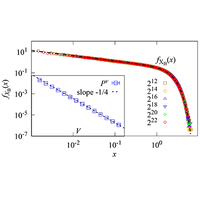
Geometric properties of the complete-graph Ising model in the loop representation

Zhiyi Li, Zongzheng Zhou, Sheng Fang, and Youjin Deng

Phys. Rev. E 108, 024129 (2023) - Published 15 August, 2023

In this article, a worm algorithm is used to study the problem of the Ising model on a complete graph. The approach shows connections between different representations of the model and leads to a better understanding of its scaling properties and critical behavior.

Social network structure and the spread of complex contagions from a population genetics perspective

Julian Kates-Harbeck and Michael M. Desai

Phys. Rev. E 108, 024306 (2023) - Published 15 August, 2023

Sign In to Your Journals Account

Filter

Recent Issues

Vol. 114, Iss. 5
November 2026
Vol. 114, Iss. 4
October 2026
Vol. 114, Iss. 3
September 2026
Vol. 114, Iss. 2
August 2026
Category
Article Type
Section

Filter

Article Lookup

Enter a citation