Recent Articles

Advecting scaffolds: Controlling the remodeling of actomyosin with anillin

Denni Currin-Ross, Sami C. Al-Izzi, Ivar Noordstra, Alpha S. Yap, and Richard G. Morris

Phys. Rev. E 111, 024403 (2025) - Published 5 February, 2025

Wrinkling and imaging of thin curved sheets

Megha Emerse and Lucas Goehring

Phys. Rev. E 111, 025501 (2025) - Published 5 February, 2025

Vertex representation of hyperbolic tensor networks

Matej Mosko, Maria Polackova, Roman Krcmar, and Andrej Gendiar

Phys. Rev. E 111, 024105 (2025) - Published 4 February, 2025

Bridging Freidlin-Wentzell large deviations theory and stochastic thermodynamics

Davide Santolin, Nahuel Freitas, Massimiliano Esposito, and Gianmaria Falasco

Phys. Rev. E 111, 024106 (2025) - Published 4 February, 2025

Impact of diffusion-driven instability on traveling wave solutions

Reeta Yadav, Moitri Sen, and Swadesh Pal

Phys. Rev. E 111, 024202 (2025) - Published 4 February, 2025

Constrained Hamiltonian systems and physics-informed neural networks: Hamilton-Dirac neural networks

Dimitrios A. Kaltsas

Phys. Rev. E 111, 025301 (2025) - Published 4 February, 2025

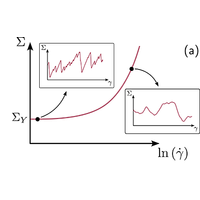
Protocol dependence for avalanches under constant stress in elastoplastic models

Tristan Jocteur, Eric Bertin, Romain Mari, and Kirsten Martens

Phys. Rev. E 111, 024101 (2025) - Published 3 February, 2025

Amorphous solids, for example glasses and granular materials, display intermittent plastic deformation events known as avalanches near the yielding transition. It is typically assumed that the characteristics of the avalanches do not depend on the driving protocol (e.g., controlling strain or stress). The two-dimensional simulations of an elastoplastic model presented in this study highlight the complex interplay between the initial elastic state, the driving protocol, and the dynamics of avalanche propagation, thus challenging the assumption of universality of the avalanche statistics.

Fluctuation theorems in general relativistic stochastic thermodynamics

Yifan Cai, Tao Wang, and Liu Zhao

Phys. Rev. E 111, 024102 (2025) - Published 3 February, 2025

Operational solution for the generalized Fokker-Planck and generalized diffusion-wave equations

K. Górska

Phys. Rev. E 111, 024103 (2025) - Published 3 February, 2025

Boomerang effect in classical stochastic models

Santiago Zamora, Lisan M. M. Durão, Flavio Noronha, and Tommaso Macrì

Phys. Rev. E 111, 024104 (2025) - Published 3 February, 2025

Relaxation fluctuations of correlation functions: Spin and random matrix models

Tanay Pathak

Phys. Rev. E 111, 024201 (2025) - Published 3 February, 2025

Data-driven discovery of self-similarity using neural networks

Ryota Watanabe, Takanori Ishii, Yuji Hirono, and Hirokazu Maruoka

Phys. Rev. E 111, 024301 (2025) - Published 3 February, 2025

This study introduces a method based on neural networks to discover self-similarity in physical systems. Traditional methods employ assumed models, while here the authors are able to identify the self-similarity parameters from data directly and extract the exponents characterizing the scale-transformation symmetries. The method can be put to use with any self-similar physical system, with potential applications in various areas, for example materials science and fluid dynamics.

Probabilistic approach for estimation of binding rate constants for clusters of targets

Boris P. Belotserkovskii

Phys. Rev. E 111, 024401 (2025) - Published 3 February, 2025

Inference of transcriptional regulation from STARR-seq data

Amin Safaeesirat, Hoda Taeb, Emirhan Tekoglu, Tunc Morova, Nathan A. Lack, and Eldon Emberly

Phys. Rev. E 111, 024402 (2025) - Published 3 February, 2025

Attosecond gamma-ray flashes and electron-positron pairs in dyadic laser interaction with microwire

P. Hadjisolomou, T. M. Jeong, P. Valenta, A. J. Macleod, R. Shaisultanov, C. P. Ridgers, and S. V. Bulanov

Phys. Rev. E 111, 025201 (2025) - Published 3 February, 2025

Polymer dynamics under tension: Mean first passage time for looping

Wout Laeremans, Anne Floor den Ouden, Jef Hooyberghs, and Wouter G. Ellenbroek

Phys. Rev. E 111, 025401 (2025) - Published 3 February, 2025

Previous studies on the formation of loops in polymers under tension relied on barrier escape methods to predict looping times. This work revisits the problem, deriving a scaling law for freely jointed chains under tension, and demonstrating that the looping time inversely scales with the equilibrium looping probability.

Availability versus carrying capacity: Phases of asymmetric exclusion processes competing for finite pools of resources

Astik Haldar, Parna Roy, Erwin Frey, and Abhik Basu

Phys. Rev. E 111, 014154 (2025) - Published 31 January, 2025

Ergodicity breaking and restoration in models of heat transport with microscopic reversibility

Piero Olla

Phys. Rev. E 111, 014155 (2025) - Published 31 January, 2025

Kink-kink solutions in Bogomol'nyi-Prasad-Sommerfield impurity models

K. Sławińska

Phys. Rev. E 111, 014228 (2025) - Published 31 January, 2025

Maintaining an autocatalytic reaction system in a protocell: Nonenzymatic RNA templating and the link between replication and metabolism

Quentin C. C. Sanders, Alex Verbeem, and Paul G. Higgs

Phys. Rev. E 111, 014424 (2025) - Published 31 January, 2025

Sign In to Your Journals Account

Filter

Recent Issues

Vol. 114, Iss. 4
October 2026
Vol. 114, Iss. 3
September 2026
Vol. 114, Iss. 2
August 2026
Vol. 114, Iss. 1
July 2026
Category
Article Type
Section

Filter

Article Lookup

Enter a citation