Recent Articles

Analyzing diffusion-limited processes in a cylinder using pair-correlation functions

Benjamin James Binder

Phys. Rev. E 111, 054106 (2025) - Published 2 May, 2025

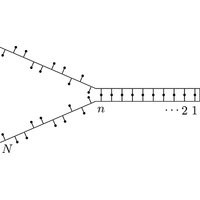
Out-of-equilibrium critical dynamics of the three-dimensional Z2 gauge model along critical relaxational flows

Claudio Bonati, Haralambos Panagopoulos, and Ettore Vicari

Phys. Rev. E 111, 054107 (2025) - Published 2 May, 2025

The Z2 gauge model on a three-dimensional lattice undergoes a continuous phase transition. Because of a duality relation with the Ising model, its static critical properties are well known. The authors show that this analogy between the critical properties of the two models does not extend to the critical dynamics, and they calculate a dynamic critical exponent for the Z2 gauge model within an out-of-equilibrium finite-size scaling framework.

#AdvancingField #UniversalBehavior

Two minimal-variable symplectic integrators for stochastic spin systems

Sagy Ephrati and Erik Jansson

Phys. Rev. E 111, 054201 (2025) - Published 2 May, 2025

Effects of interactions and boundary conditions on the performance of many-body quantum batteries

Yi-Dan Zheng, Wan-Lu Song, and Bin Zhou

Phys. Rev. E 111, 054101 (2025) - Published 1 May, 2025

Observation of ballistic thermal transport in a nonintegrable classical many-body system

Jianjin Wang and Daxing Xiong

Phys. Rev. E 111, 054102 (2025) - Published 1 May, 2025

Biased degenerate ground-state sampling of small Ising models with converged quantum approximate optimization algorithm

Elijah Pelofske

Phys. Rev. E 111, 054103 (2025) - Published 1 May, 2025

Event-chain Monte Carlo and the true self-avoiding walk

A. C. Maggs

Phys. Rev. E 111, 054104 (2025) - Published 1 May, 2025

Added mass effect in coupled Brownian particles

Long Him Cheung and Christopher Jarzynski

Phys. Rev. E 111, 054105 (2025) - Published 1 May, 2025

Power capacity, effective age, and life limit of the living cell

Andreas Paglietti

Phys. Rev. E 111, 054401 (2025) - Published 1 May, 2025

Controlled jetting of impacting drops

N. S. Satpathi, G. S. G. Reddy, and A. K. Sen

Phys. Rev. E 111, 055101 (2025) - Published 1 May, 2025

Viscous liquid dynamics modeled as random walks within overlapping hyperspheres

Mark F. B. Railton, Eva Uhre, Jeppe C. Dyre, and Thomas B. Schrøder

Phys. Rev. E 111, 055301 (2025) - Published 1 May, 2025

Discrete-time walk on one-dimensional lattice under stochastic resetting: Advantage of quantum over classical scenario

Przemysław Chełminiak, Jan Wójcik, and Antoni Wójcik

Phys. Rev. E 111, 044143 (2025) - Published 30 April, 2025

Bit reset protocols that obey activity-constrained speed limits do not minimize work for a given speed

Daan Mulder, Thomas E. Ouldridge, and Pieter Rein ten Wolde

Phys. Rev. E 111, 044141 (2025) - Published 29 April, 2025

Nonanalytic Landau functionals shaping the finite-size scaling of fluctuations and response functions in and out of equilibrium

Krzysztof Ptaszyński and Massimiliano Esposito

Phys. Rev. E 111, 044142 (2025) - Published 29 April, 2025

Landau theory describes phase transitions in terms of a free energy that is a functional of an order parameter. A common assumption is that this functional is analytic, but it can be expanded to include nonanalytic terms. Here the authors show for two specific examples that such terms can control the scaling of quantities such as the fluctuations of the order parameter at the critical point.

#UniversalBehavior #ClassicalProblem

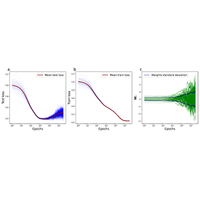
Unified theoretical framework for wide neural network learning dynamics

Yehonatan Avidan, Qianyi Li, and Haim Sompolinsky

Phys. Rev. E 111, 045310 (2025) - Published 29 April, 2025

Drawing upon methods from out-of-equilibrium statistical mechanics, the authors develop an exact analytical theory of learning dynamics in wide deep neural networks, unifying two previously disparate approaches: the Neural Tangent Kernel and the Neural Network Gaussian Process. They arrive at a novel time-dependent kernel, the Neural Dynamical Kernel. They identify two distinct learning phases, one characterized by deterministic minimization of the training error, followed by stochastic exploration of the solution subspace, ultimately converging to Gibbs equilibrium. The results reveal the mechanisms that enable neural networks to maintain robust performance despite noise.

#LandmarkContribution #MachineLearningSpotlight

General lower and upper bounds of efficiency of heat engines

Takaaki Monnai

Phys. Rev. E 111, 044135 (2025) - Published 28 April, 2025

Exact moments for a run-and-tumble particle with a finite tumble time in a harmonic trap

Aoran Sun, Fangfu Ye, and Rudolf Podgornik

Phys. Rev. E 111, 044136 (2025) - Published 28 April, 2025

Structure of superscars in a pseudointegrable right-triangular billiard

Zhen-Qi Chen, Rui-Hua Ni, Yalei Song, Hong-Ya Xu, and Liang Huang

Phys. Rev. E 111, 044137 (2025) - Published 28 April, 2025

Distinguishing photon-count fluctuation characteristics of classical and quantum light sources using non-Markovian processes

Lian Seng Tey, S. V. Muniandy, and Wu Yi Chong

Phys. Rev. E 111, 044138 (2025) - Published 28 April, 2025

Full distribution and large deviations of local observables in an exactly solvable current-carrying steady state of a strongly driven XXZ chain

Sandipan Manna and G. J. Sreejith

Phys. Rev. E 111, 044139 (2025) - Published 28 April, 2025

Sign In to Your Journals Account

Filter

Recent Issues

Vol. 114, Iss. 4
October 2026
Vol. 114, Iss. 3
September 2026
Vol. 114, Iss. 2
August 2026
Vol. 114, Iss. 1
July 2026
Category
Article Type
Section

Filter

Article Lookup

Enter a citation