Recent Articles

Reexamining nuclear chiral geometry from the orientation of the angular momentum

Q. B. Chen (陈启博) and J. Meng (孟杰)

Phys. Rev. C 98, 031303(R) (2018) - Published 26 September, 2018

Magnetic field effect on nuclear matter from a Skyrmion crystal model

Mamiya Kawaguchi, Yong-Liang Ma, and Shinya Matsuzaki

Phys. Rev. C 98, 035803 (2018) - Published 26 September, 2018

Effect of single string structure and multiple string interaction on strange particle production in pp collisions at s=7TeV

Liang Zheng, Dai-Mei Zhou, Zhong-Bao Yin, Yu-Liang Yan, Gang Chen, Xu Cai, and Ben-Hao Sa

Phys. Rev. C 98, 034917 (2018) - Published 25 September, 2018

Mass distributions of fission fragments from nuclei populated by multinucleon transfer or incomplete fusion channels in Li6,7+U238 reactions

A. Pal, S. Santra, D. Chattopadhyay, A. Kundu, A. Jhingan, P. Sugathan, N. Saneesh, Mohit Kumar, N. L. Singh, A. Yadav, C. Yadav, R. Dubey, K. Kapoor, Kavita Rani, Honey Arora, Visakh A. C., Devinder Kaur, B. K. Nayak, A. Saxena, S. Kailas, and K.-H. Schmidt

Phys. Rev. C 98, 031601(R) (2018) - Published 24 September, 2018

Signatures of few-body resonances in finite volume

P. Klos, S. König, H.-W. Hammer, J. E. Lynn, and A. Schwenk

Phys. Rev. C 98, 034004 (2018) - Published 24 September, 2018

The authors explore the detectability (signatures) of true few-body resonances, involving the separation of all particles in the system, through avoided level crossings in energy spectra in a finite box. In so doing they adapt the numerical method of a discrete variable representation (DVR) for fermions and bosons in periodic boxes and describe thoroughly its implementation.

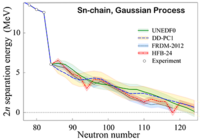
Bayesian approach to model-based extrapolation of nuclear observables

Léo Neufcourt, Yuchen Cao (曹宇晨), Witold Nazarewicz, and Frederi Viens

Phys. Rev. C 98, 034318 (2018) - Published 24 September, 2018

The Bayesian statistical approaches have a recognized utility in improving the quantified predictions for nuclear masses away from stability that provide key inputs for a variety of astrophysical applications. The present paper is devoted to the methodology of such efforts. It applies Bayesian Gaussian processes and neural networks to two-neutron separation energies of nuclei. The authors find that Gaussian processes deliver a more stable performance.

Energy-density functionals inspired by effective-field theories: Applications to neutron drops

Jérémy Bonnard, Marcella Grasso, and Denis Lacroix

Phys. Rev. C 98, 034319 (2018) - Published 24 September, 2018

Spectroscopy of weakly deformed bands in Zr87: First observation of the shears mechanism in a Zr isotope

P. Banerjee, S. Ganguly, M. K. Pradhan, Md. Moin Shaikh, H. P. Sharma, S. Chakraborty, R. Palit, R. G. Pillay, V. Nanal, S. Saha, and J. Sethi

Phys. Rev. C 98, 034320 (2018) - Published 24 September, 2018

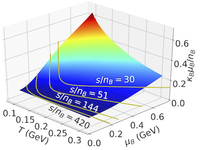
Net-baryon diffusion in fluid-dynamic simulations of relativistic heavy-ion collisions

Gabriel S. Denicol, Charles Gale, Sangyong Jeon, Akihiko Monnai, Björn Schenke, and Chun Shen

Phys. Rev. C 98, 034916 (2018) - Published 24 September, 2018

For the first time, the baryon current and its diffusive effects have been incorporated into one of the 3D relativistic viscous hydrodynamics models, successfully used to describe heavy-ion collisions at the top RHIC energies and at the LHC. This approach will be very useful in the interpretation of data coming from the low-energy Beam Energy Scan (BES) at RHIC, and for the search for a critical point in the QCD phase diagram.

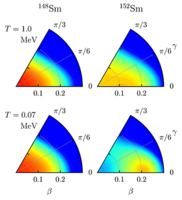
Statistical theory of deformation distributions in nuclear spectra

M. T. Mustonen, C. N. Gilbreth, Y. Alhassid, and G. F. Bertsch

Phys. Rev. C 98, 034317 (2018) - Published 21 September, 2018

The shape of atomic nuclei affects their density of states, a dependence needed to understand nuclear processes such as fission. This paper offers a new, model-independent method to extract nuclear shape distributions via a Landau-like expansion and without invoking a mean-field approximation. This allows the authors to track how nuclear deformation changes as a function of temperature and neutron number in a rotationally invariant framework, and to calculate the dependence of the state density on deformation.

Dissecting reaction calculations using halo effective field theory and ab initio input

P. Capel, D. R. Phillips, and H.-W. Hammer

Phys. Rev. C 98, 034610 (2018) - Published 21 September, 2018

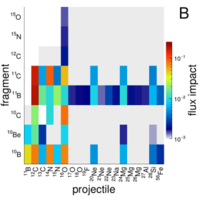
Current status and desired precision of the isotopic production cross sections relevant to astrophysics of cosmic rays: Li, Be, B, C, and N

Yoann Génolini, David Maurin, Igor V. Moskalenko, and Michael Unger

Phys. Rev. C 98, 034611 (2018) - Published 21 September, 2018

The precision of the current generation of space-based cosmic-ray experiments, such as AMS-02, PAMELA, CALET, and ISS-CREAM, is now reaching ≈1–3%, from energies of GeV/nucleon to multi-TeV/nucleon. These and future measurements of the isotopic composition and energy spectra of cosmic rays may reveal signatures of as-yet unknown phenomena in a wide range of topics, provided that the currently large uncertainties of 20–50% in many of the isotopic production cross sections can be reduced. This paper provides a systematic study of the reaction channels to produce particular isotopes and identifies the most important channels for reducing the present uncertainties. It provides a first road map for planning new measurement campaigns worldwide to reach the desired uncertainties.

Effect of the chromo-electromagnetic field fluctuations on heavy quark propagation in a deconfined hadronic medium at energies available at the CERN Large Hadron Collider

Ashik Ikbal Sheikh, Zubayer Ahammed, Prashant Shukla, and Munshi G. Mustafa

Phys. Rev. C 98, 034915 (2018) - Published 21 September, 2018

Multinucleon transfer process in the reaction Gd160 + W186

Long Zhu, Jun Su, Pei-Wei Wen, Chen-Chen Guo, and Cheng Li

Phys. Rev. C 98, 034609 (2018) - Published 20 September, 2018

Charm-strange meson production in ultrarelativistic heavy-ion collisions at energies available at the CERN Large Hadron Collider

Shuang Li and Chaowen Wang

Phys. Rev. C 98, 034914 (2018) - Published 20 September, 2018

Constraints on axion-like particles and nucleon pairing in dense matter from the hot neutron star in HESS J1731-347

Mikhail V. Beznogov, Ermal Rrapaj, Dany Page, and Sanjay Reddy

Phys. Rev. C 98, 035802 (2018) - Published 20 September, 2018

Investigation of J=1 states and their γ-decay behavior in Cr52

J. Wilhelmy, B. A. Brown, P. Erbacher, U. Gayer, J. Isaak, Krishichayan, B. Löher, M. Müscher, H. Pai, N. Pietralla, P. Ries, D. Savran, P. Scholz, M. Spieker, W. Tornow, V. Werner, and A. Zilges

Phys. Rev. C 98, 034315 (2018) - Published 19 September, 2018

Shells in a toroidal nucleus in the intermediate-mass region

Cheuk-Yin Wong and Andrzej Staszczak

Phys. Rev. C 98, 034316 (2018) - Published 19 September, 2018

Tests of the standard model in neutron β decay with a polarized neutron and electron and an unpolarized proton

A. N. Ivanov, R. Höllwieser, N. I. Troitskaya, M. Wellenzohn, and Ya. A. Berdnikov

Phys. Rev. C 98, 035503 (2018) - Published 19 September, 2018

Two-particle angular correlations in pp and p-Pb collisions at energies available at the CERN Large Hadron Collider from a multiphase transport model

Liu-Yao Zhang, Jin-Hui Chen, Zi-Wei Lin, Yu-Gang Ma, and Song Zhang

Phys. Rev. C 98, 034912 (2018) - Published 18 September, 2018
Sign In to Your Journals Account

Filter

Recent Issues

Vol. 114, Iss. 5
October 2026
Vol. 114, Iss. 4
October 2026
Vol. 114, Iss. 3
September 2026
Vol. 114, Iss. 2
August 2026
Category
Article Type
Section

Filter

Article Lookup

Enter a citation