Highlights

Precision half-life measurement of the β+ decay of K37

P. D. Shidling, D. Melconian, S. Behling, B. Fenker, J. C. Hardy, V. E. Iacob, E. McCleskey, M. McCleskey, M. Mehlman, H. I. Park, and B. T. Roeder

Phys. Rev. C 90, 032501(R) (2014) - Published 11 September, 2014

Potassium-37 is one of several isotopes that could be used to directly test the standard model weak interaction.

Azimuthal anisotropy of D-meson production in Pb-Pb collisions at sNN=2.76 TeV

B. Abelev et al. (ALICE Collaboration)

Phys. Rev. C 90, 034904 (2014) - Published 10 September, 2014

The ALICE Collaboration at the LHC has measured detailed properties of the distribution of prompt charmed mesons produced in Pb-Pb collisions. These mesons are produced during the very early stages of the collisions. The results provide crucial information to determine the most important physical processes for theoretical models.

Extracting the hexadecapole deformation from backward quasi-elastic scattering

H. M. Jia, C. J. Lin, F. Yang, X. X. Xu, H. Q. Zhang, Z. H. Liu, Z. D. Wu, L. Yang, N. R. Ma, P. F. Bao, and L. J. Sun

Phys. Rev. C 90, 031601(R) (2014) - Published 3 September, 2014

This paper presents a highly sensitive new technique to explore unusual nuclear shapes in exotic short-lived nuclei far from stability. Exploiting heavy-ion collisions at energies below the Coulomb barrier, such that the nuclei do not fuse, the work uncovers evidence for hexadecapole shapes in which the nucleus looks like an indented ellipsoid.

Linear response theory and neutrino mean free path using Brussels-Montreal Skyrme functionals

A. Pastore, M. Martini, D. Davesne, J. Navarro, S. Goriely, and N. Chamel

Phys. Rev. C 90, 025804 (2014) - Published 29 August, 2014

Skyrme functionals that successfully describe finite nuclei and homogeneous nuclear matter predict the neutrino mean free path in pure neutron matter.

Adaptive multi-resolution 3D Hartree-Fock-Bogoliubov solver for nuclear structure

J. C. Pei (裴俊琛), G. I. Fann, R. J. Harrison, W. Nazarewicz, Yue Shi (石跃), and S. Thornton

Phys. Rev. C 90, 024317 (2014) - Published 21 August, 2014

The authors use multi-resolution wavelet analysis and parallel computing to solve equations of nuclear density functional theory in three dimensions. The approach can be applied to nuclear and atomic complex quantum many-body problems involving many-particle superfluid systems, such as fissioning nuclei, pasta phases in the neutron star crust, and trapped cold fermions.

Shape evolution in the neutron-rich osmium isotopes: Prompt γ-ray spectroscopy of Os196

P. R. John et al.

Phys. Rev. C 90, 021301(R) (2014) - Published 13 August, 2014

The shape of an atomic nucleus is one of its most defining characteristics, and the evolution of nuclear shapes with nucleon number gives insights into the symmetries and the underlying nuclear interactions of this many-body quantum system. The osmium-platinum region shows a rich set of prolate, oblate, axially asymmetric, and co-existing shapes. This challenging γ-ray-spectroscopy experiment develops the yrast level scheme for 196Os and argues that this nucleus is nearly perfectly γ-unstable.

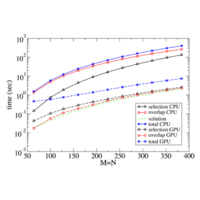
New general approach in few-body scattering calculations: Solving discretized Faddeev equations on a graphics processing unit

V. N. Pomerantsev, V. I. Kukulin, and O. A. Rubtsova

Phys. Rev. C 89, 064008 (2014) - Published 30 June, 2014

Combining the discretization of the two- and three-body scattering continuum and the use of a graphics processor unit (GPU) for parallel computing, the authors solved the Faddeev equation for neutron-deuteron scattering, using a modern realistic nucleon-nucleon potential. They carried out the calculations on a desk-top computer and achieved very short run-times.

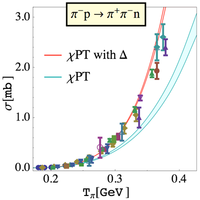
The reaction πN→ππN in chiral effective field theory with explicit Δ(1232) degrees of freedom

D. Siemens, V. Bernard, E. Epelbaum, H. Krebs, and Ulf-G. Meißner

Phys. Rev. C 89, 065211 (2014) - Published 30 June, 2014

The reaction πN→ππN is particularly well-suited for studying the role of the Δ, the lightest excitation of the nucleon. The chiral perturbation theory analysis of this reaction, in this work, shows that including explicit Δ contributions significantly improves the description of low-energy data.

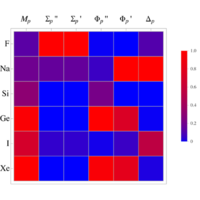
Weakly interacting massive particle-nucleus elastic scattering response

Nikhil Anand, A. Liam Fitzpatrick, and W. C. Haxton

Phys. Rev. C 89, 065501 (2014) - Published 25 June, 2014

A model-independent formulation of WIMP-nucleon scattering is used to define the experiments needed to interpret the physics of dark matter. The graphic shows the relative event rate for six different isotopes for the six different nuclear responses considered in the paper. One can see that several isotopes will be needed to distinguish between different interaction types after a discovery is made.

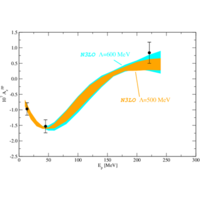
Chiral effective field theory analysis of hadronic parity violation in few-nucleon systems

M. Viviani, A. Baroni, L. Girlanda, A. Kievsky, L. E. Marcucci, and R. Schiavilla

Phys. Rev. C 89, 064004 (2014) - Published 18 June, 2014

Weak interactions between quarks induce a parity-violating (PV) component in the nucleon-nucleon potential. This work exploits chiral effective field theory at next-to-next-to-leading order to construct this parity-nonconserving component. The potential obtained is used to investigate several PV observables, including the neutron-spin rotations in scattering of polarized neutrons off protons and deuterons, and the longitudinal asymmetries in proton-proton elastic scattering and in the 3He(n⃗,p)3H charge-exchange reaction.

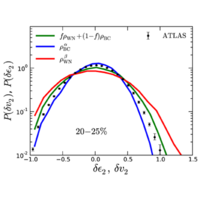
Constraints from v2 fluctuations for the initial-state geometry of heavy-ion collisions

Thorsten Renk and Harri Niemi

Phys. Rev. C 89, 064907 (2014) - Published 16 June, 2014

The authors show that recent data from the CERN Large Hadron Collider rule out all simple, commonly used, independent-particle Glauber-based models of the initial state of high-energy heavy-ion collisions. Either some nonlinear dynamics in the creation or in the evolution of the dense strongly interacting matter is necessary or one must consider additional sources of fluctuations in the particle production.

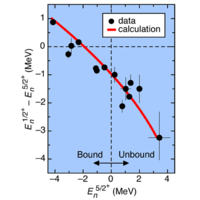
Neutron s states in loosely bound nuclei

C. R. Hoffman, B. P. Kay, and J. P. Schiffer

Phys. Rev. C 89, 061305(R) (2014) - Published 13 June, 2014

It is well-known that the relative energies of the 1s1/2 and 0d5/2 single-particle states vary drastically in light nuclei. This work shows that the effect is caused by the special properties of the neutron state with zero angular momentum, which approaches zero binding much more slowly than other orbits. Interestingly, the behavior of the relative energies of these states is fit remarkably well by a standard Woods-Saxon potential well.

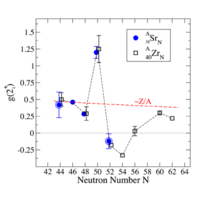
Transition from collectivity to single-particle degrees of freedom from magnetic moment measurements on 3882Sr44 and 3890Sr52

G. J. Kumbartzki, N. Benczer-Koller, S. Burcher, A. Ratkiewicz, S. L. Rice, Y. Y. Sharon, L. Zamick, K.-H. Speidel, D. A. Torres, K. Sieja, M. McCleskey, A. Cudd, M. Henry, A. Saastamoinen, M. Slater, A. Spiridon, S. Yu. Torilov, V. I. Zherebchevsky, G. Gürdal, S. J. Q. Robinson, S. D. Pain, and J. T. Harke

Phys. Rev. C 89, 064305 (2014) - Published 10 June, 2014

The evolution of shell structure and the fragility of the benchmark magic numbers is a topic of major interest in nuclear-structure physics. The authors measured the structure-sensitive g factors of states in unstable even-even strontium isotopes, following α-pickup reactions by krypton beams from a carbon target. The results help elucidate how protons and neutrons contribute to the evolution of nuclear structure in this important mass region where rapid structural changes occur.

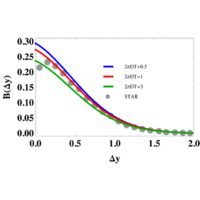
Hydrodynamics of charge fluctuations and balance functions

Bo Ling, Todd Springer, and Mikhail Stephanov

Phys. Rev. C 89, 064901 (2014) - Published 6 June, 2014

Hydrodynamic fluctuations are used to study correlations between electrically charged particles produced in heavy-ion collisions at RHIC. Comparing to STAR data the authors infer an electric charge diffusion coefficient of D≈1/(2πT) with a temperature T in the range of 150 to 200 MeV, consistent with a strongly coupled medium.

Storage of ultracold neutrons in the magneto-gravitational trap of the UCNτ experiment

D. J. Salvat et al.

Phys. Rev. C 89, 052501(R) (2014) - Published 23 May, 2014

A precise value for the neutron lifetime (about 880 s) is needed for nuclear astrophysics predictions of Big-Bang nucleosynthesis and solar neutrino production, as well as in precision searches for new physics beyond the Standard Model. This work reports on a new type of magnetic neutron trap that has the potential to resolve the present 4-sigma inconsistency in measurements of the neutron lifetime, and suggests that a next generation of measurements with less than one second uncertainty is possible.

Magnetohydrodynamics, charged currents, and directed flow in heavy ion collisions

Umut Gürsoy, Dmitri Kharzeev, and Krishna Rajagopal

Phys. Rev. C 89, 054905 (2014) - Published 13 May, 2014

High-energy heavy-ion collisions at RHIC and LHC produce the strongest magnetic fields on Earth. So far there has been no explicit measurement of them. Gursoy et al. provide a quantitative estimate of the space-time evolution of these fields in an expanding medium, and suggest a method to infer them from experimental data on charged-particle correlations. This work provides a major step toward understanding the effect of the magnetic field on directed flow and should be a benchmark for future work.

Measurement of the structure function of the nearly free neutron using spectator tagging in inelastic H2(e,e′ps)X scattering with CLAS

S. Tkachenko et al. (CLAS Collaboration)

Phys. Rev. C 89, 045206 (2014) - Published 24 April, 2014

The BONuS experiment at Jefferson Lab demonstrates a new method to extract the neutron structure function. The authors scatter electrons from a deuterium target and select spectator protons in coincidence with the scattered electrons, under kinematic conditions that ensure that the scattering took place on a nearly free neutron. This method significantly reduces nuclear binding uncertainties and allows for a precise extraction of the neutron structure function.

Linking partial and quasi dynamical symmetries in rotational nuclei

C. Kremer, J. Beller, A. Leviatan, N. Pietralla, G. Rainovski, R. Trippel, and P. Van Isacker

Phys. Rev. C 89, 041302(R) (2014) - Published 4 April, 2014

Symmetries play an important role in the understanding of complex systems. However, complete dynamical symmetries are manifest in only a few nuclei. By establishing a link between two hitherto unrelated symmetry concepts, the authors show that partial fulfillment of diverse symmetries may simultaneously occur in certain atomic nuclei.

Heavy-flavor electron-muon correlations in p+p and d+Au collisions at sNN=200 GeV

A. Adare et al. (PHENIX Collaboration)

Phys. Rev. C 89, 034915 (2014) - Published 31 March, 2014

This work measures azimuthal correlations of electron-muon pairs, which are sensitive to the presence of heavy-quark hadron pairs, primarily cc¯, that are produced in ultrarelativistic heavy-ion collisions. The results indicate that open-charm production is suppressed in deuteron on Au collisions compared to proton-proton collisions. This suggests that the cold nucleus is modifying the transport of heavy quarks or gluons in the nucleus.

Production cross sections of heavy neutron-rich nuclei approaching the nucleosynthesis r-process path around A=195

T. Kurtukian-Nieto, J. Benlliure, K.-H. Schmidt, L. Audouin, F. Becker, B. Blank, E. Casarejos, F. Farget, M. Fernández-Ordóñez, J. Giovinazzo, D. Henzlova, B. Jurado, J. Pereira, and O. Yordanov

Phys. Rev. C 89, 024616 (2014) - Published 27 February, 2014

This work reports production cross sections for more than 190, mostly neutron-rich, isotopes in the region of the closed N=126 neutron shell, by fragmentation of a 208Pb beam. The work represents a step toward making regions located at the outermost borders of the chart of nuclides experimentally accessible with new-generation radioactive-beam facilities, such as nuclei near the A=195 nucleosynthesis ``waiting point''.

Sign In to Your Journals Account

Filter

Section

Filter

Article Lookup

Enter a citation